






4 Months Up 230%, How Much Further Can the Semiconductor "Bottleneck" Rally Go?


- Core Thesis: The current bull market in US-listed semiconductor stocks is driven by AI infrastructure investment. The core logic is that "scarcity" leads to strong pricing power. Manufacturing segments such as HBM memory, advanced packaging, and EUV lithography, which have extremely high technological barriers, enjoy higher profit margins and pricing power than the design segment, reshaping the traditional "smile curve." This structural change has sparked intense debate among the market regarding the potential duration of the bubble and the pace of capacity release.
- Key Elements:
- AI infrastructure demand far exceeds the pace of capacity expansion. Goldman Sachs upgraded its 2026 DRAM supply-demand gap forecast to 4.9%. The unit price of HBM3E is approximately $300, and SK Hynix's HBM capacity for 2026 has been fully booked by Microsoft, Google, and Nvidia.
- Memory and advanced process manufacturing have become the highest-barrier, scarcest segments. Only three companies globally can mass-produce HBM, with SK Hynix holding a 50%-55% share. TSMC's CoWoS capacity lead time is 52-78 weeks, and Nvidia has secured 60%-70% of its capacity.
- In contrast, profit margins in substitutable segments like optical modules are being compressed. Chinese manufacturers dominate the 800G/1.6T market but operate on thin margins, with analysts pointing to intensifying price pressure after 2026.
- Bullish Argument: Firms like Wedbush, Goldman Sachs, and Morgan Stanley project AI capital expenditure to reach $1.6 trillion by 2031. DRAM prices could rise by 62% in 2026, with memory profit growth sustainable for 2-3 years.
- Bearish Warning: Michael Burry has accumulated a large number of put options, stating the current rally resembles the 1999 dot-com bubble. Man Group warns of excessive leverage within the AI financial architecture, predicting the first wave of loan defaults could occur in 2027-2028.
- A critical inflection point for capacity release is expected between the second half of 2027 and the first half of 2028. Industry capacity is projected to increase by 20-30%, but with HBM demand compound annual growth rate exceeding 40%, it remains uncertain whether the supply-demand gap can be closed.
- Geopolitical factors represent a systemic risk. TSMC accounts for over 90% of the global advanced process foundry market. Any escalation in cross-strait tensions or export controls could trigger a severe market repricing.
U.S. stocks closed in the early morning, with the Philadelphia Semiconductor Index (SOX) breaking through the 14,000-point mark for the first time, reaching a historic high.
Historically, there have been only two periods when the SOX surged over 230% within 14 months: from December 1998 to February 2000, and from April 2025 to the present.
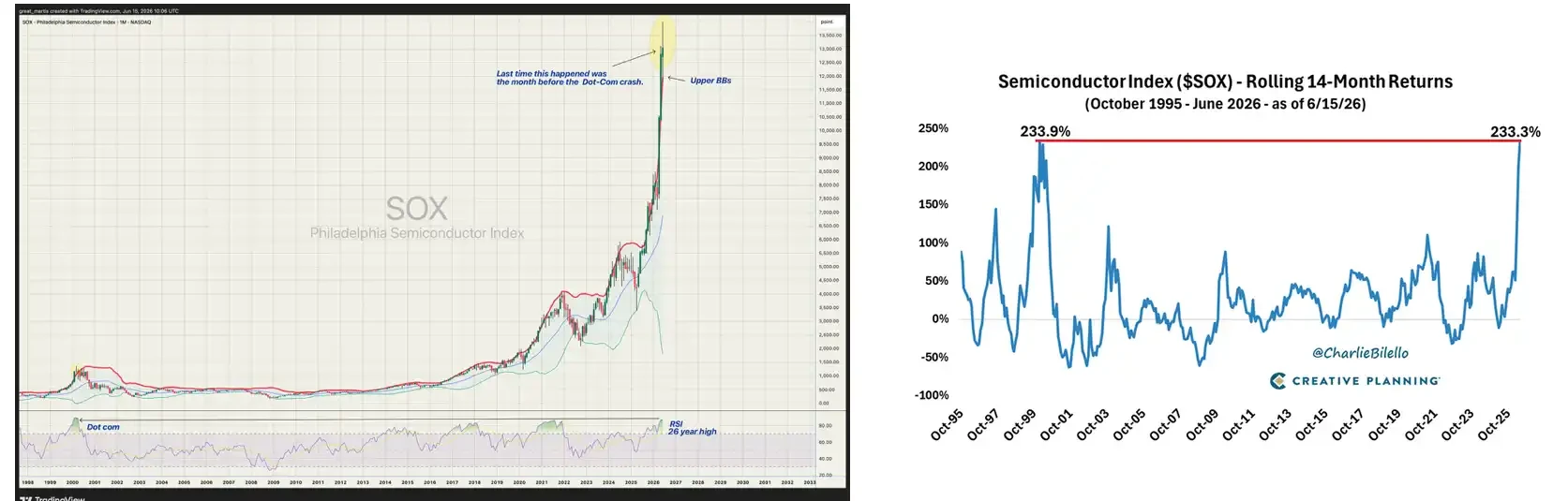
The returns in this semiconductor bull run have been highly concentrated and significant. The year-to-date gains for the memory trio—Micron, SK Hynix, and Samsung—are approximately 141%, 186%, and 114%, respectively. TSMC's U.S. ADR has gained over 50% year-to-date.
Nvidia hit a record high of $235.47 on May 14. Broadcom, Marvell, and ASML are either setting new records or approaching them in their respective niche sectors. The 52-week low for the SOXX ETF was $148, with a high near $369, representing an amplitude of almost 150%.
In April, Goldman Sachs revised its 2026 DRAM supply-demand gap forecast from 3.3% to 4.9%, calling it the most severe memory shortage in 15 years. HBM prices are even more extreme, with a single HBM3E stack costing around $300, while the upcoming HBM4 is estimated at $500 per unit. SK Hynix's entire 2026 HBM capacity has already been booked by Microsoft, Google, and Nvidia, with some customers even paying full deposits upfront to secure capacity.
Clearly, the pace of AI data center construction far exceeds the rate of chip capacity expansion.
A "Bottleneck" Bull Market
Scarcity is what creates the most profitable products.
Understanding this statement is key to grasping the core logic of this semiconductor bull run. Whoever controls the bottleneck in AI infrastructure holds the strongest pricing power. Conversely, if a segment can be replaced or squeezed on price, its stock price won't rise, no matter how high the demand.
Optical modules are a classic example of the latter. An April report from Photon Capital noted that while Chinese optical module companies occupy seven of the top ten global spots, they aren't very profitable; the real profits still go to chip companies. Zhongji Innolight and Eoptolink have achieved world-class shipment volumes and cost control for 800G and 1.6T optical modules, directly squeezing the margins of U.S. optical module companies like Coherent and Lumentum. Demand doubled, but profit margins were compressed. The reason is simple: the assembly stage of optical modules is not scarce enough.
Memory, however, has become the strongest narrative in this round of U.S. semiconductor stocks. Essentially, this is because it controls a bottleneck, and that bottleneck is tightening.
HBM is not ordinary DRAM. 3D stacking, TSV (Through-Silicon Via), and specialized packaging processes create layers of technological barriers built on over a decade of heavy asset investment. Only three companies globally can mass-produce HBM, with SK Hynix capturing about half the market share.
Interestingly, this logic also applies at the macroeconomic, national level.
The true winners in AI data center infrastructure are not "all semiconductor nations," but those countries and regions that have, over the past few years or even decades, built rare industrial clusters in some irreplaceable link of the chain. Scarcity is the key point.
Each Region Has Its Own Main Track
A very interesting perspective was raised in the U.S. stock community.
The U.S. remains at the very top of the value chain.
Companies like Nvidia, AMD, Broadcom (ASIC design), Synopsys and Cadence (EDA tools), and Arista (AI networking), along with the three major cloud providers packaging computing power into services for the world. Google, Amazon, and Microsoft are all accelerating their in-house ASIC development. Broadcom and Marvell together command roughly 95% of the custom ASIC design market. Google alone spends approximately $8 billion annually with Broadcom on TPU development.
The core manufacturing nodes are in Taiwan and South Korea, but they play entirely different roles.
Taiwan's story revolves around TSMC and advanced packaging. Only TSMC can mass-produce 3nm and 2nm process nodes globally. TSMC's three CoWoS backend factories are all at full capacity, with lead times of 52 to 78 weeks. Nvidia alone has secured 60% to 70% of CoWoS capacity. TSMC is expanding its monthly capacity from 35,000 wafers at the end of 2024 to 130,000 wafers by the end of 2026, nearly a fourfold increase. But even with this expansion, capacity remains tight. Taiwan's server OEM ecosystem, including Hon Hai (Foxconn), Quanta, and Wistron, is also ramping up alongside AI server shipments.
South Korea's story is entirely centered on memory. SK Hynix holds about 50% to 55% of the global HBM market share, Samsung has 19% to 35%, and Micron has around 5% to 20%. HBM is distinct from regular memory, involving 3D stacking, TSV, and specialized packaging, each a technological barrier built by Korean companies through continuous investment over the past decade and more.
Japan and the Netherlands also play crucial roles. Tokyo Electron makes semiconductor equipment, Shin-Etsu Chemical and SUMCO produce silicon wafers, and Ajinomoto provides ABF substrate materials. Japan may be out of the game in end-user chip products, but its position in materials and precision processing remains irreplaceable.
The Netherlands' role is even more direct: ASML monopolizes EUV lithography machines. Morgan Stanley significantly raised its ASML price target to €1,400 in January, predicting 2027 will be the year of ASML's highest profit growth, with EPS up 57% year-over-year. This judgment was based on three drivers: advanced logic foundry capacity expansion exceeding expectations, large-scale capacity expansion in the DRAM memory sector, and overall demand performing better than anticipated. Dutch packaging equipment companies like BESI have also secured a large number of orders amid the boom in AI chip packaging demand.
China and Europe have different entry points, but the logic is similar—both have built cost advantages or delivery capabilities in specific parts of the AI infrastructure chain.
Zhongji Innolight and Eoptolink are world-class in terms of shipment volume and price control for 800G and 1.6T optical modules. However, Photon Capital's analysis also warns of an important time window. The current high profit margins of optical module companies come from temporary pricing power due to the short-term shortage of 800G capacity. Once 1.6T mass production ramps up in the second half of 2026 to 2027, and second- and third-tier manufacturers catch up on capacity, pricing pressure on the module side will arrive quickly.
In Europe, companies like Schneider Electric, ABB, and Vertiv, which specialize in power distribution and cooling, have received orders far exceeding expectations amid the surge in data center electricity consumption. Wedbush estimates that hyperscaler AI infrastructure spending will reach approximately $725 billion in 2026, a 77% year-over-year increase, with power infrastructure being one of the fastest-growing sub-segments.
AI Reshapes the Semiconductor "Smile Curve"
If we use the smile curve to summarize this landscape: the left end (U.S.) handles "definition and design"; the higher middle section (Taiwan, South Korea, Netherlands, Japan) is responsible for "manufacturing advanced chips"; the lower middle section (Taiwan, China, Southeast Asia) handles "large-scale assembly"; and the right end (U.S. and China) manages "cloud platforms, models, and customer access."
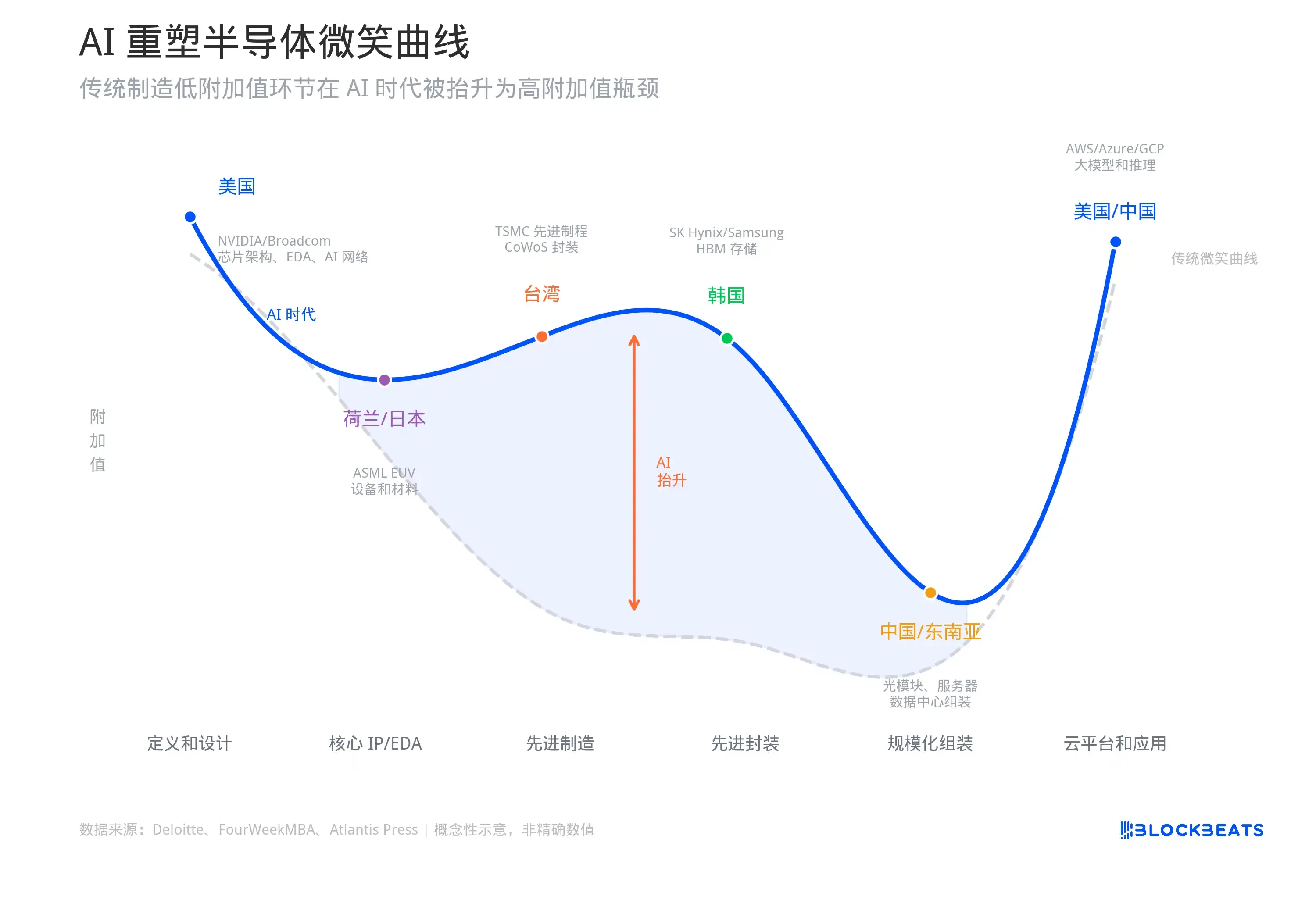
The original creator of this curve was Acer founder Stan Shih in 1992, who used the model to explain why PC assembly had the thinnest profit margins.
But thirty years later, AI data centers are reshaping this curve.
Both FourWeekMBA's value chain analysis and a paper published by Atlantis Press this year point to the same conclusion: AI has lifted the middle section of the traditional smile curve. TSMC's advanced CoWoS packaging, SK Hynix's HBM stacking, and ASML's EUV lithography—these are the "middle manufacturing segments" with the thinnest profits in the traditional manufacturing smile curve. However, in the AI era, they have become the scarcest resources, commanding profit margins and pricing power no less than the design and application ends.
Data from the paper shows Nvidia's gross margin for 2023-2024 was 72.72%, with a net margin of 48.85%. But TSMC's Q1 2026 gross margin also reached 66.2%, with a net margin of 50.5%. The profitability gap between the design and manufacturing ends is narrowing, an unprecedented phenomenon in the history of the semiconductor industry.
The traditional smile curve posits that manufacturing has the thinnest margins. AI has turned the most difficult parts of manufacturing into the scarcest resources.
Morgan Stanley's March research report on Asian semiconductors reached a similar conclusion: the 2023-2024 AI cycle was primarily concentrated on GPUs, but from 2025 to 2026, demand began spreading across the broader supply chain. Memory, advanced packaging, custom ASICs, and data center networking are all taking over the baton.
Each rotation of bottlenecks pushes a new set of previously overlooked companies into the spotlight, while the biggest winners of the previous cycle enter a digestion period.
How Far Can the Bull Run Go? A Battle of Bullish and Bearish Views
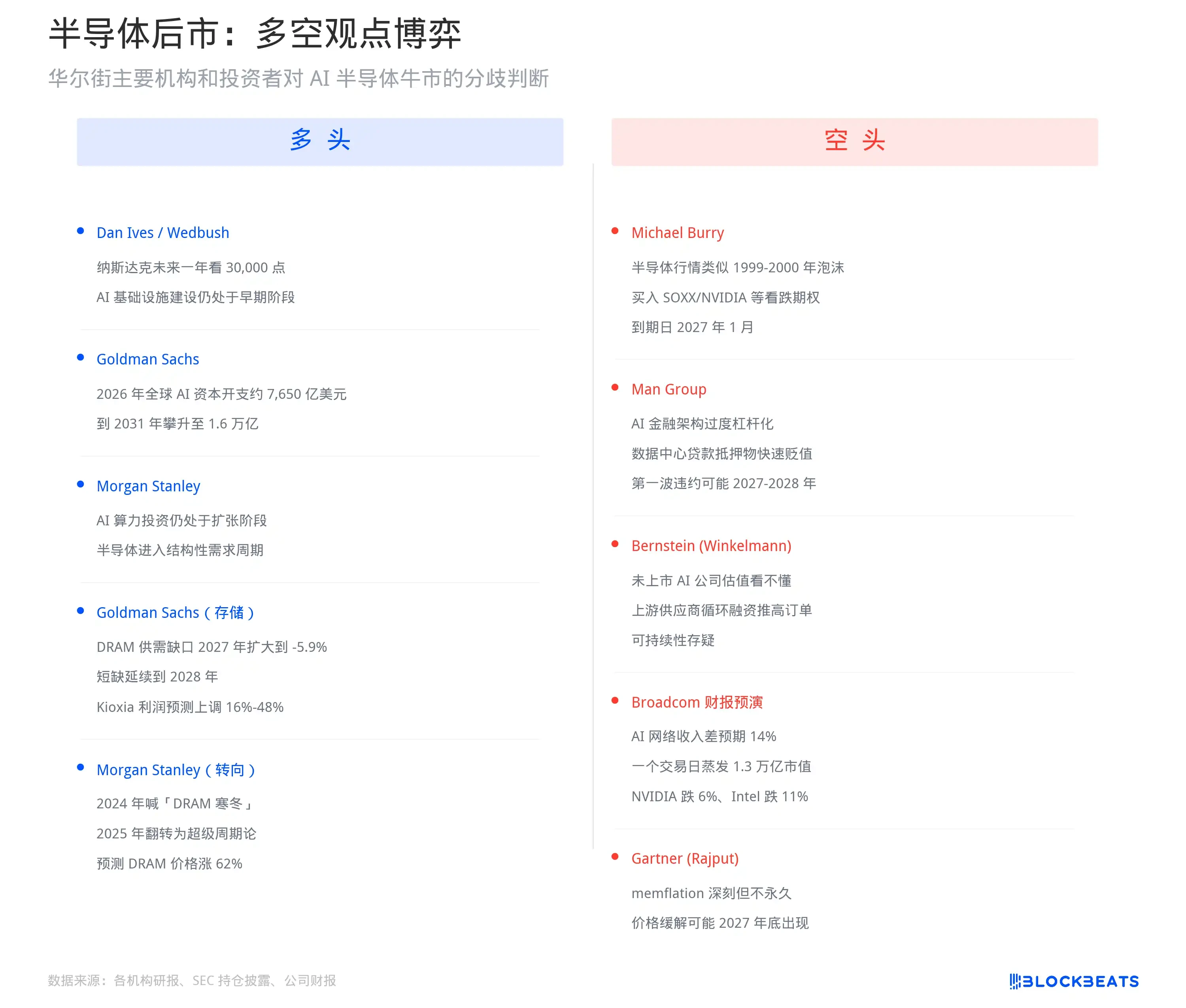
Let's first listen to the bulls. Dan Ives of Wedbush directly called for the Nasdaq to hit 30,000 points within the next year on CNBC in May, arguing that demand for AI chips still far exceeds supply. Goldman Sachs provided more specific figures, estimating global AI capital expenditure at approximately $765 billion in 2026, rising to $1.6 trillion by 2031.
In its March report on Asian semiconductors, Morgan Stanley explicitly stated that AI computing power investment is still in an expansion phase, and the semiconductor industry is entering a new structural demand cycle.
Bullish views on memory are even more aggressive. Goldman Sachs recently revised its DRAM supply-demand gap forecasts for 2026-2028 deeper into shortage territory, nearly doubling the 2027 forecast from -2.5% to -5.9%. Their assessment is that this memory cycle is different from the past, with higher visibility on AI server demand, supply growth capped by long-term lock-in agreements, and price increases that will last longer than the market expects.
Goldman Sachs even significantly raised its operating profit forecasts for Kioxia for the three years from 2027 to 2029, by 16% to 48%, arguing that these high profits could be sustained for two to three years. For a company in the highly cyclical memory business, a forecast of "three years of high profits" is extremely rare on Wall Street.
Morgan Stanley's shift in stance is even more interesting. They were still calling for a "DRAM winter" in 2024, predicting years of price declines starting in Q4 2024. Then, by 2025, they flipped to a super-cycle theory, predicting DRAM prices would rise by 62% in 2026, and that profits for SK Hynix and Samsung would beat consensus expectations by 30% to 50%.
However, the bears are also making noise, and they are significant.
Michael Burry publicly warned in May that this semiconductor rally bears a striking resemblance to the final months of the 1999-2000 dot-com bubble. With the SOX up 65% year-to-date, gaining 10% in a single week, and the SOXX ETF trading 60% above its 200-day moving average, this kind of technical stretch is historically unsustainable. SEC filings showed he purchased a large number of put options on SOXX, QQQ, Nvidia, Palantir, and Oracle, with expiry dates set for January 2027 and strike prices far below current market prices.
Man Group (one of the world's largest publicly traded hedge funds) published a lengthy analysis in June specifically dissecting the AI bubble risk. Their core argument is that the financial architecture built around AI has become too large, overly leveraged, and excessively dependent on a small number of interconnected participants.
They specifically noted that a significant amount of AI data center construction is financed through private credit, where the collateral is "hardware that depreciates as quickly as a mobile phone, not a long-lived asset like a building." The first wave of defaults could appear in 2027-2028 when initial leases expire, and the gap between financing assumptions and reality becomes unavoidable.
Looking ahead, several key time nodes deserve our attention.
Micron's earnings report on June 24 will provide forward guidance on HBM demand and capacity allocation, which will set the tone for the memory sector throughout the summer. Nvidia's next earnings report is equally critical. Any hint of even a slight slowdown in AI chip demand could lead to a wholesale repricing of sentiment across the entire sector.
Looking further out, the timeline for capacity release is the real watershed moment. SK Hynix's M15X factory is expected to start volume production in mid-2027, with its Yongin new plant accelerated to February 2027. Samsung's P5 plant will begin production in 2028. Micron's Idaho Fab 1 is expected to contribute output in mid-2027.
In total, industry capacity is set to increase by 20% to 30% from the second half of 2027 to the first half of 2028. The problem is that the compound annual growth rate for HBM demand is also over 40%. Whether supply can catch up with demand depends on whether AI capital expenditure slows down before then.
The final variable is geopolitics. The higher the concentration of the semiconductor supply chain, the greater the impact of a black swan event. TSMC alone controls over 90% of global advanced process foundry capacity—an efficiency driver in a bull market, but a systemic risk in a conflict scenario. The Taiwan Strait situation, the trajectory of U.S. export controls on China, and the degree of cooperation from Japan and the Netherlands on equipment restrictions—these factors are unpleasant to discuss when markets are good, but once a crisis hits, their pricing speed will outpace any fundamental change.


