






Xiaohongshu's second great voyage, this time sailing towards AI


- Core Thesis: Xiaohongshu is facing an existential crisis as AI threatens to disrupt its moat of "life experience," forcing it to accelerate the transformation of its accumulated user-generated real-life knowledge into AI-driven tools and businesses, while seeking a balance between monetization and preserving its authentic content ecosystem.
- Key Elements:
- Xiaohongshu's moat is built on specific, humanized life experiences (e.g., consumption decisions) accumulated by hundreds of millions of users over thirteen years. With nearly 600 million daily searches, this is its most core asset.
- AI's "pre-cooked meal" style answers may simplify decision-making, but they flatten the specific preconditions and hesitation processes within experiences, threatening the platform's foundation of user trust. The platform has implemented AI governance measures (e.g., cracking down on AI-generated copywriting) to protect authentic content.
- Xiaohongshu is proactively structuring its experience by establishing the first-level AI department Dots, acquiring the AI search product Dian Dian, and building the RED Skill tool platform, aiming to upgrade from "browsing notes" to having AI directly provide customized answers.
- Strategic investments are shifting towards AI hardware (e.g., Yunwang Innovation) and model companies (e.g., Moonshot AI), along with securing a payment license, all in an effort to complete the closed-loop business cycle from user need discovery and decision-making to transaction completion.
- Monetization data (e.g., a 29-day decision cycle for facial serums) shows its value lies in capturing users' "moments of hesitation," allowing AI to match advertisements more accurately and enabling ads to "live within the answers."
Original Author: Sleepy
At the end of 2022, shortly after ChatGPT's launch, Mao Wenchao borrowed an employee's phone. He typed a question into the dialogue box: Will Xiaohongshu be disrupted?
According to reports, from then on, he required his team to report on AI progress every two weeks. The bi-weekly schedule suggests the machine hadn't yet provided him with a reassuring answer.
In August 2023, he wrote in an internal letter that he discovered while chatting with foreign friends, a large number of questions people ask on ChatGPT are about life experiences – how to choose a product, how to use it, how to avoid pitfalls. This overlaps with Xiaohongshu's business.
But he then added, this is because there is no such accumulation of experience overseas, whereas Xiaohongshu has it. This moat would not be easily shaken by AI for some time.
Previously, the term "moat" was mostly used by entrepreneurs pitching to investors, but this time it seemed like he was reassuring his own anxious self.
That year, Xiaohongshu just turned ten, its monthly active users exceeded 300 million, it achieved profitability for the first time, with revenue of $3.7 billion and a net profit of $500 million. It was expected that profits would double the following year to over $1 billion.
In business history, companies die in two ways: from poverty, or from wealth. Countless have died from poverty, nothing much to say about them. Those dying from wealth always make the news; Kodak had money in the bank when it died, Nokia was still the industry leader when it fell.
Having money and having longevity are two different things. Abundance cannot eliminate fear; it only turns fear into a series of specific actions.
In 2026, this series of actions intensified.
On June 8th, Xiaohongshu launched RED Skill, allowing a component to be attached under a post that an Agent can copy and use.
Earlier, on April 30th, the AI first-level department, Dots, was established, encompassing models, infrastructure, and engineering products, reporting directly to the new President, Ke Nan.
Even earlier, it acquired the development company behind the AI search product, Diandian, and also obtained a payment license.
Its strategic investment list began to feature names like MiniMax, Moonshot AI, and a series of AI hardware companies.
Over the past thirteen years, the consumption experiences, lifestyle habits, and daily judgments left in posts by hundreds of millions of users are its true foundation. With the arrival of AI, it needs to reprocess these judgments, first into answers, then into tools, and finally into a business. If it doesn't want to wait to be disrupted, it has to make the first move itself.
But can experience withstand such processing? To answer this, we need to go back to 2013, back to China's own Age of Exploration.
The Age of Exploration for 70 Million People
In June 2013, Qu Fang quit her job at a foreign company and co-founded Xiaohongshu in Shanghai with Mao Wenchao. Their first product wasn't an app; it was a PDF, "Xiaohongshu Overseas Shopping Guide."
That year, the number of outbound Chinese tourists exceeded 70 million, equivalent to the entire population of France going abroad at once.
The Europeans' Age of Exploration brought back spices, gold, and colonies. The Chinese one brought back cosmeceuticals, rice cookers, and guides. Though the items were small, the human desire was the same – to bring good things from afar back home.
The world of goods outside China's borders suddenly opened up. Crowds of tourists with phones held high swarmed duty-free shop shelves, with no one to tell them what was worth buying. The information gap was like a mineral deposit; whoever gathered the experiences of those who came before first could become the mine owner.
That PDF was uploaded to a website and downloaded 500,000 times in less than a month. A few months later, it evolved into an app. A few years after that, it found its way into hundreds of millions of phones.
When Chinese people encounter a problem, they never ask for a manual; they ask people.
Fei Xiaotong wrote in "From the Soil: The Foundations of Chinese Society" that trust in rural society relies not on contracts, but on familiarity. Apprentices learn from masters, new wives ask their mothers-in-law, and first-time city dwellers look for fellow townspeople. For thousands of years, experience was passed down this way, not fast, but sufficient.
Two conditions made it sufficient: people lived close by, and life moved slowly. These two conditions were lost in the past few decades. Hundreds of millions left their hometowns, moving into apartment buildings where they didn't even know their neighbors' names. The number of things you could buy grew from a few hundred on the supply-shelf to hundreds of millions on e-commerce pages. It became hard to ask an elder who had never used a robot vacuum which model to buy. The experienced ones hadn't had the experience yet.
The internet was supposed to solve this problem, but it only magnified it. People invented the internet to get information, but ended up with so much information that no one dared trust any of it. Because most information online comes from sellers, and a seller's job isn't to help you judge, but to convince you to pay. Judgment can only come from those who don't want your money.
Xiaohongshu gathered the scattered "I've tried it" experiences of hundreds of millions of strangers. A girl from Guangzhou writes that a certain foundation will cake on her oily skin. A young man from Shenyang notes the eleven pitfalls he encountered during home renovation. A mother writes about her weeks of hesitation between two types of baby food.
Most of these writers are unknown, not experts, and their writing isn't necessarily rigorous. It might contain sponsored posts or misjudgments, but these words have a human touch.
Encyclopedias pursue definitions, advertisements pursue persuasion. These posts pursue nothing; they are testimonies, flawed testimonies. In a courtroom, it is precisely this kind of testimony that is most credible; a testimony that is too perfect sounds rehearsed. The industry later gave this phenomenon a name: Zhongcao (seeding/grass-planting).
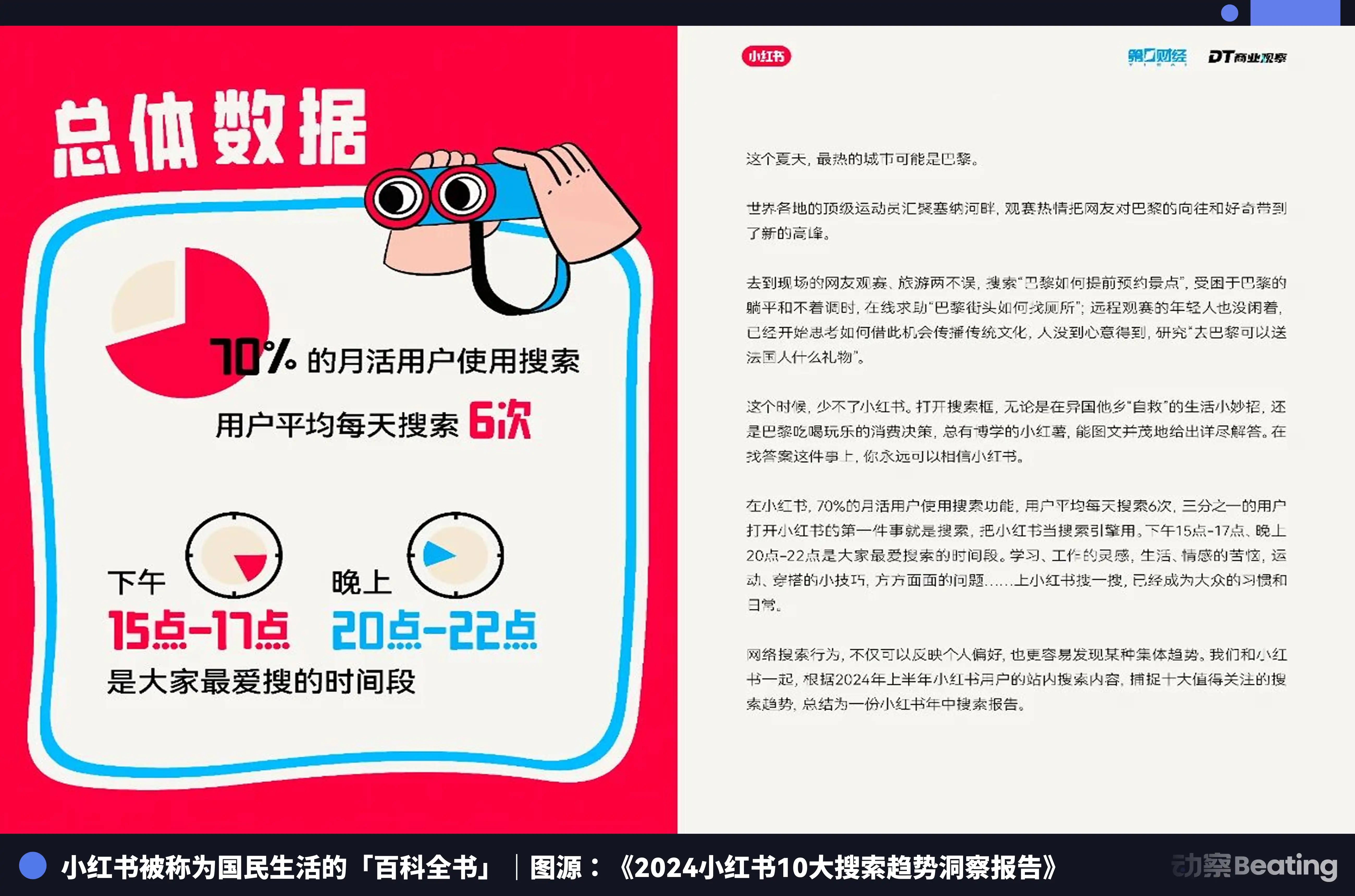
By the end of 2024, this app's daily search volume was approaching 600 million. People rarely searched for knowledge here; mostly, they searched for life: home renovation, serums, travel guides. Search engines give you data; Xiaohongshu gives you other people's experiences. Of course, there are ads, and it might not give you the most precise answer, but people still look because many questions in life don't have a single standard answer.
Behind 600 million searches lie 600 million moments of hesitation – people holding their phones late at night, unable to make a decision. This is Xiaohongshu's entire foundation.
Then, AI arrived.
Patience Runs Out
The thirty years of the internet is a history of the decline of human patience.
In the portal era, information was organized into directories; people had to find it themselves. In the search era, it became links; people had to click themselves. In the feed era, people didn't even need to search; algorithms fed them. Each change shortened patience a little more. In the AI era, information is turned directly into answers. Human patience has run out.
This isn't the user's fault. People's love for convenience is endless – wheels, elevators, remote controls were all invented for this reason. Once a person gets used to an AI dialogue box, it's very hard to go back to manually browsing and filtering through posts.
Xiaohongshu's difficulty lies in the fact that its most valuable part is precisely the hardest to compress into a single answer.
In the past, people would browse twenty posts here, compare, hesitate, and finally make their own decision. This process was slow because you'd see three people saying something is good, two regretting it, and one reminding you that the product is good but needs careful handling. Someone writes that a hotel has poor soundproofing but great breakfast. This sentence is useful because it comes from a specific person; you can roughly guess what they care about, and then decide if their experience is relevant to you.
AI is like a ready-made meal factory. What comes in is the myriad flavors of life, and what comes out is a standardized recipe. It is indeed convenient, but the hesitation, failure, and preconditions that were omitted are precisely the most valuable parts of experience.
Experience always grows from specific individuals. What skin type, which city they live in, how much budget they have – all these determine whether a piece of advice is useful. The machine's answers lack these preconditions; they sound like slogans. And slogans can't help you choose a foundation.
Xiaohongshu understands this danger. If patience can't be retained, when the day comes, its 600 million searches will become the training data for someone else's model. It will become a mine – an open-pit mine that anyone passing by can dig into.
So, it has to act itself. It didn't start too late. From 2023, it developed its own model "Xiao Di Gua," launched the AI painting tool "Trik," and tested the dialogue product "Da Vinci." Most of these products didn't make a big splash, but they weren't wasted. They were like rounds of reconnaissance, allowing Xiaohongshu to figure out first what AI could actually do for it.
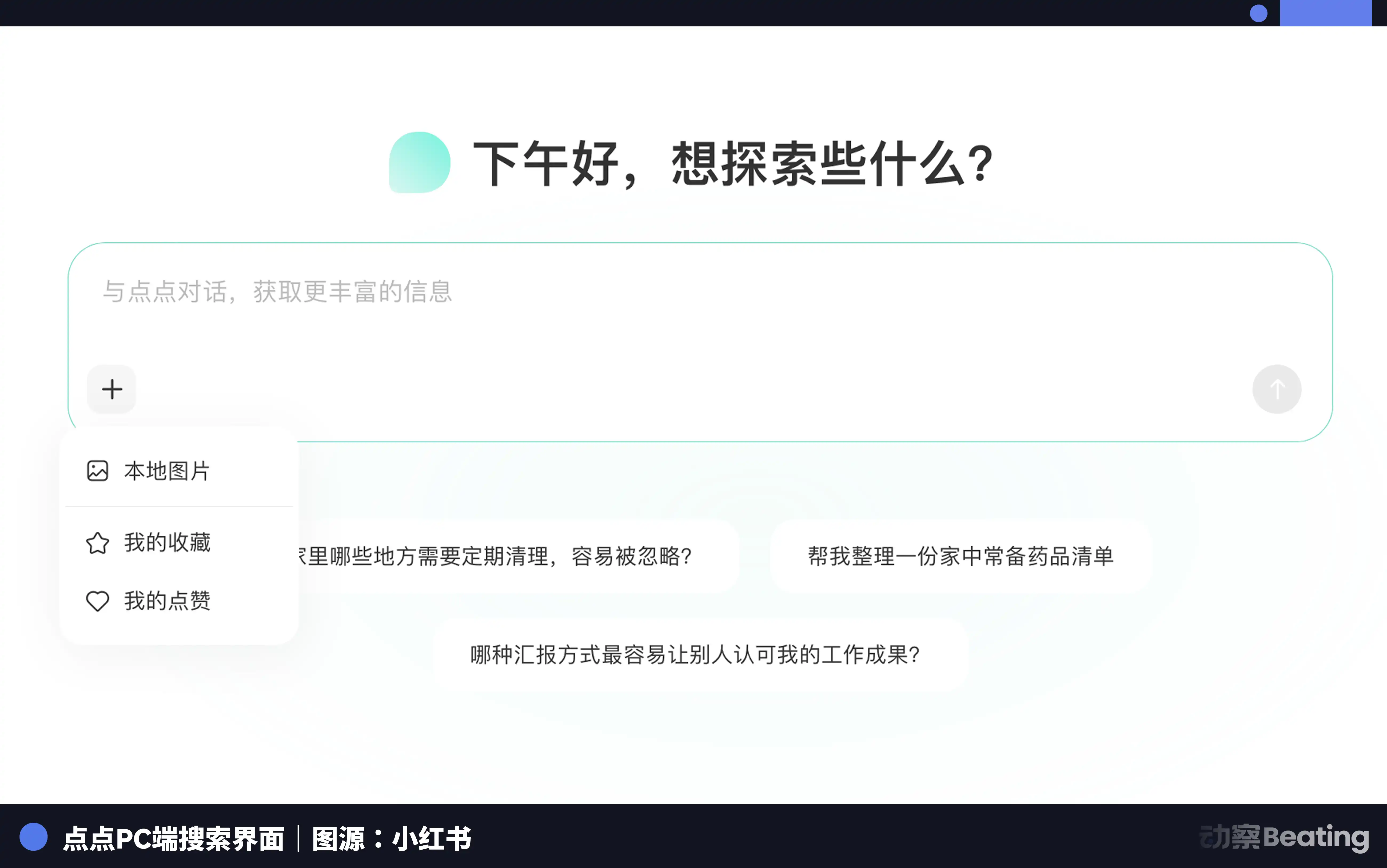
The one that truly explored the direction was Diandian. It focuses on life search, combining in-app posts with information from across the web, accepting both text/image and voice queries. Xiaohongshu later acquired the company behind it. Diandian isn't a blockbuster hit, but the scout's job was never to capture the city.
It explored one key thing: in the past, searches started from keywords; the user handed in an address. Now, queries start from a situation; the user hands in a whole set of problems. People no longer just search "Okinawa family trip"; they ask how to arrange a five-day trip to Okinawa with a three-year-old, a budget of 15,000 Yuan (approx $2,100), wanting to stay close to the sea.
To solve these problems, Xiaohongshu has successively published research on multimodal retrieval and search understanding, and open-sourced the image editing model FireRed and the search agent framework REDSearcher. It has no intention of competing with tech giants for a spot on the general model leaderboard. While others compete on parameters and benchmarks, what it wants is to understand, deconstruct, and reassemble the real human experiences scattered across text, images, videos, and comments into concrete, actionable advice. With the establishment of Dots this year, this line has moved from peripheral experimentation to core business.
Xiaohongshu wants to do the work of browsing twenty posts to piece together an answer for the user. But one answer only solves one problem. What it truly wants is to turn experience into a capability that can be called upon repeatedly.
Posts Grow Hands and Feet
This is precisely what RED Skill does. It transforms experience from content into a tool.
After the feature launched, Xiaohongshu quickly rolled out support campaigns and curated lists. 300,000 people started writing AI Skills. Gui Zang's PPT creation tool, which had garnered over 10,000 Stars on GitHub, was installed by thousands of people within days of launching on Xiaohongshu.
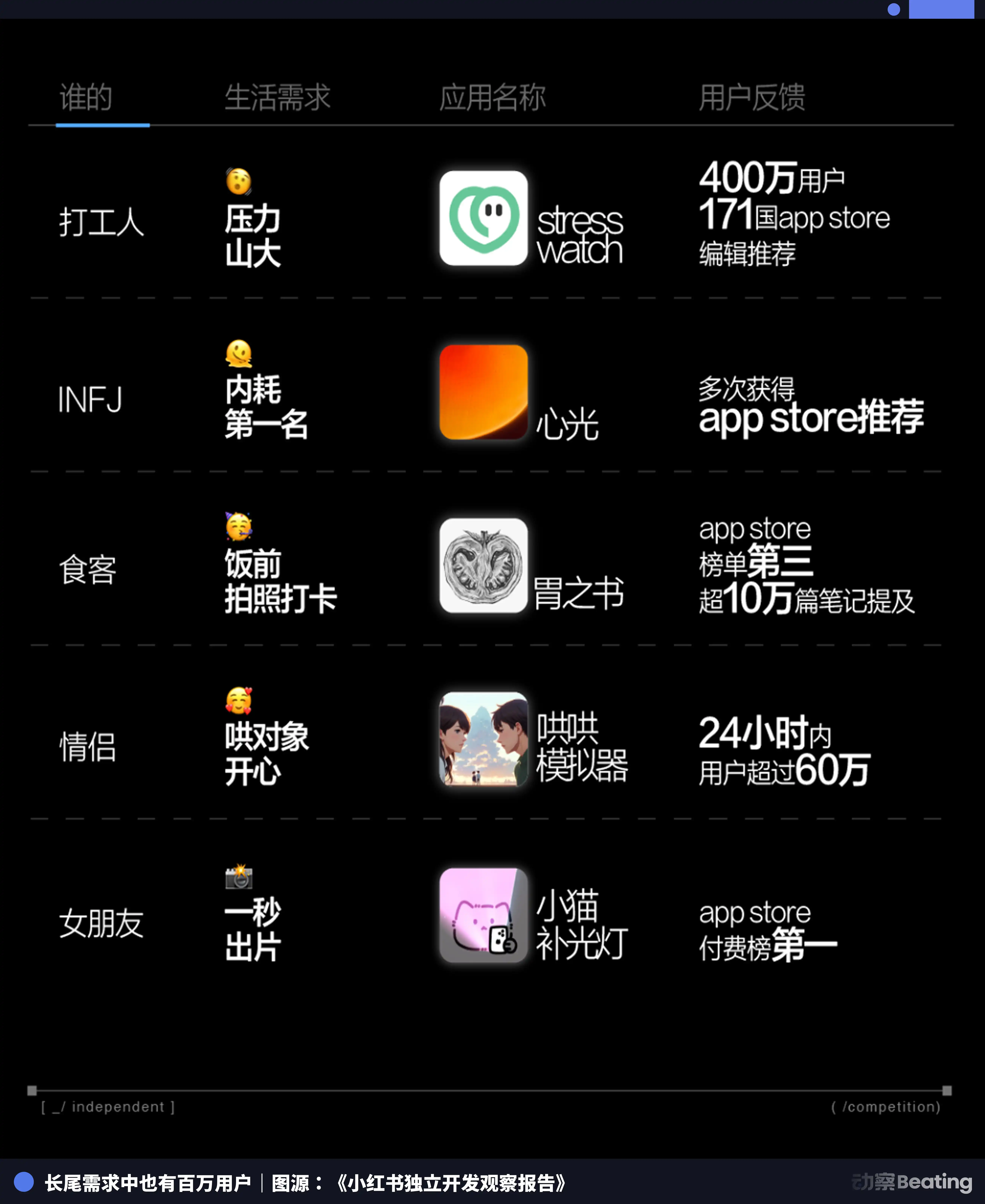
Earlier, last year's Independent Developer Competition received 1,355 projects. This spring's first Hackathon featured 48 hours of closed development with a prize pool of 500,000 Yuan. 60% of participants were born after 2000, with the youngest being twelve years old. Posts about "Build in Public" on the platform have already exceeded 1.1 million.
While these numbers aren't yet enough to prove the ecosystem is fully formed, they clearly show what Xiaohongshu wants to do.
In the past, developers looking for a cold start for their product would mostly go to GitHub or Product Hunt. There are many peers and investors there, but not necessarily many regular users. People might give you Stars or valuation, but not necessarily orders.
Xiaohongshu is targeting this exact gap. Developers post their progress here, users request features in the comments, bloggers write about their user experience, and the platform uses lists to gather initial attention. For an AI tool, building it is just the beginning. It needs to be tried, discussed, and translated into something ordinary people can understand and use.
Making tools might not be Xiaohongshu's strongest suit. But bringing tools into people's lives – that, it knows well.
For the past thirteen years, creators on Xiaohongshu were more like storytellers. Their writing was vivid, their recommendations trustworthy, their influence built up gradually. Users were willing to listen to them first and foremost because they trusted them as a person. In the AI era, creators are starting to become craftsmen. A respected figure becoming a craftsman might sound like a demotion, but it's really just a change of measurement. How many people install the tool, how many times it's called, and how many tasks it actually accomplishes for users will start to determine a creator's weight.
For someone writing posts, in the past, your experience could only be seen. Now, it can also be called. And being callable opens up the possibility of being priced.
Before the Search Term Appears
In December 2024, Dai Lidan, a partner at Capital Today, joined Xiaohongshu as Head of Strategy, tasked with establishing the strategic investment team. With a background in Computer Science from Peking University, she worked on Baidu Image Search and Baidu Maps, then earned an MBA from Harvard before returning to China to join Capital Today. She has covered technology, products, and capital.
Before she arrived, Xiaohongshu primarily invested in consumer brands – M Stand coffee, Moody contact lenses, as well as food, toys, and maternity/infant products – investments reflecting young people's lifestyles, a business it knows well. After she arrived, financial investment and strategic investment were separated, and the strategic team pivoted towards hard tech and AI. MiniMax's list of shareholders includes Xiaohongshu, and Moonshot AI's funding round exceeding $1 billion also featured it.
Its bets aren't limited to AI on screens.
In the Nanshan Science Park area of Shenzhen, centered around DJI's headquarters, a cluster of AI hardware companies is emerging. In the second half of 2025, Xiaohongshu invested in nearly ten startups here, acting quickly, sometimes finalizing deals in a day or two, and willing to use higher valuations to secure stakes.
Two of these investments were made through its subsidiary "Shu Neng Sheng Qiao." One was in Yunwang Innovation, which transformed the traditional foam roller into an AI massage robot capable of sensing body soreness and adjusting pressure and movement accordingly. The other was in Skyris, which makes companion robots that float in the air using helium, interacting with people through wings, LED eyes, and voice.
Industry insiders often call Xiaohongshu the "gateway for life decisions." These eight words look good on a PPT slide, but such nice words are often lofty.
A decision is already a very late step. When a person starts searching for "how to use a foam roller," it means the need has already been articulated. Before it becomes a search term, the need often has no name – it might just be a persistent ache in the shoulder, or someone sitting alone at home for three hours.
In the past, Xiaohongshu was downstream, waiting for people to write down their life experiences. Now, it wants to move upstream, actively finding needs that haven't yet become search terms.
In 2024, Xiaohongshu's parent company also acted as an LP investing in a fund under Jinshajiang Capital. Jinshajiang was an early investor in Xiaohongshu, discovering the company at a startup competition in 2014 and investing the following year. A decade later, the investee became the investor. With this fund commitment, Xiaohongshu bought itself a long-term channel to early-stage projects.
Of course, investing early doesn't mean seeing clearly. AI hardware has yet to prove it can achieve large-scale commercialization. Mass production, supply chains, after-sales service – each is a tough challenge, and none are businesses Xiaohongshu is familiar with. The trickier issue is data. When your shoulder is aching, the device knows. Why you are aching, the platform also wants to know. Knowing too little makes the product bad; knowing too much brings privacy risks.
But it still has to invest. What it truly fears isn't today. It's that tomorrow night, the person struggling to make a decision at midnight might not open Xiaohongshu to browse posts, but will directly hand their problem over to another AI.
When Advertising Lives in the Answer
Xiaohongshu's story inevitably comes back to monetization.
On this platform, experience and business have always been intertwined. Behind skincare advice lie skincare products; behind decoration guides lie building material suppliers. Users want to avoid detours, businesses want to be seen, and the platform wants to make money. Each wish is reasonable on its own, but putting them together requires a set


