Tiger Research: US Strategic Bitcoin Reserve – Should the Market Be Happy or Disappointed?


- Core View: US strategic Bitcoin reserve legislation has degraded from mandatory purchases to a custodial bill (ARMA) that only prohibits sales. The short-term market impact is limited, but in the long term, it may lay the legal groundwork for future mandatory purchase legislation, which is seen as a constructive factor.
- Key Elements:
- Trump's March 2025 executive order only committed to not selling the approximately 190,000 BTC (later increased to 320,000 BTC) held by the government, without requiring any new purchases, leading to a 5.7% drop in Bitcoin's price.
- Legislation has degraded from the 2024 BITCOIN Act, which required the purchase of 1 million BTC over five years, to the 2026 ARMA bill, which completely eliminates the purchase obligation and only prohibits sales for 20 years.
- ARMA has a higher chance of passing due to bipartisan support and because it does not increase fiscal costs or impact the dollar's status. However, it generates no new short-term demand, only eliminating the risk of government sales.
- If ARMA passes, it would grant Bitcoin formal legal status as a national reserve asset, potentially restarting the debate on mandatory purchases.
- Opposition from Treasury Secretary Bessent and Democrats, along with skepticism from fiscal conservatives about speculative assets, are the core obstacles stalling the BITCOIN Act.
This article is written by Tiger Research. News about the U.S. Strategic Bitcoin Reserve has been circulating for nearly two years. The original BITCOIN Act (introduced in 2024) centered on the government proactively purchasing Bitcoin, while the ARMA Act contains no such provisions at all. Whether the market should interpret this as a positive development remains an open question.
Key Takeaways
The executive order signed by President Trump in March 2025 promised not to sell Bitcoin already held by the federal government but did not require purchasing new coins. Market expectations had been higher, and when the details of the order became clear, the price of Bitcoin immediately dropped by 5.7%.
Legislative efforts that began in 2024 have significantly retreated over the past two years: from a bill requiring the purchase of 1 million BTC, it has devolved into one that only includes custodial obligations with no purchase requirements whatsoever.
The most optimistic bill currently in progress is the "American Retirement and Monetary Promotion Act" (ARMA). It is not a purchasing bill but rather prohibits the government from selling its existing Bitcoin holdings for at least 20 years.
ARMA's short-term impact on the Bitcoin market is limited. However, in the long run, establishing Bitcoin's legal status as a national reserve asset could reignite discussions about mandatory purchases, which would be positive for the market.
Background: What the U.S. Did and Didn't Do
During the 2024 presidential campaign, Trump repeatedly promised to establish a strategic Bitcoin reserve, which the market interpreted as the federal government becoming a direct buyer.
After the election, on March 6, 2025, Trump signed an executive order designating Bitcoin obtained through criminal investigations and civil forfeitures as a strategic reserve and directed its permanent holding. The order did not instruct the acquisition of new Bitcoin; it only promised not to sell the Bitcoin already owned by the government. After the order's contents were clear, the price of Bitcoin fell from approximately $92,000 to below $85,000.
At the time of signing, the federal government held approximately 190,000 BTC, representing about 0.9% of the total 21 million supply. All of this Bitcoin came from criminal and civil proceedings; not a single coin was purchased.
The current situation remains unchanged. Aside from the executive order, nothing has been codified into law.
Legislative History
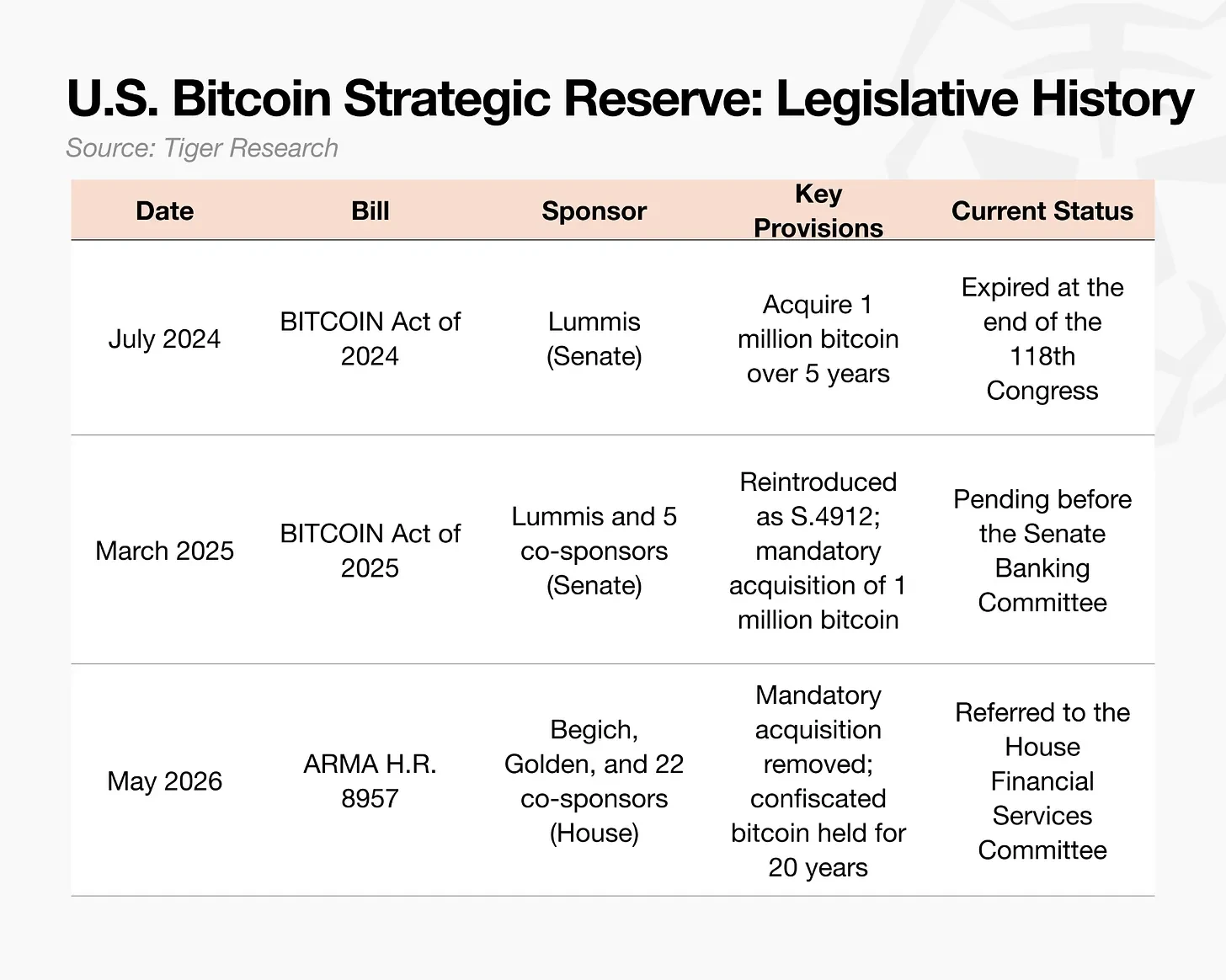
Discussions starting in 2021 led to the first concrete bill in 2024, which was reintroduced in 2025 and restructured as ARMA in 2026. The main thread of this evolution is a constant compromise with political reality: mandatory purchase quantities went from existing to non-existent. Each revision made passage more feasible but simultaneously reduced its market impact.
2024: The Original Bill
Since entering the Senate in 2021, Senator Lummis has publicly called for incorporating Bitcoin into the federal reserve. There was no consensus on this within Congress at the time, and the crypto winter of 2022-2023, coupled with the FTX collapse, made the environment even more unfavorable.
The situation shifted in 2024 when Bitcoin broke through $100,000 and spot ETFs received regulatory approval. In July of that year, Lummis proposed the first concrete legislation: purchasing 1 million Bitcoins over five years, holding them for at least 20 years, funded by Federal Reserve surplus accounts.
1 million BTC represents 4.76% of the total supply, exceeding the approximately 840,000 coins Strategy reports holding. The bill expired automatically at the end of that congressional session.
2025: Reintroduction and Stalled Progress
In March 2025, the same month as the executive order, Lummis reintroduced the BITCOIN Act as Senate Bill 954. The core structure remained unchanged: purchasing 200,000 BTC per year, totaling 1 million over five years, with a 20-year holding period. The revised version removed certain exemptions from disposal prohibitions, tightened holding obligations, and added four co-sponsors.
The market reaction was generally positive, but the bill faced substantial resistance in three areas:
- Fiscal Cost: At prevailing prices, 1 million Bitcoins were worth trillions of Korean won. Fiscal conservatives within the Republican party viewed gold as a stable store of value and Bitcoin as a speculative asset, opposing any mandatory purchase structure.
- Dollar Hegemony: Democratic critics, led by Representative Maxine Waters, argued that treating Bitcoin as a reserve asset would weaken the U.S. dollar's status as the global reserve currency.
- Treasury Secretary's Stance: In August 2025, Treasury Secretary Bessent publicly stated that the government would not pursue additional Bitcoin purchases. As the official responsible for enforcing the law, he was explicitly opposed.
The bill has remained in the Senate Banking Committee ever since.
2026: ARMA as a Legislative Compromise
In May 2026, Representative Nick Begich introduced the "American Retirement and Monetary Promotion Act" (ARMA), with Democratic Representative Jared Golden joining as a co-sponsor. The name change itself was strategic, aimed at shedding the association with the previously stalled legislation and expanding the coalition of supporters.
ARMA does two things: it consolidates all Bitcoin currently held or seized by the federal government into a single reserve managed by the Treasury Department, and it prohibits the sale of this Bitcoin for at least 20 years. The only exception to the disposal ban is for repaying the national debt.
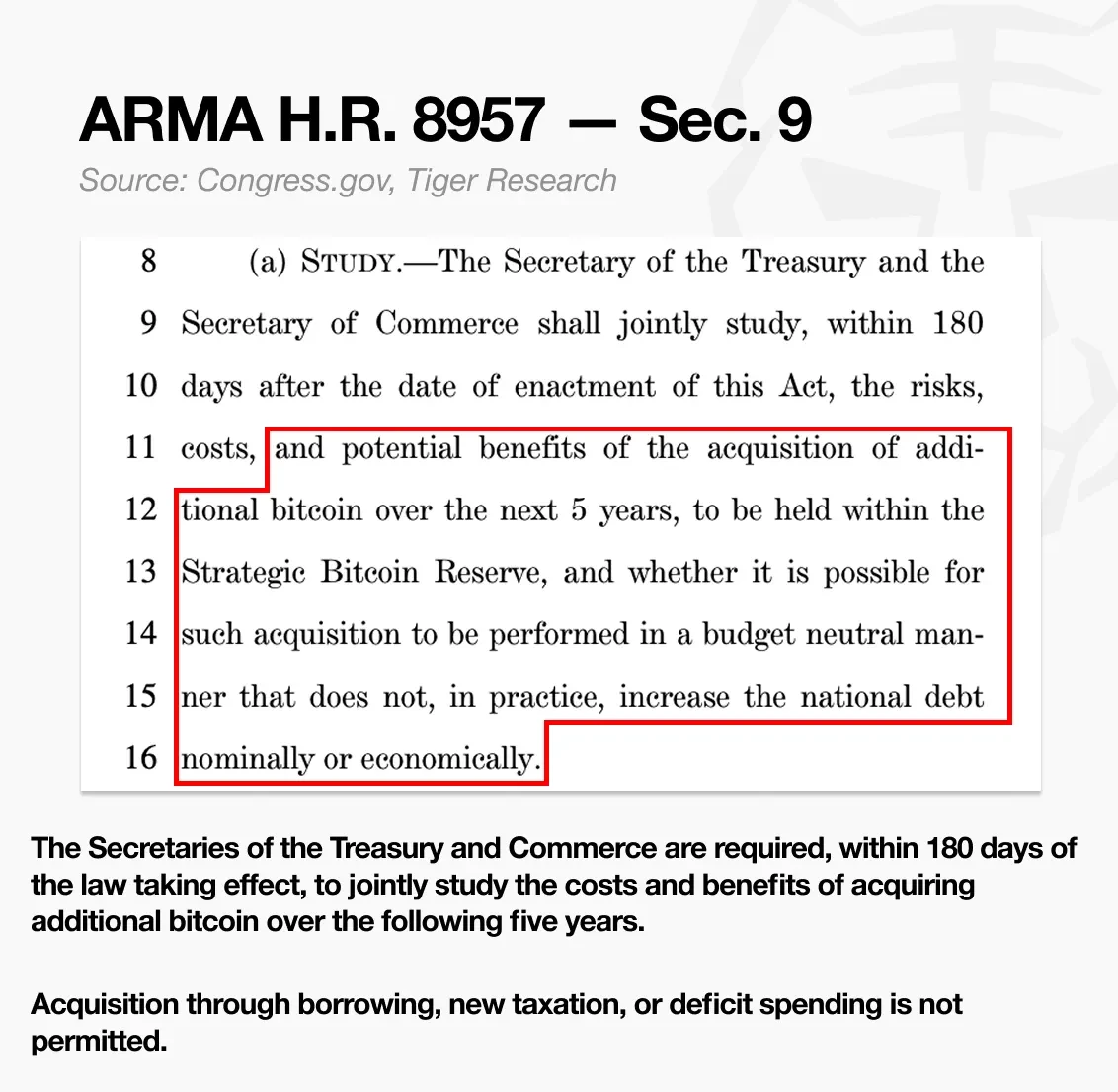
The decisive difference from its predecessor lies in what ARMA does not contain. The BITCOIN Act mandated the annual purchase of 200,000 BTC, whereas ARMA completely eliminates this obligation. Instead, it directs the Treasury and Commerce Departments to study and report within 180 days on whether additional purchases can be achieved in a budget-neutral manner. A study mandate is not a purchase mandate.
ARMA is essentially a custody and holding bill, not an acquisition bill. Its purpose is to secure passage, and its structure has been adjusted accordingly.
Short-Term Outlook: Limited Market Impact
Currently, two bills are advancing concurrently in Congress. The BITCOIN Act (S.954) is in the Senate Banking Committee; ARMA is in the House. Their goals differ: the BITCOIN Act is an acquisition bill, while ARMA is a custody bill.
ARMA has a higher probability of passage. The BITCOIN Act has been stalled in committee for over a year, burdened by fiscal costs and support limited to Republicans. ARMA enjoys Democratic support and imposes no purchase obligations, removing the most common grounds for opposition.
Even so, the passage of ARMA itself would not constitute a short-term positive catalyst for the Bitcoin market. If ARMA becomes law, the approximately 320,000 BTC currently held by the federal government would be legally barred from the market for at least 20 years. The pressure from potential government sales would disappear. However, the problem is that without any purchase obligation, there is no new demand. The market wants the government to directly buy Bitcoin, and ARMA does not provide that. Its practical effect is closer to elevating the March 2025 executive order to statutory status.
The key point is what might happen after ARMA. Nick Begich has held Bitcoin since 2013 and was one of the House co-sponsors of the BITCOIN Act in March 2025. He publicly supports Bitcoin as a strategic asset. ARMA's structure suggests a phased approach rather than a single-step move: first, establish the legal framework, then build the acquisition mandate upon it.
If ARMA passes, and Bitcoin obtains formal legal status as a national reserve asset, the debate over mandatory purchases is likely to resume on a more solid foundation. The path to this outcome is longer than the market initially priced in at the time of Trump's campaign promises, but the direction has not changed.
In short, the passage of ARMA has a limited short-term impact on price. Over the long term, it remains a constructive factor for the market. If ARMA passes, the probability of an eventual purchase legislation becoming more visible increases.