






a16z partner: Standing in the flow of capital is the true moat


- Core Thesis: Blockchain and cryptocurrency offer native opportunities for entrepreneurs to build "value-flow businesses" and layer network effects on top, transforming the movement of value itself into a sustainable moat, thereby compressing the high-cost, low-efficiency intermediaries of traditional finance.
- Key Elements:
- The strongest companies in history (e.g., railroads, Visa, Google) built their moats by positioning themselves at the point of "value flow" and taking a cut of the volume, rather than simply selling products.
- Crypto is a natively programmable technology with instant settlement. Stablecoins enable capital to move at internet speed, and open ledgers with token mechanisms deeply align users with network growth.
- Areas in traditional finance with the highest profit extraction—such as payment processing, custody, and cross-border remittances (e.g., Visa's 2-3% interchange fees)—are the primary targets for crypto entrepreneurs to "compress costs and increase speed."
- Network token design can align the interests of users, developers, and other stakeholders, creating a positive feedback loop: network growth leads to value flowing back to contributors, which in turn drives further growth.
- Future opportunities for value-flow businesses may extend to emerging areas like computing power, energy, and AI data, whose current infrastructure is not designed for large-scale global movement.
Original Title: The Money Flow Is the Moat
Original Author: Jason Rosenthal, Partner at a16z Crypto
Original Translation: Peggy, BlockBeats
Editor's Note: The core thesis of this article is straightforward: money flow itself is the moat. Looking back at business history, many of the most powerful companies didn't merely win by selling products; they positioned themselves in the middle of a "value stream," taking a cut from each transportation, payment, transaction, ad conversion, compute call, or order flow. Railroads made money from the flow of goods, Visa from its payment network, Google and Meta captured the gateway where attention converts to commerce, and AWS sits at the center of compute flow. As long as value continues to flow through a network, the network itself grows stronger.
Crypto has made this model natively accessible to startups for the first time. Blockchains provide open ledgers and programmable settlement, stablecoins enable capital to flow globally at internet speed, and token mechanisms align users, developers, and network growth together. For crypto entrepreneurs, the real opportunity isn't just building a new application; it's about finding the value channels in the old system with the highest costs, lowest efficiency, and heaviest rent extraction, then compressing them, restructuring them, and inserting themselves into the new flow of money.
The article emphasizes that the most rent-heavy and inefficient segments of traditional finance – payments, custody, lending, FX, clearing, market making – are all entry points for crypto entrepreneurs to restructure: reduce costs, increase speed, and redistribute value. This "money flow business" (taking a cut based on volume flowing through a value stream) won't stop at finance. In the future, it could extend to GPU markets, AI training data, energy, robotics, space, and rare earths.
For founders, the key questions are: Is your product already positioned in a value stream? If the scale of network activity grows 10x, will your revenue grow accordingly? Opportunities often lie where legacy infrastructure is least efficient but rent extraction is highest. Whoever can compress old costs and insert themselves into new flows has the chance to turn money flow into their moat.
Below is the original text:
Many of the best companies in history have been built by inserting themselves into the flow of money – facilitating the creation and transfer of value within a network and extracting a portion of it. The more value that flows through the network, the larger these companies tend to grow.
Crypto is the first modern technology natively built for this. If your startup isn't designing its product and business model around these principles, you're missing an opportunity. Especially since the advent of stablecoins, money and value can now flow at internet speed: global settlement, 24/7 operation, with end-to-end programmability. The underlying rails are open, the unit economics are public, and the addressable money flow market encompasses virtually every dollar that moves globally.
This Model
Blockchains are inherently network businesses. Every transaction settles on a shared ledger; every new participant strengthens the same underlying infrastructure that later users can build upon. As more people use and build on it, the network becomes more valuable for all users.
Most companies spend years trying to artificially create network effects on top of legacy infrastructure. Crypto entrepreneurs inherit these network effects from day one.
Network tokens amplify this further. A well-designed token can align users, developers, providers, validators, and the protocol itself toward a single goal: growing the network, and distributing rewards based on each participant's contribution. Protocol revenue belongs to those who actually use it. No rebates, no backroom deals – just a positive feedback loop where value flows through the system, and value flows back to those who build and drive its growth.
This isn't a new model. Crypto just makes it easier and more scalable for startups to employ it.
Railroads didn't make money selling locomotives; they made money from every ton of grain, coal, and steel that moved across their tracks. Standard Oil, U.S. Steel, and AT&T were all money flow companies. Google and Meta replaced print and TV not because their ads were inherently better, but because they plugged into the critical node where attention converts to commerce, capturing a cut from trillions of dollars of commercial intent. AWS sits at the center of compute flow.
The pattern is consistent: find where value flows, then put yourself in the middle.
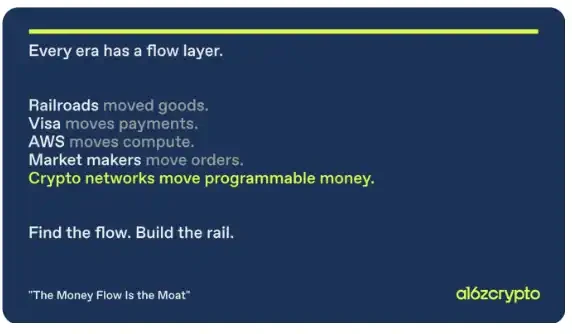
Financial markets make this pattern even clearer. Visa processed $15.7 trillion in payments in its 2024 fiscal year and recorded $35.9 billion in net revenue. Jane Street generated $20.5 billion in net trading revenue last year, surpassing Citigroup and Bank of America. The top five US market makers handle 87% of payment for order flow: they aren't predicting the market; they stand in the middle of every order flow, earning more as trading volume grows.
These businesses share another commonality: network effects. Visa is more useful to merchants the more cards are issued, and more useful to cardholders the more merchants accept it. The same applies to order flow: every additional broker tightens spreads, attracting more brokers, which in turn attracts more order flow.
Money flow combined with network effects is one of the most durable structures in business history.
Your Margin Is My Opportunity
Bezos once said, "Your margin is my opportunity." He was talking about retail, but the quote applies even more to traditional finance – the world's largest pool of rent extraction. Payments, custody, lending, FX, securitization, clearing, market making – all of it. Visa and Mastercard charge 2% to 3% interchange fees on a network designed in the 1960s; cross-border remittance corridors charge 6% to 9%; prime brokers and custodians take a cut from every securities trade. Even as the US moved to T+1 settlement in 2024, capital still sits idle overnight, a structural cost every participant must bear.
These margins are all targets. Compress costs, increase flow speed, and potentially expand the entire market. Stripe and Square have already proven this in payments.
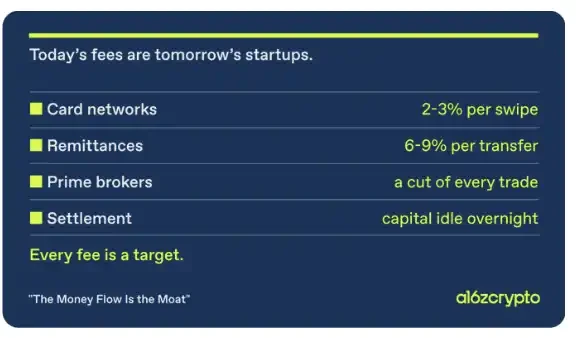
Crypto entrepreneurs have the opportunity to build the next version: programmable, instant, global, and natively positioned within the flow of money.
And this frontier extends far beyond financial services. Compute and GPU markets, memory chips, AI training data, energy, robotics, space, rare earth metals – every one of these could see massive global value flows, and existing infrastructure wasn't designed to handle this scale.
Each of these domains is an open market ready for a money flow business built on programmable infrastructure from day one. No incumbent rails, no entrenched intermediaries, no legacy interests to protect.
As a founder, you should ask yourself:
1. Are you already positioned in a money flow today?
2. If the value of activity on your product grows 10x, will your revenue grow with it?
3. If you're building a new product, where in your target market is the highest rent extraction relative to the value being created?
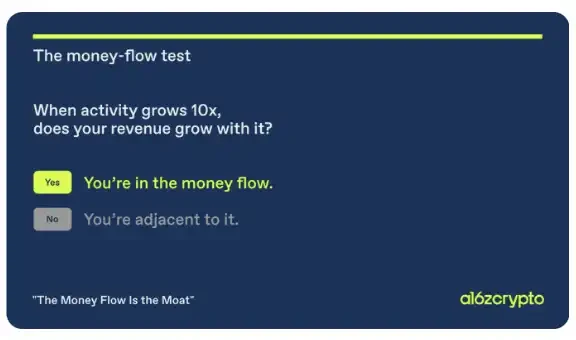
The opportunity is there. Compress it, insert yourself into the new value stream, and let the network start compounding from there.


