






AI spending is getting more aggressive by the day, and the market's patience is wearing thin.


- Core Viewpoint: The AI arms race among tech giants Microsoft, Meta, and Amazon now faces strict investor scrutiny on the returns of capital expenditure. The market's focus has shifted from revenue growth to whether these massive investments can deliver profits, making strong results alone insufficient to support stock prices.
- Key Elements:
- Alphabet posted record earnings (revenue of $112.1 billion), but an upward revision of $15 billion in its 2026 capital expenditure forecast caused its stock to fall over 7%, serving as a cautionary tale of fragile market sentiment.
- Total capital expenditure for Microsoft, Meta, and Amazon this year is projected to reach $700 billion. Wall Street predicts this could surpass $1 trillion by 2027, but visibility on spending beyond that point is limited.
- Microsoft's Azure cloud service is expected to see a 74% year-over-year increase in capital expenditure this quarter. Copilot monetization is advancing on three fronts: seat-based sales, subscription migration, and AI service pricing.
- Meta may "significantly" raise its capital expenditure guidance to cope with rising costs. It also faces regulatory pressure regarding teen social media usage, with user growth potentially hitting its lowest level since 2021.
- AWS growth could break the 30% mark, reaching a new high since 2022. However, investors are wary of whether Amazon will also raise its post-2027 capital expenditure outlook.
- Moody's warns that the shift of tech giants from asset-light to asset-heavy models, involving massive capital outlays, could threaten their credit quality. The typical direct debt level for such companies is around $460 billion.
Original Author: Zhang Yaqi
Original Source: Wall Street CN
The AI arms race among tech giants is facing the ultimate test of investor patience. Microsoft, Meta, and Amazon are all reporting quarterly earnings this week, with market focus shifting from revenue growth to a more fundamental question: When will the ever-ballooning capital expenditures finally deliver returns?
This backdrop is set by a cautionary tale from Alphabet just last week. The company reported its highest-ever quarterly profit, reaching $112.1 billion, but its stock price immediately fell over 7%—as investors grew wary of the company's decision to raise its 2026 capital expenditure forecast by $15 billion.
The combined total capital expenditures for Alphabet, Microsoft, Meta, and Amazon this year is projected to reach $700 billion, with Wall Street forecasting that figure could surpass $1 trillion by 2027.
This market fragility sets the stage for the earnings season from these three companies this week. According to Bloomberg, citing UBS Global Wealth Management, "Limited visibility on CapEx beyond 2027, combined with increased investor demands for spending discipline, may continue to suppress risk appetite." Meanwhile, Moody's, a unit of Fitch Ratings, warned last week that sustained capital expenditure plans could "threaten credit quality," noting that the direct debt of six major tech companies totals approximately $460 billion.
Microsoft: Azure Momentum is Strong, Copilot Monetization Enters a New Phase
Among the three companies, Microsoft faces perhaps the most clearly defined expectation pressure. Analysts expect Microsoft's capital expenditure this quarter to surge 74% year-over-year. Simultaneously, the market holds high expectations for the growth of Azure cloud services.
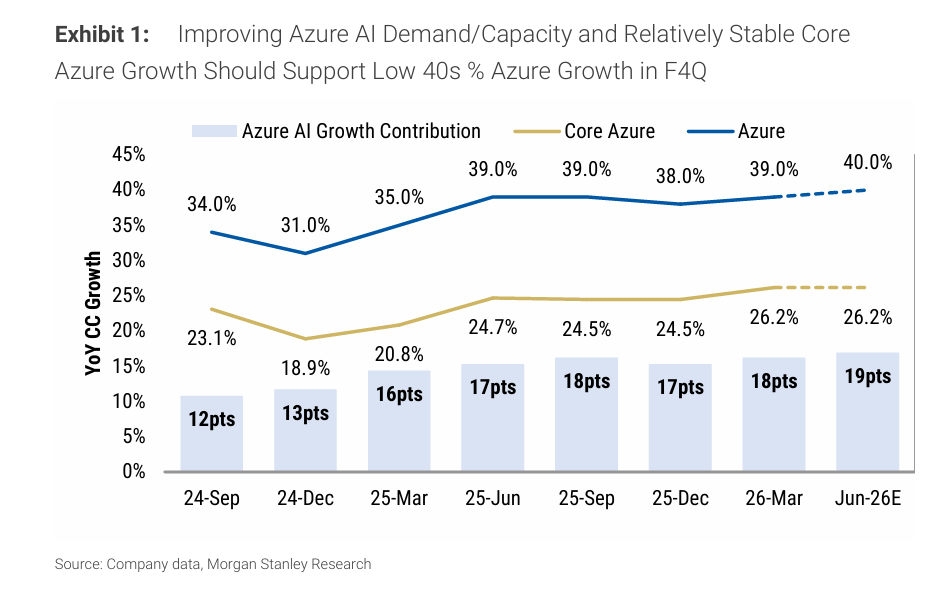
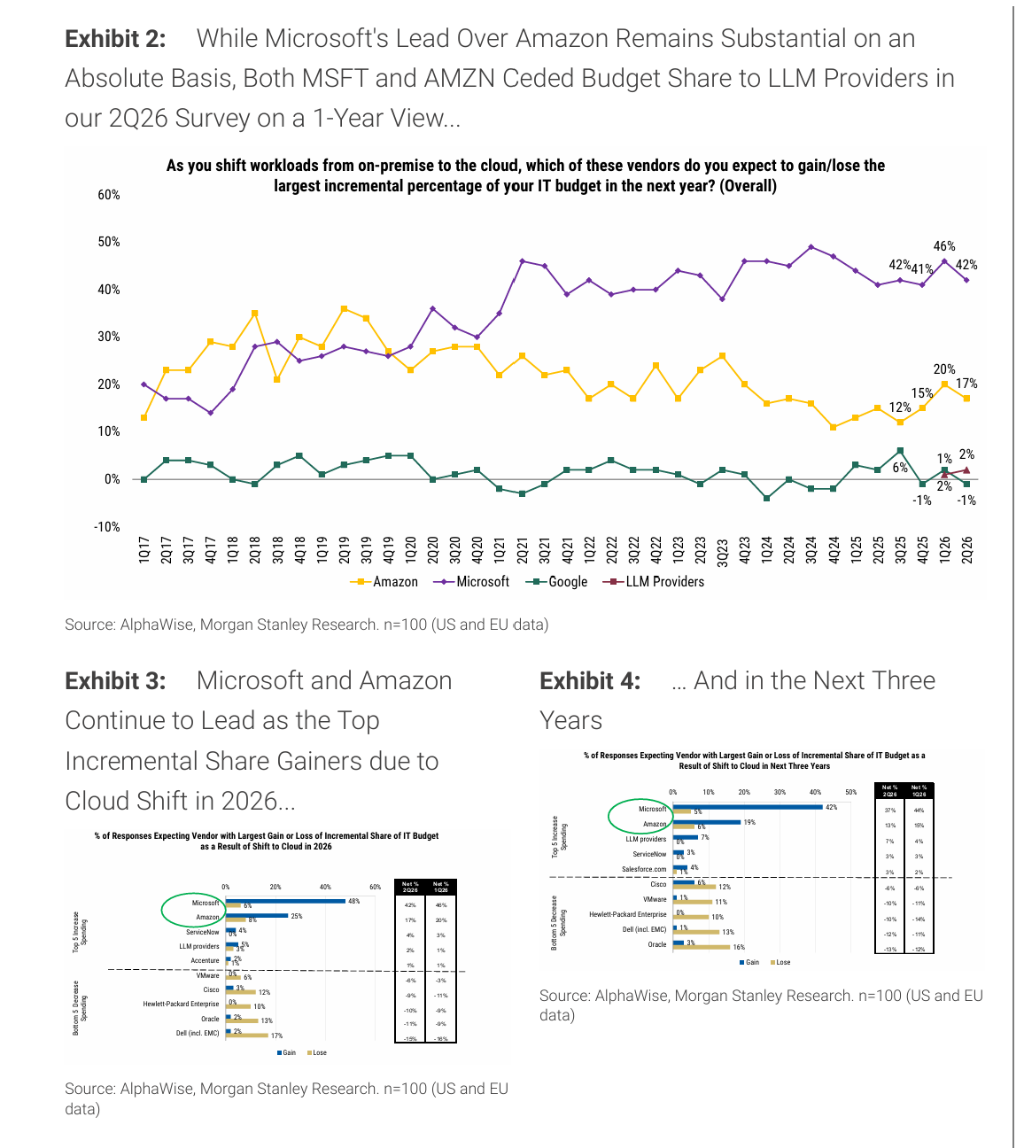
According to a Morgan Stanley research report, the bank's analysts are confident that Microsoft will achieve Azure growth of approximately 41% on a constant currency basis in its fiscal fourth quarter. This would be about 1 percentage point above the high end of management's guidance of 39% to 40%. Morgan Stanley's confidence stems from positive feedback from channel partners, continued improvement in GPU supply capabilities, and the results of their own surveys of Chief Information Officers (CIOs)—in cloud migration scenarios, 72% of CIOs expect to increase spending on Microsoft solutions in the coming year, with Microsoft leading all vendors in expectations for capturing incremental IT budgets.
The commercialization progress of Copilot is also under close scrutiny. In the third fiscal quarter, paid seats for Microsoft M365 Copilot increased from 15 million to 20 million, with management guiding for continued sequential growth in net paid seat additions. Morgan Stanley notes that Copilot's monetization path is evolving into three parallel growth drivers: direct seat sales, user migration to higher-value E7 subscription tiers, and consumption-based pricing for AI services. Notably, the price increase for Microsoft's commercial M365 took effect for new customers on July 1, 2026. Morgan Stanley estimates this pricing adjustment will contribute roughly $2 billion, $4 billion, and $6 billion in incremental revenue in FY27, FY28, and FY29, respectively.
Regarding capital expenditure, Morgan Stanley believes street estimates are still conservative and have room for upward revision. Management previously disclosed they expect capital expenditures for calendar year 2026 to be around $190 billion, with approximately $25 billion attributed to component price increases. The firm maintains its "Overweight" rating on Microsoft with a $600 price target, arguing that the current valuation, roughly 16 times expected FY28 P/E, is "too cheap" and fails to reflect the company's sustained high-growth potential.
Meta: Under Pressure from Peaking User Growth, CapEx Could Be Significantly Raised Again
Meta's situation is more complex. According to Bloomberg Intelligence (BI) analysis, Meta may "significantly" raise its capital expenditure guidance to cope with rising component costs—precisely the core trigger for Alphabet's stock decline last week.
At the same time, user growth faces new pressure from regulatory fronts. As regulators worldwide advance legislation to restrict social media use among teenagers, Meta's user growth outlook faces greater headwinds. The "Family Daily Active People" metric, which measures daily active users across its four core products, is expected to record its weakest growth performance since 2021.
Amazon: AWS Growth Could Hit a New High Since 2022
Compared to Microsoft and Meta, market expectations for Amazon's earnings report appear more optimistic. Citing Truist analysis, Bloomberg reports that Amazon's overall revenue growth could reach 17%, its highest in nearly five years. Amazon Web Services (AWS) growth is expected to potentially exceed 30%, hitting a new high since 2022. Strong demand for AI-related services is seen as the core driver of AWS growth.
However, Amazon also faces scrutiny over its capital expenditure. Following Alphabet's stock drop triggered by its raised spending forecast, investors remain highly vigilant about whether the three companies will further increase their capital expenditure outlook for 2027 and beyond.
Fitch Warns: Balance Sheets Under Pressure, Credit Risks Emerge
Moody's research report last week set a stern tone for this earnings season. The agency noted that Alphabet, Microsoft, Amazon, Meta, Oracle, and CoreWeave are transitioning from asset-light software, intellectual property, and cloud service models to an asset-heavy model requiring an "unprecedented scale of investment," a trend that could pressure the credit metrics of these companies.
Kevin McNeil, Vice President at Moody's, stated on the agency's podcast: "These are well-established large companies with balance sheets that are often pristine, but they are embarking on almost unprecedented capital deployment. The increase in capital intensity could lead to negative free cash flow for some companies, or at least a significant contraction." He further noted that debt financing "could push up leverage ratios, introducing additional risk to the balance sheet."
Among the six companies under scrutiny, Oracle appears the most vulnerable. Moody's has revised its credit rating outlook for Oracle to negative, placing its Baa2 rating just two notches above junk status. Just last month, another rating agency, S&P Global, downgraded Oracle to just one notch above investment grade. In contrast, Alphabet, Amazon, Meta, and Microsoft still maintain robust balance sheets, and their investment-grade ratings are not under immediate threat.
The Bull vs. Bear Debate: Will AI Investments Eventually Pay Off, or Are They Borrowing from the Future?
Faced with continuously expanding capital expenditures, a clear divergence of opinion has formed within the market. The core logic of the bulls is: demand is real, and the constraint on growth is supply, not demand. Taking Azure as an example, Morgan Stanley points out that Microsoft CFO Amy Hood clearly stated in last quarter's earnings call that Azure's guidance is essentially a "capacity-allocated guidance," with growth constraints stemming from data center construction progress and GPU deployment timelines, not customer demand. As Microsoft plans to double its total data center capacity over the next two years, this constraint is expected to gradually ease.
Bears, on the other hand, focus on the lack of visibility into returns. UBS Global Wealth Management notes that "limited visibility on CapEx beyond 2027" is a key factor suppressing investor risk appetite. Moody's warning is more direct: the shift from an asset-light to an asset-heavy model is eroding the high free cash flow advantages these companies have historically prided themselves on.
For long-term investors, UBS still recommends holding their positions: "For long-term investors with diversified portfolios, staying invested is the most effective strategy to navigate current uncertainty. Given robust earnings growth and an improving cyclical backdrop, attractive stock opportunities exist across sectors and regions." However, with Alphabet's cautionary tale in mind, the market's verdict is clear: Good earnings aren't enough; you have to keep a tight rein on spending.


