The History of Crypto Prediction Markets: The Fall of Elites, the Rise of Two Titans, and a Hundred Schools of Thought


- Core Thesis: This article systematically reviews the development history of prediction markets from the 1988 University of Iowa academic experiment to the fierce competition of 2026, revealing the evolutionary path from idealistic decentralized fantasies to pragmatic coexistence of compliance and wild innovation, and points out that the industry has entered a new stage where mechanism design reigns supreme and capital determines outcomes.
- Key Elements:
- The 1988 Iowa Electronic Markets (IEM) experiment proved that the wisdom of crowds based on real-money gaming can surpass traditional polls in prediction accuracy, establishing the underlying logic of prediction markets.
- From 2014 to 2018, decentralized projects like Augur attempted to build an “unstoppable Intrade” using blockchain, but ultimately fell into the trap of low user adoption and liquidity depletion due to high Ethereum gas fees, complex dispute mechanisms, and the “assassination market” controversy.
- From 2019 to 2020, modular projects like Omen solved the underlying architectural issues by integrating Gnosis conditional tokens, the Reality.eth oracle, and the Kleros on-chain court, but still failed to achieve mass adoption due to high barriers and cumbersome governance.
- After 2020, two titans emerged: Kalshi (the compliant establishment faction) and Polymarket (the wild market faction). The former fought for CFTC licensing to gain regulatory approval, while the latter monopolized global traffic and public awareness through low-cost L2s and stablecoin settlements.
- Polymarket exposed the flaw of capital manipulation of outcomes (e.g., UMA whales altering truths), while Kalshi is limited by the compliance ceiling. They represent the ultimate trade-off between “speed and risk” and “compliance and stability.”
- The 2024 U.S. presidential election became a turning point for the sector. A single Polymarket contract absorbed over $36 billion in liquidity, validating a trillion-dollar-scale demand, attracting capital and giants to enter en masse, and creating a landscape of fierce competition among many players.
- By 2026, the prediction market ecosystem will blossom in all directions, with multiple development paths emerging, such as the interest-bearing faction (Predict.fun), the macro-focused faction (Opinion.trade), and the protocol-layer outlier (42.space), deeply integrating with traditional sports betting and public chain ecosystems.
01 Origin · An Economics Class in Iowa
In the 1990s, public opinion and financial decisions across the United States largely relied on opinion polls conducted by professional institutions. The entire industry accepted the judgments of authoritative bodies as the closest approximation to the truth.
For example, after the first oil crisis in 1973, American business opinion was in a state of extreme panic.

Image: A warning sign at a US gas station in 1974. The consumer panic following the oil crisis forms the historical backdrop for the inaccuracy of traditional polls. Source: Wikimedia Commons
At the time, the most authoritative Harris Poll continuously released reports on public sentiment, concluding that "American consumers have completely abandoned large cars, and the entire nation will shift entirely to compact, fuel-efficient cars in the next decade."
With this clear conclusion, the automotive giants in Detroit and investment banks on Wall Street treated the poll report as the "market truth."
Without sufficient sales evidence, Ford and Chrysler, based solely on poll data, hastily shut down multiple profitable large-car production lines and invested hundreds of millions of dollars to forcefully develop small cars, an area they were not competent in. Wall Street subsequently revalued the entire automotive industry's stock valuation models.
This industry-wide reallocation directly caused domestic US automakers to fall into a prolonged period of passive losses when facing the aggressive攻势 of Japanese fuel-efficient cars in the following years.
This shows that while the public opinion polling system at the time played a positive role, its accuracy was not highly guaranteed.
Then, in 1988, three professors from the University of Iowa—George Neumann, Robert Forsythe, and Forrest Nelson—began to boldly question the traditional polling system: Could the judgment of a few experts truly surpass the collective judgment of millions?

Image: The Old Capitol at the University of Iowa. The IEM's academic prediction market experiment started in a university classroom. Source: Wikimedia Commons
To test this hypothesis, they abandoned traditional methods of paper surveys and questionnaires. In an economics classroom at the University of Iowa, they conducted a niche experiment that颠覆ed traditional thinking:
They built a minimalist trading market open to students for trading on the outcome of the US presidential election. They set clear financial thresholds, requiring a minimum deposit of $5 and a maximum of $500, pricing expectations entirely through the博弈 of real money.
Trading prices within the market directly corresponded to the candidates' odds of winning. After the election, participants who bet correctly split the entire prize pool proportionally.
Interestingly, the market prices formed by the spontaneous博弈 of ordinary traders had a prediction error 0.5% lower than all professional national polls.
Without expert endorsements, data models, or media guidance, relying solely on the "real interest博弈 of the group," it easily surpassed the authoritative judgment systems of the entire industry, shocking academia.
In fact, when everyone bets on their own interests, a free-flowing trading market is actually the best vehicle for uncovering hidden information, predicting the future, and restoring the truth.
This new polling model was later named the Iowa Electronic Markets (IEM).
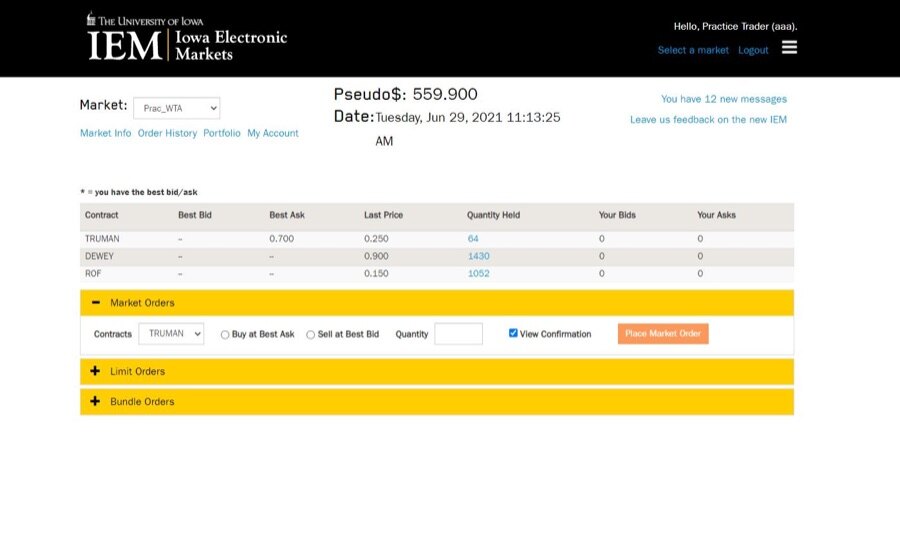
Image: Example of the Iowa Electronic Markets (IEM) trading interface. Source: https://csi.its.uiowa.edu/our-work/iowa-electronic-markets
This experiment can be seen as the first time collective intelligence, in a quantifiable and implementable form, triumphed over elite authority, also laying the most core underlying logic for prediction markets thirty years later.
However, at the time, IEM was an "outlier" difficult for the mainstream market to accept.
On one hand, traditional polling systems relied on expensive sample抽样, telephone interviews, or offline questionnaires.
This model supported a vast ecosystem of academic institutions, news media think tanks, and political consulting firms, all with complex interests.
The fact that IEM, with amateur traders, defeated professional analysts directly threatened the authority and commercial value of traditional polling agencies, essentially taking away their "bread and butter."
Therefore, IEM's model of predicting election results by buying and selling contracts was defined as illegal gambling at the time.
Although IEM received an exemption from the US Commodity Futures Trading Commission (CFTC), it was strictly limited to "academic research" and not allowed for commercialization.
Because of this, the platform set strict limits on the trading funds per participant (usually $5 to $500), resulting in a lack of substantial capital and liquidity, unable to compete with mainstream financial markets or commercial polling agencies.
On the other hand, as a university-led academic experiment, its operational interface and participation threshold were complex for the general public, many of whom could not even recite multiplication tables.
Therefore, IEM's main participant group was limited to scholars, specific students, and a small number of enthusiasts, failing to establish a mainstream application scenario.
For nearly two decades thereafter, IEM remained trapped in an academic niche, unable to reach the masses, grow, or mature, eventually becoming an obscure research tool.
02 The Idealist's "Eye of God"
In 1999, Irish entrepreneurs Ron Bernstein and Sean McNamara founded the prediction market internet platform Intrade. Later, in 2003, the platform was acquired by Tradesports, with Irish accountant John Delaney as its CEO. Under his leadership, it became one of the most famous prediction markets.

Image: Intrade co-founder Ron Bernstein (left). Source: https://www.youtube.com/watch?v=2rYpzgeCRlw
Of course, Intrade was positioned as a commercial prediction market open to the global public, meaning it was in it for the money. Users could trade on real-world outcomes like US presidential elections, wars, economic data, and corporate events. Market prices could be seen as a real-time reflection of event probabilities.
As a pioneer, Intrade quickly became one of the most influential prediction market platforms globally at the time. Its trading prices were not only widely cited by the media but also served as an important reference for political analysts, scholars, and some Wall Street institutions to observe future trends. Especially for major events like US presidential elections, Intrade's prediction accuracy was often higher than many traditional polling agencies, earning it a reputation as the benchmark of the prediction market industry.
However, as its influence grew, the old capital powers became unhappy and wielded their制裁 sticks.
Because the platform itself allowed US users to participate in contract trading involving political, economic, and financial events, US regulators gradually viewed it as an unapproved derivatives trading market. In 2012, the CFTC sued Intrade, accusing it of offering unlicensed event contract trading services to US investors.
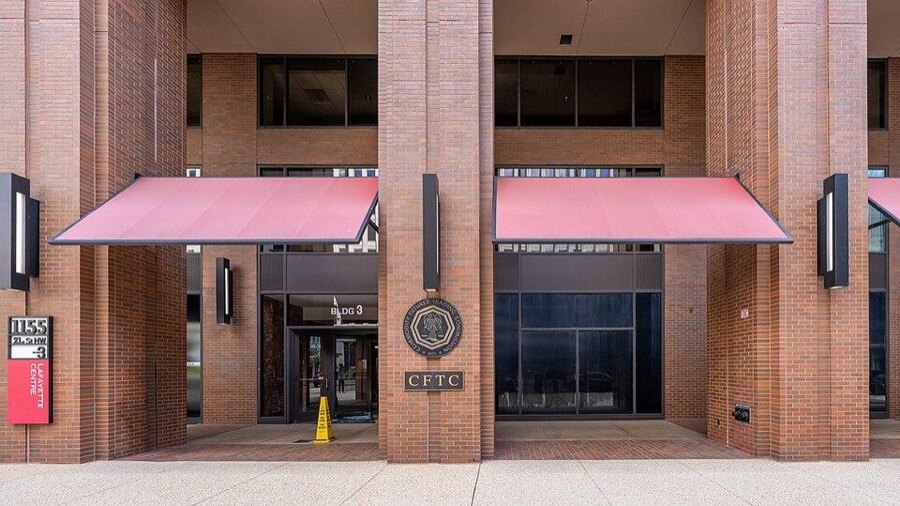
Image: The US Commodity Futures Trading Commission (CFTC). Intrade's commercial expansion ultimately hit regulatory boundaries. Source: Wikimedia Commons
Facing regulatory pressure, Intrade was forced to shut down access for US users. However, the US market contributed the majority of its trading volume. After losing its core user base, the platform's liquidity rapidly shrank. Simultaneously, internal disputes over fund management and financial problems erupted. Ultimately, in 2013, Intrade announced the cessation of all trading operations and entered liquidation.
Thus, this once globally popular platform, considered most likely to bring prediction markets into the mainstream financial system, exited the stage under the dual pressure of regulation and operational crisis.
But the story of prediction markets was only just beginning.
The Pioneer of Decentralized Prediction Markets: Augur
Intrade's sudden shutdown due to regulatory crackdown deeply stimulated a young American named Jack Peterson.
At the time, Jack Peterson was a firmly orthodox researcher. In his early thirties, he already held a PhD in Biophysics from the University of California, San Francisco, had won a US Department of Defense Science Scholarship, and had deeply studied biophysics and complex system博弈.
In his view, Intrade's prediction market model brought research closest to the truth, and its closure made him feel that the trading systems built by humans could never escape power manipulation and interest control. As a scholar obsessed with the underlying logic of collective intelligence, he wanted to do something about it.
In 2014, he abandoned his stable scientific career, dove headfirst into the early blockchain space, and immersed himself in researching consensus, event adjudication, and博弈 incentive systems on-chain. He wanted code to replace human judgment, making outcomes as fair as possible and free from centralized interference.
Similarly, 19-year-old freshman Joey Krug at a California liberal arts college was a cryptography geek. A young prodigy, he had come across Bitcoin early on and was fascinated by the narrative of decentralized, free finance. He was active in the earliest Skype core community for Ethereum, daily discussing the ecosystem's future with Vitalik and other early geeks, and keenly sensed that prediction markets would be Ethereum's first killer app.
On the other side, a young man named Jeremy Gardner was attracted by the concept of Bitcoin. He decided to drop out of college to found the largest university crypto community in the US, propagating crypto ideals across major universities, hoping more young people would join this cryptographic wave.
Around 2014, they gradually got to know each other within Ethereum's earliest developer community.
At the time, Jack Peterson was researching how to use blockchain to rebuild prediction markets and was developing an early prototype called Dyffy. Meanwhile, 19-year-old cryptography geek Joey Krug was already active in Bitcoin and Ethereum developer circles, deeply interested in the potential of smart contracts. The two clicked immediately over the concept of decentralized prediction markets.
For Joey, continuing theoretical studies on campus was less appealing than personally participating in this experiment that would change internet rules. He subsequently dropped out of Pomona College to work on the project full-time.
Soon after, Jeremy Gardner joined. This young evangelist possessed strong community organization skills and communication talent. He helped the project quickly build its first batch of supporters and spread its philosophy throughout the Ethereum ecosystem.
As the team took shape, they launched the decentralized prediction market project Augur and later established the non-profit organization Forecast Foundation to oversee the protocol's long-term development and governance.
In terms of team分工, Jack Peterson was responsible for prediction market mechanisms,博弈 models, and protocol architecture design; Joey Krug handled smart contract development and technical implementation; Jeremy Gardner took charge of community building, communication, and ecosystem expansion.
The biggest difference from Intrade was that Augur aimed to completely remove the role of a centralized operator. Anyone could create markets freely without platform approval. Event outcomes were adjudicated by $REP holders through on-chain consensus, not by a centralized agency. Even if the founding team left, the protocol could continue to run.
It wasn't the start of prediction markets, but it was the first time someone tried to rebuild them using blockchain. In a sense, Augur aimed to create an Intrade that no one could shut down. This way, even if future regulatory crackdowns occurred, they couldn't make the entire market disappear by closing a single company, as happened before.
In 2015, Augur completed one of the earliest ICOs in the Ethereum ecosystem, successfully raising $5.1 million and issuing the $REP governance token. Vitalik himself served as a project advisor, enjoying a period of immense limelight.
Gnosis: The Berlin Master, Building Inner Strength, Not Seeking the Throne
While Jack Peterson and the Augur team were trying to rebuild Intrade using blockchain, a team in Berlin, Germany, was also focusing on prediction markets.
Stefan George and Martin Köppelmann from Germany were among the earliest technical geeks to encounter Bitcoin and Ethereum, but their paths differed.
Stefan George came from a traditional software background, early on working within the SAP system, engaged in enterprise software development for a long time. Compared to US crypto entrepreneurs who loved revolutionary narratives, he was more like a typical German engineer, with an almost obsessive interest in system design and underlying architecture, especially after getting exposed to Bitcoin in 2013, becoming deeply fascinated by this peer-to-peer cash system.
Martin Köppelmann entered the crypto world even earlier. He started researching cryptography and distributed systems in university and was already a well-known developer and evangelist in the German Bitcoin community around 2013. Compared to Stefan, Martin had more of an idealistic streak. He had long focused on market mechanisms, collective decision-making, and how to use open networks to coordinate cooperation among strangers.
The two first met in the German Bitcoin and Ethereum communities. (It's worth noting how much these early communities contributed to the industry.)
At that time, Berlin was becoming one of Europe's most important crypto hubs. A large number of developers, cryptography researchers, and free software geeks gathered there, discussing Bitcoin, smart contracts, and the future form of the internet.
Stefan and Martin were also following prediction markets and often had deep discussions about them, hoping to reshape the model in a decentralized way.
However, they saw the problem from a different angle. They realized that while prediction markets superficially traded on presidential elections, World Cup winners, or interest rate decisions, they were actually trading the future outcome itself. If future outcomes couldn't be expressed in a standardized way, no matter how cleverly the market mechanism was designed, it would be difficult to scale.
What does that mean?
For instance, the Augur team was constantly thinking about how to rebuild a decentralized version of Intrade. They focused on market governance, event adjudication, dispute resolution, and how to use economic incentives to make the system self-sustaining. Whether it was the US presidential election, the World Cup winner, or the Fed's interest rate decision, it was essentially trading future outcomes. But future events themselves couldn't be directly traded on-chain.
So, to create a market, complex real-world events first needed to be broken down into standardized outcomes, which then needed to be mapped into on-chain assets that could be traded, settled, and circulated.
Based on this idea, the duo designed a framework that allowed developers to decompose a real-world event into multiple possible outcomes and generate corresponding on-chain assets for each.
For example, a presidential election could be broken down into outcomes for different candidates, the World Cup into the possibility of different teams winning, and an interest rate decision into scenarios like rate hikes, cuts, or holds. These would eventually be mapped into tokens. Users would no longer just be trading a market; they would be trading the various possibilities of the future itself.
In 2015, just before the Ethereum mainnet launch, Stefan George and Martin Köppelmann jointly launched the Gnosis project, hoping to make a mark on Ethereum.
As an aside, many later came to see Gnosis as an infrastructure project, but in reality, it started as a prediction market startup. Gnosis invested increasing resources into building the underlying framework. After years of exploration and iteration, the team developed the Conditional Tokens framework, which would later influence the entire industry. But that's a story for later.
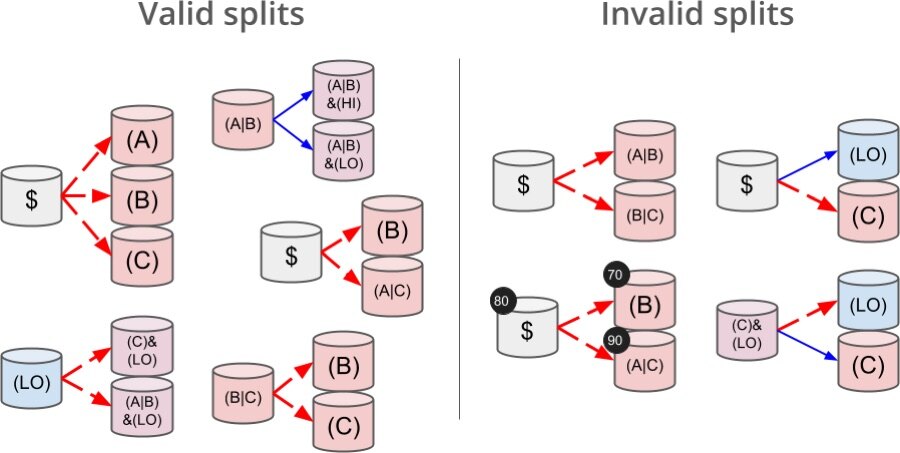
Image: Diagram of effective/invalid splitting in Gnosis Conditional Tokens. Source: https://conditional-tokens.readthedocs.io/en/latest/developer-guide.html
Returning to the Conditional Tokens framework mentioned earlier, this logic of event assetization seems very natural today, but it was a significant breakthrough in the development of prediction markets at the time.
It provided the industry with its first unified standard for event assetization, allowing future events to enter the on-chain trading system in a standardized way. Whether it was Gnosis's own Omen or the rapidly rising Polymarket later, the influence of this Conditional Tokens framework can be seen in their underlying logic.
When the ICO boom arrived in 2017, Gnosis became one of the most watched star projects in the market. The project raised approximately $12.5 million in a short time and was once considered one of the most promising startups in the Ethereum ecosystem. However, unlike Augur, as the industry matured, Gnosis did not continue to devote all its resources to the prediction market track but began expanding into broader infrastructure areas.
In the following years, projects like Safe, CoW Swap, and Gnosis Chain were born, gradually becoming important components of the Ethereum ecosystem. Gnosis itself evolved from a