






Tiger Research: The Rise of Perpetual Contracts in the Tokenized Stock Market of 2026


- Core Thesis: Against the backdrop of a sluggish cryptocurrency market diverging from traditional stock market trends, the tokenized stock market (especially perpetual futures) has grown against the tide. By offering 24/7 trading, leverage, and price discovery functions, it has fostered new strategies such as delta-neutral trading and cross-exchange arbitrage, attracting institutional interest.
- Key Elements:
- Market Divergence: In Q1 2026, the cryptocurrency market cap fell by 20.4%, and spot trading volume dropped by 39.1%. Meanwhile, stock indices like the S&P 500 repeatedly hit new highs, with capital flowing from cryptocurrencies to the tokenized stock market.
- Advantages of Perpetual Futures: They offer 24/7 trading, leverage of up to 20x, and access to stocks not available in local markets. Their prices serve as a leading indicator for the next day's opening price when spot markets are closed (correlation of 0.85-0.89).
- Delta-Neutral Strategy: When a spot premium exists (e.g., SK Hynix averaging 0.23% intraday), simultaneously holding a long spot position on KRX and a short perpetual contract position allows profiting from funding rates without taking a directional bet.
- Cross-Exchange Arbitrage: Different exchanges (e.g., Binance and Hyperliquid) price perpetual futures on the same stock differently (e.g., SK Hynix averaging 1.03% discrepancy). By holding offsetting positions, directional risk is hedged, and the price spread is captured as profit.
- Emerging Business Opportunities: Liquidity fragmentation creates opportunities for market making, regional oracle services (pricing for Asian timezone assets), tokenized issuance (expanding coverage of major Korean stocks), and basis hedge funds.
This article is written by Tiger Research. Although the cryptocurrency market is in a downturn, the tokenized stock market continues to grow. It is divided into fully collateralized spot futures and perpetual futures, with perpetual futures attracting the most attention and giving rise to a series of new strategies.
Key Takeaways
- While the stock market has been hitting new highs, both the market capitalization and trading volume of cryptocurrencies have declined. As the two diverge, the tokenized stock market has grown by building open interest in perpetual futures.
- The market is divided into fully collateralized spot futures and perpetual futures. Perpetual futures are notable because they allow 24/7 trading of stocks not available on local exchanges and enable the use of leverage.
- When regular trading hours end, price movements become a leading indicator for the next day's spot market opening, predicting not only the direction of the price movement but also the magnitude of the price fluctuation.
- Two retail trades include a delta-neutral trade that earns premium from the spot trade as funding, and cross-exchange arbitrage that exploits price gaps.
- The same structure also applies to businesses like market making, regional oracles, token issuance, and basis hedge funds. Although still small in scale, opportunities exist in both investment and business as institutional investors join.
1. The Stock Market is Absorbing Crypto Liquidity
In the first quarter of 2026, the total market capitalization of cryptocurrencies fell by 20.4%, and spot trading volume on centralized exchanges dropped by 39.1%. Bitcoin has been declining since hitting its all-time high in October 2025.
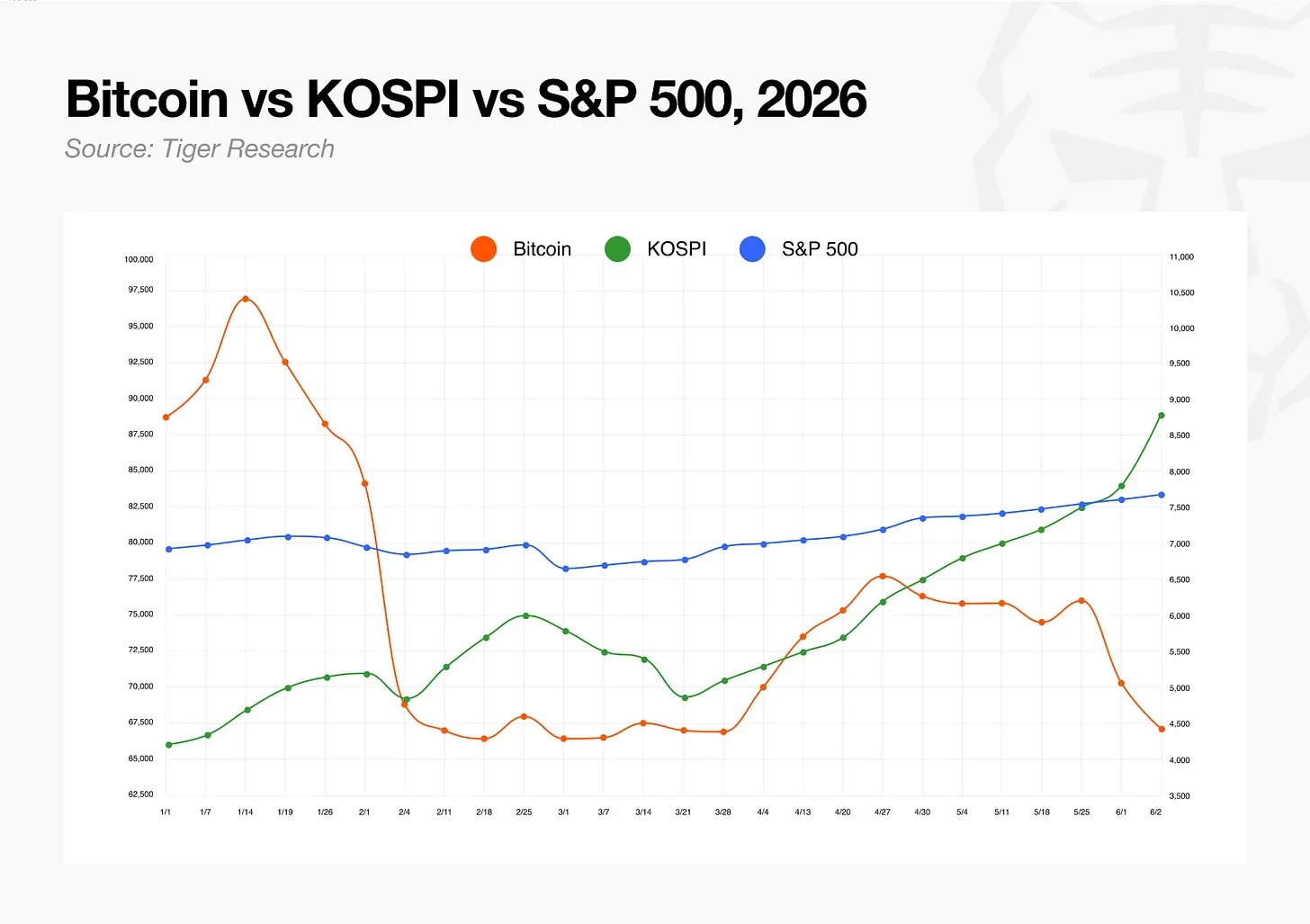
The stock market has moved in the opposite direction. The S&P 500 easily surpassed its annual target, and the KOSPI (Korea Composite Stock Price Index) doubled this year, benefiting from the rise of the semiconductor industry. Meanwhile, the total market cap of cryptocurrencies has plummeted, while most countries' stock markets have hit record highs. These two paths have never been so distinctly separate.
2. Segmented Market of Collateral, Funds Flow to Perpetual Futures
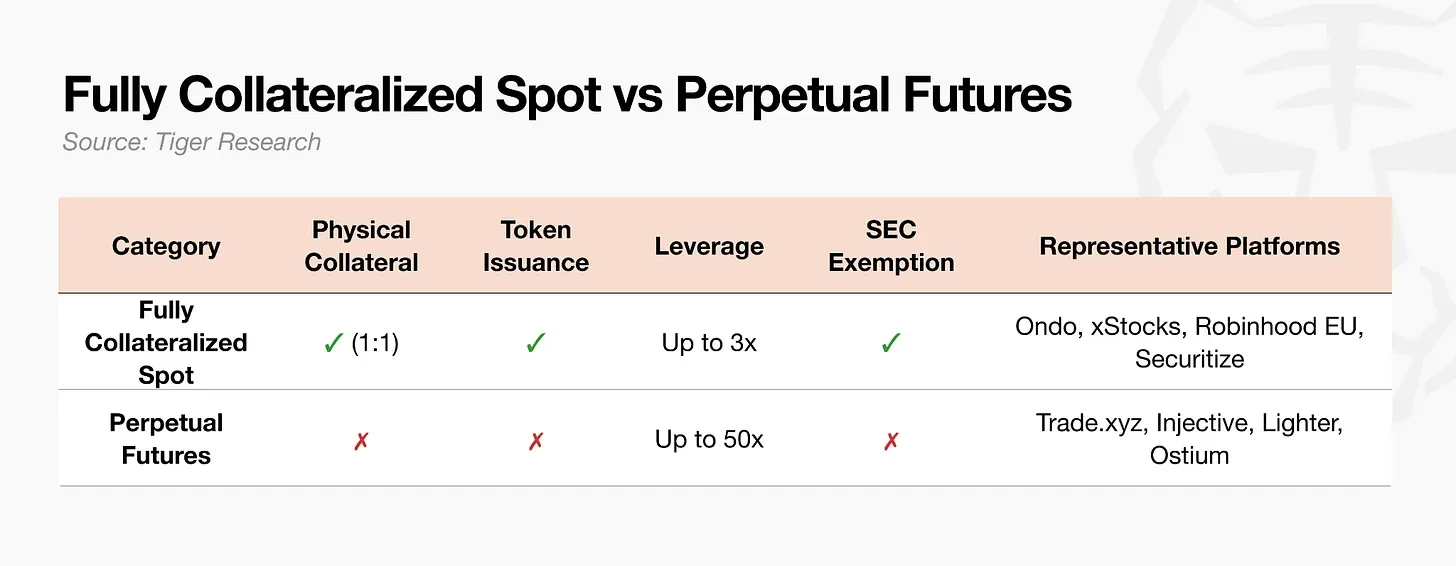
The tokenized stock market is divided into two parts based on collateral structure.
Fully collateralized spot trading involves depositing real stocks at a 1:1 ratio and then issuing tokens. Investors hold the stocks themselves or a legal claim to them. Issuance details vary by platform, but underlying assets always exist.
Perpetual futures operate differently. They do not hold any actual stocks. Traders deposit margin and open a contract that tracks the price, so there is no underlying asset to claim. Margin is typically paid in stablecoins, and a growing number of platforms now also accept other assets, such as Ethereum (ETH).
Perpetual contracts are notable because they retain the advantages of spot trading, offering 24/7 trading of stocks unavailable on local exchanges and providing higher leverage. Some fully collateralized spot products on Kraken xStocks offer up to 3x margin, while perpetual futures offer leverage of up to 20x, depending on the product. Since there is no need to custody the underlying asset and the price is tracked only through oracle data feeds, listings are fast and a wide range of tickers can be traded.
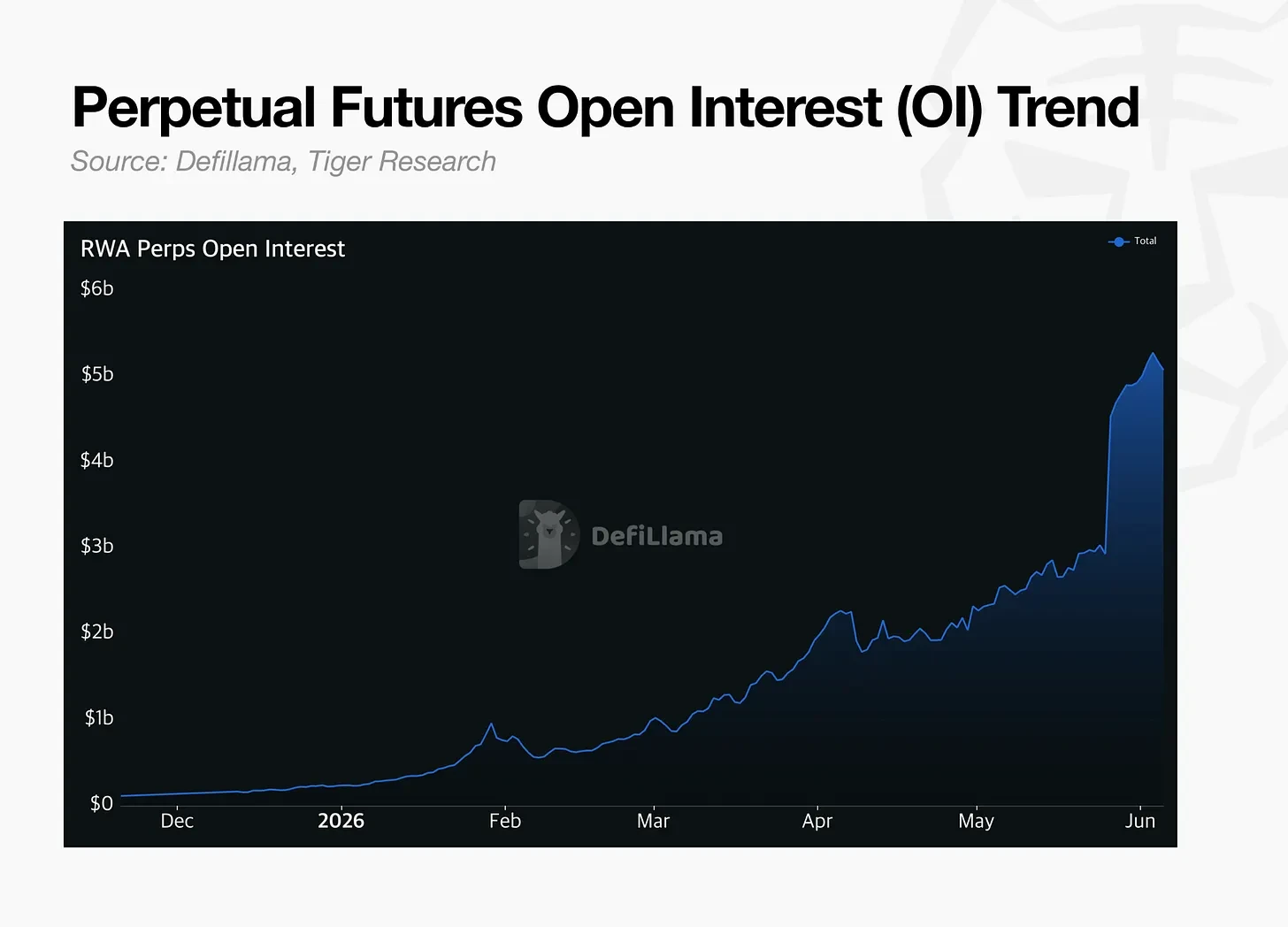
Compared to traditional markets, it is still small. The average daily trading volume in the U.S. stock market is about $1.1 trillion. The open interest in stock options (the total value of currently active contracts) is $2.25 billion. Since the metrics differ, direct comparison is difficult, but it is clear the market is still in its early stages.
The direction is clear. Open interest (OI) has grown every quarter, and regulators are beginning to recognize it as a market. The U.S. Securities and Exchange Commission (SEC) has classified such contracts as an innovative financial product, and the Commodity Futures Trading Commission (CFTC) is publicly reviewing its institutionalization in the U.S. The contract initially operated outside of regulation but is now rapidly entering the regulatory framework.
3. 24-Hour Market vs. Spot Market
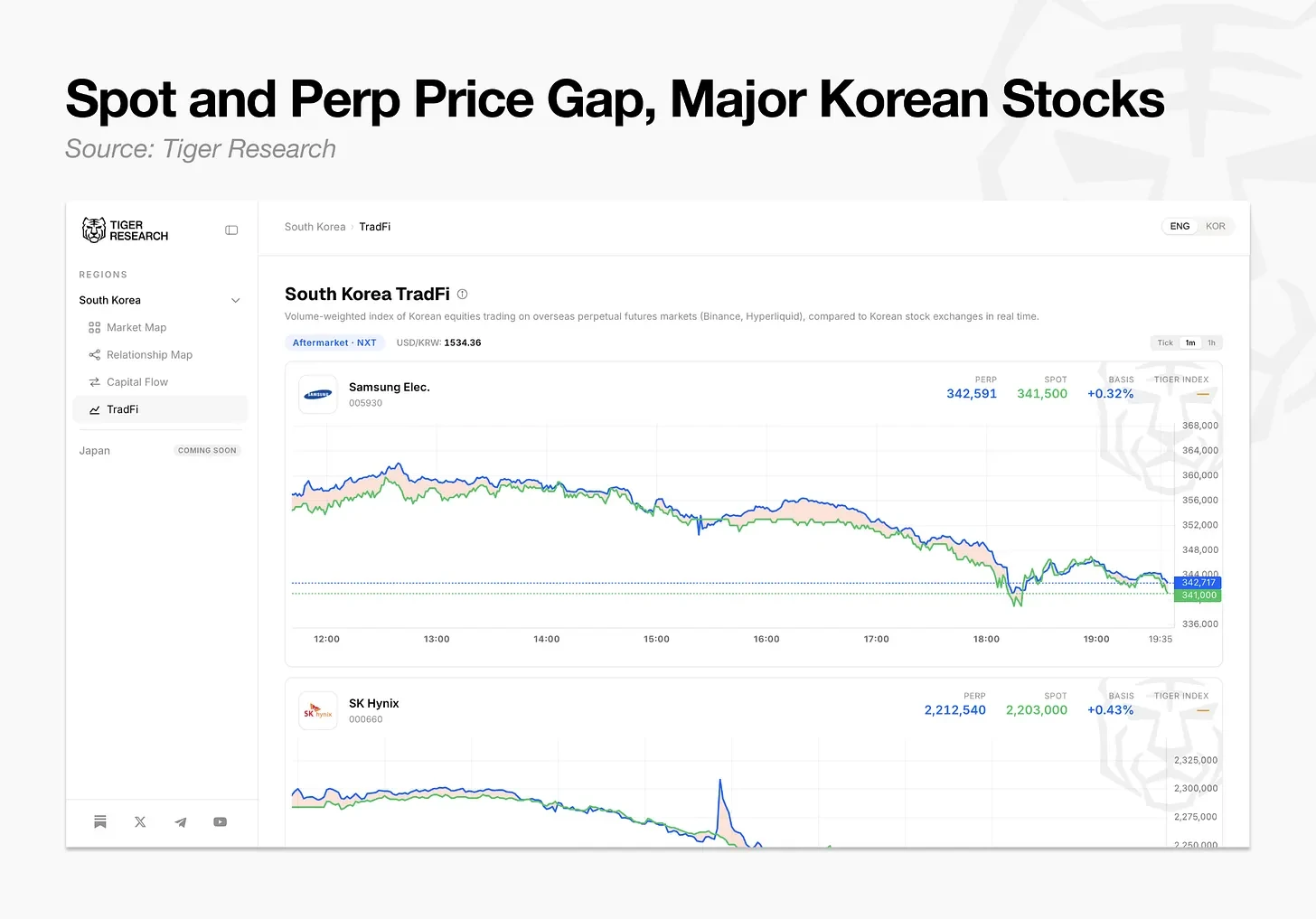
Tiger Research has tracked this change and provides a tool that allows real-time comparison of prices for Korean stocks in overseas perpetual contract markets against spot prices on the Korea Exchange (KRX). The tool aggregates prices from perpetual contract exchanges that support stocks like Samsung Electronics, SK Hynix, and Hyundai Motor, uses a volume-weighted average price, and displays it alongside each stock's domestic Korean spot price.
Current data shows three patterns.
3.1. Overnight Perpetual Futures Movements Predict Next Day's Opening
The Korean stock market is closed at night. The U.S. stock market moves, Nvidia reports, and exchange rates fluctuate, but the Korean market does not resume trading until the next morning. Perpetual futures trade during the night.
This raises the question. What price do perpetual futures reference when spot trading is closed?
The answer is that they do not follow a fixed market price. During trading hours, perpetual futures derive their spot price from institutional data. After trading hours, their own trading directly determines the price. They do not copy the closed spot market price; instead, they discover a new price based on overnight news and macroeconomic variables.
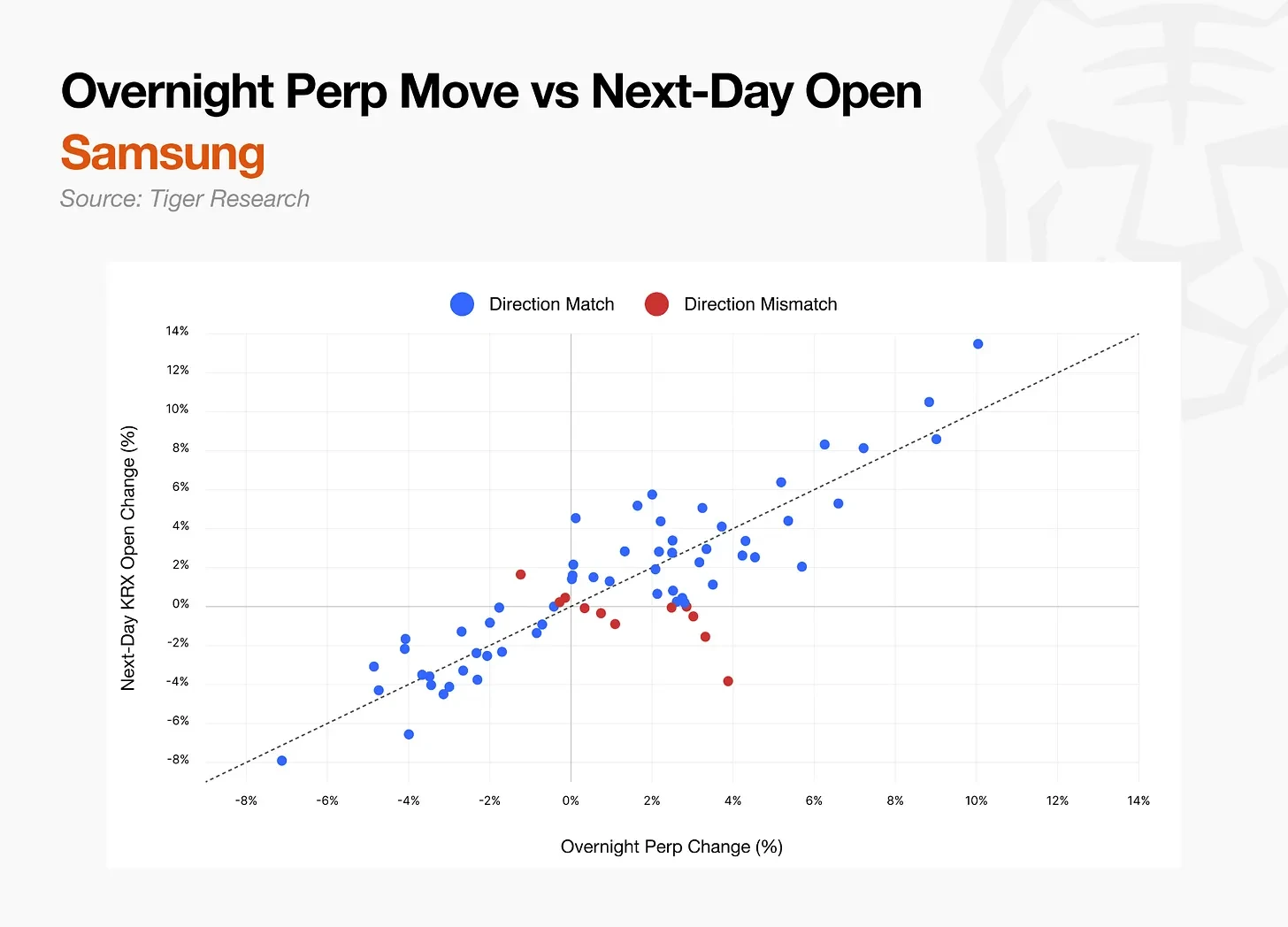
Data confirms this. On days when the perpetual futures price rose after the stock market close, Samsung Electronics and SK Hynix opened higher in the next trading session with probabilities of 82% and 95%, respectively. When the perpetual futures price fell after the close, Samsung Electronics and SK Hynix opened lower with probabilities of 96% and 78%, respectively. The directional alignment is about 85%, with a correlation coefficient between 0.85 and 0.89.
The magnitude of the move also aligns. An overnight increase of 3% in the perpetual futures price leads to an opening price increase of about 3%. The regression coefficient between the perpetual futures price change and the actual opening gap is 0.93 for Samsung Electronics and 1.00 for SK Hynix, almost predicting the magnitude of the rally.
Weekend moves are even sharper. From Friday's close to Monday's open, the predicted perpetual futures price movement aligns with the actual Monday opening price with an accuracy of 93% for Samsung Electronics and 87% for SK Hynix, as the predicted movement absorbs two days of global market volatility.
By observing overnight futures prices, one can get an early read on the direction of the morning's opening price.
3.2. Delta-Neutral Trade on Spot Premium
Perpetual contracts have no expiration date. To prevent the price from drifting too far from the reference price, longs and shorts periodically exchange a fee, known as the funding rate.
For example, when the price is above the reference price, profitable longs must pay a premium to the losing shorts. The higher the premium, the more they pay. To avoid paying this fee, traders adjust their strategies, and eventually the price returns near the reference price.
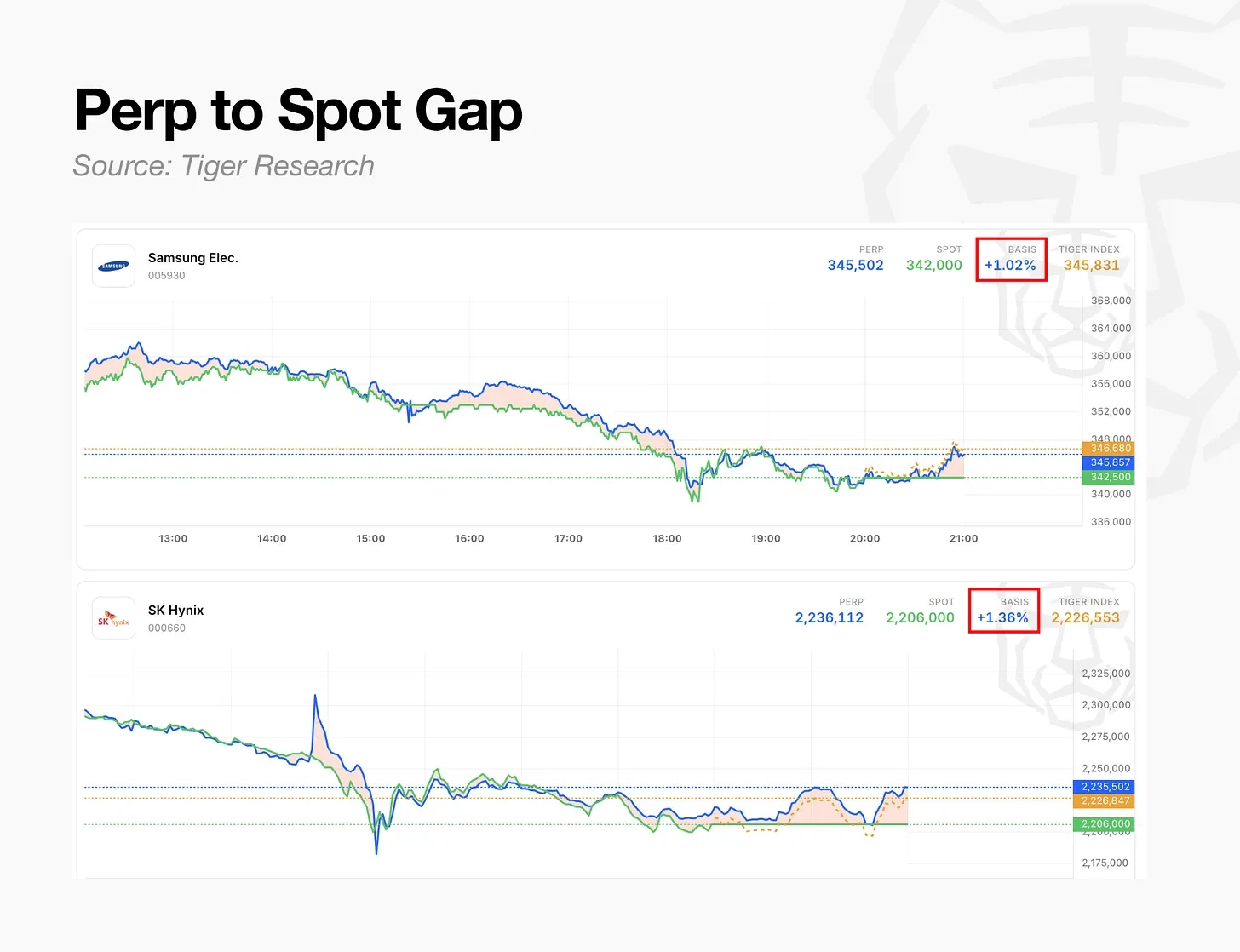
Data shows that Korean stock futures trade at a premium to the spot price, with an intraday average premium of 0.15% for Samsung Electronics and 0.23% for SK Hynix. Selling futures means collecting this premium as funding in each trading cycle.
The strategy is as follows: Buy the KRX spot intraday and sell an equivalent amount of futures contracts simultaneously. If the stock rises, the spot position gains value, and the short futures position loses; if the stock falls, the opposite occurs. They offset each other, so the final result is close to zero regardless of the stock's direction. In return, funding comes from the sold futures position. This position profits solely from the funding rate, without betting on direction. Eliminating direction risk in this way is a delta-neutral trade.
The premium does not last long. The spot gap typically narrows by half within about 40 minutes. It works in high-volatility periods when the premium widens but requires continuous monitoring.
3.3. Arbitrage Using Cross-Exchange Price Gaps
At the same time, prices for perpetual contracts on the same stock can differ between exchanges. Data from June 2026 shows that Binance's Samsung Electronics perpetual contract price was, on average, 0.93% higher than on Hyperliquid. The SK Hynynx contract price was 1.03% higher, reaching up to 2.3%.
Positions cannot be transferred between exchanges. Traders need to open opposite positions on both exchanges simultaneously. Short on the exchange with the higher price and long on the exchange with the lower price, so directional profit and loss offset each other. As the two prices converge, the initial spread turns into profit. On the exchange with the higher price, the short position also collects funding, increasing the return.
Exchanges that enter the market later tend to maintain higher prices due to less arbitrage capital flow. With more exchanges launching, this price gap repeats often in the early stages. The gap widens further at night and on weekends when spot trading is closed and exchanges determine prices independently.
4. Market Changes and Emerging Opportunities
A major challenge in this market is its fragmentation, which is both a risk and an opportunity. Liquidity is split because the same stock token is scattered across existing Korean exchanges and platforms like Hyperliquid, Binance, and Lighter. Prices differ across trading venues, making it hard to determine the 'true' price, and these price differences create room for confusion and manipulation. Applying leverage in illiquid conditions can lead to cascading liquidations. This presents both an opportunity and a risk.
The gaps listed above are for retail use. The same structure also offers opportunities for other commercial uses.
- Market Makers: The trading spread for the same stock across different exchanges ranges from 0.15% to 0.75%, widening further at night. Spreads remain persistently wide in the early morning market when arbitrage capital is scarce. Due to low liquidity and fragmented liquidity managed across multiple exchanges, demand for market making is expected to grow.
- Regional Oracles: Perpetual futures discover prices while spot trading is closed, and their accuracy depends on the oracle. Currently, oracles specialized in providing accurate prices for assets in Asian time zones like Korea, Japan, and Taiwan are still under development.
- Tokenized Issuance: Currently listed Korean companies are limited to Samsung Electronics, SK Hynix, and Hyundai Motor. The market needs an intermediary to list and manage the KOSPI 200 index components and major Asian companies.
- Basis Hedge Funds: Investors collect the premium of the futures price over the spot price as funding hourly. Funds that specialize in collecting basis and funding gaps across exchanges have a faster capital turnover than traditional basis trades, although the market size is still too small to fully absorb.
Compared to traditional markets, the perpetual futures market is small, but its significance cannot be overlooked. It discovers prices first, trades 24/7, and is rapidly moving towards institutionalization. Significant opportunities exist both in terms of investment and business.


