






The Nasdaq fell 4.2% in a single day, is the "Black Friday" bursting the US stock market bubble?


- Key Takeaway: On June 5, 2026, US stocks experienced a sharp sell-off triggered by stronger-than-expected non-farm payroll data, leading to a surge in interest rates. The high-flying AI sector plummeted, dragging down the broader market. Multiple valuation and sentiment indicators are at historically extreme levels. The market is in a fragile phase of "narrative shifting to reality." The upcoming CPI data and the Federal Reserve meeting in the next two weeks will determine the nature of this correction.
- Key Factors:
- Immediate Catalyst: May non-farm payrolls added 172,000 jobs, significantly exceeding the expected 88,000, fueling inflation expectations. The 10-year US Treasury yield rose to 4.531%, with the market pricing in the earliest possible rate hike in October.
- AI Sector Avalanche: The Philadelphia Semiconductor Index plunged over 10%. Nvidia dropped over 6%, and Micron fell 13.3%. The trigger was Broadcom's weaker-than-expected AI chip guidance and rumors of order cuts by cloud providers.
- Historically High Valuations: Before the pullback, the S&P 500's Shiller P/E ratio was approximately 39.5x (the third highest in history). The "Buffett Indicator" hit 237%, far exceeding the "severely overvalued" threshold.
- Bull vs. Bear Divide: Bears believe the bubble correction has begun (e.g., SocGen strategists warning of Nasdaq correction risks), while bulls emphasize earnings support (e.g., Goldman Sachs maintains its S&P 500 year-end target range of 6900-7600).
- Technical Breakdown: The S&P 500 broke below the lower trendline of its rising channel and is now testing the 200-day moving average (7000-7200). A decisive break below this level could confirm a 10%-15% medium-term correction.
- Key Future Junctions: The June 10 CPI data (core CPI expected at 2.8%-2.9%) and the June 16-17 FOMC meeting (potential changes in the dot plot regarding rate cut expectations) will dictate market direction.
Original by Odaily Planet Daily (@OdailyChina)
Author: Qin Xiaofeng (@QinXiaofeng 888 )
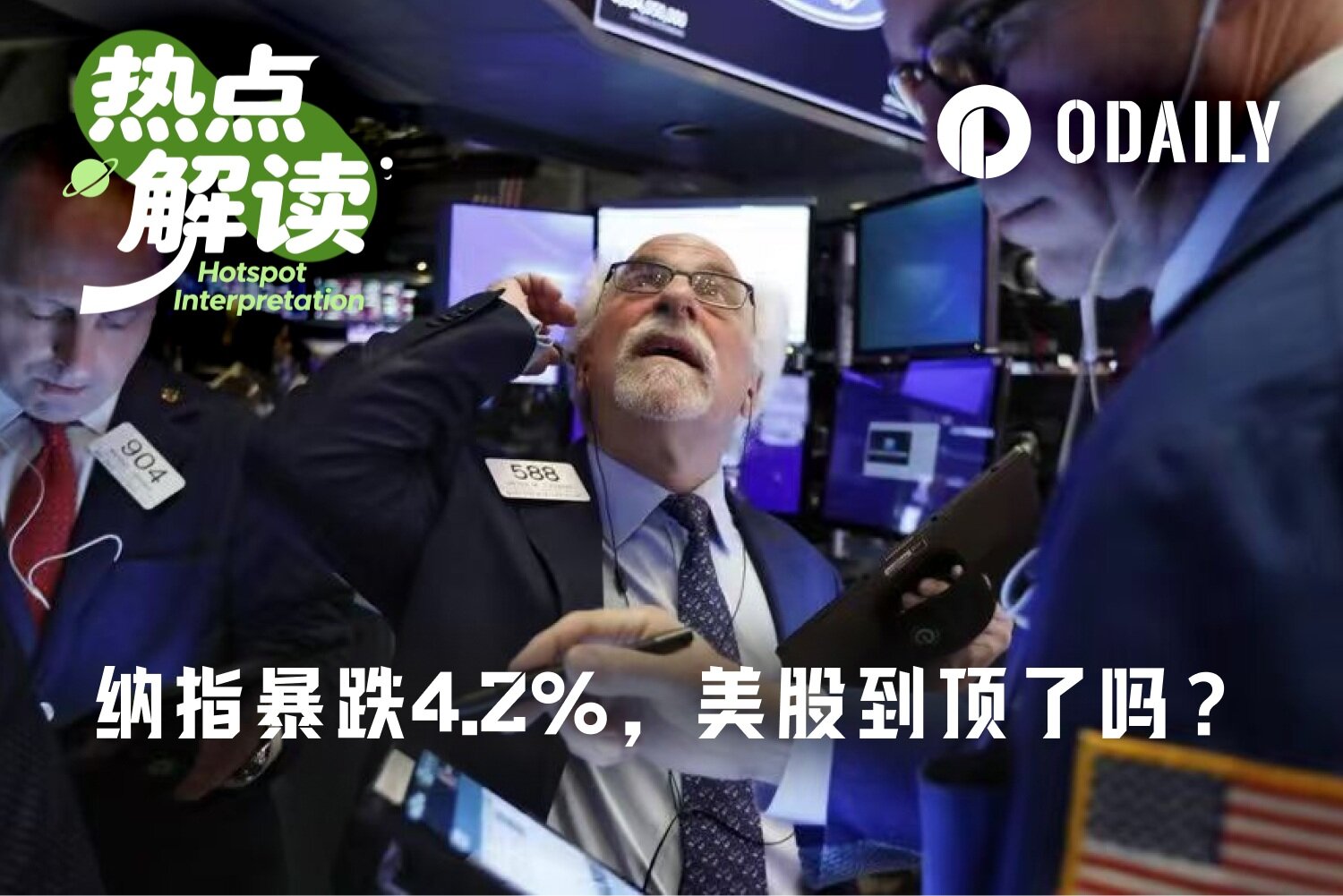
On Friday, June 5, U.S. stocks experienced their most severe single-day pullback of 2026 so far.
The Nasdaq plunged 4.18% to close at 25,709.43 points, marking its largest single-day drop since April 2025. The S&P 500 fell 2.64% to 7,383.74 points, ending a nine-week winning streak. The Dow dropped 695.15 points (1.35%) to close at 50,866.78 points. The Philadelphia Semiconductor Index plummeted over 10%, erasing approximately $1.3 trillion in market cap in a single day, with AI core stocks such as Nvidia, Broadcom, Micron, and Marvell leading the decline.
Suddenly, the question "Has the U.S. stock market peaked?" spread from trading floors to the screens of global investors. Odaily Planet Daily will conduct a rigorous analysis combining recent data and historical comparisons: Are current U.S. stock valuations too high? Is this pullback a healthy correction or a trend reversal? What will drive the market going forward?
1. The Full Picture of the June 5 Plunge: A Data-Driven "Perfect Storm"
The direct trigger for this crash was the non-farm payroll data released on Friday evening.
The U.S. Labor Department reported that non-farm payrolls increased by 172,000 in May, nearly double the market expectation of 88,000 and significantly higher than April's 115,000. April's employment data was already above expectations. Furthermore, March's figure was revised up by 29,000, and April's by 64,000, making the employment growth over the past three months the strongest in two years. This suggests that previous employment data systematically underestimated the strength of the U.S. labor market, raising concerns about an overheating economy.
The strong employment data pushed up inflation expectations, leading markets to anticipate the Federal Reserve could raise interest rates as early as October this year. Following the data release, U.S. Treasuries were sold off, with the 10-year yield rising 5.8 basis points to 4.531%, and the policy-sensitive 2-year yield surging over 7 basis points in a single day to 4.1%.
The jump in bond yields hit tech stocks hard, as high-valuation, high-growth assets are most sensitive to interest rate changes.
Although Broadcom's earnings report the previous day was strong, its guidance for AI custom chip business failed to meet the market's extremely high expectations, triggering a chain reaction. Nvidia fell over 6%, Micron dropped 13.3%, Marvell declined 16.7%, and AMD fell 10.9%. Profit-taking concentrated in the semiconductor sector, combined with doubts about the sustainability of AI capital expenditure, created an avalanche effect. Reports that Meta would add tens of billions of dollars in AI investment failed to reverse the sector's downturn.
Trading volume surged, and the VIX fear index spiked 37% to 21.15, indicating rapidly spreading risk aversion. Bitcoin concurrently fell below $60,000, while gold and crude oil also adjusted, with risk assets under broad pressure. However, not all sectors declined: defensive sectors like utilities, healthcare, and consumer staples rose against the trend, with "old-economy blue chips" like Johnson & Johnson and Coca-Cola attracting safe-haven funds. This suggests the market is not in a state of total panic, but rather undergoing a targeted adjustment of high-valuation sectors.
On a weekly basis, the S&P 500 ended its nine-week winning streak, and the Nasdaq fell 4.7% for the week, its worst performance in over a year. The Dow was relatively resilient, falling only 0.3% for the week, reflecting signs of sector rotation.
"This is an extreme example of 'good news is bad news,'" said Michael Wilson, Chief U.S. Equity Strategist at Morgan Stanley, in a post-market report. "The strong employment data means the Fed's tightening grip will be fastened even tighter. It directly undermines the only pillar supporting high U.S. stock valuations—the imminent expectation of rate cuts."
2. The AI Myth Fades: The Domino Effect of a Crowded Trade
If the non-farm data was the trigger, then the accumulated froth and fragility within the AI sector itself was the explosive powder keg.
Over the past 18 months, AI has been the sole narrative driving U.S. stocks to record highs. Nvidia's market cap once exceeded $5 trillion, accounting for over 7% of the S&P 500's weight, while the combined market cap of stocks related to the entire AI ecosystem approached 40% of the S&P 500's total value.
However, cracks in this belief began to appear entering Q2 2026.
Several cloud service providers, in recent supply chain surveys, have reportedly been cutting some orders for Nvidia's next-generation Blackwell Ultra chips, citing excessive previous hoarding and the monetization of enterprise AI applications being much slower than infrastructure investment. While Nvidia's earnings report at the end of May still showed impressive figures, its revenue growth guidance has slowed for three consecutive quarters, with gross margins showing signs of decline.
The previously extremely crowded bullish bets on big tech stocks quickly turned into a stampede of liquidations under the shock of rising interest rates. When the non-farm data triggered a rate spike, the appeal of holding these high-duration, high-valuation growth stocks suddenly plummeted, and their fragile marginal buyers—leveraged quantitative funds and retail investors—were the first to break ranks, triggering a chain reaction.
"AI trading has shifted from FOMO (fear of missing out) to the fear of being trapped." Renowned value investor and GMO co-founder Jeremy Grantham has long warned about overvalued AI stocks, often comparing the current situation to the eve of the 2000 dot-com bubble, pointing out that the revenues of many AI companies may not support their current high valuations.
3. Valuation and Historical Comparison: Has the U.S. Stock Market Reached a Bubble Peak?
This correction has sparked widespread discussion about whether the market has peaked because it occurs against a backdrop of multiple high valuation and sentiment indicators converging.
First, valuations are at historic highs. Before the June 5 correction, the S&P 500's cyclically adjusted price-to-earnings ratio (CAPE, or Shiller P/E) was around 39.5x, the third highest level after the 2000 dot-com bubble and the 2021 pandemic easing period, significantly higher than before the 2007 financial crisis. The forward P/E ratio was also around 22.5x, well above the long-term historical average of 15.8x. The "Buffett Indicator"—the ratio of total U.S. stock market capitalization to U.S. GDP—reached a high of 237% at the end of May, far exceeding the "significantly overvalued" range (>120%) defined by Buffett himself. Any unexpected negative news could accelerate a mean reversion.
Second, capital and sentiment were at extreme levels. The Bank of America Bull & Bear indicator rose to 8.5 in late May, firmly in the "extremely bullish" territory, which is often viewed as a reliable contrarian sell signal. The bullish sentiment ratio from the American Association of Individual Investors (AAII) remained in the 35%-45% range for most of May, indicating optimism but not extreme euphoria. Retail investor margin debt balances stayed near historical highs around $1.3 trillion in April-May, showing still-active leverage usage.
Meanwhile, "smart money" appeared to be retreating: Berkshire Hathaway's Q1 13F report showed its cash and equivalents reserve reached a historic high of approximately $397 billion, and the company continued to be a net seller of stocks in Q2. The corporate insider sell-to-buy ratio rose to its highest level since 2021 in May.
Third, key technical levels were breached. Last Friday, the S&P 500 not only fell below short-term moving averages but also broke through the lower boundary of its recent uptrend channel. The index is now facing a test of its 200-day moving average (around the 7,000-7,200 point range). Technicians like Jonathan Krinsky, Chief Market Technician at BTIG, point out that if the S&P 500 cannot quickly reclaim key support levels and subsequently loses the 200-day MA, it would technically confirm the potential start of a medium-term correction, possibly with a magnitude of 10%-15%.
4. Bulls vs. Bears: Correction, Pullback, or Start of a Bear Market?
Facing the market correction, Wall Street's bulls and bears quickly took sides, engaging in a heated debate.
The bearish camp argues this could be the beginning of a bubble correction. Some strategists suggest the U.S. economy shows signs of "stagflation" risk—while the May ISM Manufacturing PMI rebounded to 54.0 (expanding from the previous month), inflation indicators remain sticky. They warn that corporate profit growth faces downward revision pressure due to financing costs and demand uncertainty, and that the current equity risk premium is at a low level.
Albert Edwards, a star strategist at Société Générale who has long held cautious views, warns that the AI bubble resembles past tech bubbles, potentially involving capital misallocation and challenges for some companies, with the Nasdaq facing a significant risk of correction.
The bullish camp, on the other hand, emphasizes this is a healthy, albeit overdue, correction within a bull market. Goldman Sachs' Chief U.S. Equity Strategist David Kostin acknowledges valuations are high but believes the market, driven by earnings growth, still has support. He forecasts S&P 500 earnings per share to grow by about 7% in 2026, with AI-driven productivity improvements beginning to improve corporate profit margins in the second half of the year. "The strong non-farm data precisely proves the economy is not in a hard landing and recession risk is extremely low. Once the rate panic subsides, capital will re-recognize the solidity of the earnings base." Goldman Sachs maintains a relatively high year-end target for the S&P 500, having previously raised its range to 6,900-7,600.
UBS Global Wealth Management also advises clients to "buy the dip," citing that household and corporate balance sheets remain healthy, and corporate stock buyback plans will continue to provide a buffer for the market.
Liz Ann Sonders, Chief Investment Strategist at Charles Schwab, offered a more balanced and pragmatic perspective: "'A top' is never a single point; it's a process. Currently, the phase of broad, liquidity- and sentiment-driven rallies is over. We are entering a stock-picker's market dominated by fundamentals. The broader market indices may trade sideways and drift slightly lower in the coming months, but we won't see a 2008-style collapse unless we witness a freeze in the credit markets."
5. Key Junctures Ahead: Inflation Data and the Fed's "Judgment"
Unquestionably, two major events this week will serve as critical watersheds determining the nature of this adjustment. On Wednesday, June 10, the U.S. Consumer Price Index (CPI) for May will be released. The market generally expects core CPI year-over-year growth around 2.8%-2.9% (was 2.8% in April). If the data significantly exceeds expectations to the upside, it will reinforce market concerns about "sticky inflation" and could push back expectations for a Fed rate cut further, thereby intensifying pressure on both the bond and stock markets.
The Federal Open Market Committee (FOMC) meeting on June 16-17 will be a key observation window. Following the strong non-farm payroll data on June 5, several Fed officials reiterated the need for caution. Officials like Cleveland Fed President Beth Hammack emphasized that while the labor market shows resilience, interest rates may need to remain at current elevated levels for a longer period. The updated economic projections (dot plot) released at the meeting will be closely watched. If the median forecast shows fewer rate cuts in 2026 than previously expected, or even hints at maintaining rates unchanged for the entire year, market expectations for the rate path will undergo a significant realignment.
Additionally, geopolitical and trade policy risks could bring further uncertainty. The U.S. has previously implemented import tariffs and export controls on advanced semiconductors to strengthen domestic supply chain security and limit the outflow of key technologies. This ongoing policy direction, amidst fragile tech stock sentiment, could still have long-term implications for the global AI supply chain, potentially raising the inflation floor and consequently compressing valuations for some companies.
Summary
Back to the initial question: "Has the U.S. stock market peaked?"
For investors, many of the necessary conditions to confirm a long-term major top—extreme valuations, policy shifts, weakening core narratives, retail investor euphoria, and technical breakdowns—are appearing simultaneously for the first time in over a decade. Historical experience suggests that when these signals resonate strongly, even if the bull market doesn't end immediately, its risk-reward profile has already deteriorated significantly. The current market is in a fragile transition period from "narrative" to "reality." The long-term productivity promise of the AI revolution must now begin to withstand the rigorous scrutiny of every macroeconomic data point and earnings report.
The era of betting unilaterally on markets perpetually rising may be over. Caution is the most fundamental respect for risk. Over the next two weeks, investors need to watch every decimal point in the May CPI report and every minor shift in the Fed's dot plot. Together, they will determine whether this summer is just an interlude in a bull market or the prologue to a new era.


