






黄仁勋严选:Marvell指引再上调,2028年营收看165亿美元


- 核心观点:Marvell 上调2027财年营收指引至115亿美元,当前增长由成熟互连业务(PAM DSP等)驱动,代表未来的CPO等规模上技术仍待2027年后量产验证,高估值与执行确定性形成反差。
- 关键要素:
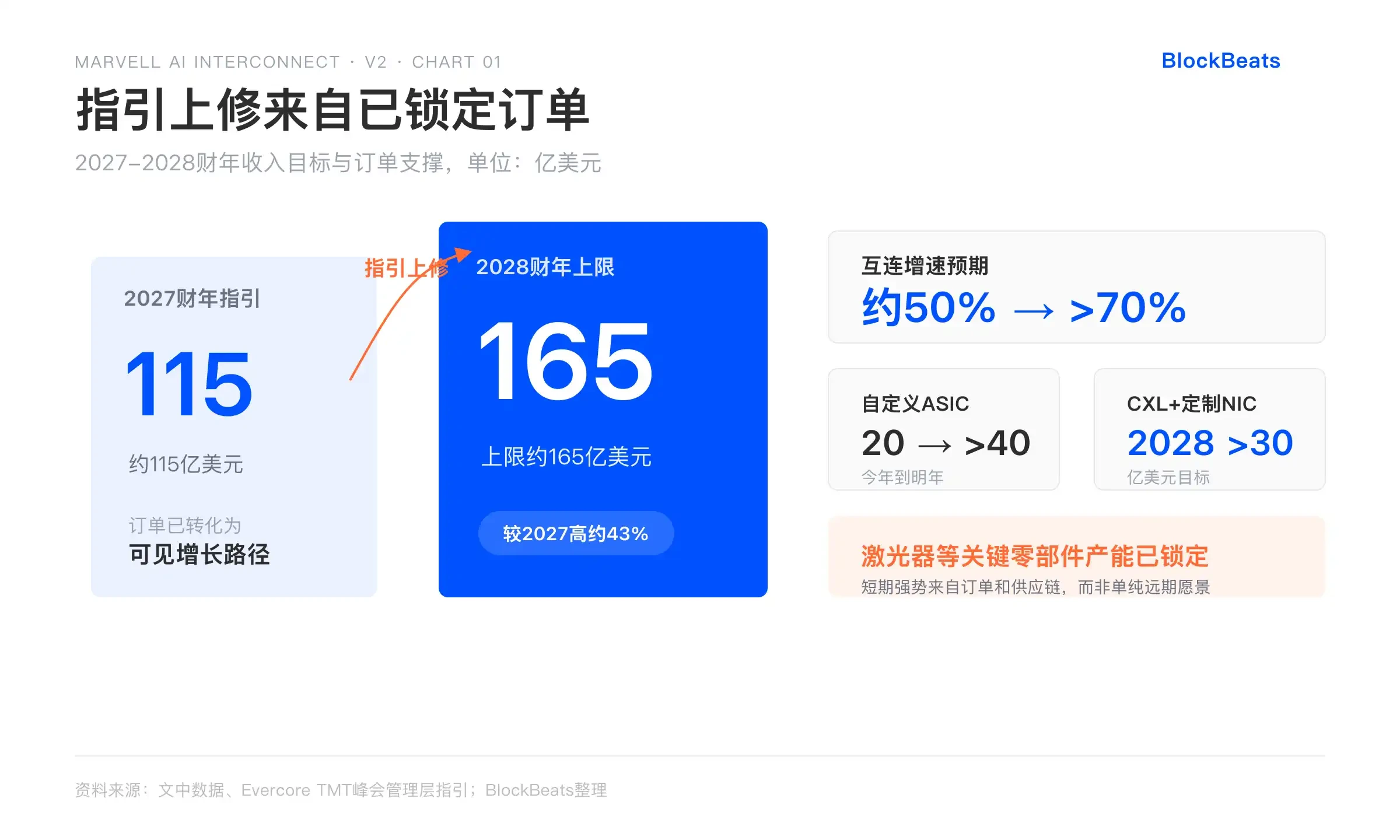
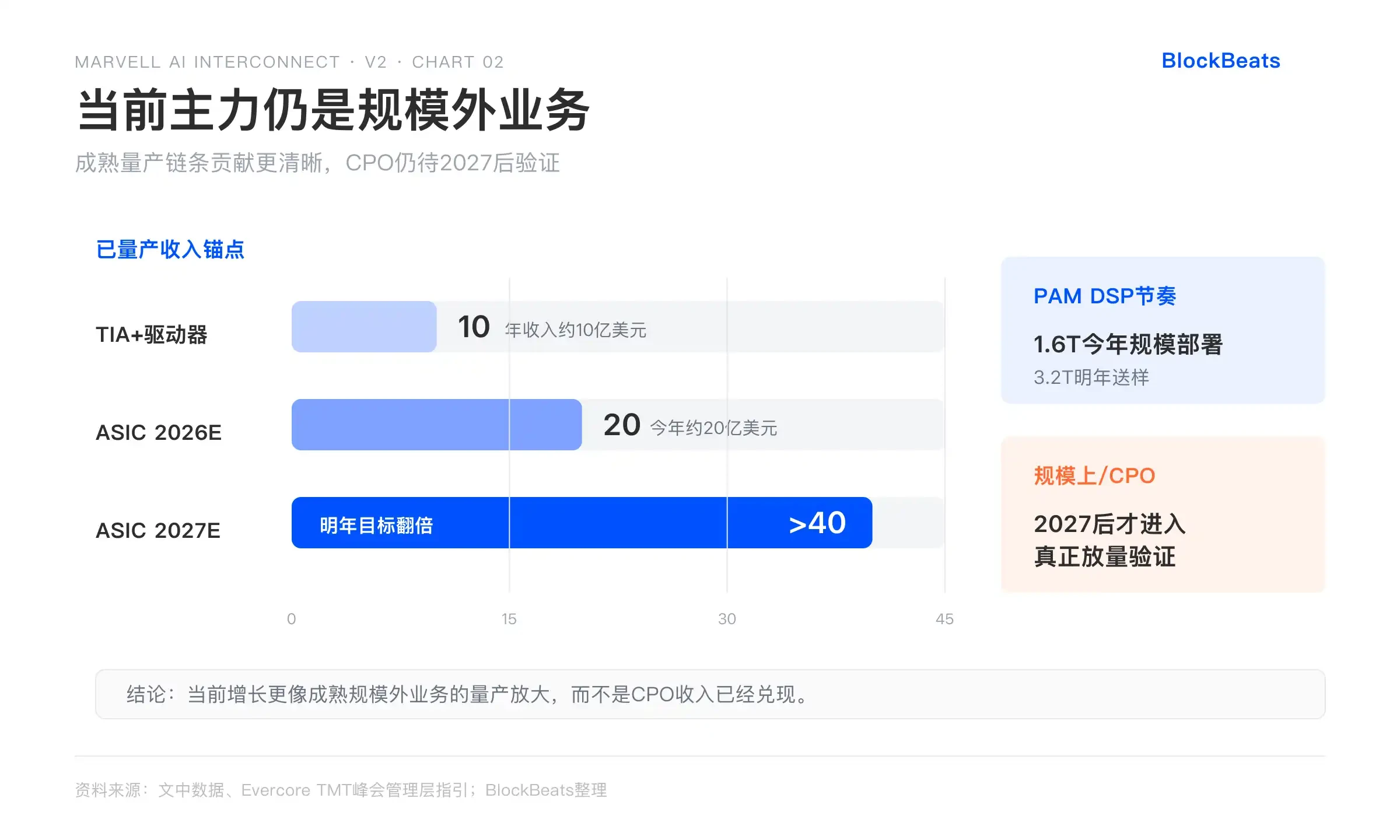
- Marvell 将2027财年营收指引上调至约115亿美元,互连业务增速预期提升至超70%,自定义ASIC今年贡献约20亿美元,明年目标翻倍至40亿美元。
- 当前增长主力为规模外业务:PAM DSP、TIA驱动器和插拔式光模块已形成成熟产品线,TIA加驱动器年收入已达约10亿美元量级。
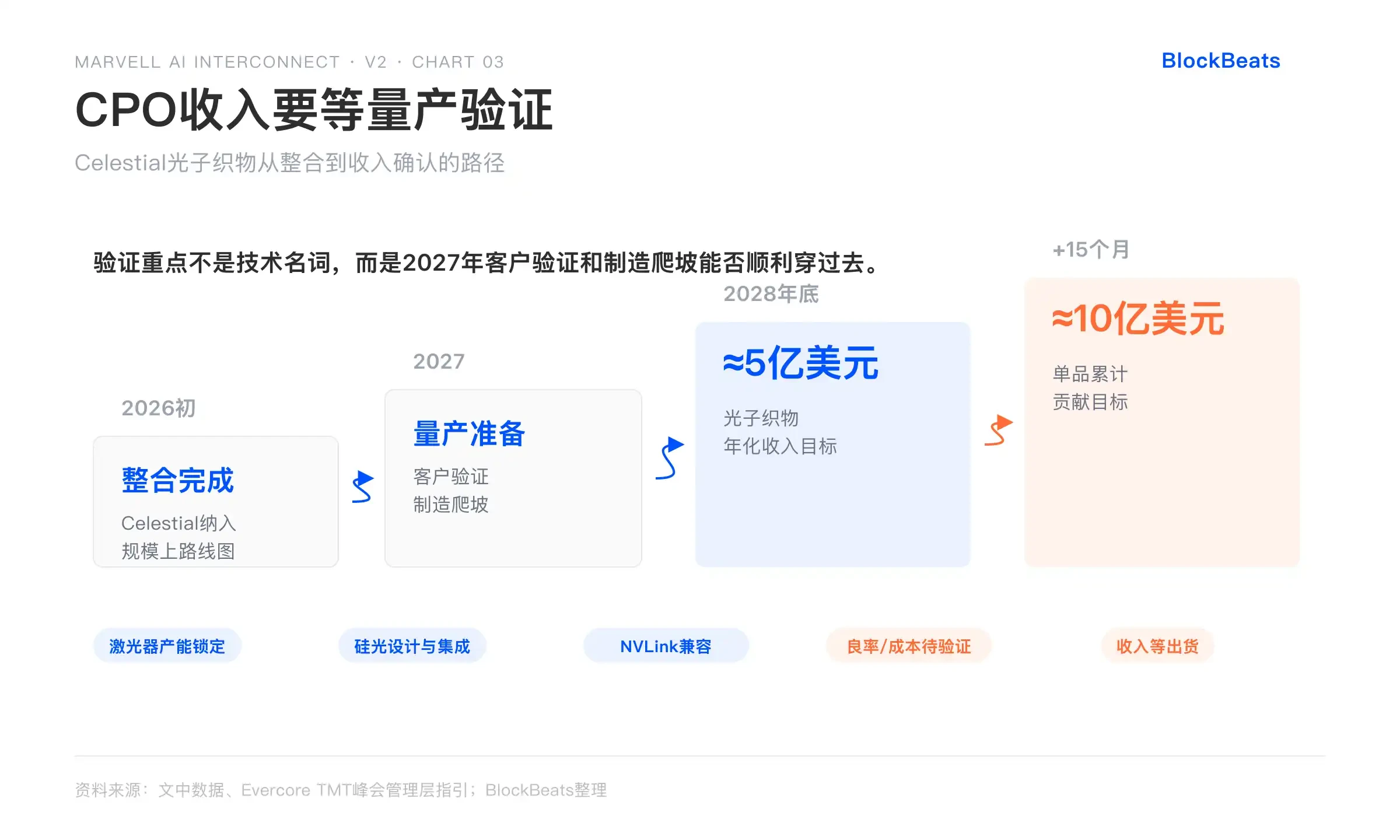
- 规模上业务(CPO)仍处早期,预计2027年量产准备,目标2028年底光子织物实现约5亿美元年度化收入,依赖客户验证和制造爬坡。
- Celestial AI收购整合后,光子织物技术将用于自定义XPU和交换机共封装,与NVIDIA NVLink Fusion合作增强技术兼容性。
- 在Broadcom网络ASIC和整体规模领先的竞争下,Marvell仍需通过更高集成度争夺增量份额,差异化取决于2027-2028年实际招标结果。
- CPO大规模量产面临良率、成本曲线、供应链稳定性等核心约束,从早期量产到形成有意义收入需多次迭代,是2028年增长可持续性的最大待验证变量。
- 股价2026年以来累计涨幅近140%-158%,波动率上升,市场讨论重心从受益转向回调风险,高估值已包含较多中长期乐观假设。
TL;DR
- Marvell raised its fiscal 2027 revenue guidance to $11.5 billion, with interconnect business growth accelerated to over 70%.
- Current growth is primarily driven by proven, scaled-out businesses, while scaled-up technologies like CPO await post-2027 validation.
- Related tickers: MRVL (US), AVGO (US), COHR (US)
Following Jensen Huang's enthusiastic endorsement, Marvell once again confirmed exceptionally strong AI-related orders at the Evercore TMT Conference, raising its fiscal 2027 revenue guidance to approximately $11.5 billion. The expected growth rate for its interconnect business was also lifted from roughly 50% to over 70%. Custom ASIC is projected to contribute around $2 billion this year, with a target to double next year. Since the beginning of 2026, the company's stock has surged nearly 140%-158%, significantly outperforming peers and the broader market. During this period, there have been multiple instances of single-day gains exceeding 30%, accompanied by a marked increase in trading volume.
Most reports interpret this series of signals as Marvell solidifying its position as the leader in AI interconnects, with the data center business becoming its absolute core. However, the reality is that the primary growth drivers remain proven, scaled-out businesses, leveraging the mass production advantages of PAM DSP, TIA drivers, and pluggable optical modules. In contrast, scaled-up optics and CPO (Co-Packaged Optics), which represent higher per-cluster value and greater strategic significance, are still being prepared for mass production in 2027. The execution certainty from early deployment to generating hundreds of millions in annualized revenue by 2028 is the key to determining whether the growth momentum can sustain through 2028, whether the company can transition from a component supplier to a strategic partner for cloud vendors, and whether the current high valuation already fully reflects optimistic expectations.
Conference Update Confirms Strong AI Orders
At the conference, Marvell raised its guidance based on actual booked AI orders and locked-in supply chain commitments, not long-term visions. Fiscal 2027 revenue guidance was raised to approximately $11.5 billion, with an upper limit for fiscal 2028 further increased to around $16.5 billion. Specifically, the interconnect business is expected to see year-over-year growth accelerate to over 70% in fiscal 2027. Custom ASIC is forecast to contribute about $2 billion this year, targeting over $4 billion next year, while disaggregated CXL plus custom NICs aim for over $3 billion in fiscal 2028.
These figures are backed by specific supporting factors. Management repeatedly noted extremely strong demand driven by capital expenditures, with orders translating into visible growth trajectories. While lead times for key components like lasers remain tight, production capacity has been secured. Marvell maintains its pace of being the first to mass-produce each generation of PAM DSP (with 1.6T deploying at scale this year and 3.2T sampling next year). This aligns with the narrative from previous earnings calls, pointing towards genuine demand rather than mere optimistic forecasts.
However, the stock price has already significantly priced in this story. Year-to-date returns far exceed those of peers and indices. Following the surge, volatility and implied option volatility have also risen in tandem. Market discussions have shifted from identifying beneficiaries to questions about "how long can it last" and downside risks. This creates a clear contrast: while the momentum backed by short-term orders is clearly visible, the market pricing already incorporates a considerable amount of medium-to-long-term optimistic assumptions.
Following the strong guidance, investors naturally question which specific businesses are driving this growth and the respective contributions from scaled-out and scaled-up operations.
Current Growth is Driven by Proven Scaled-Out Businesses
Currently, the primary driver of the interconnect business remains the scaled-out segment. Products like PAM DSPs, TIA drivers, and 400G, 800G, 1.6T pluggable optical modules form a mature product line. Being the first to mass-produce each generation helps the company secure market share. The combined TIA and driver business has already reached an annual revenue scale of approximately $1 billion. Comprehensive coverage from long-haul coherent optics to higher-speed PAM enables the company to hold a favorable position in the market for horizontal scaling between data centers.
The scaled-up business, on the other hand, is transitioning from its initial stages into an acceleration phase. As AI clusters scale from tens of thousands of GPUs or XPUs to millions, front-end computing resembles upgrading the engine, while the back-end interconnect is like expanding a single-lane highway to multiple lanes. The bandwidth demand within the cluster is approximately ten times that of the front-end. Power consumption and density bottlenecks are driving the industry's shift from traditional pluggable optical modules to near-package optics and CPO. This transformation can significantly increase the number of chips loaded per rack and expand the total addressable market.
The core of CPO lies in co-packaging optical engines with XPUs or switches, reducing electrical-to-optical conversion losses, thereby improving bandwidth density and lowering overall power consumption. This is not a simple component swap but a system-level solution to address the new bottlenecks in large-scale clusters. Through acquired SerDes IP, DSP capabilities, and the recently integrated Celestial AI technology, Marvell is attempting to build an integration advantage in this direction. However, the scaled-up business's contribution is currently limited; substantial revenue generation will only materialize after mass production begins post-2027.
Given that scaled-up represents higher content per system and market expansion opportunities, what is the status of Marvell's technology roadmap, manufacturing readiness, and execution capability in this emerging field?
What is the CPO Mass Production Path After the Celestial Acquisition?
The Celestial AI acquisition was fully integrated in early 2026. Its photonic fabric technology is incorporated into Marvell's scaled-up roadmap, destined for co-packaging with custom XPUs and scaled-up switches. Management expects to enter the formal mass production preparation phase in 2027, targeting an annualized revenue run rate of approximately $500 million for the photonic fabric by the end of 2028, with a goal to double it subsequently, contributing cumulatively around $1 billion within 15 months (on a product basis). This path is slightly optimized compared to earlier outlooks but still relies on smooth customer validation and manufacturing ramp-up.
Supply chain details indicate increased certainty. While laser lead times are tight, Marvell has secured related manufacturing capacity. The company focuses on silicon photonics chip design and integration rather than producing lasers in-house. Collaboration with NVIDIA on NVLink Fusion further covers areas like silicon photonics, network interoperability between custom XPUs and NVIDIA clusters, and OCTEON baseband support for AI-RAN. This not only enhances technological compatibility but also strengthens credibility in hyperscaler tenders, making Marvell's heterogeneous computing solutions easier to incorporate into next-generation AI factory plans.
If million-XPU scale clusters widely adopt CPO, resulting in significantly lower power consumption and higher bandwidth density, it would directly increase Marvell's content value per rack, supporting revenue and gross margin expansion. Conversely, if the 2027 mass production ramp-up is slower than expected, customer validation cycles lengthen, or yield and cost curves underperform, the 2028 contribution would be lower than current market-implied levels, putting pressure on overall guidance delivery. All current statements remain forward-looking; actual shipment and market share data won't provide harder validation until 2027.
With a full-stack layout spanning SerDes, DSP, optical engines, and custom XPUs, supported by its ecosystem partners, can Marvell maintain its differentiation against competitors and translate it into actual market share gains?
Can Marvell Sustain Its Differentiation Against Broadcom?
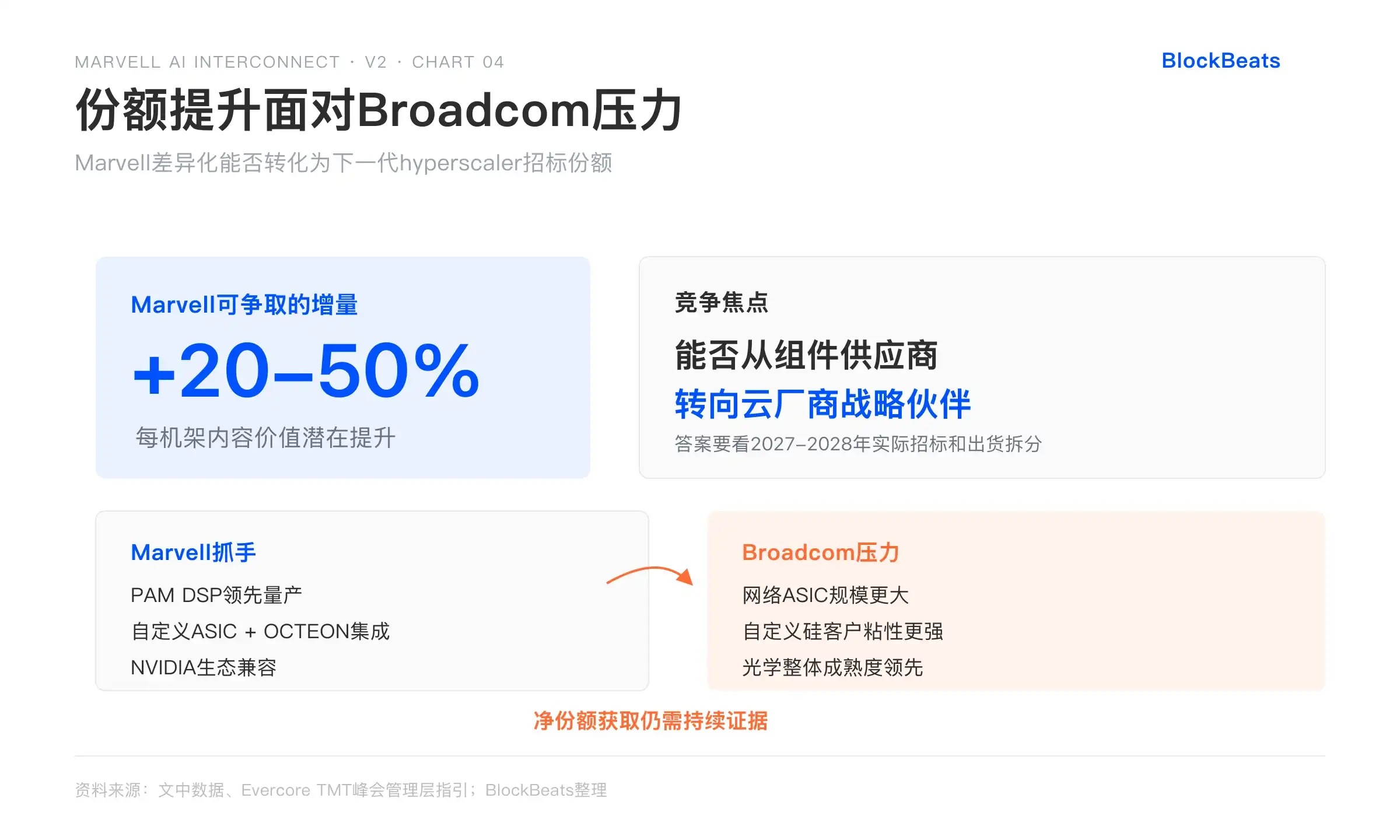
Marvell's leadership in the PAM DSP market, comprehensive coverage from long-haul coherent to 1.6T and 3.2T, and the integration advantages of custom ASIC with OCTEON are tangible achievements. The NVIDIA partnership also provides an additional option for heterogeneous computing. These elements make the company competitive in certain hyperscaler projects, particularly in scenarios requiring rapid mass production and ecosystem compatibility.
However, Broadcom maintains a clear lead in network ASICs, overall optical scale, and maturity. Broadcom's custom silicon projects are larger in volume with stronger customer stickiness. In overlapping areas of scaled-out and scaled-up technologies, Marvell still needs to leverage higher integration and specific technology paths to compete for incremental market share. The positioning as a "strategic interconnect partner" remains more of a goal for now. Its ultimate realization depends on actual tender results and shipment breakdowns in 2027-2028, not the current breadth of its layout.
For investors, this means that in next-generation hyperscaler tenders, Marvell's content value per rack could potentially increase by 20-50% from current levels, supporting revenue visibility and gross margin expansion potential. However, if the CPO ramp-up lags guidance, or if Broadcom dominates more custom projects, growth in 2028 might fall short of the best-case scenario currently implied by the valuation, increasing downward pressure on the stock. The current high-beta nature amplifies gains during narrative-driven rallies but also magnifies volatility when execution falls short of expectations.
Large-Scale CPO Deployment Remains the Key Unverified Variable
Despite strong AI orders, leading-edge PAM production, and NVIDIA compatibility providing real medium-term momentum and optionality, CPO is a nascent technology. Its path from preparation to large-scale deployment—encompassing yield, cost curves, thermal management, supply chain stability, and the sustainability of hyperscaler capital expenditure at current pace—remains the core constraint on the sustainability of growth into 2028. Historical precedent shows that new technologies typically require several iterations from early production to generating meaningful revenue. CPO is still in this early stage.
Marvell has a good track record of meeting guidance, but this ramp-up target is relatively aggressive. Valuation has already risen significantly in 2026, incorporating many best-case assumptions. Increased market discussion and crowding have also pushed up volatility. Broadcom's scale advantage will not disappear in the short term, and net share gains require continuous evidence. The current phase is one of acceleration, yet it already shows early signals of late-cycle crowding—dramatic price swings and a shifting focus towards delivery pressure are hallmarks of this characteristic.
Investors should look beyond the vision presented at the conference and instead focus on tracking actual revenue breakdowns in 2027, shipment milestones, CPO-related customer validation progress, and the pace of hyperscaler capital expenditure. These variables are most likely to change the current assessment. If 2027 milestones are met strongly, the trend of structurally increasing interconnect content will gain firmer support. If delays or market share disappointments occur, the elevated valuation will face correction pressure. The structural opportunity in AI interconnects is indeed real, and Marvell's full-stack layout offers differentiated options. However, the ultimate outcome hinges on execution details. Fiscal 2027 will be the critical validation window.


