






黄仁勋、Marvell CEO同台对谈:未来AI拼的不是算力是「连接」


- 核心观点:随着AI进入智能体时代,数据中心算力与内存瓶颈已被突破,下一个决定性战场转向“连接”需求,这正推动光通信基础设施爆发,Marvell等核心供应商将因此受益。
- 关键要素:
- 英伟达CEO黄仁勋预测Marvell将成为“下一个万亿美元公司”,并已向其战略投资20亿美元,凸显其对于AI数据中心互联的战略地位。
- Marvell数据中心业务占比从十年前的不到10%飙升至超过75%,并以年增40%的速度加速增长,市场预期其明年营收可达164亿美元。
- 核心共识在于:AI基础设施的瓶颈已依次从算力、内存转移至连接,顶级云服务商正因此重新规划网络架构。
- 黄仁勋提出“能用铜用铜,必须用光才用光”策略,并预计未来5-10年铜缆与光器件会并存,而Marvell在两个领域均提供完整方案。
- 物理限制驱动光通信需求:当单通道速率升至400Gbps时,铜缆将无法连接整个机架,促使光通信需求呈数量级增长。
- Marvell正重注CPO(共封装光学)技术,已推出基于CPO的51.2T交换机,旨在消除铜质走线,打破数据中心物理边界。
- 英伟达与Marvell合作推出NV Link Fusion,旨在融合英伟达技术平台与Marvell方案,构建解耦、异构的定制化AI数据中心。
Original Author: Dong Jing, Wall Street Insight
As AI models move into the era of massive "Agents," the computing power bottleneck in data centers is gradually shifting to "connectivity." A fundamental infrastructure revolution from copper cables to optical fibers is being fully ignited.
On the second day of the Computex conference in Taipei, China, Matt Murphy, Chairman and CEO of Marvell, a leader in AI custom chips, optical communications, and data center interconnect, delivered a keynote speech.
Nvidia CEO Jensen Huang made a surprise appearance as a special guest. The two leaders at the pinnacle of AI computing power and network interconnection shared the stage, highlighting the deep strategic binding relationship between the two companies. This joint appearance quickly became the most high-profile moment of the exhibition so far.
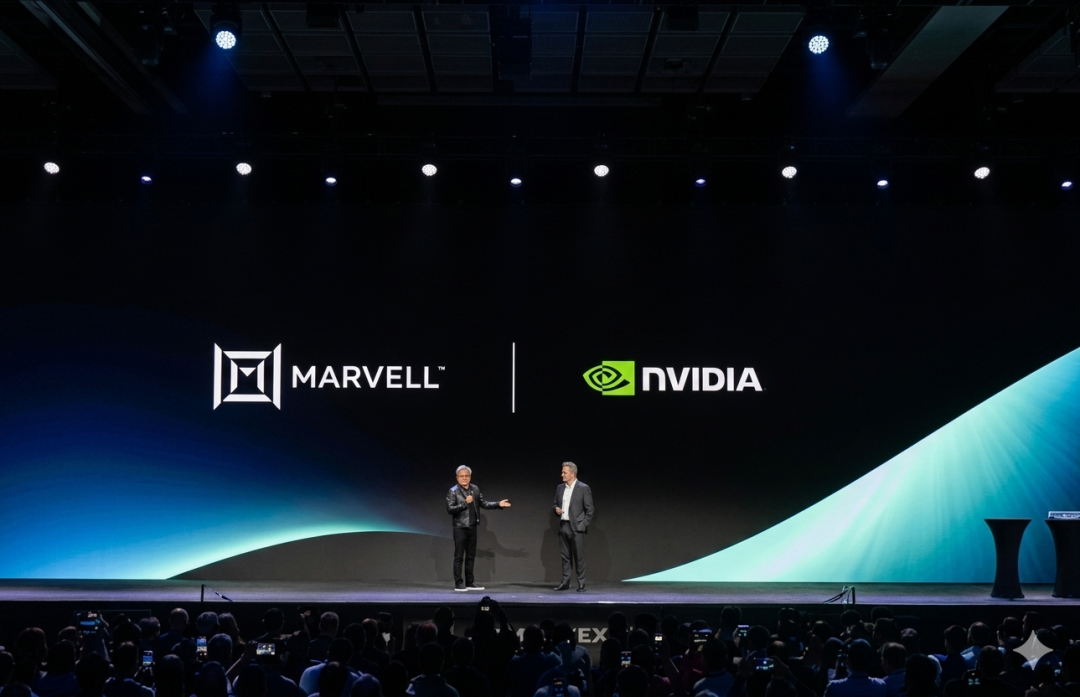
(Marvell CEO Matt Murphy and Jensen Huang in conversation at Computex)
After taking his position, Huang set the tone with one sentence: "Ladies and gentlemen, the next trillion dollar company" – he was referring to Marvell.
The audience erupted in applause. According to a Wall Street Insight article, this is the latest testament to Nvidia's strategic investment of $2 billion in Marvell announced months ago, and the deepening collaboration between the two companies in the AI data center infrastructure sector.
Following the release of the previous quarter's earnings, the market is highly focused on the extent to which Marvell will benefit from the AI supercomputing cycle.
In response, Murphy delivered a remarkable report card: Ten years ago, Marvell's data center business revenue accounted for less than 10%. Last quarter, this proportion had exceeded 75% and is accelerating at a rate of approximately 40% per year.
Based on the latest earnings guidance, Wall Street generally expects its revenue next year to reach a staggering $16.4 billion.
Behind this surge in performance, Huang and Murphy's conversation revealed the core investment theme for AI infrastructure – after the bottlenecks of computing power and memory have been sequentially broken, "connectivity" will define the system's ultimate performance. The core consensus between the two CEOs is:
The next decisive battlefield for AI infrastructure is not computing power, nor memory, but connectivity. Marvell is at the heart of this revolution.
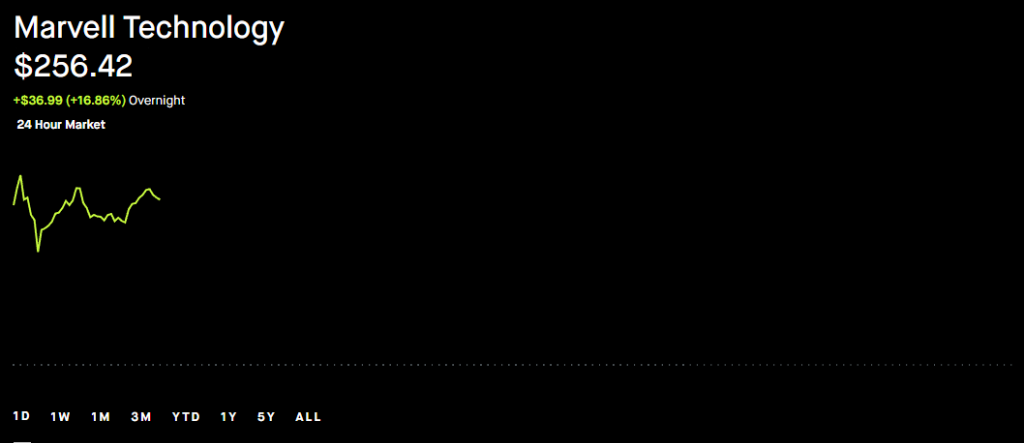
Notably, Marvell's stock price surged over 16% in after-hours trading.
The End of Computing Power is Connectivity: AI Enters the "Useful Phase," Triggering Infrastructure Interconnect Demand
Why has connectivity become so important today?
In his speech, Murphy explained why "connectivity" has become the most critical constraint using a clear logical chain:
Bottlenecks in AI infrastructure are appearing and being broken sequentially – Computing Power (led by Nvidia, making it the world's first company to reach a $5 trillion market cap) → Memory (the memory field has recently seen three new trillion-dollar market cap companies emerge) → Connectivity (currently unfolding).
"The world's top hyperscale cloud service providers are re-architecting their entire network. They realize that scaling AI infrastructure is the primary connectivity challenge," Murphy said. "This isn't just my opinion; it's feedback we get directly from our largest customers."
In their conversation, Huang provided the most straightforward business logic:
"Useful AI has arrived. It can make money now. Tokens can make a profit too.
When token production becomes profitable, everyone wants to produce more tokens. That's why the demand for Marvell is so strong, and that's why our demand is so strong."
Huang pointed out that current AI is moving towards an "Agent" model, which requires breaking down tasks and deploying them distributively across massive computing clusters. "When you break a computing problem into multiple parts and distribute them across a data center, connectivity becomes the most indispensable element."
Huang was generous in his praise for his partner, even stating outright on stage: "Ladies and gentlemen, (Marvell) this is the next trillion-dollar market cap company."
Murphy stated that a single processor can no longer meet AI workloads; the future requires millions of processors working in unison.
"Scaling computing power is fundamentally a connectivity challenge. The industry has solved the compute bottleneck and is now addressing the memory bottleneck. The next bottleneck limiting infrastructure expansion is connectivity."
"Use Copper Where You Can, Use Optics Where You Must"
The most market-relevant part of the Murphy and Huang dialogue was their assessment of the timeline for the transition from copper cables to optical fibers.
Huang's strategic framework was direct and concise: "You use optics wherever you must, you use copper wherever you can."
He explained that copper cables have physical limits in bandwidth and transmission distance. Before reaching this boundary, copper is a simple, low-cost, and practical choice. Once the critical point is crossed, optical fibers take over to handle the scaling needs between racks, between data centers, and across data centers.
His core conclusion is:
"For the next 5 to 10 years, we will still use a lot of copper cables, and simultaneously, we will use a massive amount of optical components. These data centers are now part of the infrastructure."
This judgment of "coexisting copper and optics, each with its own boundary" implies that Marvell is positioned to benefit continuously from both the copper and optical fiber domains – and Marvell is one of the few companies in the industry capable of providing complete solutions in both directions simultaneously.
Behind the timeline for the copper-to-optics shift lies an unavoidable law of physics. Murphy explained: The transmission distance of copper cables is inversely proportional to bandwidth; doubling the bandwidth halves the transmission distance.
The fastest current production system has a single-lane rate of 200 Gbps, corresponding to a copper cable length of about 2.5 meters, while a rack is about 2 meters high – considering internal cabling, 2.5 meters is already the limit.
"When we upgrade to 400 Gbps, copper cables will not be able to connect the entire rack fully. The 'Copper Wall' is moving, and it has already begun." Each time the Copper Wall shifts right by one step, the number of connections increases by at least an order of magnitude, directly igniting the demand for optical communications.
To address this physical limit, Marvell is heavily investing in CPO (Co-Packaged Optics) technology, bringing optical fibers directly into the package, adjacent to the compute chips, to solve density and power consumption challenges.
During the conference, Marvell officially launched a new 100T Ethernet switch designed for AI data centers with the industry's lowest power consumption and showcased a 51.2T switch based on CPO, completely eliminating copper traces at the board level.
"This isn't some future concept; it is being deployed right now," Murphy said. Once optical interconnects completely break the distance barrier, future data centers will no longer have rigid physical boundaries between compute and memory, allowing infrastructure to be dynamically combined on a large scale according to AI model requirements.
NVLink Fusion Builds a Heterogeneous Ecosystem: Marvell Aims to be the 'Switzerland' of the AI Era
To meet the extremely complex network architecture requirements, Nvidia previously made a strategic investment of $2 billion in Marvell, and their collaboration is expanding across multiple dimensions including optical communications, silicon photonics, and NVLink Fusion.
The advent of NVLink Fusion aims to solve the customization pain points of Cloud Service Providers (CSPs). Huang explained that while cloud providers design their custom chips (ASICs), they still want access to Nvidia's system architecture.
"You don't have to buy everything from us, just buy a part. By integrating Nvidia's technology platform with Marvell's solutions, we can essentially build a decoupled, distributed, and heterogeneous data center."
In such an ecosystem, Marvell has found its irreplaceable niche.
Murphy emphasized Marvell's neutral yet critical position:
"We work deeply with computing companies, and we also work deeply with storage companies. In many ways, we are like the 'Switzerland' of the industry, collaborating with everyone."


