






“Golden Touch” After Targeting IBM, Stock Guru Trump’s Next Move Emerges


- Core Thesis: This article reveals a significant overlap between U.S. President Trump’s personal stock portfolio, his public callouts, government industrial policies, and federal funding flows. This creates a unique “President’s Concept Stocks” phenomenon, and based on this, predicts the next batch of companies that may be singled out.
- Key Factors:
- In the first quarter after taking office, Trump executed 3,642 U.S. stock trades. This high-frequency trading volume far exceeds that of professional fund managers, drawing market attention.
- The nine publicly listed companies called out (such as Tesla, Dell, Intel) share high commonality: they all focus on narratives like AI, semiconductors, “Made in America,” and “reshoring of production capacity,” and are deeply intertwined with government interests (e.g., government shareholdings, defense contracts).
- Typical cases include Dell (built a position followed by a public callout, stock rose 14%) and Intel (personal account entered after the government held 9.9%), demonstrating a pattern of overlapping timelines for “holdings – policy – callout.”
- Based on the “government has already entered” logic, MP Materials (with the Department of Defense holding 15%) and Lithium Americas (with the Department of Energy holding 5%) are seen as the next potential companies to be singled out.
- Companies like Oracle, Broadcom, and Apple, due to their CEOs’ personal relationships, existing holdings, or investment commitments, are also considered potential targets for a “re-callout” or “first-time callout.”
This White House has a stock-picking president.
According to newly disclosed financial documents, Trump executed 3,642 U.S. stock trades in the first quarter of this year, averaging about 58 trades per trading day. This frequency far exceeds that of most professional fund managers.
If it were just frequent trading, it might not grab the market's attention.
What's truly sparking discussion on Wall Street is another set of increasingly hard-to-ignore data: over the past year, the public companies Trump has specifically praised by name are showing an increasingly clear overlap with his portfolio holdings, government industrial policies, and federal fund flows.
Perhaps the most striking example was when Trump turned the White House's South Lawn into a Tesla product launch event last year. In front of media cameras, he sat inside a Model S, calling Tesla a "great product" and the Cybertruck the "coolest design."
This was followed by a series of companies entering his public praise list, including Dell, Intel, Micron, Nvidia, IBM, Apple, and Thermo Fisher.
Some companies saw significant stock price movements after being named; in some cases, Trump's accounts had already established positions before he praised them; and some companies also received government contracts, subsidies, export permits, or other policy support simultaneously.
When these events occur in isolation, they might just be coincidences. But when more and more coincidences start pointing toward the same group of companies, one can't help but wonder: Is Trump genuinely supporting U.S. manufacturing and the tech industry, or is he shaping a "Presidential Concept Stock" list of his own?
And if this pattern truly exists, the most pressing question for the market is: Who will be the next to get a shoutout from the White House?
Common Traits of the Companies Praised
From the March 2025 spectacle of turning the White House South Lawn into a Tesla showroom to May 2026, nine publicly listed companies have been publicly praised or endorsed by Trump in posts. The frequency notably increased in 2026, with Dell and Intel being the most typical examples.
On February 10th of this year, Trump's account established a position of $1 million to $5 million. On May 8th, he publicly urged people at the White House to "go buy a Dell, they're great." Dell's stock rose about 14% intraday that day. Before this, the Dell family had already pledged $6.25 billion to "Trump accounts."
Intel is another classic case. In August 2025, the Trump administration converted the $8.9 billion subsidy owed to Intel under the CHIPS and Science Act into equity, acquiring approximately 9.9% at $20.47 per share. This made the U.S. government Intel's largest shareholder, with the community dubbing it "America's state-owned enterprise." Six months later, in early March 2026, his personal account also appeared in Intel holdings. Subsidies turned into equity, government backing, personal holdings, and public endorsements – all became tailwinds for Intel.
Another milestone was Palantir (PLTR). On April 10th, he endorsed it on Truth Social by company name and ticker symbol, stating it had "proven to have powerful combat capabilities and equipment," making him the first sitting president to do so.
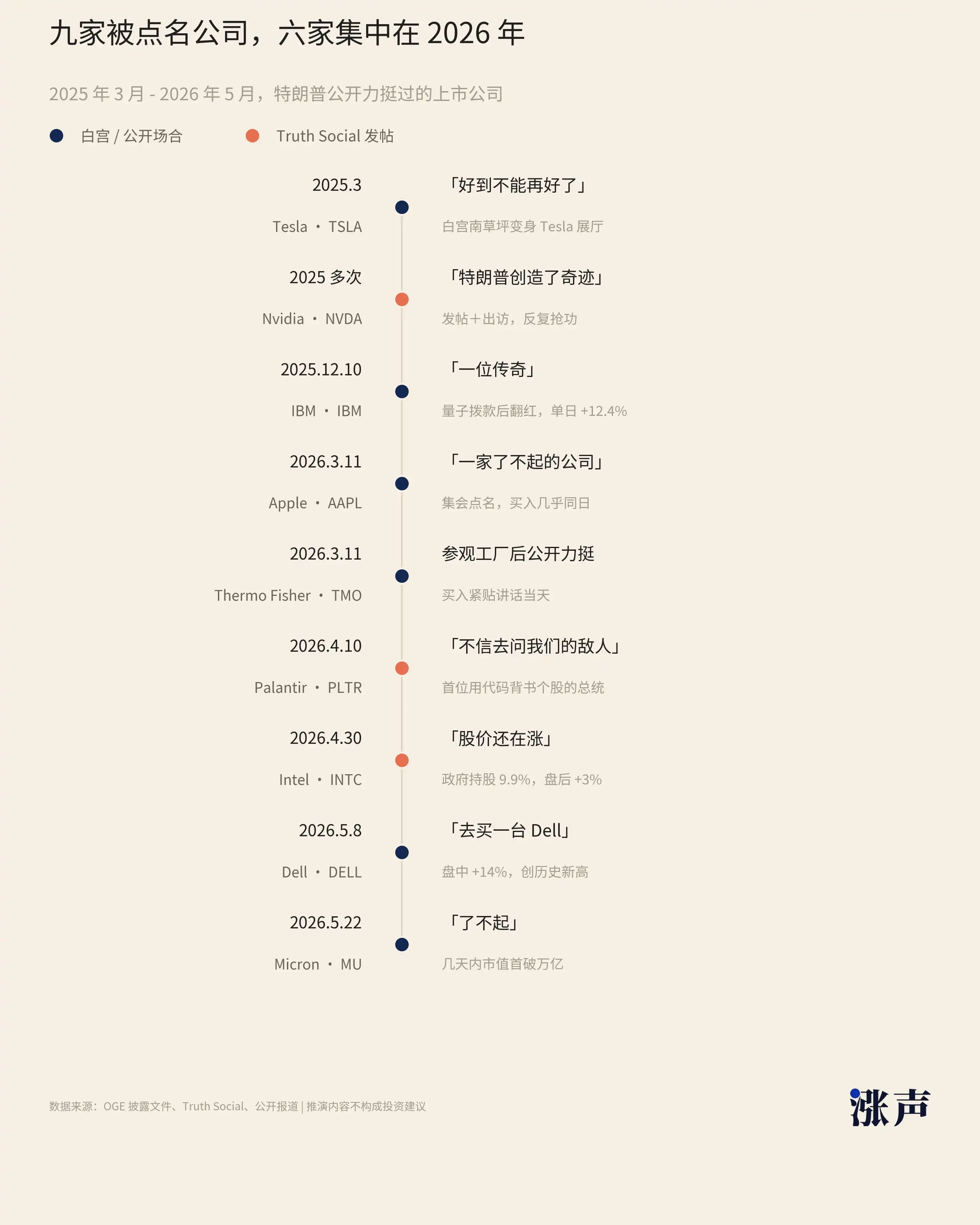
Expanding the scope from Trump's personal holdings to all publicly listed companies he has praised by name reveals a list far beyond the few well-known tech giants. Based on records from public speeches, White House events, and Truth Social posts, Trump has explicitly praised at least nine publicly listed companies over the past year, causing short-term stock price surges, including Intel, Dell, Micron, Palantir, IBM, Apple, Thermo Fisher Scientific, Tesla, and Nvidia.
BlockBeats has summarized some of their common traits:
First and most obviously, they almost all fit the narrative of "New AI Technology," "Leading U.S. Manufacturing," and "Reshoring Production Capacity."
Industrially, they are highly concentrated in the AI computing power and semiconductor chain. Intel, Micron, Nvidia, and AMD are chip companies; Dell provides computing hardware; IBM focuses on quantum computing; Palantir deals in AI software.
Secondly, each praised company has a government interest interface that can be directly leveraged. For example, the government holds 9.9% of Intel; Palantir is a major federal contractor; IBM and Intel receive CHIPS Act funding; Nvidia and AMD benefit from relaxed export licenses to China; Dell received a $9.7 billion Pentagon contract on May 27th after being praised. Apple was praised for its promise to invest in the U.S. and manufacture iPhone glass in Kentucky; Intel and Micron are building domestic wafer fabs; Dell assembles AI servers in the U.S.; IBM runs a quantum foundry in Albany; when Tesla was praised, Musk immediately pledged to double U.S. production on the spot. Trump rarely praises purely overseas production capacity; what he praises is the act of "bringing production lines back to America."
To some extent, these companies' narratives have been packaged and elevated to "national security" and "competition with China." Chips are a bottleneck to overcome; quantum computing is cybersecurity. Of course, a prerequisite for being praised is often the CEO first offering fealty.
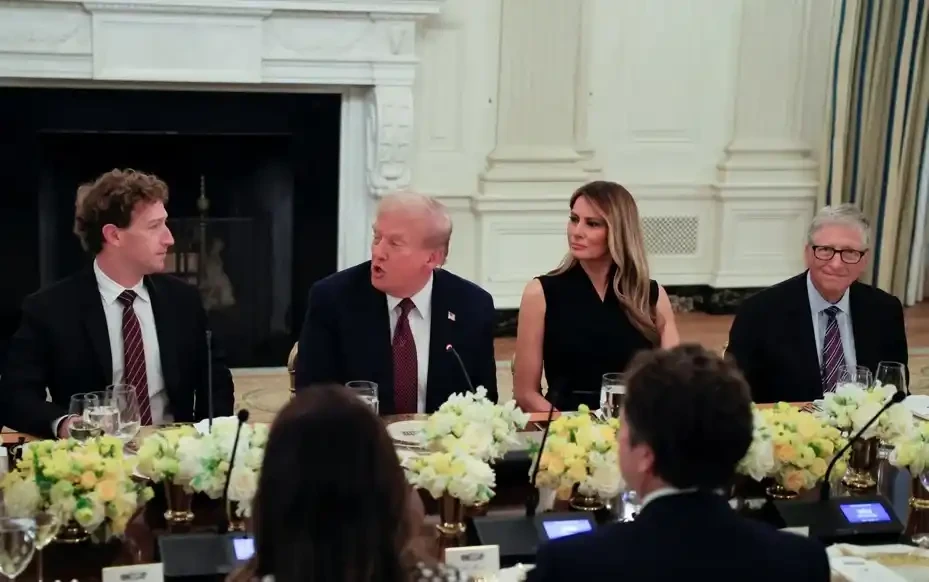
After taking office last year, Trump hosted a dinner for tech giants, asking each one about their investment amounts in the U.S.
Ultimately, all this positivity stems from "having the right connections." These CEOs generally show public support for Trump or have personal relationships with him.
Jensen Huang accompanied him on trips and publicly thanked him; the Dell family donated $6.25 billion to "Trump accounts"; Oracle's Larry Ellison is a long-time supporter who was deeply involved in the Stargate and TikTok deals; Musk was an ally during the period he was praised; Arvind Krishna was named in the room.
While the White House's official line is that the president's assets are held in a trust managed by his children, with independent third-party discretionary accounts handling trades, and that Trump himself does not participate in specific transactions, we can indeed observe a temporal overlap between Trump's endorsement timing and his personal holdings and trading.
For example, Palantir was heavily bought in March; weeks later, Trump named it on Truth Social. Dell was bought in February with $1 million to $5 million per month, followed by a public endorsement in May. For Apple and Thermo Fisher, the purchases and public praise happened almost on the same day.
If these patterns hold true, predicting Trump's next endorsement might not be too difficult.
Who Might Be the Next to Get a Shoutout
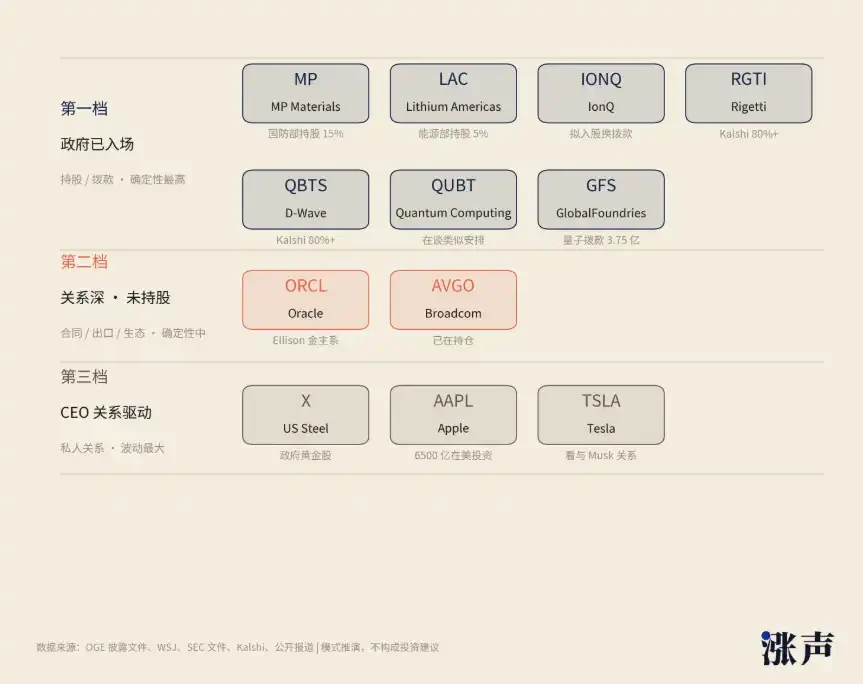
First, the most likely candidates are companies where the government has already taken a stake: MP Materials (MP), Lithium Americas (LAC), IonQ (IONQ), Rigetti (RGTI), D-Wave (QBTS), and others.
MP Materials is one of the most critical rare earth magnet suppliers in the U.S., primarily involved in rare earth mining, separation, and processing to produce permanent magnet materials used directly in fighter jets, electric vehicles, and missile systems.
In other words, it's not just a "resource company"; it's a part of the defense supply chain.
In July 2025, the U.S. Department of Defense acquired approximately 15% equity through shares and related arrangements, transforming it from a regular public company into a de facto "quasi-strategic asset." Crucially, this move predated the government's stake in Intel.
What's interesting about the market here is that compared to Intel's frequent discussion, MP Materials has remained relatively low-key, not even being prominently featured in any political narrative. This state of "already entered but not yet narrated" itself constitutes a lag in pricing.
Lithium Americas is a typical lithium resource development company. Its core asset is the Thacker Pass lithium project in Nevada, one of the largest known lithium resources in North America. The strategic importance of lithium for EVs, battery storage, and military energy systems needs no explanation.
Through warrants and project structures, the U.S. Department of Energy indirectly holds about 5% equity and holds roughly a 5% economic interest in the Thacker Pass project. Furthermore, the project is tied to General Motors (GM), creating a tripartite structure of "government + industry + public company."
More critically, the U.S. Department of Energy explicitly defined Thacker Pass as a "national security-level strategic lithium asset" in its documents.
Additionally, according to the Wall Street Journal, companies including IonQ (IONQ), Rigetti (RGTI), and D-Wave (QBTS) are discussing securing at least $10 million in grant support through "government equity or quasi-equity arrangements." Quantum Computing (QUBT) and Atom Computing are also being discussed within a similar framework.
These quantum computing players are still in a very early stage, but their unique position lies in naturally straddling the intersection of national security and basic scientific research.
Looking at the longer timeline, the U.S. government had previously launched a roughly $2 billion quantum technology support program, with IBM receiving about $1 billion, GlobalFoundries (GFS) getting about $375 million, and the remaining funds distributed to various labs and companies.
IBM has already been fully traded by the market, so the next step naturally falls to purer quantum plays. Notably, the market is already pricing this in ahead of him. On Kalshi, in the market betting on "which companies the government will invest in this year," the probabilities for Rigetti and D-Wave have already been priced above 80%.
GlobalFoundries (GFS) deserves a special mention. It received the $375 million quantum grant, is a domestic U.S. wafer foundry, and occupies both the chip and domestic manufacturing lanes simultaneously. This makes it the most suitable candidate to be casually named during an "American Chipmaking" event.
Beyond companies where the government has already taken a stake, there are some that structurally fit perfectly and have deep government ties but haven't received explicit equity stakes yet.
However, this category might be more likely to be praised in the context of contracts, exports, or ecosystem support, potentially making such endorsements less direct than previous ones.
Oracle (ORCL) might be the strongest candidate here. With Ellison's personal relationship, the Stargate and TikTok deals, and existing holdings in his portfolio, all the soft conditions are in place, awaiting a formal verbal endorsement. Broadcom (AVGO) is similar; a core supplier of custom AI chips and data center construction, it's already sitting in his portfolio.
Another category is companies driven by CEO personal relationships. The US Steel (X) angle deserves special attention. In the Nippon Steel acquisition case, the government secured a "golden share" stronger than ordinary equity holdings, and the "Protect American Steel" narrative can be revived at any time. Although Apple has already been praised, its $650 billion U.S. investment commitment is a reusable narrative, making a repeat shoutout highly probable. Tesla's inclusion, however, depends on the state of his relationship with Musk and is the most volatile item on this list.
It's important to clarify that the above is a pattern extrapolation based on publicly disclosed industrial policies and holdings clues. It is not a deterministic prediction and certainly does not constitute investment advice. These targets themselves carry extremely high political premiums, and political premiums are always a double-edged sword. They can boost a stock price after a single post, but they can also compress valuations when the wind changes direction.
After all, relying solely on shouts from the "White House stock picker" makes the stock price appreciation quite fragile.


