







- Core Thesis: The recent rebound in software stocks is not merely a technical correction but a market actively re-evaluating winners based on their ability to implement AI Agents: platform software companies that control customer gateways, enterprise data, workflows, and permission systems stand to be the primary beneficiaries of AI, while less defensible SaaS businesses face a threat to their fundamental business models.
- Key Factors:
- The software ETF IGV rose approximately 17.4% from the end of March to May 22nd, but the recovery is uneven, with stronger rebounds seen in sectors like cloud monitoring, security, and databases.
- The traditional SaaS per-seat subscription model is being challenged by AI Agents, as the market questions whether automation will reduce enterprise demand for software seats.
- Successful AI Agent implementation requires four key elements: an entry point, data, workflows, and permissions. This framework allows software companies possessing these capabilities (e.g., Salesforce, Snowflake) to undergo a revaluation.
- Salesforce (CRM) earnings will hinge on whether Agentforce can generate tangible orders, proving that AI enhances rather than replaces CRM; market revenue expectations stand at approximately $110.5 billion, representing 12% YoY growth.
- Snowflake (SNOW) earnings will depend on translating the AI narrative into actual data consumption growth. The market will focus on product revenue guidance (approx. $12.6 billion, up 26.9% YoY) and key customer metrics.
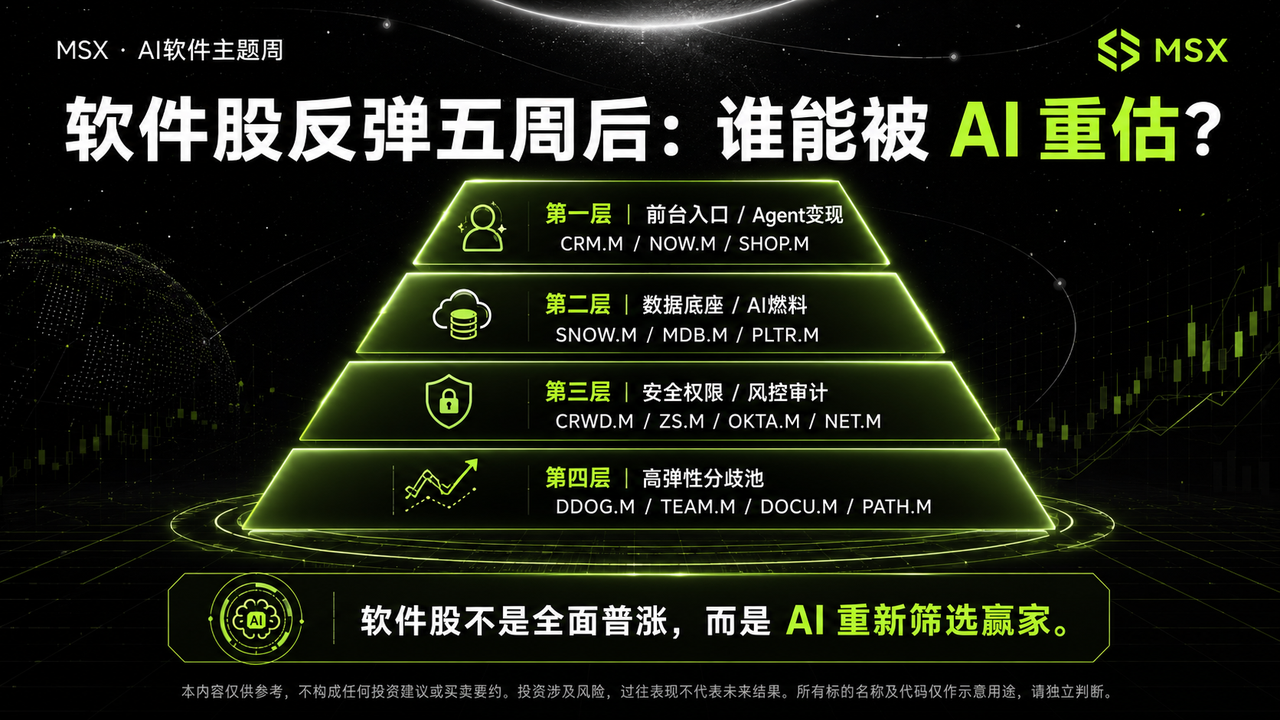
- Software stocks can be stratified by AI capability: front-end gateways (CRM, NOW), data infrastructure (SNOW, MDB), security/permissions (CRWD, ZS), and high-flexibility pools (DDOG, TEAM), with each layer reliant on earnings validation.
Over the past two months, if there's been one dominant narrative in U.S. stocks, it's undoubtedly AI hardware, computing power, NVIDIA, optical communications, electricity, and data centers.
However, there's another sector quietly making a comeback — software stocks.
This isn't hindsight bias. In the article "Oil Prices Surge, Rates Struggle to Fall, Tech Giants Stumble: Where are Q2's Excess Returns in U.S. Stocks?," Maitong clearly highlighted the "valuation correction" in the software sector, emphasizing that the focus shouldn't be on all SaaS, but rather on security software, enterprise platform leaders, and high-beta divergent pools, including PANW.M, CRWD.M, NET.M, CRM.M, NOW.M, ZS.M, INTU.M, ADBE.M, MDB.M, SNOW.M, DDOG.M, TEAM.M, among others.
Looking back, this assessment has been partially validated: measured from March 31 to May 22, the software ETF IGV rose from $80.05 to $94.01, an increase of approximately 17.4%. In other words, software stocks have experienced a clear cyclical recovery from oversold levels.
The bigger question, however, is whether this rebound is merely a technical correction after a significant sell-off, or if AI Agents are fundamentally re-pricing certain software companies in the market.
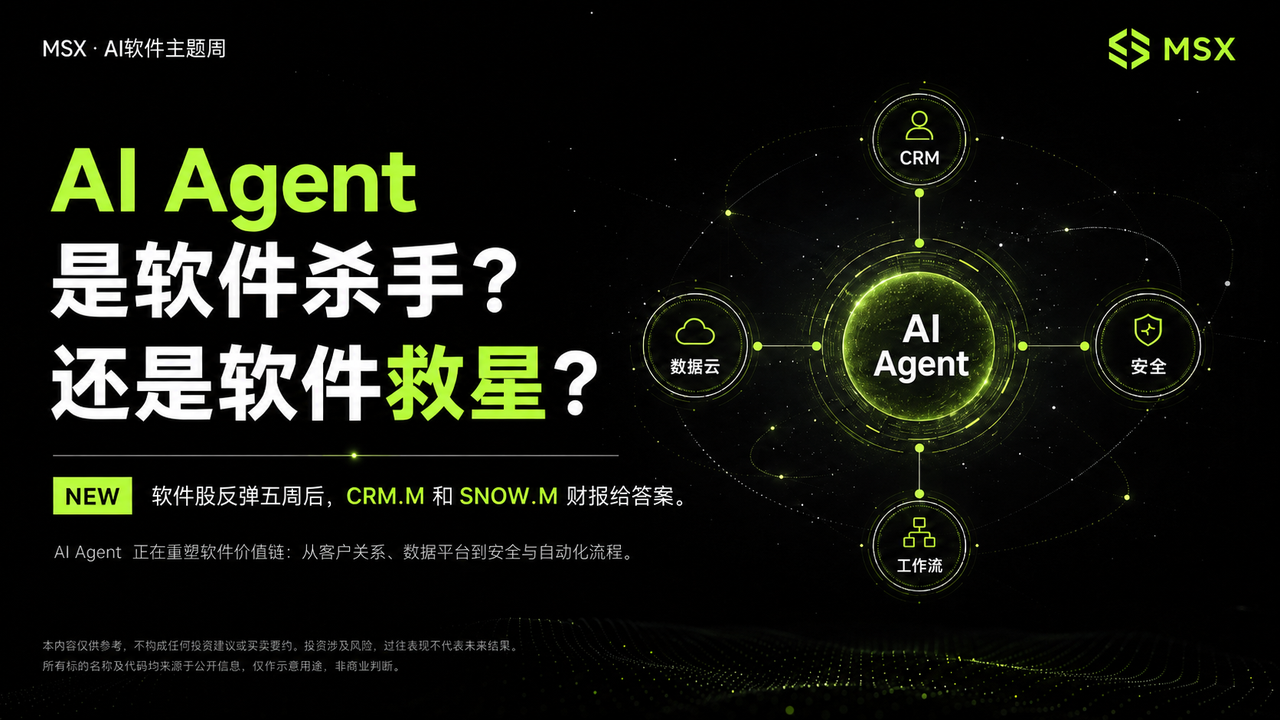
1. Beyond the Rebound: Why Were Software Stocks Shunned by the Market?
Consider the data below.
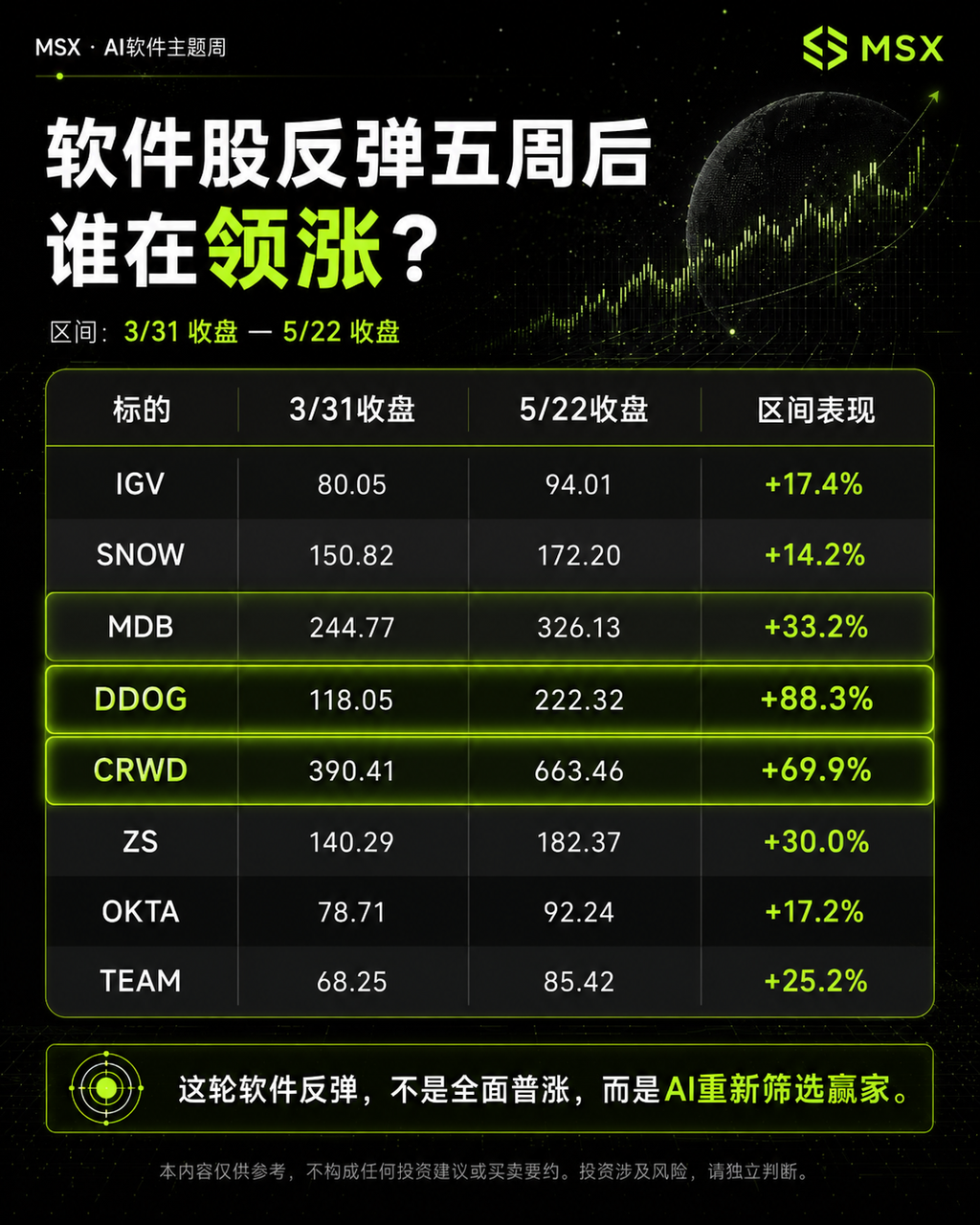
This data illustrates a straightforward point: It's not that no one is buying software stocks anymore. The market is already re-pricing specific segments, particularly companies involved in cloud monitoring, security, databases, and data clouds. Their rebound momentum is significantly stronger than IGV itself.
But this doesn't mean "all SaaS is heading back to a bull market."
More accurately, this software rebound reflects AI re-sorting the winners. The market is distinguishing which software will be replaced by AI Agents and which will become more critical because of their implementation.
As is well known, software stocks have been under pressure recently, not just due to deteriorating earnings, but because the market is questioning the traditional SaaS business model.
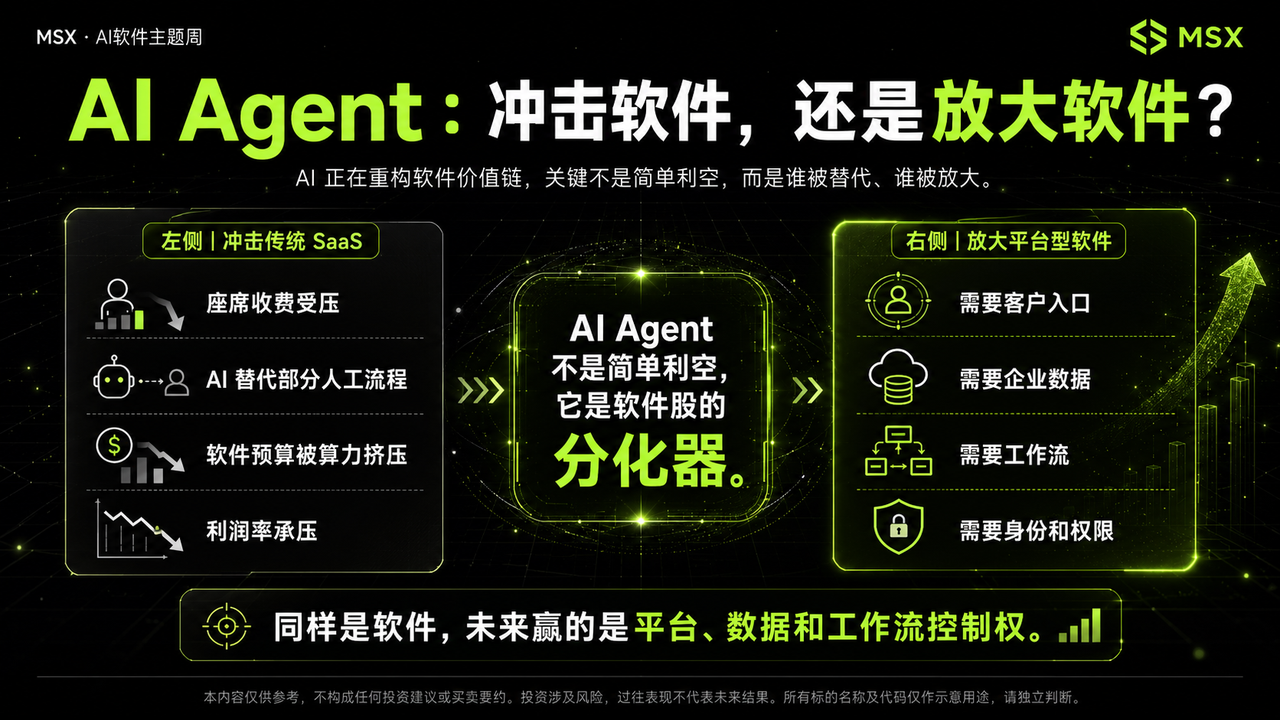
Traditional SaaS often charges per head or per seat. Companies pay subscription fees based on the number of sales seats, customer service seats, or collaboration seats they buy. But with the advent of AI Agents, the market is asking a sharp question: If one AI Agent can do the work of multiple employees, will companies still need that many SaaS seats?
This is the core logic behind the past de-rating of software stocks.
AI Agents can potentially automate writing emails, following up with clients, generating contracts, analyzing data, processing tickets, and executing approvals. Once these tasks are automated, the traditional software model of "more people equals more seats equals higher revenue" faces a challenge.
Simultaneously, corporate AI budgets have been flowing more towards GPUs, cloud computing power, data centers, and infrastructure, leaving software companies in a squeezed position. More troubling is that if AI only adds R&D and computing costs without improving profit margins, valuation pressure on software companies will persist.
As we mentioned in our Q2 outlook, for enterprise software, platform technology, and cybersecurity companies, if AI only increases spending without improving margins, valuation pressure will continue to rise.
So, what the market truly dislikes about software stocks isn't just slowing growth, but the uncertainty surrounding the business model itself.
2. The Key Isn't "Having AI," It's Whether AI Can Become Revenue
The market is also beginning to realize that AI Agents don't operate in a vacuum.
For a truly implementable enterprise AI Agent, at least four things are needed:
- First, an interface, such as sales, customer service, marketing, IT ticketing, and office collaboration – these are where real work happens in a company;
- Second, data, without internal enterprise data, an AI Agent can only give generic answers, making real decisions difficult;
- Third, processes, companies don't want AI for chit-chat; they want it to initiate approvals, update CRMs, process tickets, generate quotes, and close business loops;
- Fourth, permissions and security, in the future, it's not just humans who can make mistakes. Agents could also misoperate, access data without authorization, or leak information, making identity, security, and auditing even more critical;
This is why a recovery logic for software stocks is emerging. AI Agents don't necessarily bypass software; they may need to sit on top of it.
In other words, AI Agents will indeed impact SaaS that merely sells seats without strong data and process moats. However, for software companies that control customer interfaces, enterprise data, workflows, and permission systems, it could become a new growth driver.
One of the most critical software earnings reports this week is from Salesforce.
Salesforce will report its FY2027 first-quarter earnings after the market closes on May 27. The company has clearly positioned itself as the "#1 AI CRM," stating it helps enterprises become "agentic enterprises" by integrating humans, agents, apps, and data into a unified platform.
Market expectations currently place Salesforce's quarterly revenue at approximately $11.05 billion, a year-over-year increase of about 12%; adjusted EPS is expected to be around $3.11, up from $2.58 in the same period last year. The options market also suggests traders anticipate a potential swing of nearly 9% in CRM's stock price post-earnings.
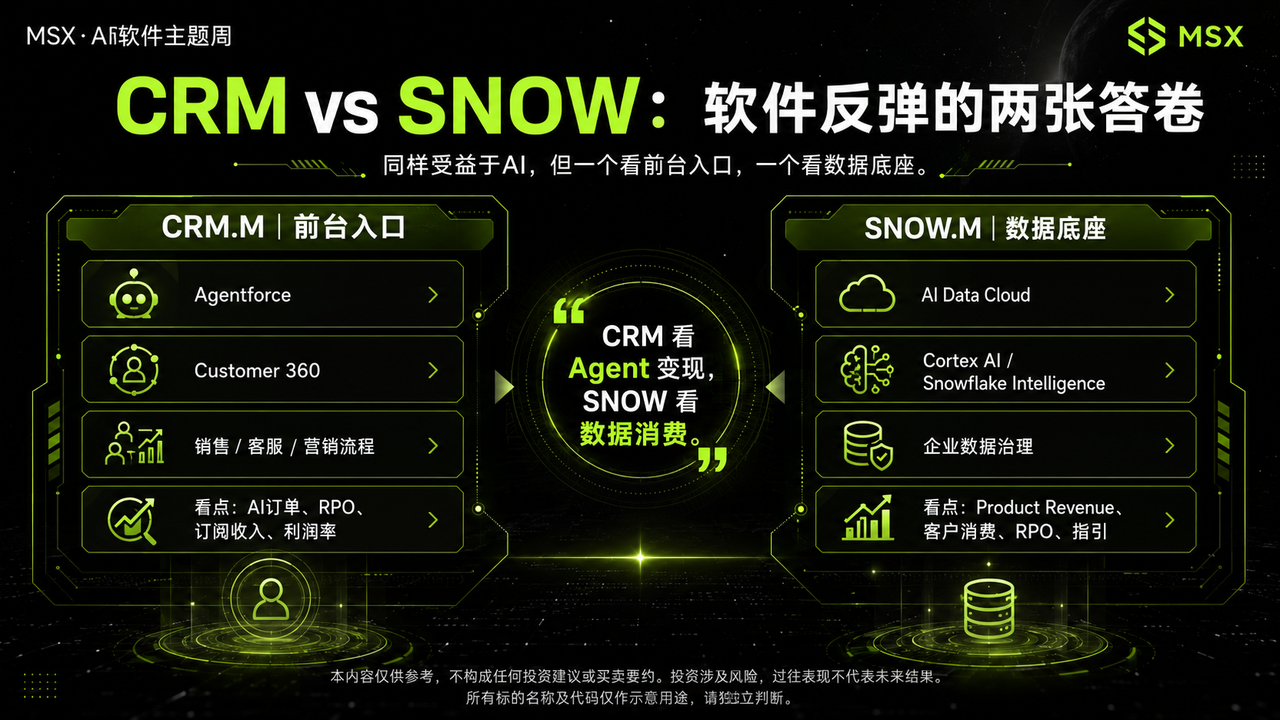
But the real focus of this report isn't whether traditional CRM revenue slightly exceeds expectations. It's whether Agentforce can prove that AI Agents are truly commercializable.
The market will scrutinize several issues: Does Agentforce have real orders? Are AI features boosting RPO and subscription revenue? Are customers willing to pay extra for AI Agents, or do they see it as just an add-on to existing software? Can profit margins and buybacks continue to support the valuation of a mature software company?
CRM's answers are crucial. If Salesforce can demonstrate that AI Agents enhance CRM rather than replace it, the rebound in software stocks won't just be a valuation correction; it could enter a phase of AI-driven revaluation.
Another key earnings report is from Snowflake.
Snowflake will also report its FY2027 first-quarter results after the market closes on May 27. The company positions itself as the AI Data Cloud, emphasizing its platform helps enterprises derive value from data, applications, and AI.
The logic for SNOW.M and CRM.M is different.
CRM is more of a front-end interface, while SNOW is more of a back-end data foundation. For an AI Agent to help a company make decisions, it first needs to access, understand, and govern enterprise data. No matter how powerful the model, it's difficult to truly implement without clean, unified, and callable data.
Before the earnings, Snowflake provided FY2027 Q1 product revenue guidance of $1.262 billion to $1.267 billion, corresponding to approximately 27% year-over-year growth; the Zacks consensus estimate for Q1 product revenue is about $1.26 billion, representing approximately 26.9% year-over-year growth. The market will also focus on the number of million-dollar customers, total customer count, net revenue retention, and the adoption of AI products like Snowflake Intelligence and Cortex Code.
Therefore, the key for SNOW.M isn't "having an AI narrative," but whether that AI narrative can translate into more data consumption.
If Product Revenue exceeds the high end of guidance, customer consumption continues to recover, and RPO and large customer numbers improve, it would suggest that enterprise AI isn't just stuck at the model layer but is beginning to drive usage of data platforms.
Conversely, if the AI story sounds good but consumption growth and guidance are weak, the market might interpret this rebound as a "valuation correction" rather than a "fundamental re-rating."
In short, CRM.M is about whether Agents can generate revenue, while SNOW.M is about whether AI can drive data consumption.
3. How to Categorize Software Stocks in This Recovery?
This software recovery shouldn't be viewed simply as all software stocks rising together. A more logical approach is to categorize them based on the capabilities required for AI Agent implementation.
- The first tier is Front-end Interfaces and Agent Monetization, represented by companies like CRM and NOW. They control sales, customer service, business processes, and enterprise work interfaces. If AI Agents truly integrate into workflows, these companies have the opportunity to monetize AI as a product;
- The second tier is Data Foundation and AI Fuel, represented by companies like SNOW, MDB, and PLTR. AI Agents need to access internal enterprise data to understand the business. The more complex the data, the more important governance becomes, and the higher the value of these platforms;
- The third tier is Security, Identity, and Permissions, represented by companies like CRWD, ZS, OKTA, and NET. The more autonomous Agents become, the more companies need to manage permissions, audit behavior, and prevent data leaks. Future security software won't just protect humans; it must also define the boundaries of Agent actions;
- The fourth tier is High-Beta Divergent Pool, such as DDOG, TEAM, DOCU, and PATH. These stocks have high elasticity but are also more dependent on earnings validation. If AI can increase usage frequency, customer stickiness, and revenue growth, they can continue to recover. If it's just a valuation bounce, the sustainability will be much weaker;
So, are AI Agents a software killer or a software savior?
The answer is: both are possible.
For software companies lacking data, process, and customer interface moats, AI Agents could compress their value. But for platform-type software companies that control customer relationships, enterprise data, business processes, and security permissions, AI Agents could become a new growth engine.
This is also why software stocks have rebounded for five or six weeks, yet the market hasn't delivered a final verdict.
The real answers will be revealed in upcoming earnings reports – CRM needs to prove Agentforce can generate real orders; SNOW needs to show enterprise AI can drive data consumption; security software must demonstrate that in the age of AI automation, the demand for permissions and risk management will only grow stronger; and high-beta software stocks need to prove their rebound is based on revenue, margins, and guidance, not just sentiment.
In short, as the saying goes, true gold fears no fire. Ultimately, companies with interfaces, data, processes, and permissions will have the opportunity to transition from "AI victims" to "AI beneficiaries."


