






Perp DEX regains market attention: What have the leading projects been doing this year?


- Core Insight: The Perp DEX sector has evolved beyond being a simple alternative to CEX derivatives. It is now expanding into areas such as stablecoins, RWA, prediction markets, proprietary chains, and yield-bearing collateral to compete for global asset trading demand, with the competitive focus shifting from crypto assets to traditional financial asset trading.
- Key Elements:
- Hyperliquid has expanded into RWA and prediction markets via HIP-3 and HIP-4. The 24-hour trading volume of its top HIP-3 markets (e.g., crude oil) is approaching the level of mid-tier mainstream assets on Binance.
- Aster has launched its own chain, Aster Chain, introduced Shield Mode for private transactions, and listed traditional financial assets like SpaceX Pre-IPO via the Permissionless Listing Vote.
- StandX is differentiating itself around "yield-bearing collateral," introducing Maker Points to incentivize maker liquidity, Position Yield to improve capital efficiency for open positions, and Block Trade for large-volume transactions.
- Lighter has initiated a LIT buyback program and launched the Liquidity Partner Program, allocating approximately $250,000 per week to reward participants providing liquidity for RWA markets (e.g., crude oil, precious metals, equities).
- Following the investment from Circle Ventures, edgeX launched its V2 Beta contract, supporting trading across diverse assets including crypto, traditional finance (e.g., gold, crude oil), and prediction markets.
Original author: Changan I Biteye Content Team
This week, Hyperliquid once again became the market focus.
The HYPE price surged over 40% in a week, hitting an all-time high. Concurrently, Perp DEX-related projects like Aster, Lighter, and edgeX also saw varying degrees of increase, bringing the entire sector back into the market's spotlight.
Over the past year, the Perp DEX sector has undergone significant changes. They are no longer merely on-chain alternatives to CEX derivatives, nor do they compete solely through trading mining, points, and fee rebates. Instead, they are continuously expanding into areas like stablecoins, RWA, prediction markets, proprietary chains, revenue buybacks, and yield-bearing collateral.
This article chronologically traces the changes of several representative Perp DEXs over the past year, examining their recent achievements and respective focuses.
1️⃣Hyperliquid: From Trading Platform to On-Chain Financial Infrastructure
Over the past year, Hyperliquid's transformation isn't just about expanding trading volume; its product boundaries have clearly widened. Evolving from a platform centered on perpetual contracts, it now extends into stablecoins, prediction markets, and an open contract deployment platform.
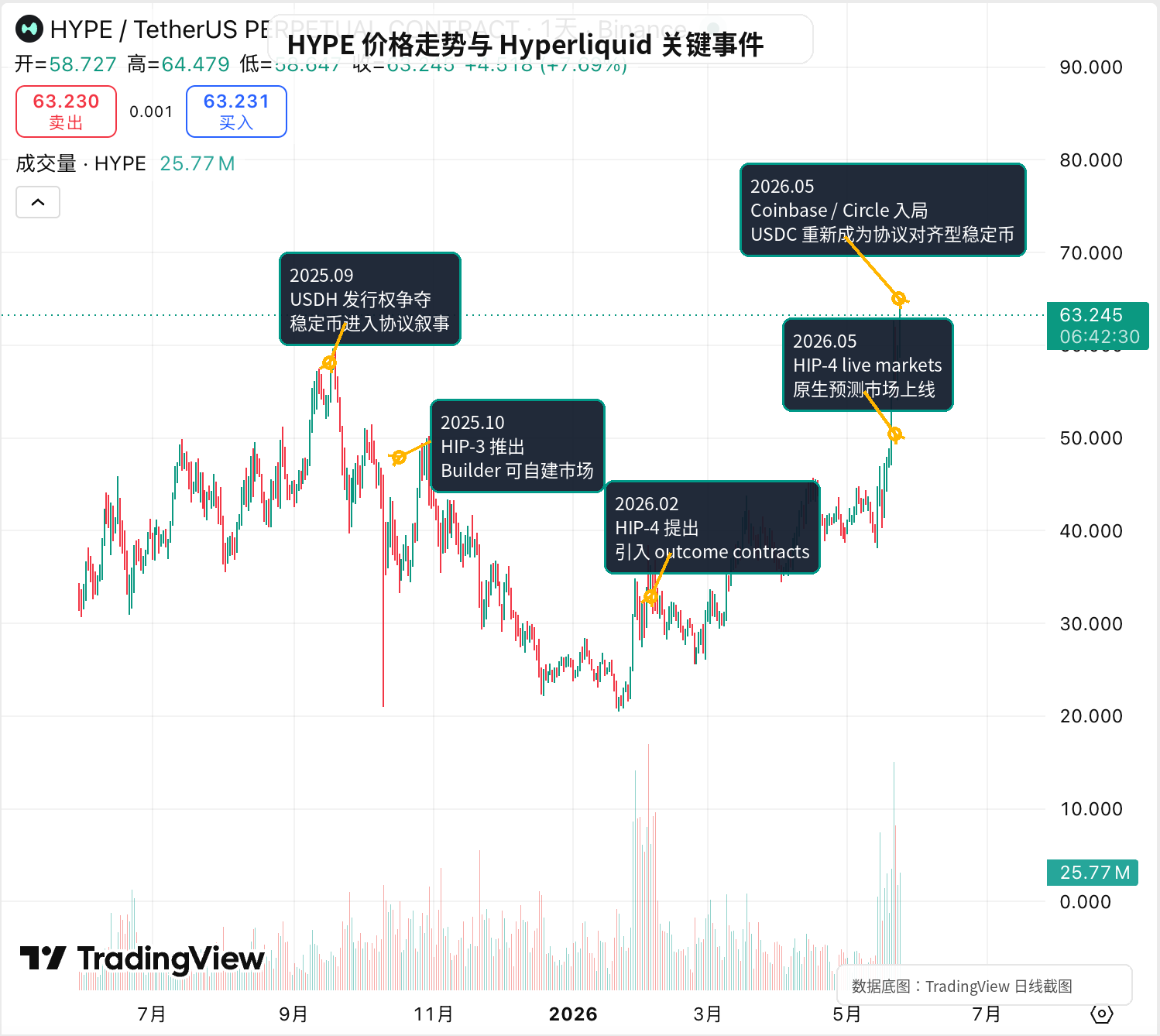
September 2025: USDH Competes to Become Hyperliquid's Settlement Asset
In September 2025, Hyperliquid advanced its native stablecoin, USDH. Unlike typical stablecoin launches, USDH's uniqueness lies in its bid to become the primary US dollar liquidity gateway within the Hyperliquid ecosystem.
October 2025: HIP-3 Transitions from Official Token Listings to Builder-Created Markets
In October 2025, Hyperliquid introduced HIP-3. Previously, Hyperliquid's perpetual market listings were primarily determined by the core team. Post-HIP-3, external Builders can deploy their own Perp markets on Hyperliquid.
HIP-3 markets now cover asset classes like traditional finance, commodities, and equities.
- WTI Crude Oil 24h volume ~$877 million, Open Interest ~$209 million;
- Brent Crude Oil 24h volume ~$368 million, OI ~$323 million.
For context, the 24h volume in top HIP-3 markets is already approaching the level of mid-tier mainstream assets ranked 10th to 20th on Binance's volume leaderboard.
May 2026: HIP-4 Launches, Hyperliquid Enters Native Prediction Markets
In February 2026, Hyperliquid proposed HIP-4, introducing outcome contracts; development advanced on testnet, with the first live outcome markets appearing in early May.
Unlike traditional perpetuals, HIP-4 allows users to trade on which price range the underlying asset will settle into.
Currently, HIP-4 has listed two BTC price prediction markets, including "Will BTC be above a certain price at a specific time?" and "Which price range will BTC fall into?"
The key difference from Polymarket is that HIP-4 isn't a standalone product; it's integrated directly into Hyperliquid's account and matching systems. Users don't need to move funds and can participate in prediction markets using the same trading account.
Based on current data, HIP-4 is still in its early stages. The top market has a 24h volume of approximately $32,900 and Open Interest of about $34,900.
For comparison, in BTC daily price prediction markets, a single Polymarket market sees around $433,700 in daily volume, while Hyperliquid's leading HIP-4 market sits at roughly $32,900 – about 1/13th of Polymarket's, indicating a very early phase.
May 2026: Coinbase & Circle Enter, USDC Becomes the Protocol-Aligned Stablecoin
Also in May 2026, Hyperliquid's stablecoin strategy saw a new development.
Coinbase announced plans to act as a capital deployer, activating AQAv2 on USDC; Circle will serve as the technical deployer, handling CCTP and native cross-chain infrastructure. Both Coinbase and Circle have committed to staking HYPE to activate AQAv2. As part of the transition arrangement, Native Markets has agreed to grant Coinbase the right to purchase the USDH brand assets.
This signals that the focus of protocol-aligned stablecoins within the Hyperliquid ecosystem is shifting from USDH to USDC.
With Coinbase as the capital deployer sharing the majority of reserve yield income with the protocol, USDC becomes a stablecoin better aligned with Hyperliquid's revenue distribution logic.
In future network upgrades, the HIP-4 outcome markets will also use USDC as the quote asset.
2️⃣Aster: From Volume Explosion to Building Its Own Trading Ecosystem
Unlike Hyperliquid, which spent a year expanding protocol boundaries, Aster's growth path is more direct: first scale trading volume, then progressively expand products and infrastructure.
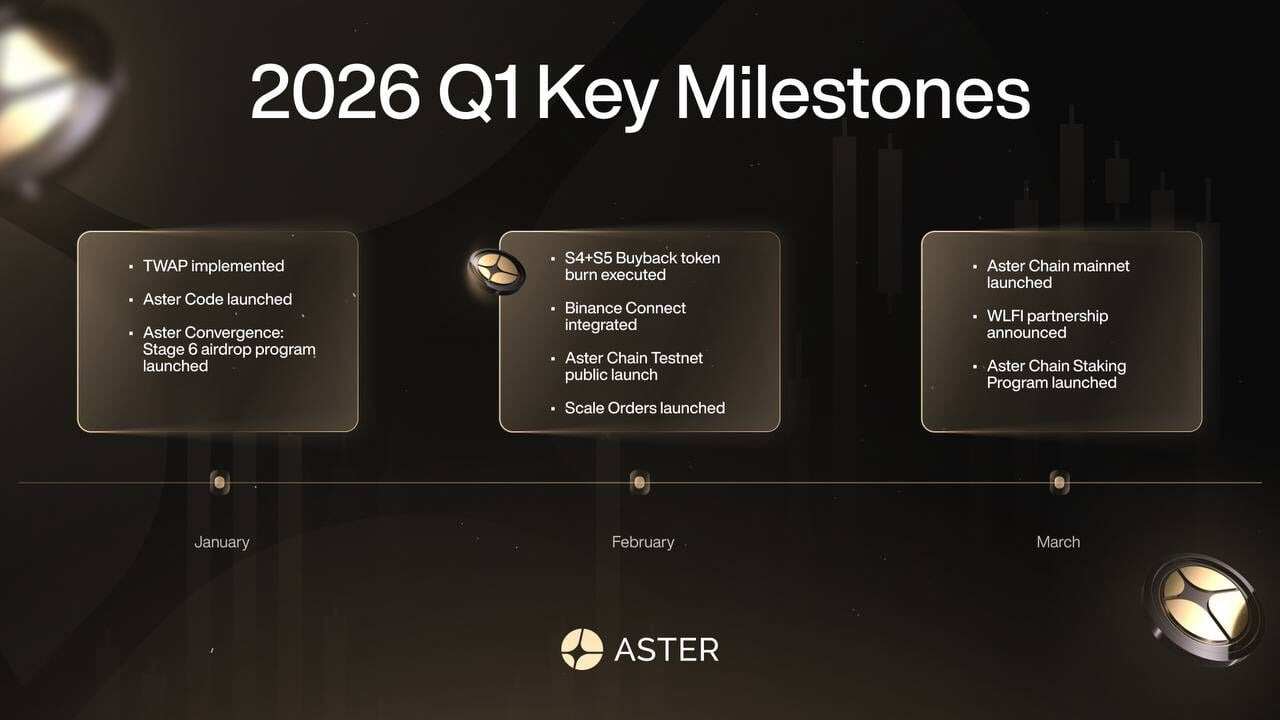
December 2025: Shield Mode Launched
Aster published its 2026 H1 Roadmap, concurrently beginning the rollout of Shield Mode, TWAP strategy orders, and the expansion of RWA perpetual markets for stocks, forex, and commodities.
March 2026: Aster Chain Mainnet Phase 1 Launches, Aster Transitions from Perp DEX to Proprietary L1
Focusing on private transactions, using ZK proofs and privacy addresses to conceal trade information, while emphasizing low latency, high throughput, and a zero-gas experience.
Aster aims not to be just a multi-chain Perp DEX but to integrate matching, privacy, RWA assets, trading incentives, and governance into its own on-chain ecosystem.
May 2026: Continuous Listing of Global Hot Assets & Permissionless Listing Vote
Aster continues expanding tradable assets, adding more stocks, Pre-IPO, commodities, and forex markets, such as the SpaceX Pre-IPO perpetual contract.
Simultaneously, Aster launched the Permissionless Listing Vote. This mechanism effectively opens up some listing authority to the community: qualified validators or ASTER stakers can propose new trading pairs, with the community voting on whether to list them.
This is similar to Hyperliquid's HIP-3, shifting from "the platform decides which assets to list" to "external participants collaboratively drive new markets."
Current data shows some traditional finance-related markets are gaining trading activity. For example,
- Crude Oil (CLU) 24h volume ~$8.37 million,
- Silver (XAG) ~$7.48 million, Gold (XAU) ~$3.30 million;
- In the Pre-IPO market, SpaceX contract 24h volume ~$1.50 million.
3️⃣StandX: Turning Perp Margin into Yield-Bearing Assets
Most Perp DEXs compete only on matching, leverage, and trading fees. StandX's approach is more interesting: it attempts to turn idle or sunk capital during the trading process back into yield-generating assets.
January 2026: StandX Launches Maker Points.
It rewards not just filled trades, but order book liquidity. Users earn Maker Points simply by placing limit orders, even before they are filled; filled orders then generate Trading Points.
In other words, StandX first incentivizes passive liquidity within its orderbook.
March-April 2026: StandX Launches SIP-1 through SIP-4
The product direction becomes clearer: building a more capital-efficient Perp trading layer centered around DUSD, position yields, and large trade execution.
- SIP-1 is Block Trade, extracting large derivative trades from the regular orderbook to enable on-chain matching and StandX settlement, reducing the impact of large orders.
- SIP-2 is Position Yield, allowing eligible perpetual positions to participate in yield distribution.
- SIP-3 further strengthens DUSD's native yield, directing a portion of StandX Perps trading fees to the DUSD yield pool.
- The latest SIP-4 extends Block Trade to TP/SL scenarios. It's not just adding a take-profit/stop-loss button; it creates position-linked execution rights, allowing users more flexible trade arrangements around future exit prices, protection prices, and reservation fees.
Viewed together, StandX's product narrative is quite comprehensive: DUSD addresses margin yields, Maker Points incentivizes orderbook liquidity, Position Yield improves position capital efficiency, and Block Trade with TP/SL caters to larger, more professional trading needs.
This makes StandX feel less like a pure Perp DEX and more like a trading system built around "yield-bearing margin." Its differentiation isn't offering higher leverage, but minimizing capital idleness for users before, during, and after trades.
4️⃣Lighter: Since 2026, Shifting from Airdrop Expectations to Revenue Buybacks, RWA, and ZK Security Narrative
January 2026: LIT Buyback Initiated, Protocol Revenue Tied to Token
In January 2026, Lighter initiated the LIT buyback plan. Unlike many projects holding revenue in treasuries, Lighter stated it would use fees generated by the DEX and future products for on-chain LIT buybacks.
Early reports indicated the protocol treasury had approximately $1.35 million USDC available for market buybacks at launch; multiple buybacks have been executed since.
February 2026: Upgrade to LLP, Designing Dedicated Liquidity Strategies for RWA
In February 2026, Lighter upgraded its Liquidity Provider infrastructure, introducing independent strategies for different market types, including crypto perpetuals, forex, and RWA markets. This manages risk, liquidation, and ADL separately for different assets, rather than sharing one liquidity pool across all markets.
This step laid the groundwork for subsequent RWA expansion. Since markets for commodities, stocks, and forex have volatility, trading hours, and liquidity structures different from crypto assets, using a single pool for all risks would have limited scalability.
April 2026: Liquidity Partner Program Launched, Focused on Boosting RWA Depth
In April 2026, Lighter launched the Liquidity Partner Program, rewarding participants providing deep liquidity to RWA markets. Open to everyone, rewards are distributed via random order book snapshots, with weekly reward amounts announced in advance.
The program offers approximately $250,000 in weekly rewards, primarily targeting crude oil, precious metals, and equity markets like NVDA and Tesla.
5️⃣edgeX: Since 2026, Moving from Pre-TGE Incentives to EDGE Chain and TradFi Perps
February 2026: Circle Ventures Investment, Native USDC Integration Becomes a Focus
In February 2026, Circle Ventures invested in edgeX.
With Circle Ventures' involvement, edgeX can subsequently utilize USDC for margin, settlement, cross-chain operations, and institutional liquidity access, smoothing its TradFi Perps roadmap.
March 2026: EDGE TGE, Tokenomics Goes Live
In March 2026, edgeX first announced EDGE airdrop terms and opened pre-market trading. Later, it officially confirmed the EDGE TGE for March 31st.
April-May 2026: TradFi Perps Expansion, edgeX Adds Equities and Commodities Markets
Post-TGE, edgeX continued expanding TradFi Perps, adding numerous equities, commodity, and macro markets, including NVDA, TSLA, AAPL, Gold, Silver, and Crude Oil.
This is similar to Hyperliquid's HIP-3 and Aster's RWA expansion, extending Perp DEXs beyond crypto asset trading into traditional financial asset trading.
Current trading data shows liquidity forming in some TradFi markets. For example:
- Gold (XAUUSDC) 24h volume ~$9.49 million
- Crude Oil (BZUSDC) ~$5.89 million
May 2026: Contract V2 Beta Launches, edgeX Moves from Single Perp DEX to EDGE Stack
In May 2026, edgeX opened Contract V2 Beta.
Simply put, V1 was edgeX's initial trading system, primarily used to establish derivative trading. V2 is the next-generation system, designed to host more markets, faster matching, and more complex trading products.
This upgrade now supports derivatives, spot trading, prediction markets, and trading of traditional financial assets like stocks, ETFs, gold, and crude oil.
Currently in Beta, the platform already shows many new markets, such as equities and commodity perpetuals.
Closing Thoughts
Looking back over the past year, the evolution of Perp DEXs is clear: they are no longer satisfied with just being on-chain derivatives exchanges.
They have chosen different paths, but the underlying judgment is similar: Perp DEXs cannot remain confined to the crypto derivatives market.
This year, U.S. equities have performed strongly, with tech stocks, AI-related assets, and traditional financial markets continually attracting capital. For on-chain trading platforms, user demand now extends beyond trading BTC, ETH, and altcoins. Users want to trade crypto, equities, indices, gold, crude oil, and even Pre-IPO assets from a single account.
Therefore, Perp DEXs are competing not just for the crypto derivatives market, but for the larger demand for global asset trading. This explains why, over the past year, several leading Perp DEXs have focused efforts on TradFi assets.
The HYPE surge merely propelled Perp DEXs back into the market spotlight. The deeper, more fundamental shift is this: the competition among Perp DEXs has evolved from being CEX alternatives to determining "who can capture more of the global asset trading demand."


