






Gate 研究院:预测市场进入主流周期,Gate 已成为 Top3 交易入口


- มุมมองหลัก: เมื่อตลาดคาดการณ์ก้าวเข้าสู่วงจรการเงินกระแสหลัก Gate.io ผ่านการผสานรวม Polymarket ได้เปลี่ยนการซื้อขายเหตุการณ์บนเชนที่ซับซ้อนให้เป็นประสบการณ์การแลกเปลี่ยนแบบรวมศูนย์ที่เหมาะสำหรับผู้ใช้ทั่วไป ด้วยฐานผู้ใช้ที่กว้างขวางและระบบนิเวศการซื้อขาย ปัจจุบันเป็นช่องทางกระจายสินค้า Top3 ของ Polymarket ซึ่งบ่งชี้ว่าแพลตฟอร์มการซื้อขายกำลังพัฒนาจากการซื้อขายสินทรัพย์เพียงอย่างเดียวไปสู่ยุคของการซื้อขายข้อมูลเหตุการณ์แบบหลายมิติ
- ปัจจัยสำคัญ:
- ภาพรวมตลาด: ตลาดคาดการณ์เข้าสู่ช่วงการเติบโตแบบก้าวกระโดด ปริมาณการซื้อขายรายเดือนในปี 2569 ใกล้แตะ 3 หมื่นล้านดอลลาร์ สถาบันการเงินแบบดั้งเดิม เช่น ICE (ลงทุน 1.6 พันล้านดอลลาร์), Cboe และ Nasdaq เร่งวางแผนในด้านสัญญาอีเวนต์
- การเปลี่ยนแปลงของผู้ใช้: ตรรกะการซื้อขายกำลังเปลี่ยนจากการซื้อขาย "ราคา" ของสินทรัพย์ไปสู่การซื้อขายความน่าจะเป็นของ "เหตุการณ์ในอนาคต" โดยตรง ผู้ใช้ตลาดคาดการณ์มีความทับซ้อนสูงกับผู้ซื้อขายอนุพันธ์แบบดั้งเดิม ซึ่งล้วนเป็นกลุ่มที่มีความถี่สูงและมีความไวต่อข้อมูลสูง
- กลยุทธ์ของ Gate: Gate ใช้ผู้ใช้ทั่วโลกมากกว่า 53 ล้านราย ช่องทางเงิน USDT และระบบนิเวศ Spot/Futures โดยใช้รูปแบบ "ซื้อขายแทน/ดำเนินการแทน" ที่คล้ายกับ Gate Alpha เพื่อขจัดแรงเสียดทานในการทำธุรกรรมบนเชน
- การออกแบบผลิตภัณฑ์: Gate นำเสนอโครงสร้างคู่ทั้งโหมดคาดการณ์และโหมดซื้อขาย พร้อมเพิ่มส่วนเหตุการณ์ฉับพลัน การเรียกดูตามหมวดหมู่ ฯลฯ ขยายสายผลิตภัณฑ์จาก "Spot+Futures" เป็น "Spot+Futures+Event Trading"
- วงจรปิดทางธุรกิจ: Gate และ Polymarket สร้างเกื้อกูลซึ่งกันและกัน Gate ได้รับสถานการณ์การซื้อขายความถี่สูงและคุณสมบัติเป็นช่องทางข้อมูล ในขณะที่ Polymarket ได้รับความสามารถในการกระจายสินค้าระดับ CEX และช่องทางเงิน USDT
- การยืนยันการกระจายสินค้า: หลังจากผสานรวมเพียง 6 สัปดาห์ Gate กลายเป็นช่องทางกระจายปริมาณการซื้อขาย Top3 ของ Polymarket และแม้กระทั่งกลายเป็นช่องทางกระจายที่ใหญ่เป็นอันดับสองในบางวัน ซึ่งยืนยันประสิทธิภาพของโมเดลการกระจายสินค้าผ่าน CEX
摘要
• Prediction markets have entered the mainstream financial cycle. Platforms like Polymarket are experiencing sustained growth in trading volume and user activity. Traditional financial institutions such as ICE, Cboe, and Nasdaq are accelerating their布局, with event trading emerging as a significant branch of derivatives and information financialization.
• Gate is the first major trading platform to integrate Polymarket. Leveraging its 53 million global users, USDT on-ramps, spot and derivatives ecosystem, and an in-account agency trading model similar to Gate Alpha, it encapsulates complex on-chain prediction markets into a CEX-native event trading experience.
• Gate has become a Top 3 volume distribution channel for Polymarket, validating the critical value of CEX distribution capabilities for the expansion of prediction markets. This creates a mutually beneficial structure: Gate provides users and a funding gateway, while Polymarket offers event markets and probabilistic pricing.
In the current industry evolution, prediction markets have moved from niche on-chain applications to the mainstream financial spotlight. Since 2024, platforms like Polymarket have seen a surge in trading volume and user activity; in March 2026, ICE, the parent company of the NYSE, announced an additional $600 million strategic investment in Polymarket, bringing its total investment to $1.6 billion. Traditional exchanges like Cboe and Nasdaq are also launching event-driven contracts. Demand for trading events related to macro-politics, economics, AI developments, and crypto industry hotspots is continuously growing. This trend indicates that the 'future' itself is gradually becoming a tradable asset. Against this backdrop, Gate has taken the lead in integrating Polymarket, becoming the first major trading platform in the crypto industry to introduce prediction markets into a centralized trading system.
As one of the world's top crypto trading platforms, Gate boasts significant advantages: a user base exceeding 53 million; a product ecosystem covering spot and futures, supporting over 4,600 trading pairs; a global presence and high trading activity. Leveraging these strengths, Gate seamlessly embeds prediction markets into its ecosystem, expanding its product line from the traditional 'Spot + Futures' to 'Spot + Futures + Event Trading'. Gate is accelerating its transformation into the next-generation information financialization gateway for both retail and professional investors, seizing the lead in event-driven financial innovation. Currently, Gate has become a Top 3 distribution channel for Polymarket.
1. Industry Trend: Prediction Markets Enter the Mainstream Financial Cycle
1.1 Rapid Market Expansion
Prediction markets have entered an explosive growth phase. Since the start of 2026, the notional trading volume of prediction markets has exceeded $20 billion for four consecutive months, approaching a record high of nearly $30 billion in April 2026 alone. Sports events and political hotspots continue to attract trading, while new areas like pop culture, finance, and weather are also gradually growing.
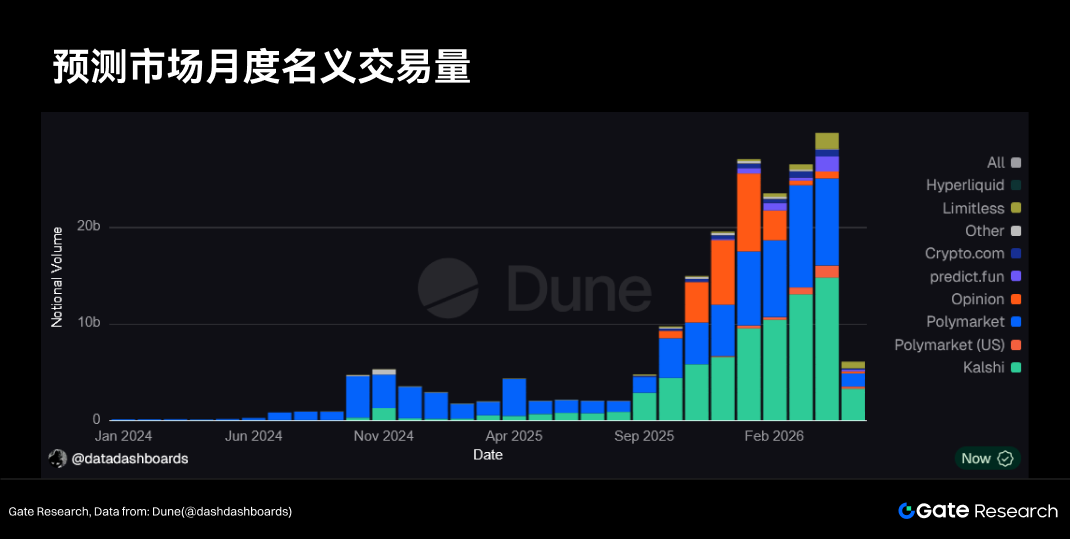
Concurrently, institutional capital continues to flow in. The valuations of major platforms like Polymarket and Kalshi are rising, exceeding tens of billions of dollars. The international regulatory environment is gradually loosening, and the regulatory framework continues to evolve, with event contracts being more systematically included in regulatory discussions. Prediction markets are gradually becoming a global information-based financial infrastructure.
1.2 Changing User Trading Behavior
The rapid expansion of prediction markets also reflects a change in user trading logic.
For a long time, mainstream trading behavior in the crypto market has been similar to traditional finance, primarily revolving around asset volatility: buying and selling mainstream assets like BTC and ETH; using leverage to amplify volatility gains; and short-term trading around liquidity cycles. The core is trading 'price' itself, with market participants profiting by judging asset price trends.
With the maturation of infrastructure like Polymarket, the objects of user trading are quietly shifting towards deeper driving factors such as policy direction, market narratives, AI technological progress, macroeconomic events, and regulatory changes. Users are no longer just trading the 'price of outcomes' but are beginning to directly trade 'outcomes themselves,' i.e., pricing the probability of future events.
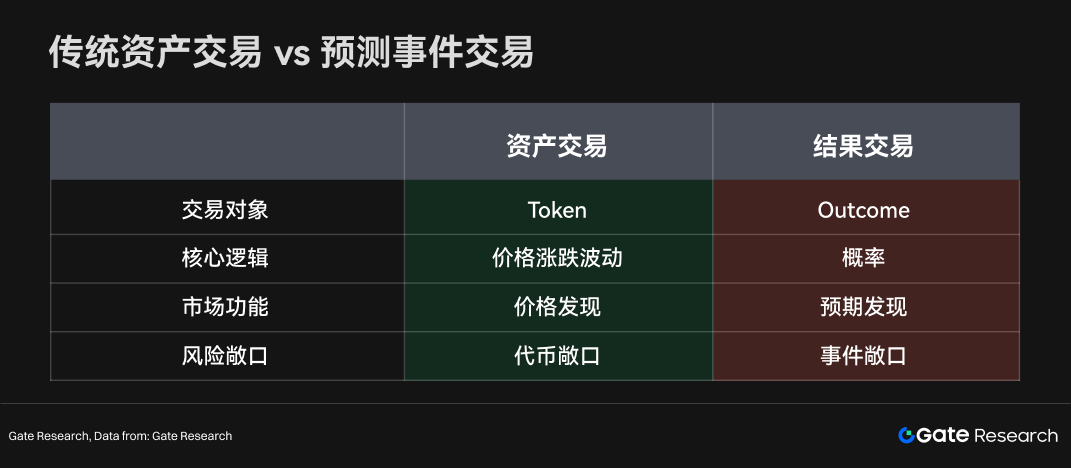
Compared to mapping expectations through assets, prediction markets offer a more direct way of trading information, allowing event expectations to be priced and traded with extreme efficiency. This explains the high overlap between prediction market users and traditional perpetual contract and options users. These are all trading groups characterized by high frequency, high information density, and high event sensitivity. The difference lies in traditional contract markets trading price fluctuations, while prediction markets trade future probabilities.
1.3 Convergence of Prediction Markets and Traditional Trading Markets
The financialization process of prediction markets is accelerating their deep integration with traditional trading markets.
From a product logic perspective, prediction markets exhibit distinct derivative-like characteristics. In traditional financial markets, futures trade future prices, and options trade volatility. Prediction markets, in essence, trade the probability of future events occurring, thus acting as a typical event-driven derivative. This means prediction markets are not a new species entirely separate from the traditional financial system but an important new branch of the derivatives market.
At the same time, prediction markets restructure markets around events and expectations, giving them unique value by providing a novel price discovery mechanism. Unlike indirectly reflecting various information through asset prices, prediction markets can directly price event outcomes in real-time and with precision. This ability for direct information pricing is the core reason why prediction markets are attracting increasing attention from traditional financial institutions.
Against this trend, the role of centralized exchanges is also quietly transforming. In the past, the core competitiveness of CEXs focused on listing capabilities, liquidity depth, and contract trading capabilities. In the prediction market-dominated cycle, new competitive dimensions are rapidly emerging, including the ability to operate around hot events, handle and respond to high-frequency information, innovate event trading products, and optimize the user information trading experience.
Therefore, the future trading platform will no longer be limited to being a crypto asset exchange but is expected to gradually evolve into a one-stop trading platform encompassing crypto, TradFi, and future event trading. This is the deep strategic significance of Gate's current proactive layout in prediction markets: to preemptively occupy the high ground of the information trading era and complete the role upgrade from an asset trading platform to a comprehensive one-stop trading platform.
2. Gate's Strategic Positioning and Product Advantages
Gate's integration of Polymarket leverages the user scale, account system, capital gateway, and trading infrastructure of a Top Tier CEX to transform the inherently Web3-native prediction market into a CEX-native event trading experience accessible to ordinary traders. The product integration design for prediction markets adopts a logic similar to Gate Alpha's 'agency trading/execution' model. Users select events, judge direction, and place orders on the Gate frontend, while Gate handles the backend processes, including underlying Polymarket market access, asset path conversion, order execution, and position display.
2.1 Gate's Fundamental Advantages: Users, Liquidity, and Distribution Capability
Gate has over 53 million global users, covering more than 80 jurisdictions, supporting over 4,600 digital assets, and has formed a multi-asset product matrix including Spot, Futures, Wealth Management, Web3, TradFi, and Pre-IPO. The CoinDesk Data exchange report from March 2026 shows Gate is the world's third-largest centralized derivatives trading platform, with its derivatives market share rising to 12%. Users of derivatives, contracts, and high-frequency trading are naturally characterized by high information sensitivity, high trading frequency, and strong event response capabilities – precisely the core demographic most easily converted to prediction markets.
More critically, Gate's advantages have been validated by actual distribution results. In officially tracked Builder data, Gate has become a Top 3 trading volume distribution channel for Polymarket on both a weekly and monthly basis. On a recent single day, Gate temporarily became the second-largest trading volume distribution Builder for Polymarket, achieving this just one and a half months after integration.
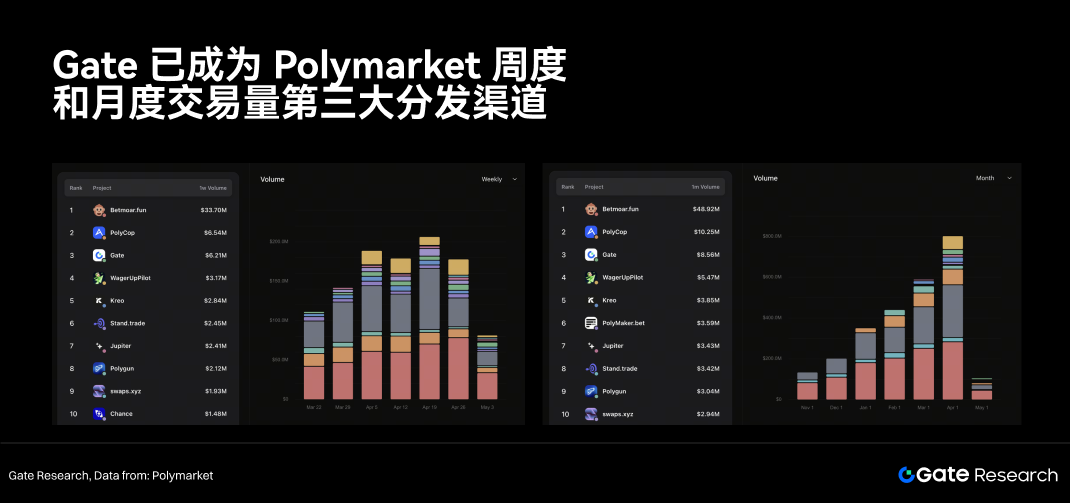
This result shows that Gate has become a significant entry point for Polymarket's incremental users and trading traffic. Future competition in prediction markets won't just occur at the protocol layer but also at the distribution layer; whoever controls users, capital, and trading scenarios will have a greater opportunity to become the core traffic node for event trading.
2.2 Gate's Product Design Logic: The In-Account Agency Trading Model Similar to Gate Alpha
The long-standing barriers to on-chain prediction markets are user entry, capital entry, product standardization, and trading experience. Polymarket addresses market mechanisms and on-chain settlement, but ordinary users still face friction from wallets, networks, Gas, USDC, cross-chain interactions, and order execution. Gate abstracts away this complexity, compressing the multi-step on-chain process into an in-account trading pathway.
Gate's prediction market design draws inspiration from Gate Alpha. Instead of directing users to jump to an on-chain DApp to complete transactions themselves, Gate provides a standardized trading entry point on its frontend and handles the underlying market access, asset path conversion, and trade execution on the backend. Users see an event trading interface within the CEX, while the backend connects to Polymarket's prediction market liquidity and Yes/No share mechanism.
This model can be understood as an 'in-account agency trading and execution' logic. Gate was one of the first centralized exchanges to explore CEX-On-Chain models, and Gate Alpha provided mature and replicable experience, allowing users to use USDT in their Gate account to participate directly in early-stage on-chain asset trading. Gate's prediction market product continues this logic, packaging the on-chain prediction market as an in-account tradable product. Users do not need to prepare their own wallets, handle cross-chain operations, obtain Polygon USDC, or manage Gas fees, nor do they need to understand Polymarket's on-chain interaction details. They simply select an event, choose a direction, and place an order within Gate.
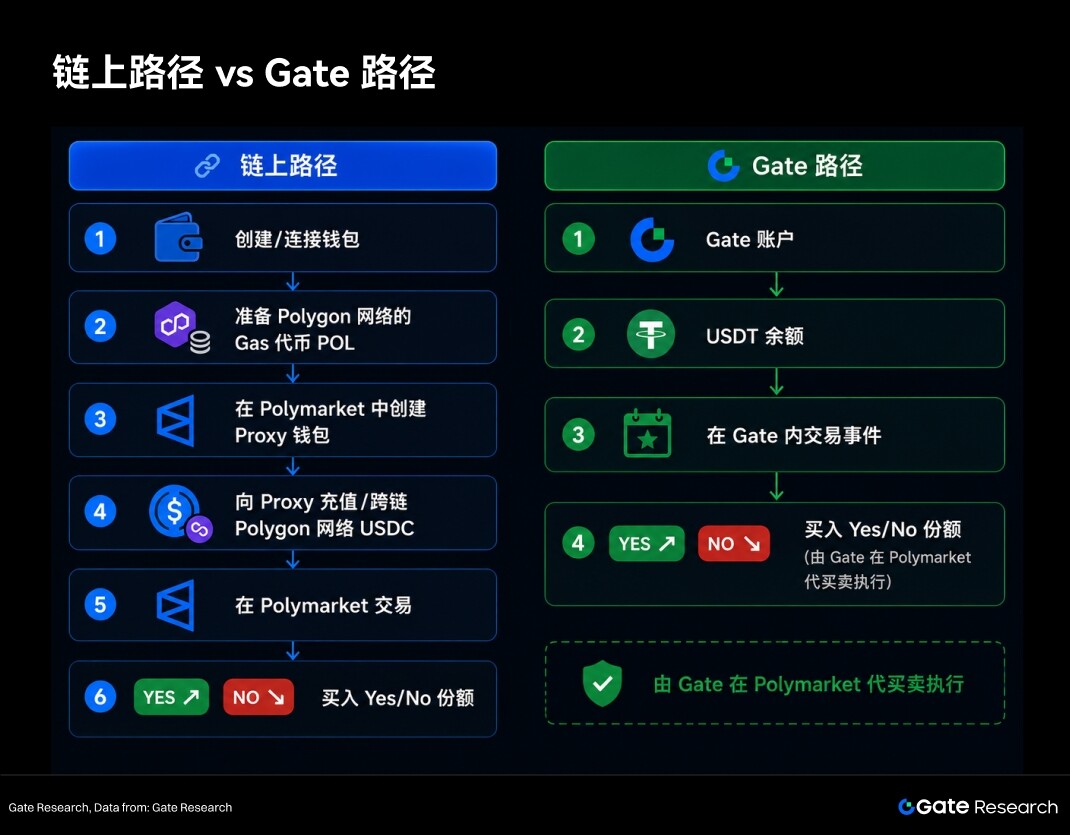
It's clear that within this framework, Gate significantly optimizes the entry path. It is not just a reliable traffic redirect portal but a CEX-based encapsulation layer for prediction markets. Users make trading decisions on the Gate frontend, while Gate handles the underlying capital conversion, order routing, market interaction, and position display, transforming Polymarket's originally Web3-native trading flow into the familiar CEX user experience of account balances, order placement, position holding, and settlement.
This is the key reason Gate has become Polymarket's third-largest distribution channel. Prediction markets themselves provide event pricing and liquidity foundations, but true large-scale expansion depends on low-friction entry points. Through an agency trading mechanism similar to Gate Alpha, Gate encapsulates on-chain event trading into in-account event trading, significantly lowering the entry barrier for users and improving the conversion efficiency from browsing events to placing actual orders.
2.3 Gate's Event Trading Experience: Dual Mode Design and Ecosystem Synergy
While retaining Polymarket's core mechanism, Gate introduces a dual structure of Prediction Mode and Trading Mode. The Prediction Mode suits new users trying to understand Yes/No probabilities and outcome payouts. The Trading Mode provides an order book, candlestick charts, market depth, and various order types, resembling a contract or professional trading interface.
Importantly, prediction markets will not be isolated from Gate's existing Spot, Futures, and TradFi products. Instead, they act as leading signals in the user decision chain. For example, if the probability of a Fed rate cut event rises rapidly, a user might simultaneously adjust positions related to BTC, ETH, Gold, or US stock indices. If the probability of a geopolitical event changes, a user might simultaneously monitor assets like Crude Oil, Gold, Stablecoins, and other safe-havens. If the probability of a crypto regulatory event changes, a user might adjust related token positions and contract strategies.
Therefore, after integrating Polymarket, Gate's product structure has expanded from the traditional 'Spot + Futures' to 'Spot + Futures + Event Trading'. This means Gate now not only accommodates asset price volatility but also possesses the capability to handle users' direct judgments on real-world events, macro trends, policy changes, and market narratives, thereby increasing the information density and user trading chain of the entire ecosystem.
2.4 New Features: Evolving Beyond an Entry Point into an Event Trading Workstation
Gate's integration of Polymarket will not stop at the trading access level. It is continuously evolving into an integrated event trading workstation encompassing event discovery, trade execution, asset management, and strategy tracking. A series of upcoming new features will further solidify Gate's product advantages in the prediction market distribution layer. Gate aims to help users discover events faster, participate in events more efficiently, manage positions more clearly, and foster a strategy discovery mechanism through leaderboards and user profiles.
Firstly, at the event discovery layer, Gate will launch more comprehensive search and categorization capabilities. Users can quickly search for global hot events using fuzzy keyword matching, with results highlighted, combined with smart recommendations, category browsing, real-time trending, recent browsing history, and search history to reduce the path cost from 'seeing a hotspot' to 'finding the market'. After adding secondary categories to the homepage, sections like Recommendation, Sports, and Crypto will become clearer, allowing users to quickly enter relevant event markets based on their interests.
Secondly, at the real-time opportunity capture layer, Gate will introduce a Breaking News section, aggregating major news, sports events, crypto market movements, and other high-attention events. Core trading opportunities in prediction markets often arise from information changes and swift probability re-evaluations. Therefore, 'discovering the event first' is itself a crucial part of the trading experience. The Breaking News section compresses event news, market heat, and trading entry points into a single product pathway, helping users move faster from information assessment to trading action.
Thirdly, at the trading category expansion layer, sports events will support more derivative markets, such as point spreads, over/under totals, and interactive features like sliding to select scores and one-click order placement. Sports have always been one of the highest-frequency and lowest-user-understanding-cost categories in prediction markets. Users won't just trade win/loss outcomes but also more granular event exposures like score ranges, handicap results, and total score trends.
Fourthly, in asset and billing management, Gate will enhance history categorization and billing filtering. Users can view records of various fund changes like buys, sells, refunds, and claims, and filter by transaction type, hiding small transactions or claimed market records. A clear billing system significantly boosts user trust in fund flows, position changes, and the settlement process.
Fifthly, in the strategy discovery layer, the leaderboard feature will introduce multi-dimensional rankings based on profit/loss, trading volume, highest profit, etc., and display key data such as portfolio value, trading volume, maximum profit, and total P&L.
These features collectively form the Gate prediction market product flywheel: Event Discovery → Hotspot Recommendation → Quick Trading → Position & Billing Management → Leaderboard & Strategy Discovery → Trade Again.
3. Commercial Value: The Mutual Benefits for Gate and Polymarket
Gate's integration of Polymarket creates a mutually beneficial structure. Gate gains new event trading scenarios, increased user activity, and platform differentiation. Polymarket gains a CEX-grade user entry point, a USDT capital channel, and a lower-friction transaction conversion path. Gate has already become Polkymarket's Top 3 trading volume distribution channel, preliminarily validating the commercial synergy of the partnership.
3.1 For Gate: Enhancing User Activity and Platform Information Hub Status
Unlike traditional token trading, prediction markets revolve around news, events, policies, and hotspots, inherently possessing stronger time sensitivity and social sharing attributes. Users may not trade spot or contracts daily, but they might check the changing probability of a popular event every day.
This product characteristic will increase the frequency of Gate App opens and enhance users' reliance on Gate for information. Gate becomes not just a platform users open to place orders, but an information hub where users check event probabilities, market sentiment, and global hotspots. Prediction markets bring Gate higher-frequency information consumption scenarios and longer user retention chains.
3.2 For Polymarket: Access to CEX-Grade Distribution and USDT Capital Gateway
From a competitive landscape perspective, the next phase of prediction market competition is no longer just between underlying markets, but a combination of prediction market infrastructure and large-scale distribution entry points. The partnership between its biggest competitor, Kalshi, and Robinhood has already proven that mainstream trading entry points can significantly amplify user reach, transaction conversion, and brand recognition for prediction markets. By embedding event contracts into its brokerage trading system, Robinhood brought a broader retail user base to Kalshi, contributing over 50% of its trading volume and pushing event trading from a niche product into the mass trading scene.
The strategic significance of Polymarket for Gate lies exactly in complementing Gate's CEX-grade distribution capabilities. Polymarket originally possessed strong liquidity, event coverage, and user mindshare in on-chain prediction markets. However, compared to Kalshi, its incremental user entry points are more Web3-native. Gate's integration provides Polymarket with a sufficiently large global crypto trading platform ally, capable of reaching Gate's over 53 million global users, including a group of high-frequency, high-information-sensitivity derivatives and contract traders.
Therefore, Gate becoming Polymarket's third-largest distribution channel is not just a data point. It demonstrates that with Gate's support, Polymarket is expanding from relying solely on on-chain DApp traffic to leveraging the CEX account system, USDT capital gateway, and mature trading interface.
3.3 For Both Parties: Expanding Trading Boundaries and Forming a Complete Event Trading Loop
The partnership expands the trading boundaries for both parties into crypto assets, macro-economics, politics, sports, AI


