The "Trump Paradox" of the Midterm Elections: The Stronger He Gets, The More Dangerous It Is for the Republican Party


- Core Thesis: As Trump's national approval rating declines, he is strengthening his dominance within the party through a more ruthless "loyalty screening." However, this victory is weakening the Republican Party's competitiveness in the general election and paralyzing its legislative capabilities.
- Key Elements:
- Trump's "Revenge Politics" is Working: He defeated Kentucky Rep. Massie (a libertarian critic) and Louisiana Sen. Cassidy (who voted for impeachment), and forced five state senators in Indiana out of office.
- Personal Loyalty Prioritized Over Electoral Strategy: In Texas, Trump supported Attorney General Paxton to retaliate against Senator Cornyn for past criticism. This move could force the Republican Party to spend hundreds of millions of dollars defending a seat in a deep red state, draining national resources.
- Polling Signals are Dangerous: Trump's approval rating among independent voters is only 26%; 47% of respondents believe his policies have harmed them; in a hypothetical election, Democrats lead by 11 points.
- Executive Actions Intensify Conflict: Trump reached an $1.8 billion settlement with the IRS and established an "Anti-Weaponization" fund. This move has unsettled Republican leaders and been condemned by Democrats as "money laundering for loyalists."
- Legislative Progress Stalled: Due to political weakness, Trump's demands—such as suspending the gas tax and ending the "filibuster"—have all been rejected by congressional Republicans. In the future, defeated lawmakers (like Cassidy) may actually show more independence during their final term.
Original Title: The Trump paradox: What's good for him is weighing down his party
Original Author: The Washington Post
Compiled by: Peggy
Editor's Note: Trump's political paradox is becoming increasingly clear: while his approval rating among national voters continues to decline, his dominance within the Republican Party is growing ever stronger.
The core of this article is not about whether Trump can still influence the Republican Party, but how this influence is reshaping the party's electoral prospects. On one hand, he forces party candidates to pledge loyalty through endorsements, primary challenges, and political purges. On the other hand, this political screening process, centered on personal loyalty, may also weaken the Republican Party's competitiveness in the general election.
From Thomas Massie to Bill Cassidy, and from the Indiana state senate primaries to the Texas Senate primary, Trump's "revenge politics" is consistently demonstrating his ability to mobilize the Republican grassroots. But the problem is, winning a party primary is not the same as winning a national election. For the Republican Party, the real risk is not that Trump cannot control the party, but that the deeper his control, the narrower the party's space becomes among independent and moderate voters.
More concerning is that Trump's strong-arm tactics have not translated into effective legislative power. On issues like the gas tax, voting rights legislation, immigration funding, and military action in Iran, there remains a clear tension between him and congressional Republicans. This means Trump can force party members to pledge loyalty, but he may not be able to make them bear the full cost of his political agenda.
Trump has built a party that is highly loyal to him, even when his executive actions anger the broader public, the Republican Party chooses to follow. This political structure, paradoxically, undermines his influence among voters outside his base.
For the midterm elections, the biggest variable facing the Republican Party may not be the Democrats, but Trump himself. For Trump, victories in primaries are solidifying his authority within the party. But for the Republican Party, these victories may also be pushing it towards a harder-to-win general election.
Below is the original text:
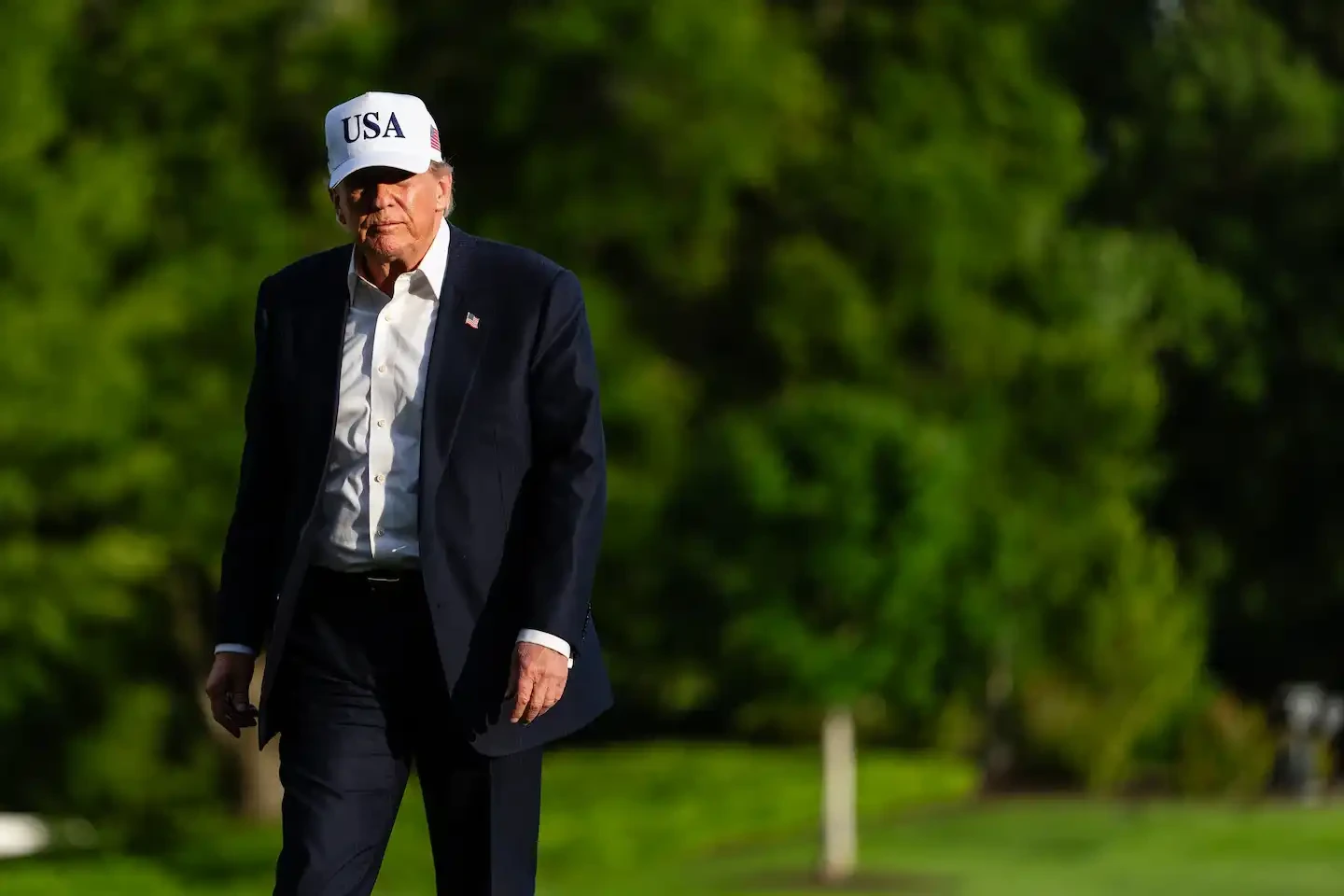
President Donald Trump walks on the South Lawn of the White House after arriving aboard Marine One on Friday. (Eric Lee/Pool/The Washington Post)
President Donald Trump does not believe in the so-called "political gravity."
The more his national standing slips — with multiple polls showing his approval rating nearing historic lows — the tighter he grips the Republican Party, jeopardizing the electoral prospects of this subservient party in the fall through a series of unpopular and even blatant actions.
The result is a paradox: the President demands political loyalty within his party with an intensity rarely seen in history, yet his frequent executive actions continuously alienate the broader public. This cycle makes him increasingly unwilling and unable to use Congress to address voters' most pressing concerns. And it is a cycle Trump seems neither willing nor able to break.
On Tuesday, Trump secured one of his most coveted "trophies": libertarian Republican Rep. Thomas Massie (R-Ky.) was ousted. The eight-term congressman was one of the most prominent Republican critics of Trump in the House and had led efforts to publicly release government documents related to convicted sex offender Jeffrey Epstein. Trump initially opposed the move until he realized he couldn't stop it, then changed his stance.
Massie lost badly in the primary to a previously unknown political newcomer, former Navy SEAL Ed Gareln, who was handpicked by Trump and backed by tens of millions of dollars from Trump allies.
Three days before Massie's defeat, Louisiana Republican Senator Bill Cassidy also lost. Trump had called Cassidy "very disloyal." Five years earlier, during the second impeachment trial related to the January 6, 2021, attack on the U.S. Capitol, Cassidy had voted to convict Trump. Although the senator had since tried awkwardly to mend ties with Trump, he ultimately failed to even make it to a runoff.
Earlier this month, Trump's "revenge tour" swept through Indiana. Republican voters heeded his call, ousting five of seven state senators who had refused to redraw the state's congressional districts as Trump demanded. One race remains undecided, with the latest tally showing the two candidates separated by just two votes.
On Tuesday, Trump flexed his political muscle again: in the Texas Republican Senate primary runoff, he endorsed state Attorney General Ken Paxton to challenge incumbent Senator John Cornyn. The move frustrated many Republicans on Capitol Hill, as Cornyn was seen as a stronger general election candidate; if Paxton wins, the party may be forced to spend hundreds of millions of dollars in this deep red state to ensure its candidate's victory, funds that might otherwise be needed to support candidates elsewhere.
But as is often the case, Trump made clear this decision was personal, not tactical or policy-based. Cornyn has occasionally criticized Trump in the past, though he has recently tried hard to curry favor, even proposing a bill to name one of America's longest highways after Trump.
It was not enough. In a social media post endorsing Paxton, Trump wrote: "John Cornyn is a good man, and I have worked well with him, but he did not support me during my tough times."
"I actually believe that MAGA has never been more united than it is right now," Trump told reporters Tuesday. But if the Republican Party wants to maintain control of Congress in the fall elections, it must secure substantial support from other voters. And in Trump's view, this election is about his own political survival.
"You have to win the midterms, because if we don't win the midterms, then it becomes — I mean, they'll find a reason to impeach me. I'll be impeached," he told House Republicans at a retreat in January.
But for now, the biggest drag on the GOP's ability to hold its slim majorities in the House and Senate is Trump himself. The latest New York Times/Siena College poll, released Monday, is just another example: the public strongly disapproves of Trump's war in Iran and his handling of the cost of living. Even on immigration, his strongest issue, Trump trails by 15 percentage points.
Among key independent voters, Trump's approval rating has fallen to 26%. Some 47% of respondents said his policies have hurt them personally, up from 41% in the fall. Perhaps the most alarming data point for Republicans: Democratic voters reported higher enthusiasm for voting this year; Democrats led by 11 points on the hypothetical question, "If the election were held today, which party would you vote for?"
Meanwhile, even Republicans are uneasy about some of Trump's recent attention-grabbing actions. This includes his $10 billion lawsuit against the IRS earlier this year over the leak of his tax returns, and the subsequent settlement.
The agreement establishes a taxpayer-funded $1.8 billion compensation fund for those who claim, like Trump, to have been persecuted by a "politicized justice system." Beneficiaries could likely include some of those charged for their violent role in the January 6, 2021, attack on the U.S. Capitol, when Trump supporters tried to overturn his loss in the 2020 presidential election.
"I'm not a big supporter of that," Senate Majority Leader John Thune (R-S.D.) told reporters Tuesday when asked about the fund.
Democrats were more direct.
"This kind of corruption has never been this naked, and it has never been this widespread," said Sen. Patty Murray (D-Wash.) at a hearing attended by acting Attorney General Todd Blanche. "But what's happening now is: you write the checks, and Trump and his cronies cash them. And American taxpayers, who are already feeling the pinch of high prices, will foot the bill."
Under the settlement, Trump and his sons cannot personally receive payments from the so-called "anti-weaponization" fund. However, the IRS is also "permanently enjoined and excluded" from collecting unpaid taxes from Trump, his family members, or his businesses that accrued before the settlement was reached.
Despite Trump's tough stance on unilateral executive actions, his political weakness also undermines his ability to push things through the legislative branch. Many of his agenda items are currently stalled in Congress.
Neither Thune nor House Speaker Mike Johnson (R-La.) has embraced Trump's call for a gas tax holiday. The Senate has also resisted his demand to end the filibuster rule. Trump wants to use this to advance his top priority, the Save America Act, which includes a provision requiring people to prove their citizenship when registering to vote. Trump says the bill is necessary for election security, but opponents argue it would lead to voter suppression.
Another recent point of frustration for Trump is that Senate rule advisors refused to allow hundreds of millions of dollars for security costs related to his highly unpopular White House ballroom project to be inserted into a pending immigration enforcement funding bill.
For Trump, the "golden halo" from defeating incumbent Republicans may also cast a shadow. These individuals will remain in office until January next year and will likely be far less intimidated by him.
On Tuesday, just after losing his primary, Cassidy made a public act of defiance: for the first time, he voted to advance a resolution blocking Trump from continuing to order strikes on Iran.
"In Louisiana, I have heard from many people, including supporters of President Trump, who are worried about this war," Cassidy said in a statement.
In February, Massie told The Washington Post: "I have some colleagues who are just waiting for their primaries to be over, and then they'll start to develop some more independent voices."
As things stand, for their own political survival, they may have no other choice.