逼近历史警戒线:美债长端融资成本飙升,30年期得标利率创2001年最高


- 核心观点:美国长期国债标售利率连创多年新高,显示市场对财政赤字和通胀风险要求更高补偿,长端收益率持续趋陡,美国政府长期融资成本面临本世纪罕见压力。
- 关键要素:
- 30年期国债标售得标利率达5.216%,创2001年以来最高;10年期标售利率4.683%,为2007年以来最高。
- 买家结构分化:30年期标售中间接投标者获配比例降至66.8%(低于7月77.7%),一级交易商占比升至11.5%,显示部分最终需求由交易商兜底承接。
- 财政赤字与供给成为长端利率独立驱动因素:美国债务规模约31万亿美元,本财年利息支出达1.17万亿美元,同比增15%,期限溢价上升而非美联储政策预期主导走势。
- 财政部正考虑调整发行策略,倾向将新增发债集中于2至7年中短期限品种,但市场质疑缩短久期策略的可持续性,认为根本解决需收紧预算。
- 长期收益率上行已向实体传导,30年期固定房贷利率升至6.69%,为2025年7月以来最高,企业及居民融资成本同步承压。
Original Authors: Zhao Ying, Li Dan
Original Source: Wall Street Insights
The long-term financing costs of the U.S. government are approaching historical warning levels. Results from two consecutive long-term Treasury auctions this week show that the compensation level investors demand for holding long-dated U.S. debt has risen to multi-decade highs, putting tangible pressure on the Treasury Department and the Trump administration.
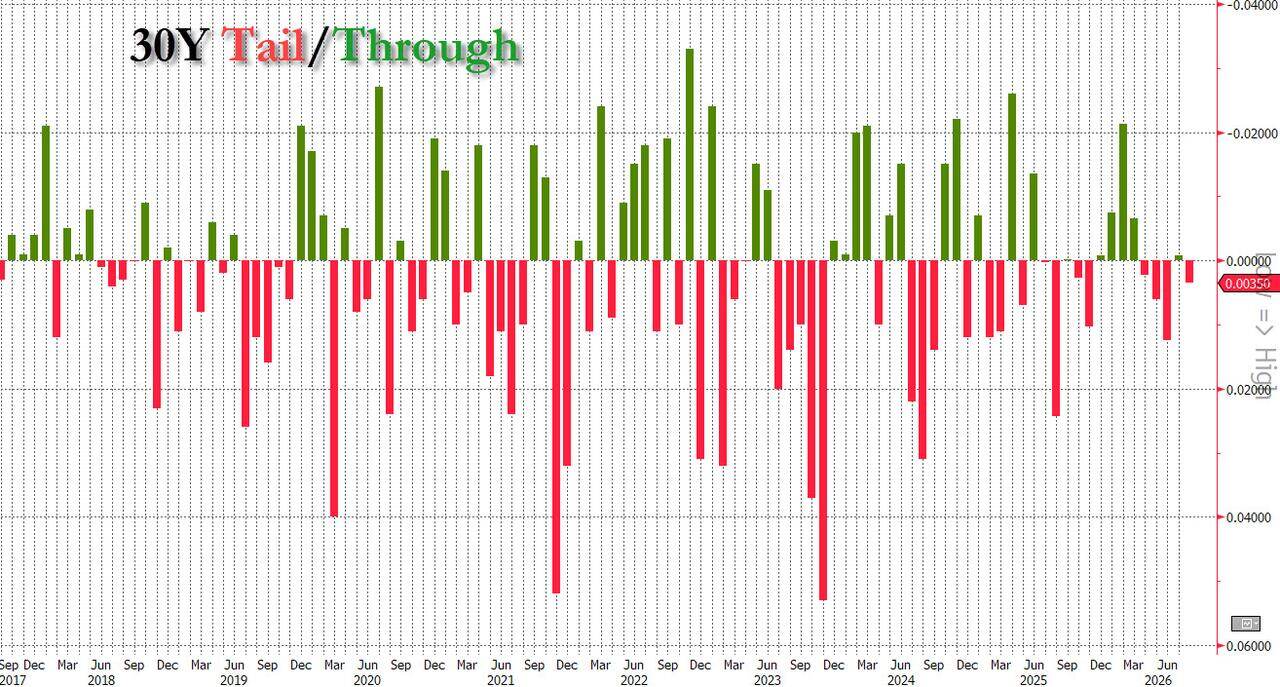
On Thursday, the U.S. Treasury completed a $25 billion auction of 30-year Treasury bonds, with the high yield reaching 5.216%, the highest level since 2001. The auction saw a slight "tail"—the high yield came in about 0.4 basis points above the when-issued yield, meaning investors required a higher yield than the prevailing market price to take down the paper. The previous day, a $42 billion auction of 10-year Treasury notes saw the high yield reach 4.683%, the highest since the 2007 global financial crisis.
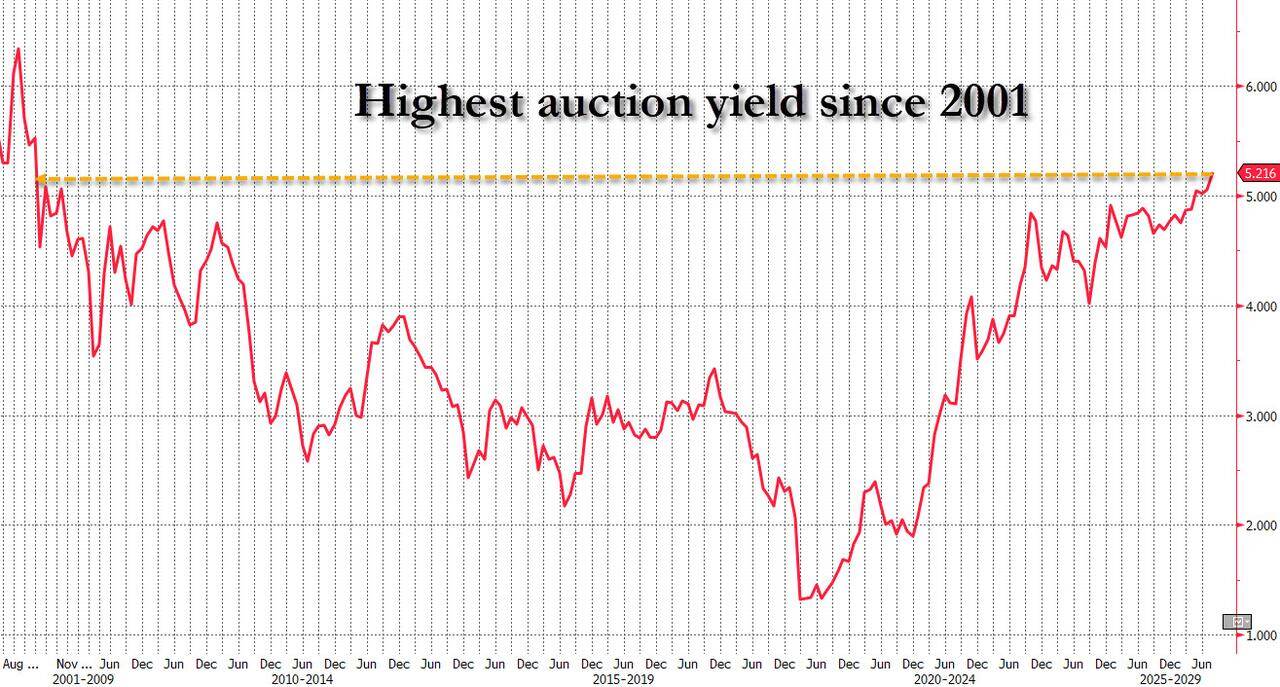
The market impact of these two auctions, which successively set multi-year records, extends beyond the auctions themselves: the 30-year Treasury yield closed about 4 basis points lower on the day, but the spread between 5-year and 30-year Treasury yields widened further to its steepest level since May. The yield curve continued to steepen, indicating that pressure on the long end has not dissipated with the day's price action.
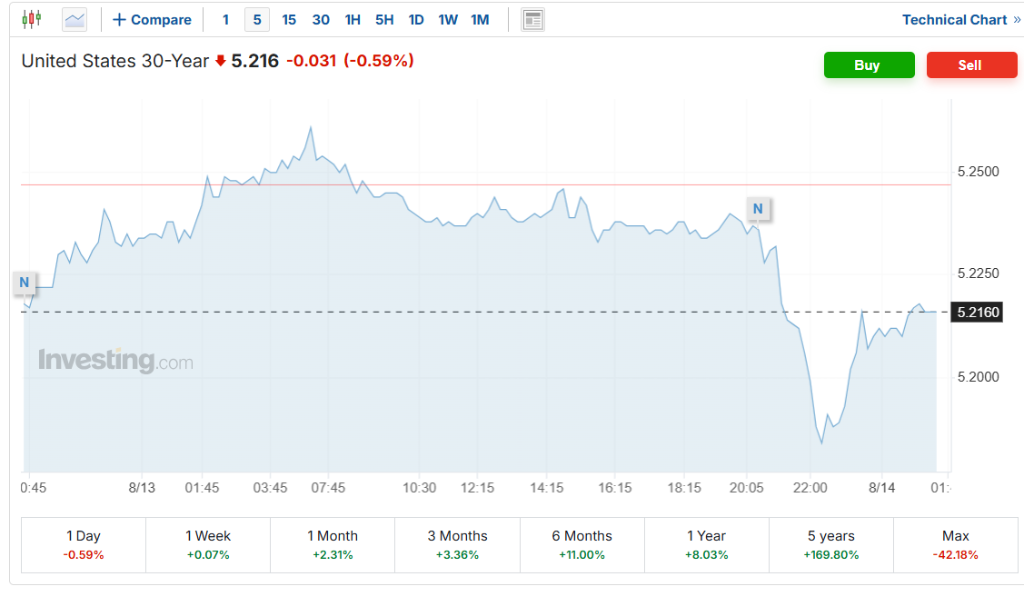
Michal Stanczyk, portfolio manager on the global fixed income team at Allspring Global Investments, stated, "If investors continue to demand higher compensation for inflation and fiscal risk premiums, long-term yields could move even higher, breaking through the 5% threshold."
Demand Isn't Collapsing, but the Structure Is Diverging
The headline numbers from Thursday's 30-year auction weren't necessarily poor. The bid-to-cover ratio was 2.39 times, higher than the average of 2.36 times for the previous six similar auctions, indicating that absolute demand hasn't significantly withered.
However, the shift in the buyer base warrants attention. Indirect bidders, which include foreign central banks and other overseas institutions, saw their allocation drop to 66.8%, down from July's near-record 77.7% and below the 67.0% average of the previous six auctions. Primary dealers' allocation rose to 11.5%, up 150 basis points from July and above the recent average of 10.6%. Since primary dealers typically act as backstop buyers, their increased share combined with the decline in indirect bidders suggests that some demand from end investors was absorbed by dealers.
Wednesday's 10-year auction presented a slightly different picture. The tail was more contained at 0.1 basis points, and primary dealers' allocation declined, indicating that end investors retained some appetite. However, the 4.683% high yield itself was the highest in nearly two decades. Gennadiy Goldberg, head of U.S. rates strategy at TD Securities, commented, "The strong absorption of supply suggests demand is indeed there—it just has its price."
Fiscal Supply and Term Premiums Are Dominating the Long End
The persistently high long-end yields can no longer be explained solely by expectations for Fed policy.
Following the July CPI data, market expectations for a Fed rate hike in September have cooled, with traders currently pricing in roughly a 35% probability of a hike in September, down from around 50% earlier this week. Yet, 10-year and 30-year Treasury yields have not followed the moderation in monetary policy expectations lower. Instead, they continue to hover near multi-year highs, and the yield curve has actually steepened further.
Market analysts point out that expanding fiscal deficits, increasing Treasury supply, and rising term premiums are emerging as independent variables driving long-end yields. The Demi Hu team at Barclays wrote in a research note, "As the market becomes increasingly reliant on price-sensitive investors, an equivalent amount of Treasury supply may require greater yield concessions to clear the market."
The current U.S. national debt stands at approximately $31 trillion, having doubled since 2018. Fitch Ratings on Thursday affirmed the U.S. sovereign rating at "AA+" with a stable outlook but warned that the fiscal deficit relative to the size of the economy in 2026 will widen further due to tax cuts and tariff rebate measures. As of this fiscal year, U.S. interest payments have accumulated to $1.17 trillion, a 15% year-over-year increase.
Debate Over Issuance Strategy: Can Shortening Maturities Persist?
Facing long-end pressure, the Treasury Department quietly adjusted the language in its quarterly refunding statement last week, changing its pledge to "continue to assess the potential for increases" in nominal coupons and FRNs to "consider adjustments as appropriate." The market has interpreted this as authorities leaving room for potential reductions in long-dated debt issuance.
Market consensus suggests that if the Treasury increases issuance of fixed-income securities, the focus will be on medium-term maturities ranging from 2 to 7 years. This would be an extension of the existing strategy of shortening duration—authorities have already tilted issuance towards short-dated bills under one year to circumvent high long-end yields, but this move simultaneously elevates refinancing risk.
John Fath, managing partner at BTG Pactual Asset Management US LLC, questioned the sustainability of this strategy: "I think the only clear solution is for the U.S. government to tighten its budget. You can only push issuance to the short end to a certain extent, and beyond that, it becomes what I would call irresponsible."
From Treasuries to Mortgages, Cost Pressures Transmit to the Real Economy
The impact of rising long-term Treasury yields has extended into the broader economy. As the pricing benchmark for U.S. financial markets, Treasury yield movements directly influence financing costs for corporate bonds, residential mortgages, and other asset classes. Last week, the average rate on a 30-year fixed-rate mortgage in the U.S. rose to 6.69%, the highest level since July 2025.
Matt Wrzesniewsky, head of fixed income client portfolio management at Vanguard, believes that current elevated yield levels offer investors "another entry opportunity." Vanguard expects the 10-year Treasury yield to remain in a range of 4.25% to 4.75% and prefers adding interest rate exposure through intermediate maturities rather than 30-year long bonds.
In the near term, the completion of these two auctions demonstrates that the market's absorptive capacity remains intact. But the very fact that 30-year Treasuries were issued at a yield of 5.216% sends a clear signal: Against the backdrop of widening deficits, increasing supply, and lingering inflation uncertainty, the U.S. government's long-term financing costs are at levels rarely seen in this century. The demand dynamics at upcoming medium- and long-dated auctions will serve as a critical window to assess whether this trend evolves further.