How to Regulate Single-Stock Leveraged ETFs? On Thursday, the Entire Market is Watching the South Korean Government's Meeting


- Core Viewpoint: Single-stock leveraged ETFs, launched in South Korea just a month and a half ago, are accused of exacerbating market volatility and triggering a record number of circuit breakers, forcing the nation's top economic decision-making body (F4) to intervene urgently and seek solutions.
- Key Elements:
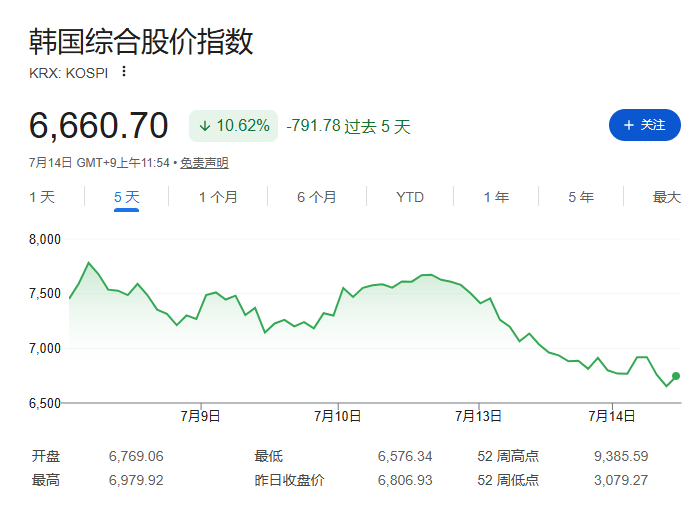
- The recent sharp decline in South Korea's KOSPI index, with a single-day drop of over 8% triggering the seventh circuit breaker this year, has been widely attributed by the market to the single-stock leveraged ETFs launched in May.
- This product allows investors to place 2x bets on individual stocks like Samsung Electronics. Its amplification effect, "fueling the rally on the way up and accelerating the decline on the way down," exacerbated price deviations during volatile market conditions.
- The regulatory language has been unusually harsh. The head of the Financial Supervisory Service openly "regretted" failing to prevent the product's launch and acknowledged facing structural dilemmas, including net purchases of nearly 10 trillion won by retail investors and difficulties with forced liquidation.
- Data confirms the impact: Since the product's launch, the proportion of days with KOSPI single-day changes exceeding 3% has surged from 27% to 52%. The "sidecar" mechanism has been triggered 35 times this year, far exceeding the previous record.
- A high-level "F4" meeting is imminent to discuss three potential remedial measures: raising margin requirements, limiting price fluctuations, and adjusting leverage ratios. However, officials admit these might only serve as "temporary patches."
Original Author: Long Yue
Original Source: Wall Street CN
A financial product that has been live for just a month and a half has already thrown South Korea's top economic decision-makers into emergency mode.
South Korea's "F4" high-level coordination mechanism will hold a meeting this Thursday to discuss countermeasures regarding the impact of single-stock leveraged ETFs on the stock market. This is the first time this topic has formally entered the highest-level economic coordination platform, which involves the Ministry of Economy and Finance, the Financial Services Commission, the Bank of Korea, and the Financial Supervisory Service.
The trigger for the incident is clear: The KOSPI plummeted over 8% in a single day on Monday, triggering its seventh circuit breaker of the year. The market has pointed the finger directly at single-stock leveraged ETFs. These products amplify the intraday price movements of individual stocks, accelerating price deviations during periods of high volatility and creating a "magnifying effect" that exacerbates upward and downward trends. Single-stock leveraged products were officially launched on May 27, allowing investors to place 2x bets on the price movements of Samsung Electronics and SK Hynix. The returns of these products are linked to a multiple of the daily price change of the underlying asset. To achieve this matching, the underlying assets must be bought or sold daily, further amplifying market volatility.
Before Thursday's meeting, South Korean securities companies and asset management firms had already planned to hold an industry meeting on Tuesday to discuss leveraged ETF issues and overall market conditions, effectively taking stock in advance of the government meeting.
Regulatory Tone Escalates, Rare Utterance of 'Regret'
The regulatory stance has shifted from "concern" to "self-criticism," with officials even admitting to facing structural dilemmas.
On July 13, Financial Supervisory Service Governor Lee Bok-hyun presided over a closed-door meeting at the Yeouido Financial Investment Association attended by representatives from 20 asset management firms. During the meeting, he admitted: "There is a structural problem, so it is unlikely we can provide a clear answer." He further stated, "Under the current circumstances, this issue cannot be resolved all at once and requires continuous monitoring, revision, and improvement." This reflects the deep-seated dilemma financial authorities face when formulating concrete solutions.
Regarding the so-called "structural problem," Lee did not elaborate. The general external interpretation is twofold: Firstly, individual investors have already net purchased nearly 10 trillion Korean won in these products, making forced liquidation nearly impossible. Secondly, these products were launched only after joint revisions to the enforcement decree by the Blue House, the Financial Services Commission, and the Korea Exchange. Forced delisting would damage the legal credibility of the relevant regulations.
He also stated: "This doesn't seem to be a matter that any single person can decide. The authorities (Financial Services Commission) may also need extensive deliberation. We (the Financial Supervisory Service) will do our best, but currently, we are in a position of bearing criticism. Asset management firms should frankly share their actual demands and suggestions regarding the institutional framework, which will serve as important references for policy decisions."
During a regular press conference on the 22nd of last month, Financial Supervisory Service Governor Lee Bok-hyun stated bluntly: "Regarding the launch of single-stock leveraged ETFs, I regret not doing my utmost to prevent it." This wording is extremely rare in the context of South Korean financial regulation. However, the day after this statement, the KOSPI plunged 10%. From the 22nd of last month to the 13th of this month, the cumulative decline of the KOSPI has exceeded 25%.
Earlier this month, he further stated that regulators are "seriously examining the unintended consequences that have emerged since the launch of these products."
Deputy Prime Minister and Minister of Economy and Finance Koo Yun-cheol also stated at a National Assembly meeting last week, "Given that various issues have been raised, we are currently discussing plans for remedies and minimizing related problems."
Senior Presidential Secretary for Policy Kim Yong-beom clearly stated at a press conference that the F4 meeting is thoroughly studying the issue of single-stock leveraged ETFs exacerbating market volatility. "If remedial measures are deemed necessary, decisions will be made at the F4 meeting on market conditions," he said.
Three Tracks Moving Forward: Higher Margin Requirements, Price Limit Restrictions, Adjusting Leverage Ratio Caps
Prior to Thursday's meeting, regulators have been concurrently advancing countermeasure research along multiple tracks.
According to sources in the South Korean financial investment industry, financial authorities have formally requested asset management firms to submit specific improvement suggestions regarding the market volatility potentially caused by single-stock leveraged ETFs. The authorities will gather industry opinions before commencing formal policy formulation.
Possible measures currently under market discussion fall into three categories: increasing margin requirements, limiting daily price fluctuation ranges, and adjusting the cap on leverage ratios.
The Financial Services Commission will convene experts from major securities companies and asset management firms on the 14th to discuss supplementary measures for single-stock leveraged products. Specific proposals include raising the minimum margin requirement (the amount of funds investors must deposit in their accounts upfront) and strengthening pre-investment education.
However, regulatory officials also concede that these plans "might be temporary patches rather than a solution to the structural root causes of market volatility." This implies that even if a decision is reached at Thursday's meeting, subsequent policies may still face further adjustments.
Data Confirms the Impact: Circuit Breakers Hit an All-Time Record
The comparison of market volatility before and after the launch of single-stock leveraged ETFs is stark. According to data from NH Investment & Securities, in the 96 trading days before the product launch, the proportion of days where the KOSPI fluctuated more than 3% in a single day was 27% (26 days). In the 33 trading days following the launch up to the 13th, this ratio soared to 52% (17 days). In contrast, the US S&P 500 index has yet to experience a single-day fluctuation of 3% so far this year.
Data from the Korea Exchange shows that as of the 13th, the securities market has triggered the "sidecar" (a temporary trading halt mechanism, including 17 buy-side triggers and 18 sell-side triggers) 35 times this year. This is significantly higher than the total of 3 times last year and has already surpassed the all-time record of 26 times set during the 2008 global financial crisis, even before July concludes. The circuit breaker mechanism, which fully halts market trading, has been triggered 7 times this year, exceeding half of the total 13 triggers since its introduction in 2000.
The Wall Street Journal also noted: "The volatility of the South Korean stock market has been further amplified by leveraged products linked to Samsung Electronics and SK Hynix."
Product Live for a Month and a Half, Triggers Top-Level Intervention
Approximately a month and a half after its listing in South Korea, the regulatory pressure on single-stock leveraged ETFs has rapidly escalated from the Financial Supervisory Service level to the highest economic decision-making level.
Kim Yong-beom pointed out at the press conference, "The related products have been operating for about a month and a half. The F4 will carefully assess their actual impact on the market."
Currently, market expectations for stricter restrictions on these products are intensifying. Tighter leverage ratios, higher investor entry barriers, or other structural constraints are all under discussion. As the market continues its violent turbulence, criticism is growing louder regarding the rushed launch of these products in less than five months.
The direction of future policy will depend on the assessment conclusions of the South Korean F4 meeting on Thursday.