






Nvidia's Rare Stumble: Flagship Product Delayed by a Year, AMD and Google See a Window of Opportunity


- Key Insight: Nvidia's Kyber NVL144 rack, based on the Rubin Ultra architecture, faces a delay of over 12 months until 2028 due to extreme difficulties in manufacturing its core component, the PCB midplane. Its transitional solution, the NVL72x2, has also been canceled after client opposition. Meanwhile, the NVL576 system confronts technical challenges with CPO, creating a temporary void in Nvidia's scaling roadmap and opening a window of opportunity for competitors.
- Critical Elements:
- The direct cause of the Kyber NVL144 delay is the manufacturing difficulty of the PCB midplane (orthogonal backplane), which uses a hybrid material of 78-layer M9-grade copper-clad laminate, quartz fabric, and PTFE, with line widths and spacing ≤25μm to achieve 448G+ SerDes speeds.
- Nvidia's previously developed NVL72x2 transitional solution was canceled after cloud service providers and hyperscale data center operators opposed its "unusual design and heavy operational burden," effectively blocking both development paths.
- The NVL576 system connects eight Oberon racks via CPO. However, CPO currently faces technical hurdles. According to SemiAnalysis, it may be delayed or shipped only in limited quantities, casting doubt on its production maturity.
- The 4-compute-chip version of the Rubin Ultra has been canceled, leaving only a 2-chip version. This significantly reduces the compute ceiling per rack, prompting Nvidia to plan on selling more racks to compensate for the performance gap.
- Nvidia currently lacks a proven solution in the scaling domain for Rubin Ultra, providing a window of opportunity for competitors like AMD's MI500X and Google's TPUv8i Broadfly to surpass Nvidia in scaling capabilities.
Original title: "SemiAnalysis Reveals Pre-Market News: NVIDIA's Kyber NVL144 Rack Delayed Over 12 Months Due to 'PCB Midplane Manufacturing Difficulties'"
Original author: Long Yue
Original source: Wall Street News
On the morning of July 6, semiconductor industry research firm SemiAnalysis posted a thread of six consecutive tweets on X (formerly Twitter), revealing significant delays and multiple cancellation decisions for NVIDIA's Kyber NVL144 rack architecture. The news drew market attention before the opening bell.
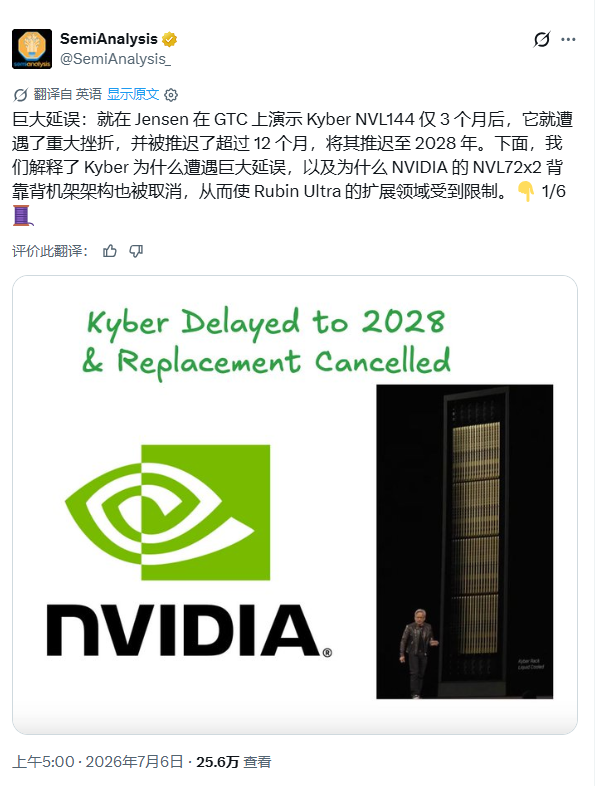
SemiAnalysis stated bluntly: "Major delay: Just three months after Jensen Huang showcased Kyber NVL144 at GTC, the product has suffered a major setback, with delays exceeding 12 months, pushed back to 2028."
The PCB Midplane: The Board Stalling Kyber
SemiAnalysis analyzes that the direct cause of the Kyber NVL144 delay points to a critical hardware component—the PCB Midplane, also referred to by NVIDIA as the "Orthogonal Backplane."
The firm stated: "The Kyber NVL144 rack architecture has been delayed to 2028 because the PCB midplane still faces major challenges in the manufacturing process. The NVL576, which connects 8x Oberon racks via CPO between NVSwitches, is also likely to be delayed or limited to small-volume production due to current CPO challenges."
The gray board Jensen Huang showcased at the GTC conference in March was precisely the orthogonal backplane of the Rubin Ultra (Kyber architecture) cabinet. Its function is to achieve a 90° vertical interconnection between the compute tray and the switch tray—compute trays are inserted vertically, connecting directly board-to-board with the rear switch trays through this midplane, completely eliminating the traditional cable jungle.
The manufacturing difficulty of this board is extremely high. According to the aforementioned technical analysis, the backplane uses a hybrid material of M9-grade copper-clad laminate (CCL) + quartz fabric (Q-fabric) + PTFE, with a layer count of 78 (formed by laminating three 26-layer boards), and line width/spacing ≤ 25μm to meet the ultra-high-speed signal integrity requirements at 448G+ SerDes rates.
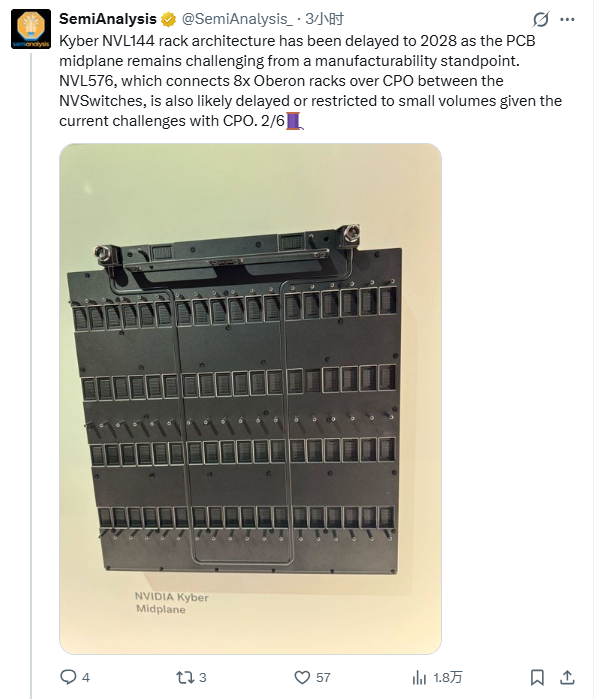
Why is this board indispensable? According to technical analysis, the Rubin Ultra NVL144 rack needs to connect 144 GPUs within a single domain. If using the copper cable approach, it would require over 20,000 cables, increasing weight by more than 30% and causing severe signal attenuation. The orthogonal backplane is one of the few feasible solutions under current technological conditions.
The Alternative NVL72x2 Plan Was Also Canceled
Facing the manufacturing difficulties of Kyber, NVIDIA attempted to develop a transitional solution—the NVL72x2 back-to-back rack architecture.
According to SemiAnalysis, the design concept of this plan was to place two Oberon racks back-to-back, expanding the scale domain through pure copper NVLink, thereby circumventing the manufacturing challenges of the Kyber midplane.
However, this plan ultimately failed to materialize. SemiAnalysis stated that NVL72x2 "was canceled due to strong opposition from cloud service providers and hyperscale data center operators over its peculiar design and heavy operational burden."
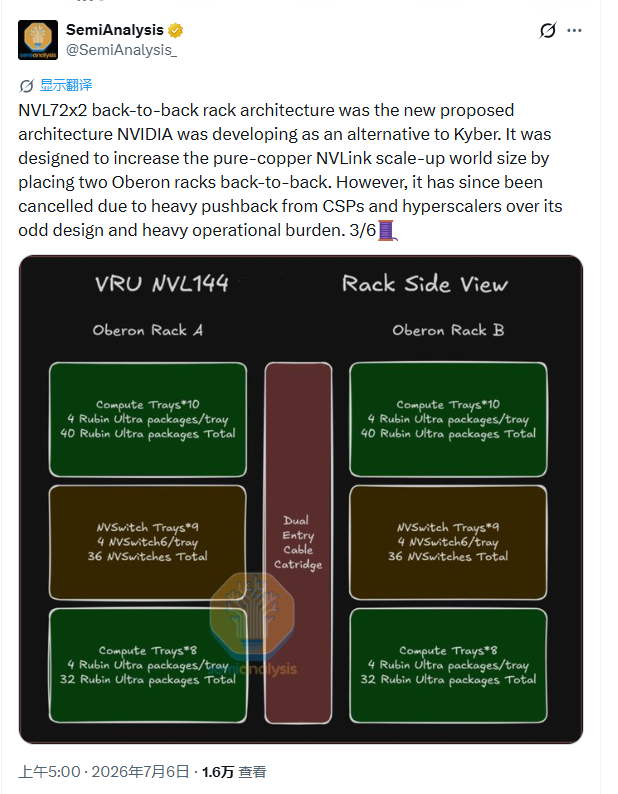
With both paths blocked, NVIDIA faces a temporary gap in scaling the Rubin Ultra.
NVL576 Also Under Pressure, CPO Challenges Cannot Be Ignored
The Kyber NVL144 is not the only one delayed. SemiAnalysis also pointed out that NVL576—a larger-scale system connecting 8 Oberon racks via CPO (Co-Packaged Optics)—"given the current challenges facing CPO, may also be delayed or limited to small-volume shipments."
CPO is the optical interconnect technology NVIDIA is introducing for the first time in the scale-up network at the Rubin Ultra stage. According to a research report SemiAnalysis published in March 2026, the design scheme for NVL576 involves maintaining copper cable expansion within the rack and connecting NVSwitches between racks via CPO, forming a two-tier fully interconnected network.
However, the production maturity of CPO itself remains a variable. In the research report, SemiAnalysis explicitly states that the CPO NVSwitch will not be formally ready until the Feynman generation.
Rubin Ultra Itself Shrinks: 4-Chip Version Canceled
Alongside the aforementioned delay news, another significant product-level change was disclosed.
SemiAnalysis stated that the 4-compute-chip version of Rubin Ultra has been canceled, "and only the smaller 2-compute-chip version of Rubin Ultra remains, whose actual performance is about half that of the 4-chip version."
This means, even if the Kyber rack is eventually delivered on schedule, the computing power ceiling per rack has been substantially lowered.
In response, SemiAnalysis indicated that NVIDIA will compensate for this shortfall by "significantly increasing the sales of Oberon Rubin racks and Oberon Rubin Ultra racks."

Competitive Window: AMD and Google May Benefit
The gap in the scale-up domain directly affects NVIDIA's competitive position in large-scale training scenarios.
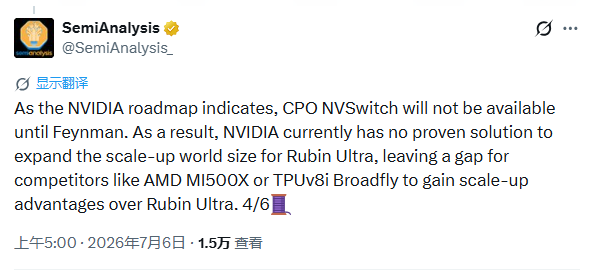
SemiAnalysis noted: "NVIDIA currently has no proven solution to scale up the Rubin Ultra's scale domain, leaving room for competitors like AMD MI500X or TPUv8i Broadfly to surpass Rubin Ultra in scalability."
According to NVIDIA's current roadmap, the CPO NVSwitch will not appear until the next-generation Feynman platform. Until then, the scale-up ceiling for Rubin Ultra remains constrained.
SemiAnalysis concluded the tweet thread by noting that the aforementioned delays and cancellations impact the memory, PCB, and ODM supply chains.
The manufacturing challenge of the Kyber midplane directly points to the technological bottleneck of high-end PCB suppliers. The 78-layer ultra-high-density PCB, M9-grade CCL, and PTFE hybrid materials required for this midplane represent the current limits of PCB manufacturing technology.





