日元이 40년 최저에 근접: 일본은행이 1%까지 인상했는데도 왜 막지 못할까?


- 핵심 의견: 일본은행이 금리를 1%로 인상하고 사상 최대 규모(11.7조 엔)의 외환 시장 개입을 단행했음에도 불구하고, 엔화는 1986년 이후 최저 수준으로 하락하며 전통적인 정책 방어선이 무력화되었음을 보여주고 있다. 엔화의 운명은 완전히 연준의 정책 주기에 묶여 있으며, 향후 추이는 미국의 추가 금리 인상 여부, 지정학적 리스크 완화, 일본은행의 추가 긴축 신호에 달려 있다.
- 핵심 요소:
- 금리 인상과 시장 개입 모두 실패: 일본은행은 2026년 6월 금리를 1%(31년래 최고)로 인상했고, 재무성은 5월 사상 최대 규모인 737억 달러를 개입했지만, 엔화는 여전히 161.57엔 부근에서 거래되며 1986년 저점인 162.25엔에 근접하고 있다.
- 미일 금리차 확대가 핵심 동인: 연준의 점도표에 따르면 2026년 말 금리 중간값이 3.8%로 상향 조정되었고, 9월 금리 인상 확률은 34.4%까지 상승했다. 미일 명목 금리차는 263bp에 달하며, 캐리 트레이드 수익률은 여전히 매력적이다.
- 캐리 트레이드 청산 리스크 누적: 2024년 8월 일본은행이 15bp만 인상했음에도 엔화가 5% 급락한 사례가 있다. 현재는 금리 차이와 포지션 규모가 훨씬 더 커져 있으며, BIS는 이 전략을 "증기 기관차 앞에서 동전 줍기"에 비유하며 꼬리 리스크가 집중되어 있다고 경고한다.
- 일본, 인플레이션과 부채의 딜레마에 직면: PPI는 전년 대비 6.3% 상승하며 수입 인플레이션이 악화되고 있다. 그러나 정부 부채는 GDP의 250%를 넘어서며, 금리가 1% 오를 때마다 이자 지출이 3.7조 엔 증가하여 재정 지속 가능성에 제약이 된다.
- 핵심 변수 1: 연준의 행보. 만약 미국 9월 CPI가 지속적으로 예상치를 상회하며 금리 인상을 촉발한다면, 미일 금리차는 300bp에 근접하고 엔화는 162.25엔을 돌파하여 저항선이 없는 165엔선까지 상승할 수 있다.
- 핵심 변수 2: 지정학적 리스크 완화. 6월 22일 미-이란 협상이 진전을 보였으며, 만약 원유 가격이 하락하면 일본의 무역 적자가 완화되어 엔화에 구조적 지지 요인을 제공할 수 있다.
- 핵심 변수 3: 7월 일본은행 회의. 시장은 올해 추가 금리 인상이 없을 것이라고 예상하고 있지만, 성명서에 "추가 조정"이라는 문구가 등장할 경우 캐리 트레이드 기대치를 일부 변화시킬 수 있다. 다만 우에다 가즈오 총재의 회의 후 신호는 불확실성을 내포하고 있다.
Original Source: Wall Street CN
During Asian trading on June 23, the dollar-yen pair was trading around 161.57, just a hair's breadth away from last week's high of 161.81 — the weakest the yen has been since December 1986.
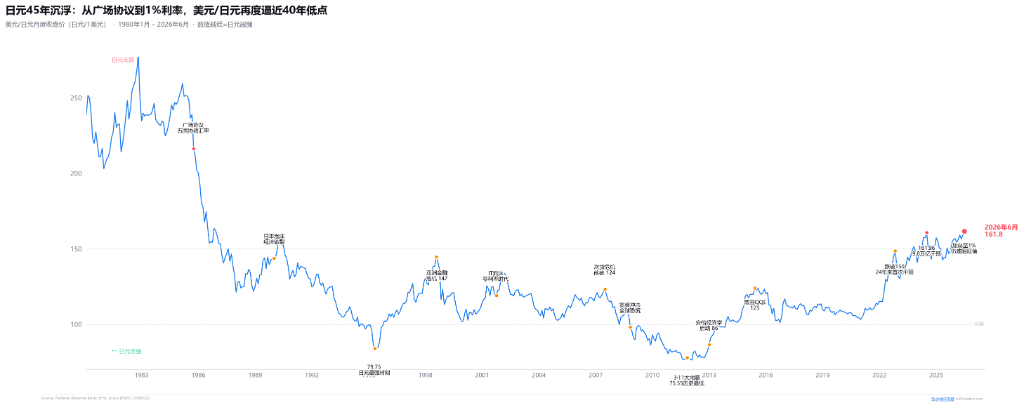
This came just last Tuesday, after the Bank of Japan raised its policy rate to 1% — the highest in 31 years.
In other words: The BOJ did the most hawkish thing within its power, and instead of rising, the yen weakened further.
Finance Minister Satsuki Katayama has been so alarmed that she directly called US Treasury Secretary Scott Bessent to discuss exchange rates. Japan spent a record 11.7 trillion yen (approx. $73.7 billion) in May to intervene in the currency market. The market is now fixated on 161.96 — the previous "defense line" from July 2024. If breached, the next target is 162.25 from December 1986.
But the truly dangerous signal isn't the price itself; it's that this time, both defense lines — rate hikes and intervention — have failed simultaneously.
1% Interest Rate, 350bp Yield Gap
On June 16, the BOJ raised its policy rate from 0.75% to 1%, with a 7-1 vote — only one member dissented. This marked the fifth rate hike since the tightening cycle began in March 2024 and the first time Japan's interest rate reached the 1% threshold since 1995.
Looking solely at the BOJ's actions, it has been quite aggressive. Moving from -0.1% to 1% in 22 months is a net increase of 110 basis points.
But the problem is: You're hiking rates, but so is everyone else, and much faster.
The US federal funds rate is currently in the 3.50-3.75% range, left unchanged after the Fed's June meeting — but the story behind it is far more ominous than it appears.
The Fed's June dot plot showed that of the 19 FOMC participants, 18 submitted forecasts, with 9 expecting more rate hikes in 2026. Breakdown: 5 predicted two more hikes (25bp each), 1 predicted three, and 3 predicted one. The median year-end rate jumped from 3.4% in March to 3.8% — the sharpest single upward revision since the dot plot was introduced in 2012. US CPI in May hit a three-year high of 4.2%, while core PCE remains stuck near 3% year-over-year.
Now, let's do the math: US rate at 3.63%, Japan rate at 1.00%. The nominal interest rate differential is 263 basis points.
But the long-end spread is even starker: The 10-year US Treasury yield is around 4.45%, while the 10-year Japanese government bond yield is around 2.65% — a gap of about 180 basis points.
Coupled with the BOJ's continued bond purchases (though reduced by 200 billion yen per quarter, they won't fully stop until April 2027), the upside for JGB yields is being artificially suppressed by the central bank itself. This means the annualized return from the carry trade (borrowing yen, buying US bonds) remains attractive — roughly 263bp on the short end and 180bp on the long end. The BOJ's bond-buying operations are artificially capping JGB yields, and market pricing implies no further rate hikes from the BOJ this year, making the carry trade's yield base seem solid.
But the real risk isn't whether the BOJ will "hike significantly." The destructive power of carry trades has never been in small rate moves, but in the stampede-like unwinding triggered by crowded positioning and unexpected catalysts. August 2024 is a case in point: The BOJ hiked by just 15bp to 0.25%, and combined with weaker-than-expected US jobs data, it triggered a chain reaction where the Nikkei plunged 12% in a single day and USD/JPY crashed from 156 to 141. The BIS later aptly assessed in its review that carry trades are like "picking up nickels in front of a steamroller" — accumulating steady returns during low volatility, but suffering massive losses when tail risks erupt. Today's yield differential is even wider, and positions are only more crowded.
JPMorgan Asset Management's APAC Chief Market Strategist Tai Hui put it bluntly: "The rate hike itself was expected. What really surprised was the overwhelming 7-1 support — which shows the committee is more worried about inflation than growth."
Parsing this statement: There is a consensus within the BOJ that 1% is not enough. But the market doesn't believe it will dare to keep hiking.
An 11.7 Trillion Yen "Brake Pad"
If rate hikes can't stop the yen's fall, then just buy yen directly.
Official data from Japan's Ministry of Finance released on May 29 showed that between April 28 and May 27, Japanese authorities spent a cumulative 11.735 trillion yen (approx. $73.7 billion) on currency intervention, setting a single-month record.
The largest single-day action occurred on April 30 (just before Japan's Golden Week): The yen was pulled sharply from 160.72 to 155.50, a daily swing of over 3%, reversing about 5 yen. Additional operations followed in early May, with total scale estimated at 9.5-10 trillion yen.
This marks the third consecutive year of large-scale intervention by Japan:
April-May 2024: 9.79 trillion yen (approx. $62.3 billion), triggered at 160.25
July 2024: 5.53 trillion yen (approx. $36.8 billion), triggered at 161.76
April-May 2026: 11.74 trillion yen (approx. $73.7 billion), triggered at 160.72
Total over three years: Over 27 trillion yen, nearly $180 billion.
But what's the effect? It's always the same: A short-term reversal of 3-5 yen, then a return to pre-intervention levels within 4 to 8 weeks.
Jesper Koll, expert director at Monex Group, offers a vivid analogy: "Intervening in the FX market without changing domestic monetary policy is like hitting the brakes while your right foot is stomping on the accelerator — at best, the passengers get jostled a bit; at worst, you burn out the brake pads."
We are now at the "brake pads burning out" moment.
Compare this to the 1985 Plaza Accord — where the G5 coordinated action across policy, rates, and fiscal measures, pushing the yen from 240 to 200, achieving a permanent trend reversal of about 17%. Today, Japan is acting unilaterally, while US Treasury Secretary Bessent merely "took the call," with no sign of coordinated action.
Warsh's Silence, More Fearsome Than a Rate Hike
The market's faint hope for the yen was that the Fed might cut rates due to economic weakness, thereby narrowing the US-Japan yield spread.
The Fed's June meeting completely extinguished that hope.
Fed Chair Kevin Warsh did two significant things:
First, he refused to submit a dot plot projection. This is the first time since the dot plot was introduced in 2012 that a Fed chair has not submitted a personal forecast. Warsh had publicly criticized the dot plot before his appointment for creating a "false sense of precision." But the timing of his silence at the June meeting was particularly delicate — right when inflation surged to 4.2% and the committee was deeply divided. The market cannot "position" this chair anywhere on the hawk-dove spectrum, and the uncertainty itself is a form of pressure.
Second, the meeting statement removed the previous language suggesting that "the next move would be a rate cut." Combined with 9 hawkish dots and the median rising to 3.8%, this is equivalent to saying, "We may not be hiking this time, but a rate hike is now on the next card table."
Market pricing reflects this anxiety: CME FedWatch shows a 8.8% probability of a rate hike in July, rising to 34.4% in September, and nearly 50% by October. The implied year-end rate is around 3.95%.
In other words: The current US rate of 3.63% is not only not going down, but there is about a one-in-three chance it will rise above 4% by year-end.
This means the US-Japan yield spread is not only unlikely to narrow but may even widen further.
Japan's Own Inflation Ledger
A common counterargument: A weaker yen benefits Japanese exports, so the Japanese government is actually happy to see it.
This might have held true before 2022. But Japan in 2026 is no longer that deflationary economy.
Japan's Producer Price Index (PPI) rose 6.3% year-over-year in May, the fastest pace in over three years, primarily driven by surging energy costs. Although core CPI fell to 1.4% in April (suppressed by policies like government gasoline tax cuts and free high school tuition), the BOJ explicitly stated in its June statement: "The pass-through of rising crude oil prices to costs is progressing relatively quickly in B2B transactions and may spread to broader consumer price increases."
Behind this is the oil price shock from the Iran conflict. Although US-Iran talks made progress on June 22 (the US announced a 60-day waiver for Iranian oil exports), pushing Brent crude briefly below $77, the situation in the Strait of Hormuz is far from truly stable.
For Japan, rising imported energy costs directly increase domestic costs, and the weaker yen amplifies import prices. Prime Minister Sanae Takaichi's government has allocated a 3 trillion yen supplementary budget to subsidize household energy expenses, but fiscal space is not unlimited.
The deeper issue is the contradiction between Japan's massive government debt stock and rising interest rates.
Japan's government debt is approximately 1,250 trillion yen (over 250% of GDP). If rates continue to rise from 1%, interest payments alone could consume the fiscal budget. According to MOF estimates, a 1 percentage point increase in interest rates would increase the government's annual interest expense by about 3.7 trillion yen.
This is the BOJ's dilemma: Don't hike, the yen continues to fall, worsening imported inflation; hike, government debt interest payments soar, making fiscal policy unsustainable.
Next Steps: Three Variables Decide the Direction
Whether the yen can stop falling depends not on what Japan does unilaterally — both rate hikes and intervention have reached their limits. The real variables lie outside Tokyo.
Variable One: Will the Fed actually raise rates again?
This is the most critical variable. Current market pricing shows only an 8.8% chance of a rate hike in July, but it rises to 34% in September and nearly 50% by October. If US CPI and core PCE continue to exceed expectations over the next two months — the June SEP already sharply revised its 2026 PCE forecast from 2.7% to 3.6% — the probability of a September hike could quickly move towards 50% or more. At that point, the US-Japan nominal yield spread would approach 300bp, and the yen would likely break through 162.25, entering uncharted territory not seen since 1986. Without a Plaza Accord or G5 coordination, the next vague technical reference level only appears around 165.
Variable Two: The actual implementation of US-Iran negotiations.
On June 22, the US announced a 60-day waiver for Iranian oil exports, providing a rare window for de-escalation in the Strait of Hormuz. Brent crude briefly fell below $77. If a final agreement is reached before August, Japan, as a pure energy importer, would see a significant easing of imported inflation pressures. Falling oil prices would directly narrow Japan's trade deficit, providing structural support for the yen — this is the most bullish scenario for the yen among the three possibilities. However, geopolitical negotiations are notoriously volatile, so this should not be taken as a base case assumption.
Variable Three: The BOJ's stance at its July meeting.
After the June rate hike to 1%, market pricing implies no further hikes this year — this is the core premise for the yen's weakness. However, against the backdrop of 6.3% PPI, if the July statement includes language like "further adjustments to the degree of accommodation may still be necessary," even without immediate action, it could marginally change the profit/loss calculation for carry trades. However, Governor Ueda Kazuo has not spoken publicly since missing the June meeting (due to hospitalization), creating uncertainty around the policy signals from the July meeting.
Conclusion
The story of the yen has never been just about exchange rates.
It encapsulates Japan's survival dilemma in the era of Globalization 3.0: An aging, heavily indebted economy dependent on energy imports, whose monetary policy autonomy has been completely held hostage by the US interest rate cycle.
The BOJ raised rates to a 31-year high — not enough. The Ministry of Finance spent $180 billion — not enough. The finance minister called Washington — the other side just politely answered.
In 1986, the yen weakened to its limit at 162, then appreciated sharply in the aftermath of the Plaza Accord. That year, Japan was still the world's second-largest economy, challenging for the top spot.
In 2026, the yen is back at 162. But this time, there is no Plaza Accord, no G5 coordination. Only Japan is hitting the brakes — while the accelerator is under Washington's foot.