Gate研究院: 예측 시장이 주류 주기로 진입, Gate가 Top3 거래 진입로로 부상


- 핵심 견해: 예측 시장이 주류 금융 사이클에 진입함에 따라 Gate.io는 Polymarket을 통합하여 복잡한 온체인 이벤트 거래를 일반 사용자에게 적합한 중앙화 거래소 경험으로 전환했습니다. 방대한 사용자 기반과 거래 생태계를 바탕으로 Polymarket의 Top3 유통 채널이 되었으며, 이는 거래 플랫폼이 단순 자산 거래에서 다차원 이벤트 정보 거래 시대로 진화하고 있음을 시사합니다.
- 핵심 요소:
- 시장 구도: 예측 시장은 이미 폭발적 성장기에 접어들었으며, 2026년 월 거래량은 300억 달러에 육박하고 있습니다. ICE(16억 달러 투자), Cboe, Nasdaq 등 전통 금융 기관들도 이벤트 계약 분야에 대한 투자를 가속화하고 있습니다.
- 사용자 변화: 거래 논리가 자산의 '가격' 거래에서 '미래 이벤트'의 확률을 직접 거래하는 방향으로 전환되고 있습니다. 예측 시장 사용자는 기존 파생상품 거래자와 중복도가 높으며, 둘 다 고빈도, 고정보 민감 집단입니다.
- Gate 전략: Gate는 5300만 이상의 글로벌 사용자, USDT 자금 진입로 및 현물/선물 생태계를 활용하여 Gate Alpha와 유사한 '매수/매도 대행' 모델을 채택, 온체인 거래의 마찰을 제거했습니다.
- 제품 설계: Gate는 예측 모드와 거래 모드의 이중 구조를 제공하며, 돌발 섹션, 카테고리 브라우징 등의 기능을 새롭게 추가하여 제품 라인을 'Spot+Futures'에서 'Spot+Futures+Event Trading'으로 확장했습니다.
- 비즈니스 선순환: Gate와 Polymarket은 상호 이익을 창출합니다. Gate는 고빈도 거래 시나리오와 정보 진입로 속성을 얻고, Polymarket은 CEX 수준의 유통 능력과 USDT 자금 채널을 확보합니다.
- 유통 검증: Gate는 통합 후 단 6주 만에 Polymarket의 Top3 거래량 유통 채널이 되었으며, 심지어 단일 일일 기준으로 2위 유통 채널에 오르기도 했습니다. 이는 CEX 유통 모델의 효율성을 입증합니다.
Summary
• Prediction markets have entered the mainstream financial cycle. Platforms like Polymarket are experiencing sustained growth in trading volume and user activity. Traditional financial institutions such as ICE, Cboe, and Nasdaq are accelerating their involvement, positioning event trading as a key branch of derivatives and information financialization.
• Gate is the first major trading platform to integrate Polymarket. Leveraging its 53 million global users, USDT on-ramps, spot and perpetual ecosystem, and an account-based proxy trading model similar to Gate Alpha, it encapsulates complex on-chain prediction markets into a CEX-native event trading experience.
• Gate has become a Top 3 volume distribution channel for Polymarket, validating the critical value of CEX distribution capabilities for prediction market expansion. This creates a synergistic structure where Gate provides user and capital on-ramps, while Polymarket offers event markets and probability pricing.
In the current evolution of the industry, prediction markets have gradually moved from niche on-chain applications into the mainstream financial spotlight. Since 2024, on-chain platforms like Polymarket have seen a surge in trading volume and user activity; in March 2026, ICE, the parent company of the NYSE, announced an additional $600 million strategic investment in Polymarket, bringing its total investment to $1.6 billion. Traditional exchanges like Cboe and Nasdaq are also launching event-driven contracts. Demand for trading events related to macro politics, economics, AI developments, and crypto industry hotspots continues to grow, indicating that the "future" itself is becoming a tradable asset. In this context, Gate has taken the lead in integrating Polymarket, becoming the first major trading platform in the crypto industry to introduce prediction markets into a centralized trading system.
As one of the world's leading crypto trading platforms, Gate possesses significant advantages: a user base exceeding 53 million; a product ecosystem covering spot and futures with support for over 4,600 trading pairs; global reach and high trading activity. Leveraging these strengths, Gate seamlessly integrates prediction markets into its ecosystem, expanding its product line from the traditional "Spot + Futures" to "Spot + Futures + Event Trading." Gate is accelerating its transformation into the next-generation information financialization gateway for both retail and professional traders, seizing the lead in event-driven financial innovation. Gate has now become a Top 3 distribution channel for Polymarket.
1. Industry Trend: Prediction Markets Enter the Mainstream Financial Cycle
1.1 Rapid Market Expansion
Prediction markets have entered an explosive phase. Since the beginning of 2026, the notional trading volume of prediction markets has exceeded $20 billion for four consecutive months, approaching a new all-time high of nearly $30 billion in April 2026. Sports events and political hotspots continue to attract trading, while other areas like pop culture, finance, and weather are also experiencing gradual growth.
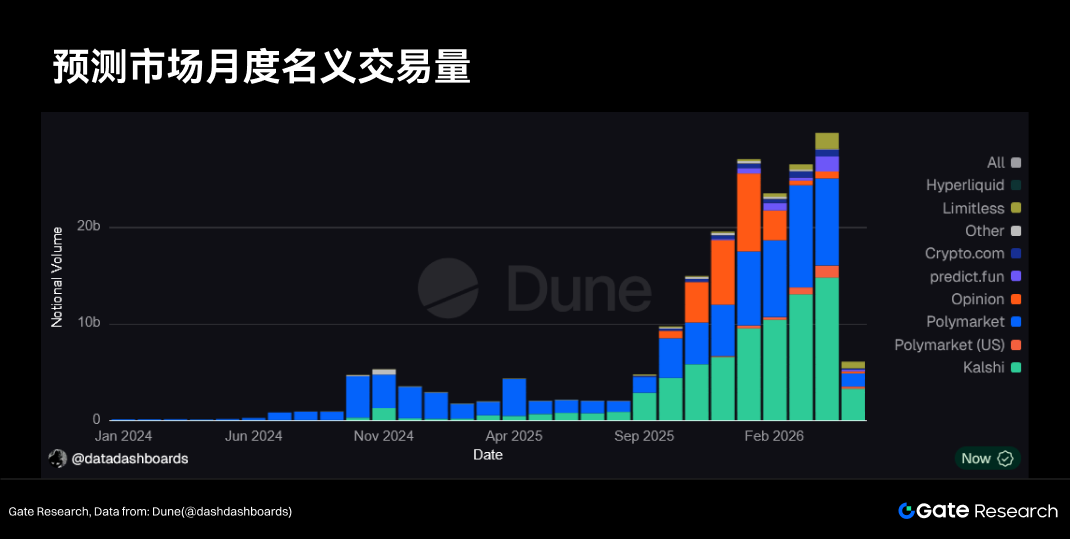
Simultaneously, institutional capital continues to flow in. The valuations of the two major platforms, Polymarket and Kalshi, are rising, exceeding tens of billions of dollars. The international regulatory environment is gradually loosening, regulatory frameworks continue to evolve, and event contracts are being more systematically incorporated into regulatory discussions. Prediction markets are gradually becoming a global informational financial infrastructure.
1.2 User Trading Behavior is Changing
The rapid expansion of prediction markets also reflects a shift in user trading logic.
For a long time, mainstream trading behavior in the crypto market has been similar to traditional finance, primarily revolving around asset volatility: buying and selling major assets like BTC and ETH; using leverage to amplify volatility returns; engaging in short-term trading around liquidity cycles. The core is trading "price" itself, where market participants seek returns based on their judgment of asset price movements.
With the maturation of infrastructure like Polymarket, the objects of user trading are subtly shifting towards deeper driving factors: policy direction, market narratives, AI technological progress, macroeconomic events, and regulatory changes. Users are no longer just trading the "price of an outcome," but are starting to directly trade the "outcome itself," effectively pricing the probability of future events.
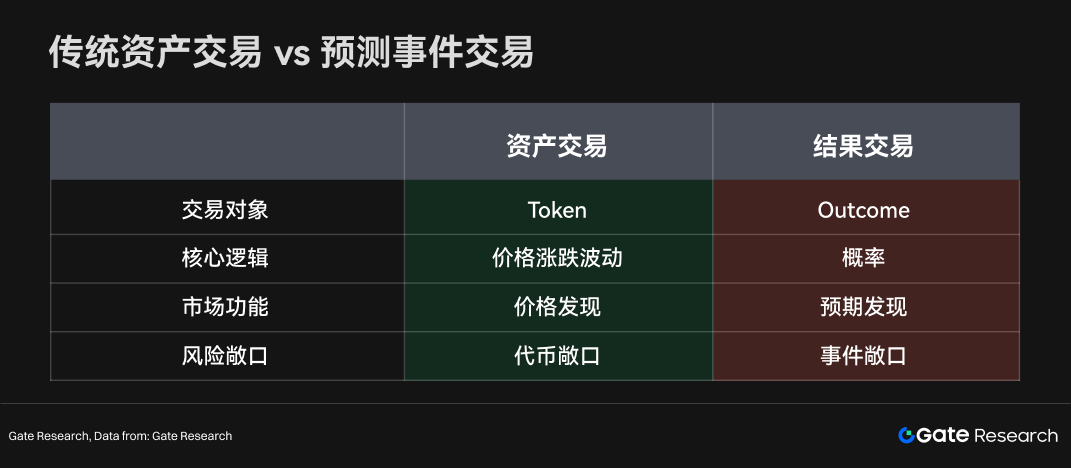
Compared to mapping expectations through assets, prediction markets offer a more direct form of information trading, allowing event expectations to be priced and traded with high efficiency. This explains why prediction market users highly overlap with traditional perpetual swap and options users. These are all trading groups characterized by high frequency, high information density, and high event sensitivity. The difference is that traditional derivatives markets trade price volatility, while prediction markets trade future probabilities.
1.3 Blending of Prediction Markets and Traditional Trading Markets
The financialization of prediction markets is accelerating their deep integration with traditional trading markets.
From a product logic perspective, prediction markets exhibit distinct derivative characteristics. In traditional financial markets, futures are used to trade future prices, and options are used to trade volatility. Prediction markets, by nature, trade the probability of future events occurring and can therefore be seen as a typical type of event-driven derivative. This means prediction markets are not a completely new species independent of the traditional financial system but rather an important new branch of the derivatives market.
Simultaneously, prediction markets restructure market dynamics around events and expectations, granting them unique value and providing a novel price discovery mechanism. Unlike indirectly reflecting various information through asset prices, prediction markets can directly provide real-time, accurate pricing for event outcomes. This direct information pricing capability is the core reason why prediction markets are attracting increasing attention from traditional financial institutions.
In this trend, the role of centralized exchanges is also undergoing a subtle transformation. Previously, the core competitiveness of CEXs was concentrated on listing capabilities, liquidity depth, and contract trading capabilities. In the prediction market-dominated cycle, new competitive dimensions are rapidly emerging, including the ability to operate around hot events, handle and respond to high-frequency information, innovate event trading products, and optimize the user experience for information trading.
Therefore, future trading platforms will no longer be limited to crypto asset exchanges but are expected to evolve into one-stop trading platforms encompassing crypto, TradFi, and future event trading. This underscores the deep strategic significance of Gate's current proactive布局 in prediction markets: securing a vantage point in the era of information trading and completing the upgrade from an asset trading platform to a comprehensive one-stop trading platform.
2. Gate's Strategic Positioning and Product Advantages
Gate's integration of Polymarket leverages the user scale, account system, capital on-ramps, and trading infrastructure of a Top Tier CEX to convert the originally Web3-native prediction market into a CEX-native event trading experience directly accessible to ordinary trading users. The product integration design for prediction markets adopts a logic similar to Gate Alpha's "proxy trading / execution" model. That is, users complete event selection, direction judgment, and order placement on the Gate frontend, while Gate handles the underlying Polymarket market access, asset path conversion, order execution, and position display on the backend.
2.1 Gate's Foundational Advantages: Users, Liquidity, and Distribution
Gate serves over 53 million global users across more than 80 jurisdictions, supports over 4,600 digital assets, and has formed a multi-asset product matrix including Spot, Futures, Earn, Web3, TradFi, and Pre-IPO. A March 2026 exchange report by CoinDesk Data showed Gate as the world's third-largest centralized derivatives trading platform, increasing its derivatives market share to 12%. Derivatives, perpetual, and high-frequency trading users, by nature, possess high information sensitivity, high trading frequency, and high event response capability, making them the core demographic most easily converted to prediction markets.
More critically, Gate's advantages are validated by actual distribution results. In officially tracked Builder data, Gate has become a Top 3 trading volume distribution channel for Polymarket on both a weekly and monthly basis. On a recent single day, Gate even became the second-largest trading volume distribution Builder for Polymarket, all achieved just 1.5 months after the integration began.
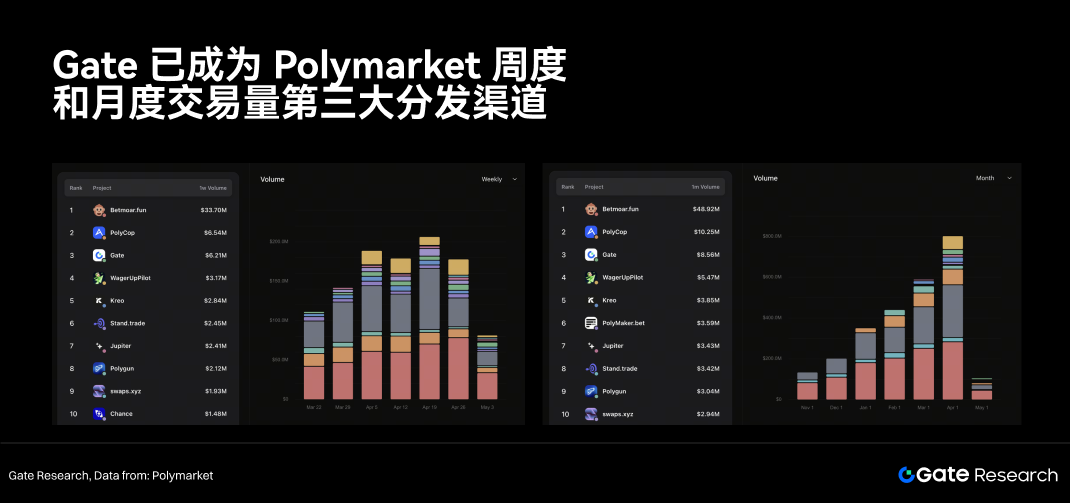
This result indicates that Gate has become an important gateway for new users and trading traffic for Polymarket. Future competition in prediction markets will occur not only at the protocol layer but also at the distribution layer. Those who control users, capital, and trading scenarios are more likely to become core traffic nodes for event trading.
2.2 Gate's Product Design Logic: In-Account Proxy Trading Model Similar to Gate Alpha
The long-standing barriers to entry for on-chain prediction markets include user onboarding, capital on-ramps, product standardization, and trading experience. Polymarket solves market mechanisms and on-chain settlement, but ordinary users still face friction points like wallets, networks, gas fees, USDC (often on Polygon), cross-chain bridges, and order interaction. Gate abstracts away this complexity, compressing the multi-step on-chain process into a simple in-account trading path.
Gate's prediction market design draws inspiration from Gate Alpha. Instead of directing users to jump to an on-chain DApp to trade independently, Gate provides a standardized trading entry point on the frontend and handles the underlying market access, asset path conversion, and trade execution on the backend. Users see an event trading interface within the CEX, while the backend is connected to Polymarket's prediction market liquidity and Yes/No share mechanism.
This model can be understood as an "in-account proxy trading and execution" logic. Gate was one of the earliest centralized exchanges to explore CEX-On-Chain integration. Gate Alpha provided mature and referenceable experience, allowing users to use USDT within their Gate accounts to directly participate in early on-chain asset trading. Gate's prediction market product continues this logic, packaging the on-chain prediction market as a tradable product within the account. Users don't need to prepare their own wallets, handle cross-chain transfers, obtain Polygon USDC, or pay gas fees, nor do they need to understand Polymarket's on-chain interaction details. They simply select an event, choose a direction, and place an order within Gate.
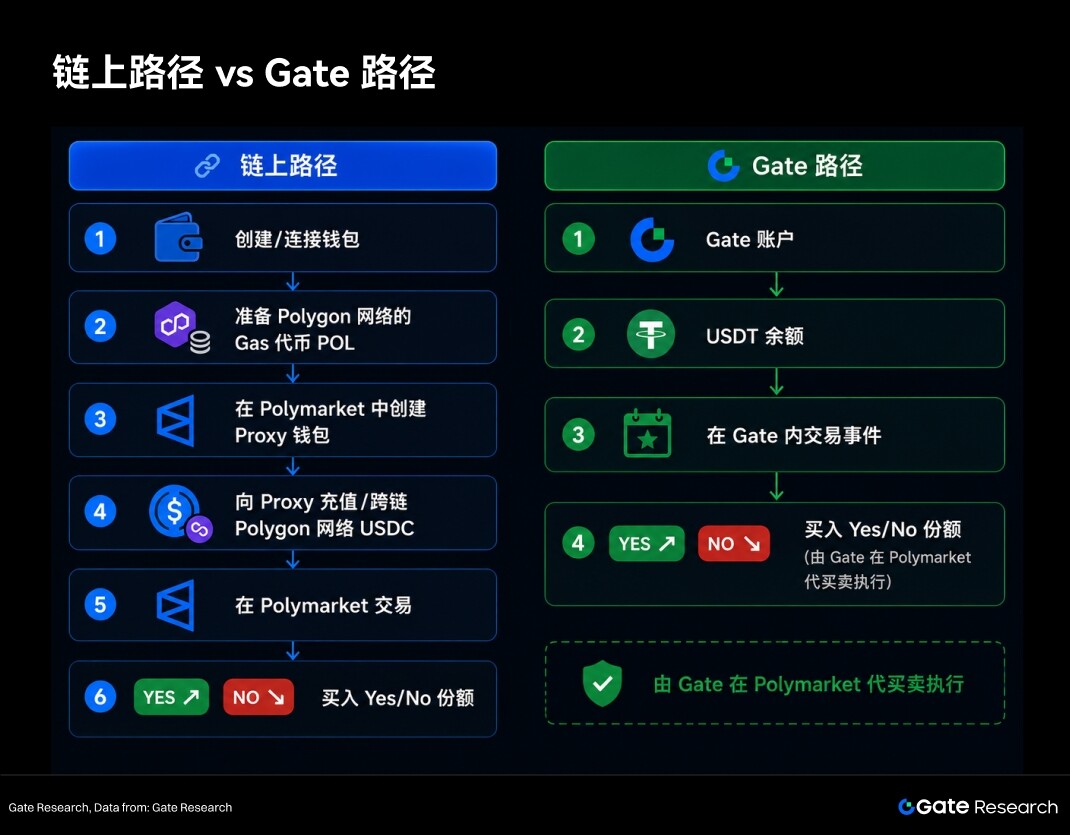
It's easy to see that within this framework, Gate has significantly optimized the entry path. It is not just a reliable traffic redirection portal but also a CEX-native encapsulation layer for prediction markets. Users make trading decisions on the Gate frontend, while Gate handles fund conversion, order routing, market interaction, and position display on the backend, transforming Polymarket's originally Web3-native trading flow into the familiar account balance, order placement, position holding, and settlement experience of a regular CEX user.
This is also the key reason Gate has become the third-largest distribution channel for Polymarket. Prediction markets themselves already possess event pricing and liquidity foundations, but large-scale expansion relies on low-friction entry points. Through a proxy trading mechanism similar to Gate Alpha, Gate encapsulates on-chain event trading into in-account event trading, significantly lowering the barrier to entry for users and improving the conversion efficiency from browsing events to actually placing trades.
2.3 Gate's Event Trading Experience: Dual-Mode Design and Ecosystem Synergy
While retaining Polymarket's core mechanisms, Gate introduces a dual structure comprising Prediction Mode and Trading Mode. Prediction Mode is suitable for new users to understand Yes/No probabilities and outcome payouts. Trading Mode provides an order book, candlestick charts (K-line), depth charts, and various order types, resembling a futures or professional trading interface.
Importantly, prediction markets will not be isolated from Gate's existing spot, futures, and TradFi products; instead, they will become leading signals within the user's decision-making chain. For example, if the probability of a Fed rate cut event rises rapidly, a user might simultaneously adjust positions in BTC, ETH, gold, or US equity index funds. If the probability of a geopolitical event changes, a user might concurrently look at crude oil, gold, stablecoins, and safe-haven assets. If the probability of a specific crypto regulatory event changes, a user might also adjust related token positions and contract strategies.
Therefore, after integrating Polymarket, Gate's product structure has expanded from the traditional "Spot + Futures" to "Spot + Futures + Event Trading." This means Gate not only handles asset price volatility but also can accommodate users' direct judgment on real-world events, macro trends, policy changes, and market narratives, thereby enhancing the information density and the user's trading chain within the entire ecosystem.
2.4 New Features: Evolving Beyond an Entry Point into an Event Trading Hub
Gate's integration with Polymarket will not stop at providing a trading interface. It is continuously evolving towards an all-in-one Event Trading Hub encompassing event discovery, trade execution, asset management, and strategy tracking. A series of newly launched features further strengthen Gate's product advantages in the prediction market distribution layer. Gate aims to help users discover events faster, participate more efficiently, manage positions more clearly, and foster strategy discovery through leaderboards and user profiles.
At the event discovery layer, Gate will launch more comprehensive search and categorization capabilities. Users can quickly search for global hot events via fuzzy keyword matching, with results highlighted. This will be combined with smart recommendations, category browsing, real-time trending, recent browsing, and search history features to reduce the friction from "seeing a hot topic" to "finding the relevant market." With the addition of secondary categories on the homepage, sections like Recommendation, Sports, and Crypto will become clearer, allowing users to quickly navigate relevant event markets based on their interests.
Second, at the real-time opportunity capture layer, Gate will introduce a Breaking News section, aggregating major news, sports updates, crypto market conditions, and other high-attention events. Core trading opportunities in prediction markets often arise from information changes and rapid probability re-evaluation. Therefore, "discovering an event in real-time" is itself a crucial component of the trading experience. The Breaking News section compresses event news, market heat, and trading entry points into a single product path, helping users transition faster from information assessment to trading action.
Third, at the trading category expansion layer, sports events will support more derivative markets, such as point spreads and over/under totals. Interactions like sliding to select a score and quick-clicking to place an order will be supported. Sports have always been one of the categories with the highest trading frequency and the lowest user comprehension cost in prediction markets. Users can trade not only win/loss outcomes but also more granular event exposures like score ranges, handicap results, and total score trends.
Fourth, at the asset and billing management layer, Gate will enhance historical categorization and billing filtering functions. Users can view various fund change records like buys, sells, refunds, and claims, and filter them by transaction type, hiding small transactions or settled market records. A clear billing system can significantly enhance user trust in fund flows, position changes, and the settlement process.
Fifth, at the strategy discovery layer, a leaderboard feature will introduce multi-dimensional rankings for PnL, trading volume, highest profit, etc., and display key data like position value, trading volume, highest profit, and total PnL.
These features collectively form the flywheel for Gate's prediction market product: Event Discovery → Hot Recommendations → Quick Trading → Position & Billing Management → Leaderboard & Strategy Discovery → Further Trading.
3. Business Value: Mutual Benefits for Gate and Polymarket
Gate's integration of Polymarket has created a mutually beneficial structure. Gate gains new event trading scenarios, increased user activity, and platform differentiation. Polymarket gains access to a CEX-grade user entry point, a USDT capital channel, and a lower-friction path for trade conversion. Gate's status as a Top 3 trading volume distribution channel for Polymarket preliminarily validates the business synergy of this partnership.
3.1 For Gate: Enhancing User Activity and Platform's Information Hub Status
Unlike traditional crypto trading, prediction markets are built around news, events, policies, and hot topics, making them naturally more time-sensitive and socially viral. Users may not trade spots or futures daily, but they might check the probability change of a trending event every day.
This product characteristic can increase the frequency of opening the Gate App and strengthen users' reliance on Gate for information. Gate becomes not just a platform users open to place orders, but also an information hub where users check event probabilities, gauge market sentiment, and find global hot topics. Prediction markets bring Gate higher-frequency information consumption scenarios and longer user retention chains.
3.2 For Polymarket: Gaining CEX-Level Distribution and USDT Capital Entry
From a competitive landscape perspective, the next phase of competition in prediction markets is no longer just between underlying protocols but a combination of prediction market infrastructure and major distribution gateways. The partnership between Polymarket's biggest competitor, Kalshi, and Robinhood has already proven that mainstream trading gateways can significantly amplify user reach, trade conversion, and brand recognition for prediction markets. By embedding event contracts into its brokerage trading system, Robinhood provided Kalshi with a broader retail user base, contributing over 50% of its trading volume and propelling event trading from a niche product into a mainstream trading scenario.
Gate's strategic significance for Polymarket lies precisely in filling this gap in CEX-level distribution capability. While Polymarket originally had strong liquidity, event coverage, and user mindshare in on-chain prediction markets, its incremental user acquisition was more Web3-native compared to Kalshi. Gate's integration provides Polymarket with a sufficiently large global crypto trading platform ally, capable of reaching Gate's over 53 million global users, including a cohort of high-frequency, information-sensitive derivatives and contract traders.
Therefore, Gate becoming the third-largest distribution channel for Polymarket is not just a channel data point. It signifies that, with Gate's support, Polymarket is expanding its traffic source from a single on-chain DApp to the vast user base of a CEX account system, a USDT capital gateway, and a mature trading interface.