Cerebras IPO 급등 68%, 체인상 시장은 몇 시간 전에 이미 가격을 정해놨다


- 핵심 요점: 이 기사는 Cerebras 상장 첫날 주가 급등을 분석하며, 체인 기반 Pre-IPO 무기한 계약 플랫폼 TradeXYZ의 가격 책정 정확도가 기존 플랫폼을 훨씬 능가한다고 지적합니다. 또한, 개방적인 글로벌 참여, 양방향 거래 메커니즘, 연속 가격 책정이라는 구조적 이점을论证하여, 이 플랫폼이 투자은행 주도의 전통적인 IPO 가격 책정 방식을 뒤엎을 가능성이 있음을 주장합니다.
- 핵심 요소:
- Cerebras IPO 발행가는 185달러였으나, 상장 첫날 시초가는 350달러로 108% 이상의 프리미엄을 기록했고, 종가는 311달러였습니다. Forge와 Hiive 같은 기존 플랫폼의 최종 가격 책정은 각각 113.50달러와 224.93달러로 시초가와 큰 차이를 보였습니다.
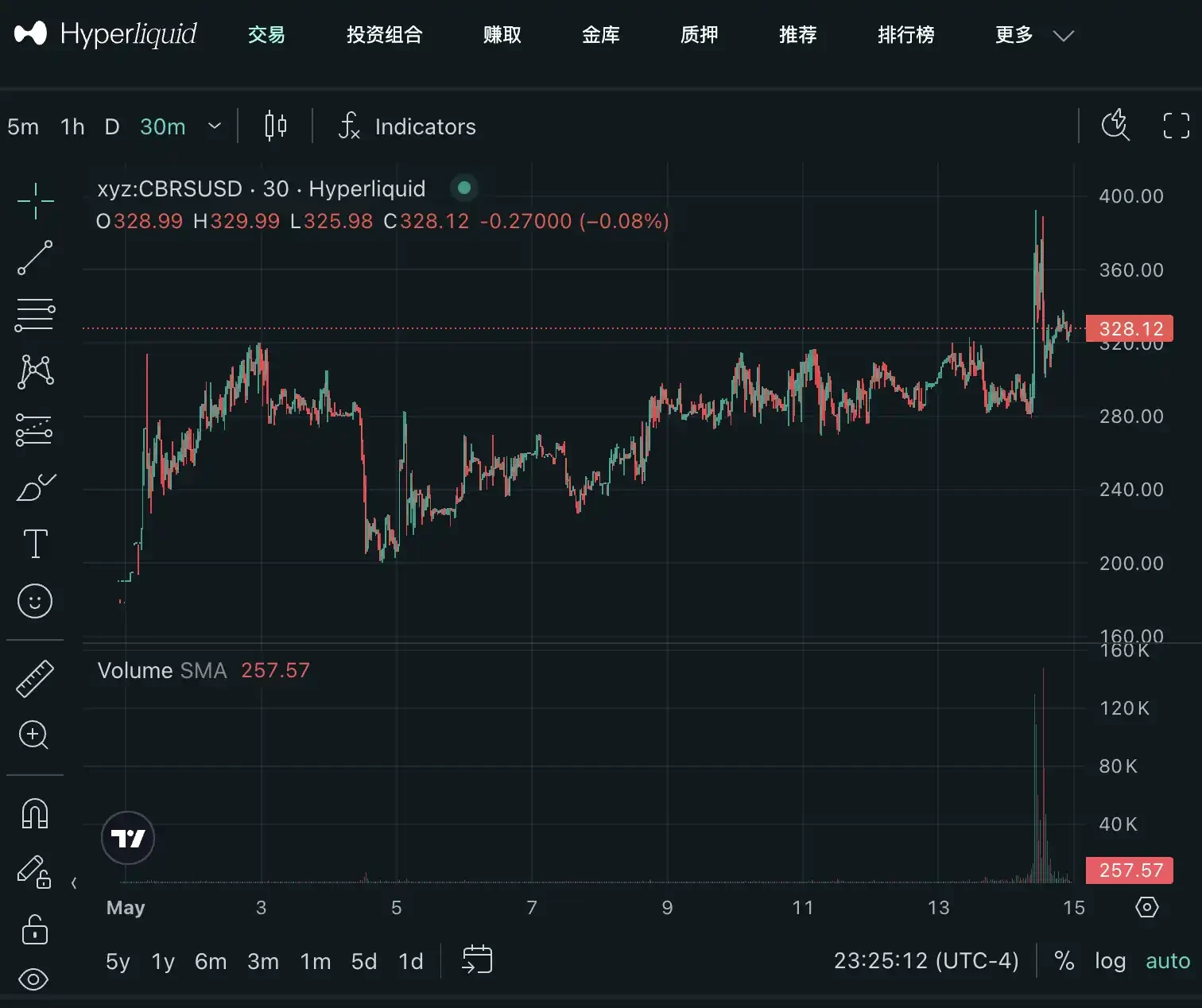
- TradeXYZ의 Pre-IPO 무기한 계약은 2주 동안 288~320달러 구간에서 안정적인 가격을 유지하다가, 개장 직전 380달러까지 급등하며 실제 시장 가격에 더 가까워졌습니다. 24시간 거래량은 2억 8천만 달러에 달했습니다.
- 전통적인 IPO 가격 책정은 투자은행의 수요 예측(bookbuilding)을 통한 정보 독점에 의존합니다. 투자은행은 가격을 낮춰 기관 투자자들에게 높은 첫날 상승분을 제공함으로써 자신들의 협상력을 유지합니다.
- TradeXYZ는 전 세계 누구나, 자격 제한 없이 참여할 수 있도록 허용하며 공매도와 매수를 모두 지원하여 양방향 게임을 형성합니다. 반면, 기존 플랫폼은 단방향 시장(매수 전용)이어서 가격이 체계적인 낙관론에 의해 왜곡되기 쉽습니다.
- 체인상 시장은 7×24시간, 3초마다 업데이트되는 연속적인 가격 책정을 제공하여 뉴스와 정서 변화를 실시간으로 반영할 수 있습니다. 반면, 기존 플랫폼은 가격 업데이트 빈도가 낮고(예: Forge는 하루 한 번), 데이터가 실시간 체결 가격이 아닙니다.
- 기사는 SpaceX, OpenAI 등 곧 고액 IPO를 앞둔 기업들을 언급하며, 체인 기반 Pre-IPO 시장이 월스트리트의 가격 책정 권위에 지속적으로 도전할 것이라고 예측합니다.
Cerebras, which the industry regards as "Nvidia's strongest challenger," went public on the Nasdaq today.
Cerebras opened at $350, with an IPO price of $185. It briefly surged to $385, a premium of over 108% from the IPO price of $185 per share, triggering an upside circuit breaker on its first day of trading.
While this premium is staggering, traders have noticed that TradeXYZ's on-chain Pre-IPO Perp was the most accurately priced platform for Cerebras, surpassing a host of traditional Pre-IPO platforms.
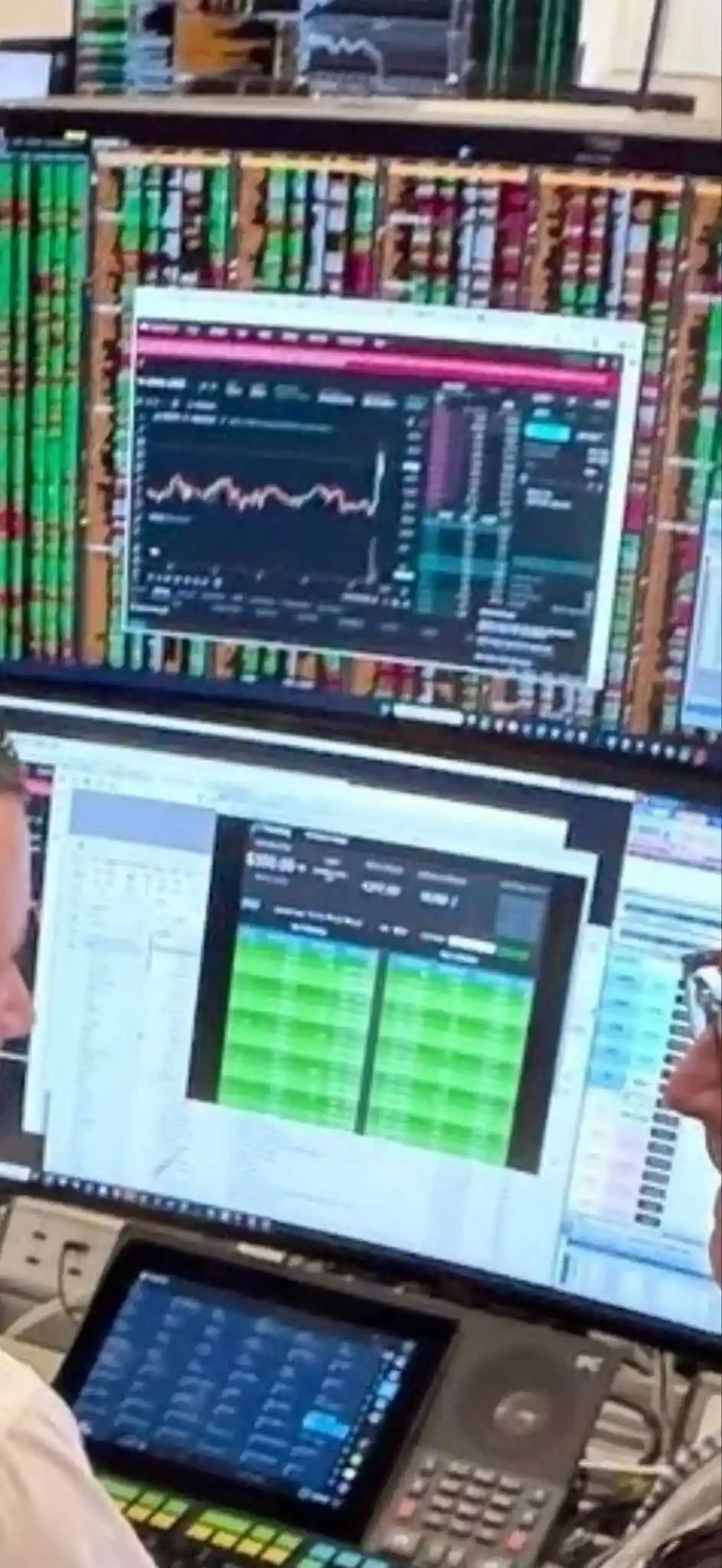
Rumor has it that Morgan Stanley traders are also watching the Cerebras price K-line on Hyperliquid. Source: Community
What exactly did the Pre-IPO Perp disrupt?
Before diving into the comparison, let's first discuss Cerebras's IPO opening price.
On May 4, Cerebras submitted an amended S-1 to the SEC with an initial price range of $115 to $125. This was the first public figure from the underwriting syndicate of Morgan Stanley, Citigroup, Barclays, and UBS.
On May 8, the price range was raised to $125 to $135. On May 11, it was raised again to $150 to $160, and the number of shares increased from 28 million to 30 million. On the evening of May 13, the final price was set at $185. On May 14, trading opened directly at $350.
Okay, now let's look at those platforms.
First is Forge Global, a private secondary market used by professional institutions, which appears to have the worst pricing.
Forge is one of the world's largest private equity secondary trading markets, listed on the NYSE, serving institutional investors, VCs, and qualified individual investors. Its core product, "Forge Price," is an algorithmic pricing model that integrates secondary market transactions, funding round information, and platform order book data, considered one of the most authoritative price references in the private market.
Accessing Forge requires qualified investor certification, with an annual income threshold of $200,000 or net assets exceeding $1 million. This is not a place for the average person.
Cerebras's price movement on Forge is clear from the chart: from around $20 per share in 2023, stabilizing in the $30 to $40 range in early 2025, rapidly climbing with funding news in early 2026. On May 12, the day before the IPO pricing, the final Forge Price reading was $113.50, corresponding to a valuation of $29.26 billion.
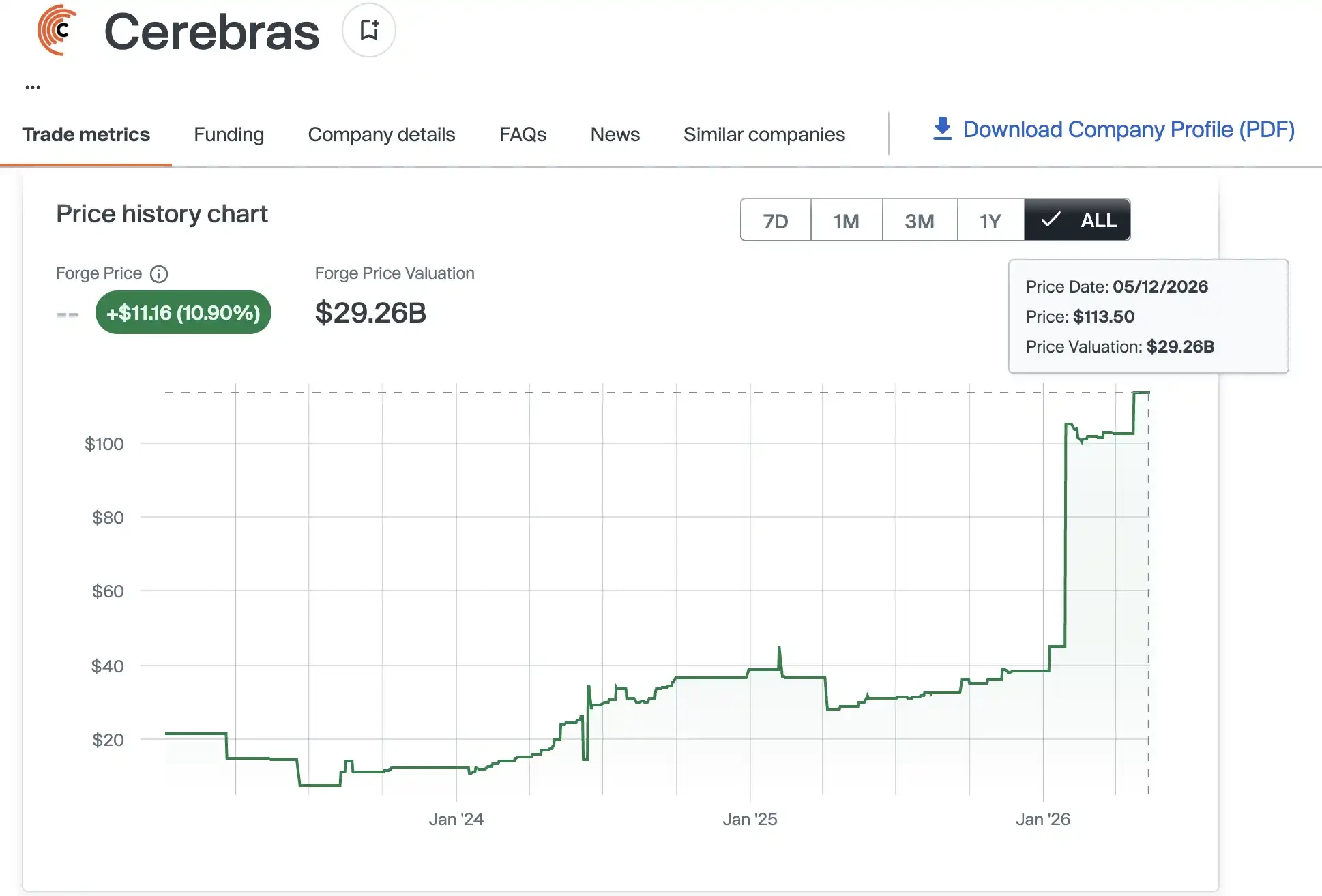
The deviation between Forge Price's $113.50 and the closing price of $311 is already 174%, let alone the opening price of $350.
Now look at the more active secondary market, Hiive. Hiive's positioning is similar to Forge's, but it focuses more on active transaction matching. Its user profile leans more towards high-net-worth individual investors and small VCs, with a higher transaction frequency than Forge. The price trend chart on Hiive shows that Cerebras's price updates are more frequent and more volatile.
Hiive's final traded price was $224.93, marked as "Final Hiive Price," the last valid price on the platform before Cerebras's listing.
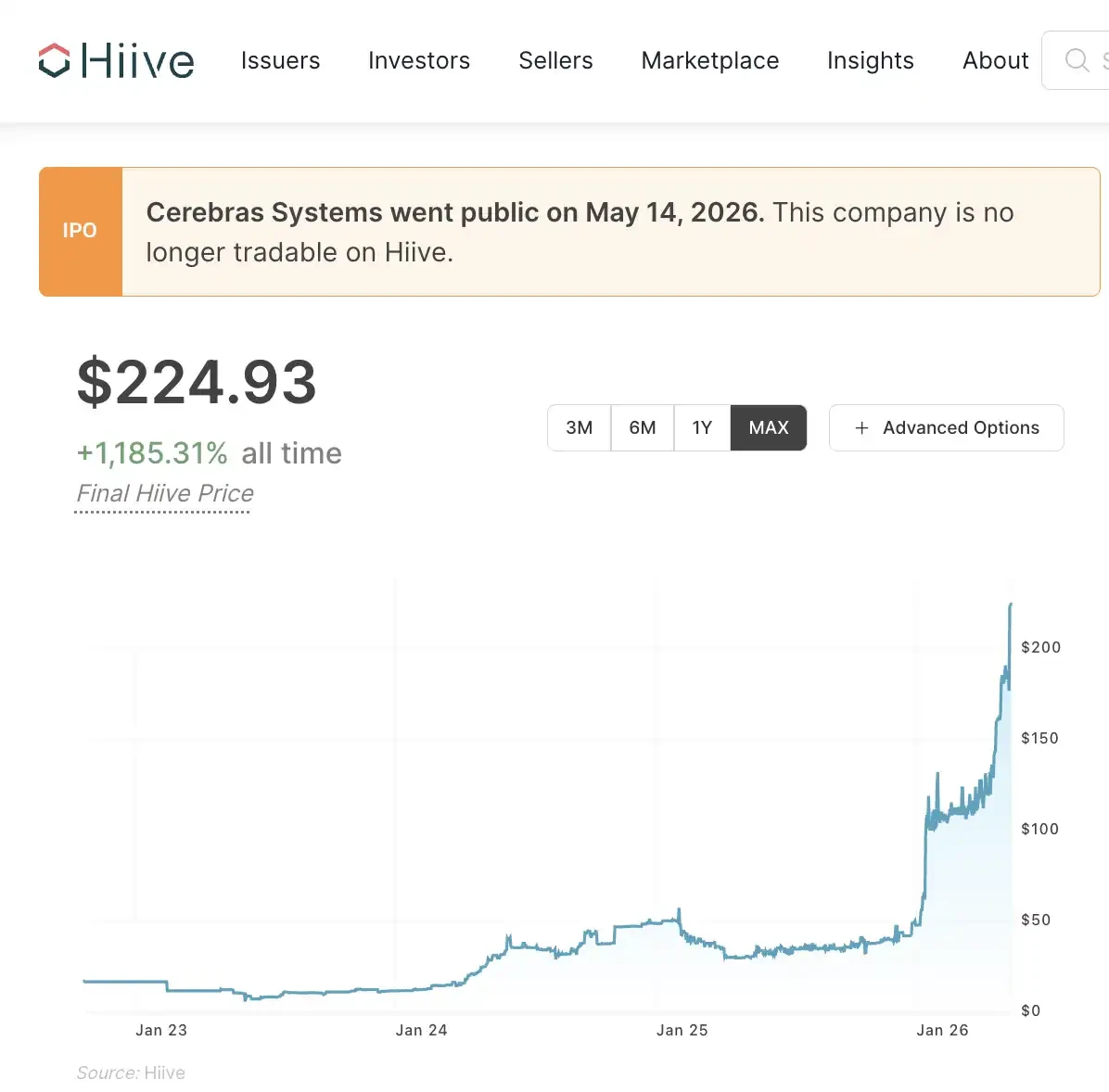
$224.93 is much more accurate than Forge's $113.50, but still has a 38% deviation from the closing price of $311 and a 56% deviation from the opening price of $350.
Hiive's price is more accurate than Forge's because its transactions occur later and are more密集, capturing more market sentiment close to the IPO. However, it is still a one-sided market, only trading real equity, with no shorting mechanism and no 24/7 continuous matching.
Now let's look at TradeXYZ.
Launched on May 1, with an initial reference price of $175 and a maximum leverage of 5x, anyone in the world holding a USDC wallet could participate, going long or short.
Within two weeks, the on-chain Pre-IPO Perp traded steadily in the $288 to $320 range. At 10 PM on May 14, three hours before Nasdaq officially opened for retail trading, the CBRS on-chain contract price quickly surged from the $290 range to $380, with an hourly trading volume close to $100 million. The 24-hour total volume was $280 million, with open interest of $57.77 million, making it the platform's fourth most active stock contract.
Some might say TradeXYZ was just lucky this time and the accurate pricing was a coincidence.
But this rebuttal misses a more important point: TradeXYZ's accurate pricing is not accidental; it's structural.
Why is TradeXYZ's pricing more accurate?
To understand why TradeXYZ's pricing is more accurate, you must first understand why investment banks have monopolized the pricing power of traditional IPOs for so long.
The traditional IPO pricing mechanism relies on a core premise: all judgments about "what this company is worth" must be aggregated through the investment bank's bookbuilding process.
The CEO and CFO fly to major financial centers, meeting all key institutional investors within two weeks, telling the company's story one-on-one and collecting indicative prices. These indications all flow into the book managed by the underwriters.
No one knows what Fidelity bid, how many shares BlackRock subscribed for, or Tiger Fund's indicative price. The investment bank is the only one with a complete picture.
This information asymmetry creates the investment bank's bargaining power. They can set the price at a level that "clears the order book but leaves enough first-day pop for institutions." This is an art. A 20x oversubscribed book indicates all institutions know $185 is low, but the bank locked that information away, set the issue price at $185, institutions got an 89% first-day gain at the open, and they'll come back for the next roadshow.
But when a 24/7 market exists, allowing anyone to participate, allowing short selling, with all positions verifiable in real-time on-chain, price information no longer needs to be aggregated through a book.
The higher the barrier, the worse the pricing. The more open it is, the more accurate the pricing.
TradeXYZ allows anyone globally to participate, with no asset thresholds, no geographic restrictions, and no invitation system. Every transaction and every order is a participant publicly expressing their judgment of Cerebras's value with real money.
This means TradeXYZ's price aggregates a far wider information set than a roadshow – not just institutional judgments, but the judgments of all market participants aware of this IPO opportunity. More information sources mean a price closer to true value.
At the same time, the short-selling mechanism makes it harder for the price to be distorted.
Forge and Hiive are essentially one-sided markets. Sellers are employees or early investors looking to cash out, and buyers are qualified investors bullish on the company. No one can publicly bet "I think this company is overvalued" because the channel for short selling simply doesn't exist.
This creates a systemic bias: prices in a one-sided market can only be driven by upward pressure; bearish forces have no outlet, leading to a price that is systematically skewed towards optimism.
TradeXYZ allows shorting. Anyone who thinks Cerebras is overvalued can open a short position with margin, using real capital to express their judgment. This two-way game is a necessary condition for price equilibrium. The struggle between bulls and bears makes the price harder to dominate by a single sentiment.
Most importantly, Forge Price updates once a day; it's the output of an algorithmic model, not a real-time market transaction. Hiive's transactions are discrete; days might pass between trades. During a roadshow, investment banks release price signals to the market every few days, each time selective disclosure.
TradeXYZ is a continuously operating matching market, updating its price every 3 seconds. When news like Sam Altman appearing in a roadshow video breaks, or rumors that Arm and SoftBank tried to acquire Cerebras leak, or news that the book oversubscription multiple went from 10x to 20x emerges, the price moves immediately.
The Pre-IPO craze this year is just beginning.
Cerebras is only the first. Later this year, SpaceX, OpenAI, and Anthropic are all preparing for their IPOs. This will be the largest batch of tech IPOs in human history, potentially raising over a hundred billion dollars.
And this means Hyperliquid and TradeXYZ will continue to disrupt Wall Street's understanding and command more pricing power.