Anthropic과 OpenAI가 직접 프리마켓 코인-주식의 논리를 끊어냈다


- 핵심 의견: Anthropic과 OpenAI가 잇달아 이사회 승인을 받지 않은 주식 양도(SPV를 통한 간접 보유 포함)를 인정하지 않는다고 선언하면서 프리마켓 주식 토큰 시장이 폭락했다. 이는 이러한 토큰의 법적 리스크를 드러내며, 업계의 '거품 제거'를 촉발할 수 있다.
- 핵심 요소:
- Anthropic과 OpenAI는 모두 이사회 동의 없이 이루어진 주식 양도는 무효이며, 매수자의 주주 권리를 인정하지 않고, SPV(특수목적회사)의 자사주 매입을 명시적으로 금지한다고 발표했다.
- 시중의 프리마켓 주식 토큰(예: Prestock의 ANTHROPIC, OPENAI)은 대부분 SPV 구조를 기반으로 하며, 그 가치는 SPV가 보유한 원주(原株)의 유효성에 의존한다. 회사가 이를 인정하지 않으면 토큰 가치가 제로가 될 수 있다.
- SPV '마트료시카' 구조는 리스크를 증가시킨다: 다중 계층 구조의 법적 투명성이 낮고, 관리비가 수익을 단계적으로 잠식하며, 어떤 계층의 지분이라도 무효 판정을 받으면 가치 사슬이 붕괴된다.
- 시장 반응이 격렬하다: ANTHROPIC 토큰은 하루 만에 20.62% 급락한 1,082달러를 기록했고, OPENAI 토큰은 26.82% 폭락한 1,440달러를 기록하며, 투자자들은 권리 확정 리스크에 공포를 느꼈다.
- 프리마켓 선물 계약 상품(실제 주식을 보유하지 않고 IPO 가격에 베팅하는 상품)은 상대적으로 영향이 적은데, 이는 지분 뒷받침보다는 가격 게임에 의존하기 때문이다.
- 업계 의견은 분분하다: 한쪽에서는 대형 기업들의 SPV 차단이 프리마켓 토큰의 논리를 종식시킬 것이라고 주장한다. 다른 쪽에서는 투자자들이 비공식 채널의 거래 리스크를 감수해야 한다고 본다.
- 이번 사건은 투기자들을 위한 리스크 교육으로 간주되며, 무분별하게 성장해 온 프리마켓 주식 토큰 시장에 경계를 긋고 '거품을 제거'하는 데 도움이 될 것이다.
Original | Odaily (@OdailyChina)
Author | Azuma (@azuma_eth)

The pre-IPO stock token market has just experienced a violent shock. The epicenter of this earthquake comes from two statements made by AI giants Anthropic and OpenAI.
Anthropic and OpenAI Successively Refuse to Acknowledge Unauthorized Transfers
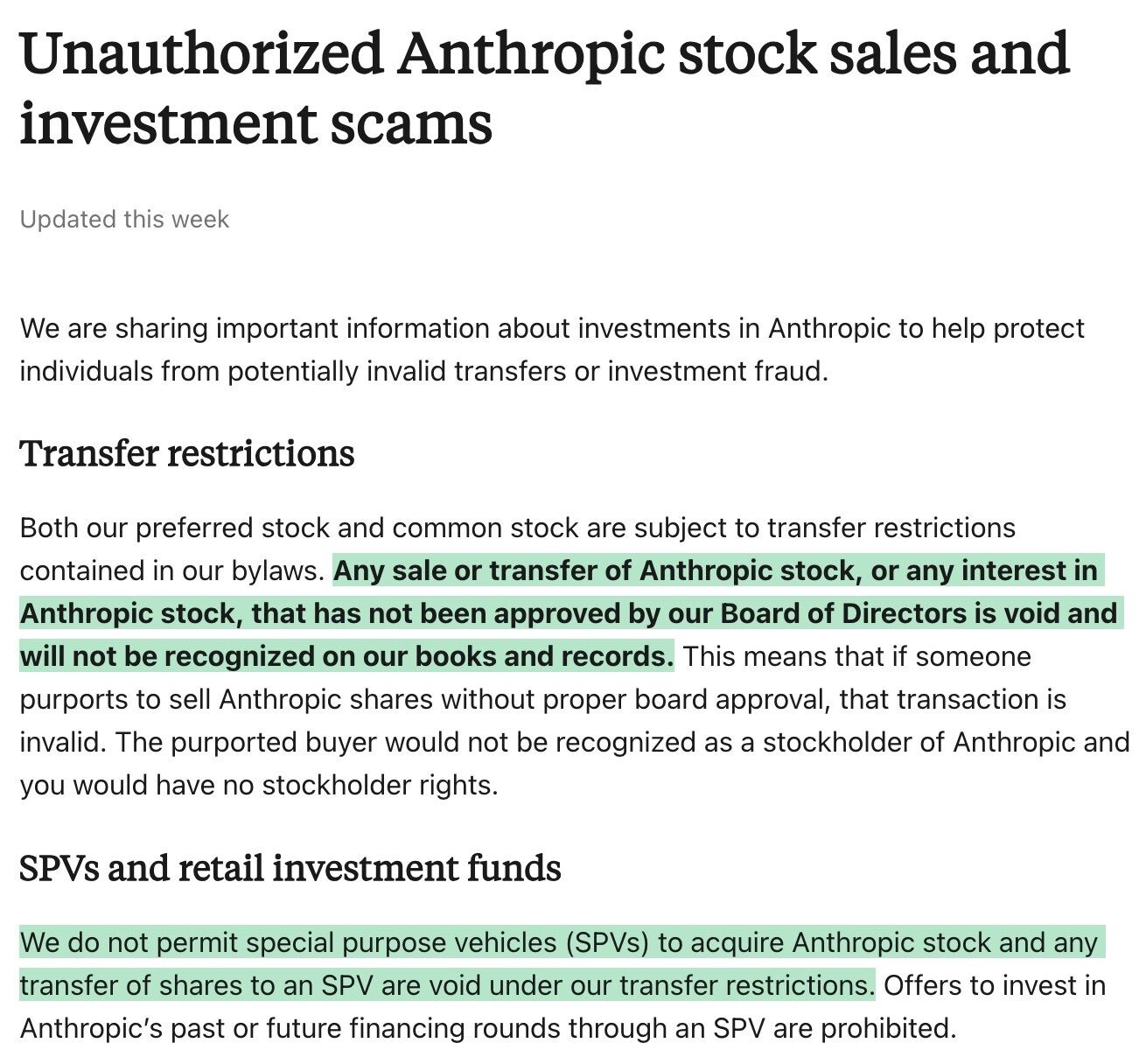
Today, Anthropic updated an official statement released in February this year, titled "Unauthorized Anthropic Stock Sales and Investment Scams."
In the article, Anthropic clearly stated: "Any sale or transfer of Anthropic stock, or disposal of rights to Anthropic stock, not approved by our Board of Directors is void (note the use of the word 'void'), and will not be recognized on the company's books and records. This means that if someone sells Anthropic stock without the Board's approval, the transaction will be deemed invalid. The so-called buyer will not be recognized as an Anthropic shareholder and will have no shareholder rights."
Shortly after Anthropic's statement update, OpenAI also followed suit, announcing: "All equity is subject to transfer restrictions. No shares may be transferred, directly or indirectly, without the Company's written consent. Any sale without such consent is not only unauthorized but also void."
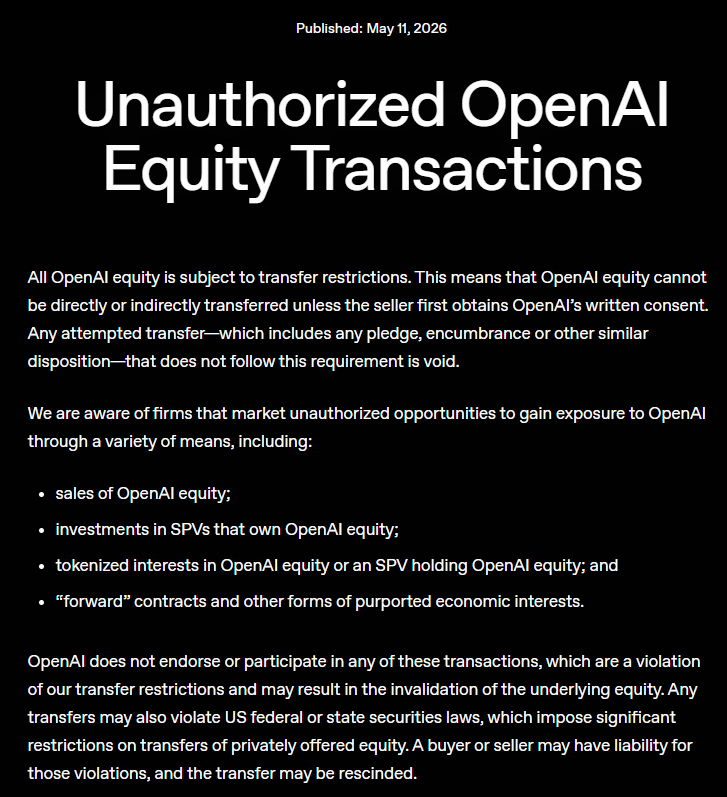
In their announcements, both Anthropic and OpenAI explained that the company's preferred and common stock are subject to transfer restrictions stipulated in the bylaws, and therefore all stock transfers require Board consent.
Anthropic also specifically emphasized that the company does not allow "Special Purpose Vehicles" (SPVs) to acquire Anthropic shares, and any transfer of shares to an SPV violates the company's transfer restrictions... Certain investment funds may claim to offer indirect channels for investing in Anthropic stock, but these funds are likely attempting to circumvent transfer restrictions. Therefore, any third party claiming to sell Anthropic stock to the public – whether through direct sales, forward contracts, stock tokens, or other mechanisms – may be engaging in fraud or offering worthless investments due to Anthropic's transfer restrictions.
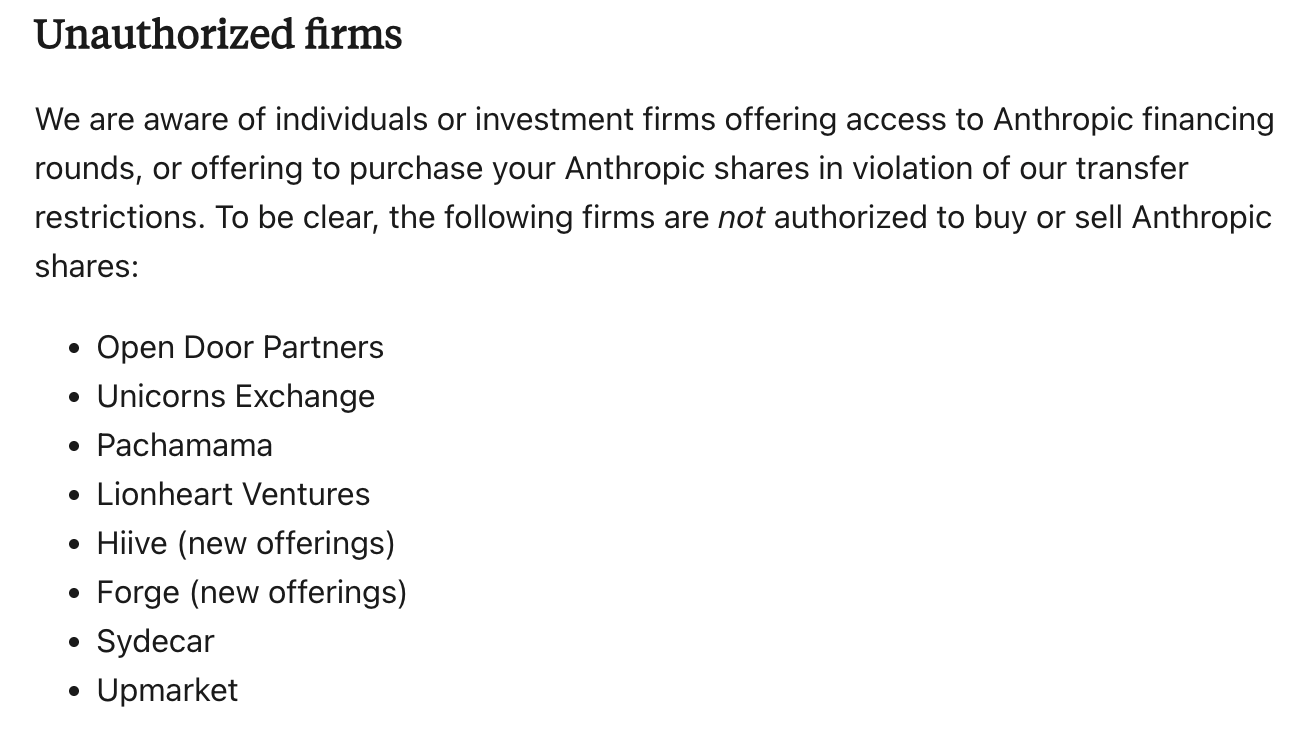
- Note from Odaily: The image shows unauthorized equity transfer platforms named by Anthropic.
What is an SPV?
To understand why this update has such a massive impact on the pre-IPO stock token market, one must first understand what an SPV is.
In traditional pre-IPO stock trading, directly transferring original shares is extremely difficult, limited not only by company bylaws but also involving complex legal procedures. Against this backdrop, SPVs emerged.
An SPV is a separate legal entity established for a specific transaction or investment purpose. It can be understood as a 'shell company specifically created to hold an asset.' Multiple investors can contribute capital to the same SPV, indirectly holding shares of a company or a class of assets, thereby achieving centralized ownership, lowering entry barriers, and optimizing legal and tax structures. SPVs are particularly common in popular pre-IPO stock trading. Since many star companies are often reluctant to directly bring in a large number of small shareholders, institutions typically set up an SPV first, which then uniformly invests in the target company.
For example, what the market calls "participating early in Anthropic or OpenAI share subscriptions" essentially involves investors contributing capital to a specific SPV, which then uniformly acquires Anthropic's unlisted equity.
Currently, most pre-IPO stock token platforms on the market (like Prestock) use an SPV structure.
- The platform or its partners register an SPV in a certain jurisdiction. This SPV's sole task is to buy Anthropic's original shares on the secondary market (usually from employees or early investors).
- The platform then issues derivative tokens on-chain (e.g., ANTHROPIC or OPENAI). These tokens are defined in legal agreements as a "claim on the economic benefits of this SPV."
- Theoretically, the token is pegged 1:1 to the original stock. For every 1 token issued, the off-chain SPV should hold the corresponding shares.
The current problem is, Anthropic and OpenAI have now clearly stated they 'do not recognize unauthorized stock transfers.' This means if an SPV transfers stock without Board approval (which is almost certainly not granted), the stock held by that SPV could be deemed invalid in the eyes of Anthropic and OpenAI. If the stock held by the SPV is invalid, the "economic benefits" that the on-chain tokens refer to become worthless.
The "Matryoshka Doll" Risk of SPVs
A major reason Anthropic and OpenAI are so opposed to SPVs is the emerging risk of excessive financialization of SPVs, fueled by the continuous hype surrounding their pre-IPO stock tokens (Anthropic's pre-IPO valuation once soared to $1.4 trillion, far exceeding its valuation in the last funding round).
Among these, the most concerning issue is the "Matryoshka doll" problem of SPVs – many investors buying pre-IPO stock tokens think they are buying company shares, but they are actually only buying a claim on the economic benefits of a particular SPV. More alarmingly, many SPVs do not directly hold Anthropic's original shares but are themselves nested two to three layers deep within other SPVs.
This "Matryoshka doll" structure is actually very dangerous.
- Legal Transparency Issues: With each additional layer, the authenticity of the underlying asset becomes fuzzier. It is extremely difficult for investors to confirm whether the SPV at the bottommost layer has obtained the company's Board approval for the transfer.
- Management Fee Exploitation: Each layer of SPV charges management fees, performance fees, and dividends. After layers of peeling, the investor's actual returns are severely diluted.
- Risk of Total Loss: If the equity transfer at any single layer is deemed "void" by Anthropic, the entire value chain collapses instantly.
Whether for reputational reasons or investor protection, Anthropic and OpenAI clearly do not want to see this situation.
Pre-IPO Stock Tokens Plunge, Contracts Remain Relatively Stable
The market reacted immediately once the announcements from Anthropic and OpenAI gained traction.
On PreStocks, ANTHROPIC experienced a significant drop, falling below $1,000 at one point before settling at $1,082 as of 12:00, a sharp single-day decline of 20.62%. OPENAI is currently reported at $1,440, a sharp single-day decline of 26.82%.
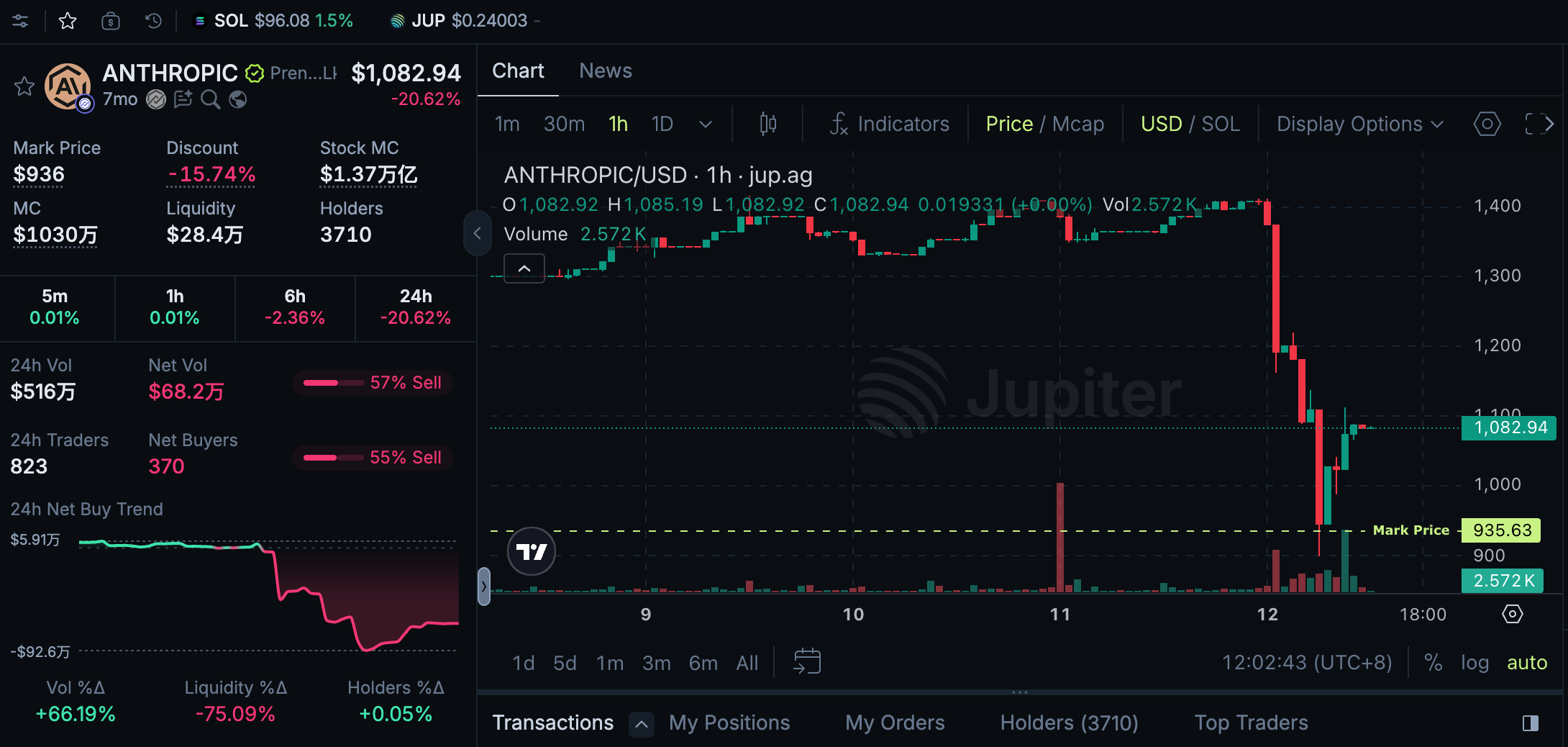
Investor panic is easy to understand. Since Anthropic and OpenAI have clearly stated they do not recognize unauthorized shareholdings, the "rights" behind these tokens could potentially become "worthless paper." Holders may face enormous verification costs and legal litigation expenses.
Interestingly, while pre-IPO stock tokens came under pressure, another type of pre-IPO trading product performed relatively steadily – pre-IPO contracts that rely purely on bilateral market speculation. This is because such products essentially do not hold any real stock; the restrictions imposed by Anthropic and OpenAI do not affect them. They are simply "bilateral bets" on the future IPO price, relying on the price competition between buyers and sellers.
Predicting Future Trends
In response to the "non-recognition" stance of Anthropic and OpenAI, two distinct voices have emerged within the industry.
Some believe the logic of pre-IPO stock trading is dead. If top-tier companies like Anthropic and OpenAI take the lead in cracking down on SPVs, other giants may follow suit. With the underlying equity support shaken, it is questionable whether the so-called pre-IPO stock tokens still hold value.
However, another part of the industry, including Rivet founder Nick Abouzeid, believes this is not a big deal. Trading pre-IPO stock tokens through unofficial channels has always been a gamble; buyers should have realized from day one that 'the company might not recognize it.' You lack the opportunity for direct investment; obtaining that opportunity through other means inevitably involves bearing some risk.
In summary, with the premium on pre-IPO stock tokens continuously expanding and market sentiment gradually becoming frenzied, the statements from Anthropic and OpenAI have undoubtedly poured cold water on the entire track.
In the past few months, more and more investors have started viewing pre-IPO stock tokens as a 'low-barrier channel to participate in the growth of top AI companies.' The valuations of some AI-concept pre-IPO stock tokens have clearly detached from reality, even exhibiting crazy speculative premiums far exceeding their last funding round valuations. Against this backdrop, Anthropic and OpenAI's public "fact-checking" could be seen as, to some extent, redefining the boundaries of this wild and growing new market.
For speculators, this is a risk lesson; but for the long-term development of the industry, the market might just need such a moment of "de-bubbling."