






支持率不足1%、BIP-110はそれでもビットコインをソフトフォークに導くのか?


- 核心見解:ビットコインのBIP-110提案は、銘文などの非貨幣的データを制限することを目的としている。支持率の低さから強制起動に直面しているものの、チェーンのフォークを引き起こす可能性があり、その最終的な成否はコミュニティのコンセンサスとマイナーのハッシュレートに依存する。
- 重要要素:
- マイナーの支持率は1%未満、ノードの支持率はわずか14.64%であり、BIP-110の支持率は極めて低い。
- 8月の起動しきい値である55%に達しなかった場合、提案は強制ウィンドウ期間に入り、実行ノードは不適合ブロックを拒否し、ネットワークのフォークにつながる可能性がある。
- 支持派は開発者Luke Dashjrを代表とし、銘文は「ジャンクトランザクション」であり、ビットコインの通貨としての用途を圧迫し、ノードの負担を増加させると考えている。
- 反対派は、BIP-110では問題を根本的に解決できず、イノベーション(例:BitVM)を阻害し、検閲耐性の精神に反し、二重支払いリスクやチェーン分裂を引き起こす可能性があると主張している。
- Oceanのハッシュレートシェアはわずか2.6%である一方、F2Poolなどの主要マイニングプールは明確に反対しており、大多数のマイナーの利益に基づけば、BIP-110チェーンはハッシュレート不足により「自然消滅」する可能性が高い。
- 現在、銘文トランザクションの割合は5%まで低下しており、BIP-110起動後にハッシュレートが不足すれば、少数派チェーンが「最長チェーン」になることは難しく、最終的には独立してフォークし、新しいコインとなる可能性がある。
- 予測市場では、BIP-110の起動成功確率はわずか10%であり、反対派は公然とその失敗に賭けている。
Original: Odaily Planet Daily(@OdailyChina)
Author: Golem(@web3_golem)
As the August mandatory window period approaches, discussions around the BIP-110 proposal have once again heated up.
BIP-110 was proposed by Dathon Ohm in December 2025 and is supported by Bitcoin Core developer Luke Dashjr. The proposal aims to restrict arbitrary/non-monetary data in Bitcoin transactions over the next year, primarily targeting large-scale data storage like Ordinals and Bitcoin NFTs, with the goal of reducing "junk transactions" on the network and refocusing Bitcoin on its monetary function.
The proposal has been controversial since its inception, but data shows that BIP-110 currently lacks mainstream support from miners and nodes. The activation threshold for BIP-110 is 55%. According to statistics, miner support is currently below 1%, and out of a total of 102,674 nodes on the network, only 15,035 are willing to enforce BIP-110, a rate of 14.64%.
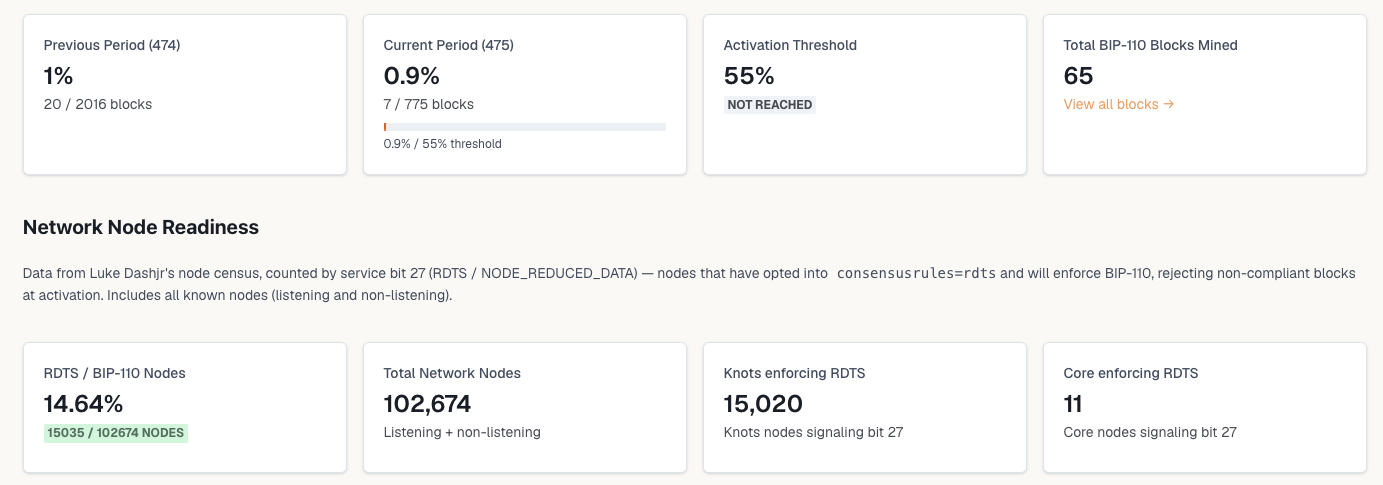
BIP-110 miner and node support rates
Typically, a proposal with such low support would not pass on the Bitcoin network. However, the aggressive nature of BIP-110 lies in the fact that even without consensus, nodes supporting BIP-110 will enforce it. If BIP-110 fails to reach the 55% activation threshold before block height 961,632, it will enter a mandatory window period (block heights 961,632-963,647). During this period, nodes running BIP-110 will reject non-compliant blocks, forcibly raising the adoption rate to 100%, ultimately leading to mandatory activation of BIP-110 at block height 965,664.
Based on the current block generation speed of the Bitcoin network, BIP-110 will enter the mandatory window period in early August. This means that although BIP-110 is a soft fork proposal, the Bitcoin network will experience a chain split (a minority chain supporting BIP-110 and the main chain not supporting it).
BIP-110 Remains Contentious
According to Bitcoin's "longest chain rule," only when the actual mining power supporting BIP-110 forms a majority (>50%) will they become the longest chain, and the entire network will converge on the new rules, i.e., a successful soft fork. Therefore, although the forced activation of BIP-110 seems inevitable, its long-term viability ultimately depends on consensus. Otherwise, BIP-110 will meet the same fate as most Bitcoin soft forks in history: natural death.
Supporters: BIP-110 is Not a Change, but a Denial of Change
The main representatives of BIP-110 supporters are Luke Dashjr and his mining pool, Ocean. Even in his early years, Luke Dashjr was a radical figure in the Bitcoin developer community opposing BRC-20 and inscriptions, and he provided the initial draft suggestions for the BIP-110 proposal.
Luke Dashjr is seen as a champion of Bitcoin maximalism. They are unwilling to see Bitcoin block space used for any purpose other than Bitcoin transfers. The BIP-110 proposal characterizes the inscriptions that emerged in 2022 as a "Bitcoin attack," arguing that allowing arbitrary data to be embedded in Bitcoin transactions imposes a huge and unnecessary burden on nodes and occupies a large amount of block space. This forces monetary transactions to bid higher fees to be included in blocks, crowding out Bitcoin's monetary use case.
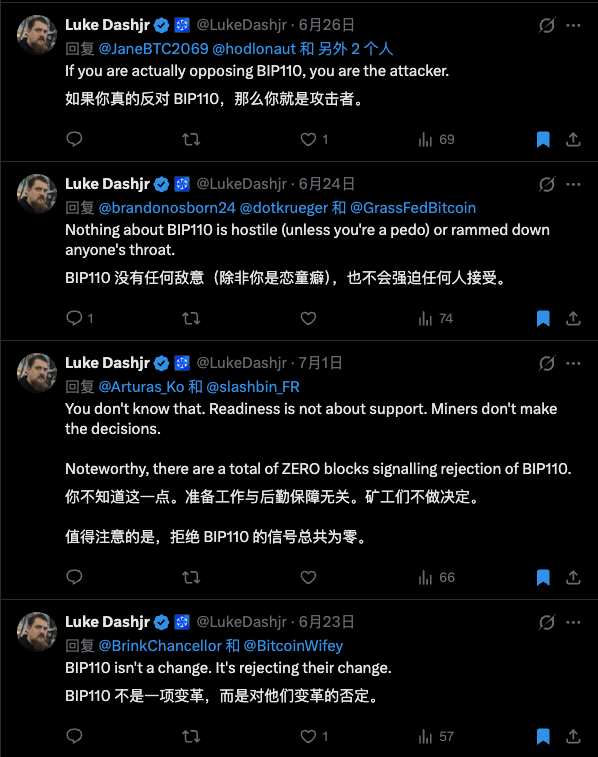
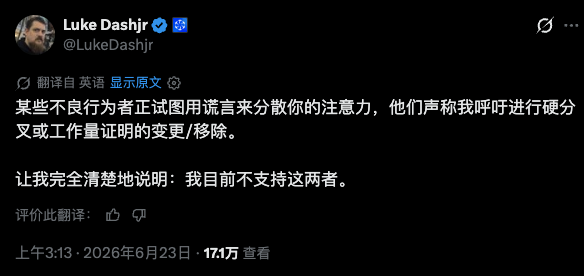
Therefore, Luke Dashjr stated on platform X that BIP-110 is not a change, but a denial of change. When facing opponents of BIP-110, he also employed sophistry. On one hand, he claims BIP-110 is not hostile and does not force anyone to accept it; on the other hand, he argues that anyone opposing BIP-110 is the real Bitcoin attacker.
Furthermore, although the current miner vote in favor of BIP-110 is very low (<1%), Luke Dashjr remains optimistic, noting that the miner vote directly opposing BIP-110 is also nearly 0%. His implication is that miners are not making a decision; once BIP-110 is activated, they will naturally follow.
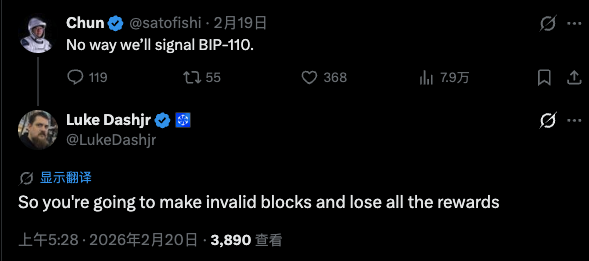
In reality, as of now, the only mining pool publicly supporting BIP-110 is Luke Dashjr's own, Ocean. F2Pool co-founder Wang Chun publicly stated as early as February that he would never support BIP-110. Luke Dashjr confidently replied under his post, saying, "Then you will be mining invalid blocks and lose all your rewards."
According to miningradar data, F2Pool is the third-largest Bitcoin mining pool globally, with a hashrate share of 13.6%. Ocean's current hashrate is only 24.6 EH/s, accounting for 2.6% of the total network hashrate.
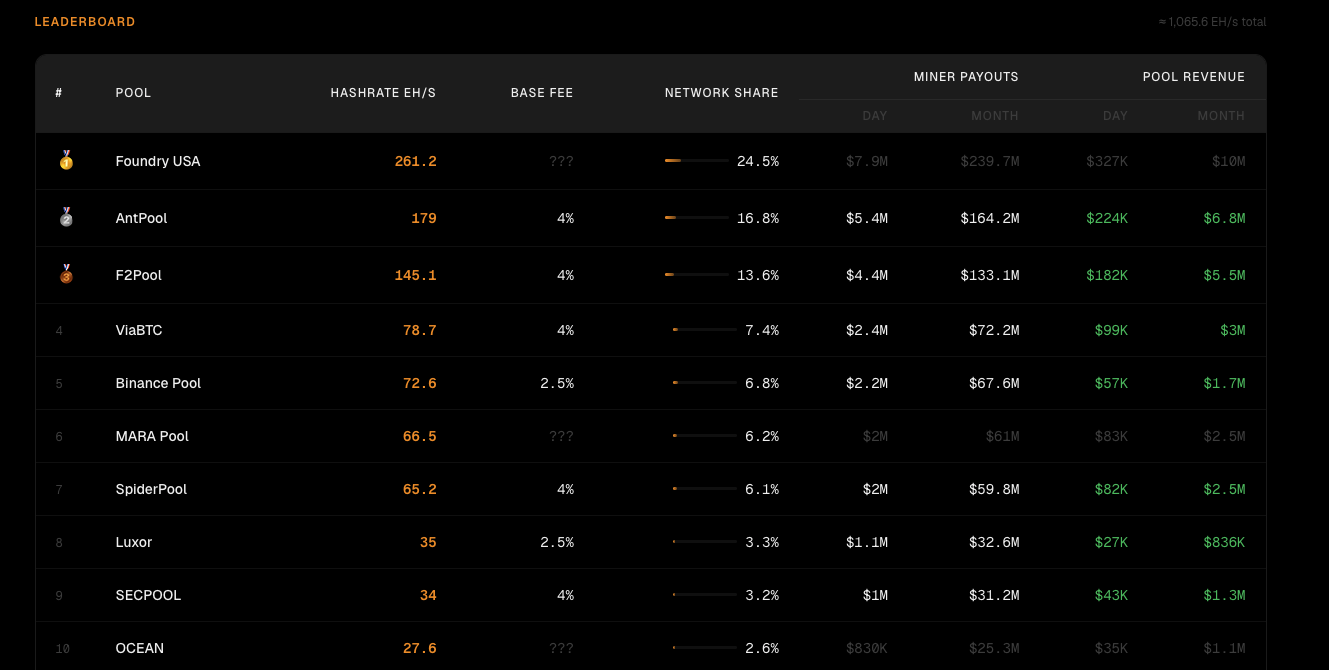
Bitcoin mining pool ranking
If Ocean ends up being the only mining pool supporting the fork, they would only be able to produce 3-5 blocks per day. Such efficiency and block generation speed would be insufficient to become the "longest chain" on the Bitcoin network.
Opponents: BIP-110 Doesn't Solve Problems, It Creates New Ones
Opponents of the BIP-110 proposal do not just focus on whether BIP-110 will succeed after activation. They criticize that it cannot solve the "junk transaction" problem on the Bitcoin network and, at the same time, creates many potential new problems. In short, the strong opposition to BIP-110 stems from concerns about numerous unintended consequences, not from any fondness for Ordinals or inscriptions. Prominent opponents include cypherpunk pioneer Adam Back, Bitcoin Core developer Jameson Lopp, and Strategy founder Michael Saylor.
First, opponents argue that BIP-110 cannot fully solve the "junk transaction" problem facing the Bitcoin network. The author of the BIP-110 proposal also admits it can only provide temporary relief. Jameson Lopp believes that Bitcoin's block size limit and the competitive fee market for block space have already mitigated the junk transaction problem to some extent. However, Bitcoin remains a target for various junk transaction attacks primarily because almost no one truly uses the Bitcoin network, leaving fees persistently low. This fails to create sufficient fee pressure to deter most junk transactions.
At the same time, BIP-110 would stifle Bitcoin's future innovation. The BIP-110 proposal also acknowledges that restrictions on Taproot hinder the implementation of advanced features or complex covenants like BitVM on the Bitcoin network. Although BIP-110 is described as a one-year temporary restriction, Jameson Lopp views this as a delaying tactic by Luke Dashjr. If these restrictions severely limit future Bitcoin upgrades, it could potentially lead to a hard fork rather than a soft fork.
Adam Back, on the other hand, focuses more on Bitcoin's censorship resistance and decentralized spirit. He argues that BIP-110 would subjectively censor transactions within a block, its fundamental purpose being to police others. This goes against the neutral and censorship-resistant spirit that the Bitcoin network has upheld since its inception and represents a dangerous step towards centralization and control. Adam Back uses Bitcoin maximalism to negate the Bitcoin extremist's change to Bitcoin, effectively 'fighting fire with fire.'
Michael Saylor summarized BIP-110 as a "Bitcoin Iatrogenic Proposal," suggesting that the "treatment" itself could harm Bitcoin rather than solve existing problems.
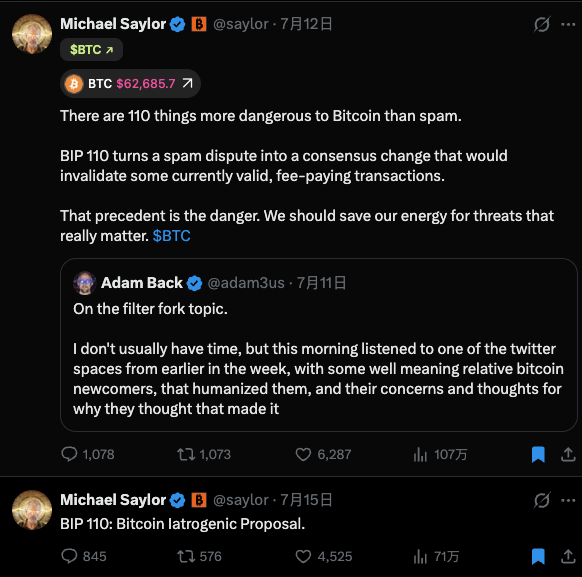
Furthermore, Michael Saylor believes that if BIP-110 is converted into consensus, some valid fee-paying transactions would also become invalid, and setting such a precedent for censorship is the real danger.
Another severe consequence that opponents fear most is that activating BIP-110 might split the Bitcoin chain ecosystem. This could create two competing chains vying for the title of "real Bitcoin." In such a scenario, the uncertainty of the fork outcome could potentially lead to Bitcoin double-spending risks. Even without a double-spend, if BIP-110 eventually evolves into a new chain, it would fragment Bitcoin's developer resources, hashrate, and monetary consensus.
Opponents believe BIP-110 is attempting to solve a cultural problem with a technical solution, which could ultimately create even more unpredictable issues.
Despite their concerns, opponents are confident in BIP-110's failure. Jameson Lopp made a bet on BIP-110 back in February, with a minimum stake of 1 BTC. To date, no BIP-110 supporter has publicly accepted the bet.
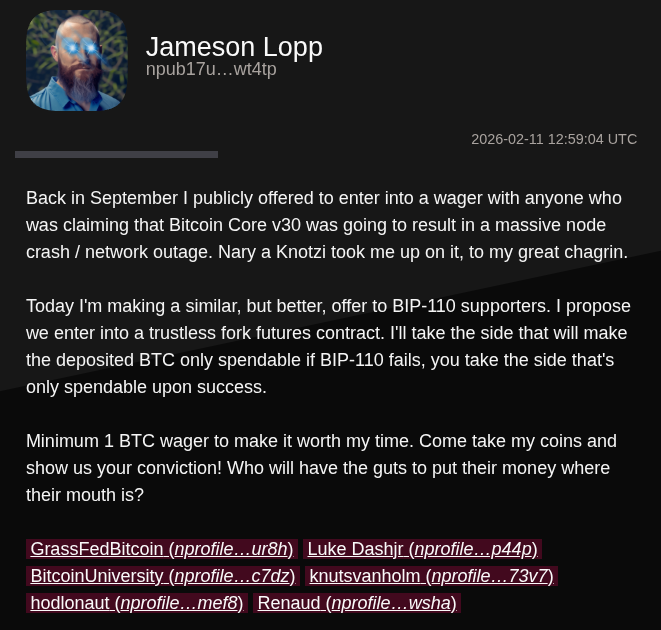
Jameson Lopp's bet offer to BIP-110 supporters
On the prediction market Predyx, the probability of "BIP-110 activating and being enforced on Bitcoin between September 1-7, 2026" is 10%. The settlement condition for "Yes" is that the BIP-110 chain becomes the "longest Bitcoin chain" accepted by the majority of nodes.
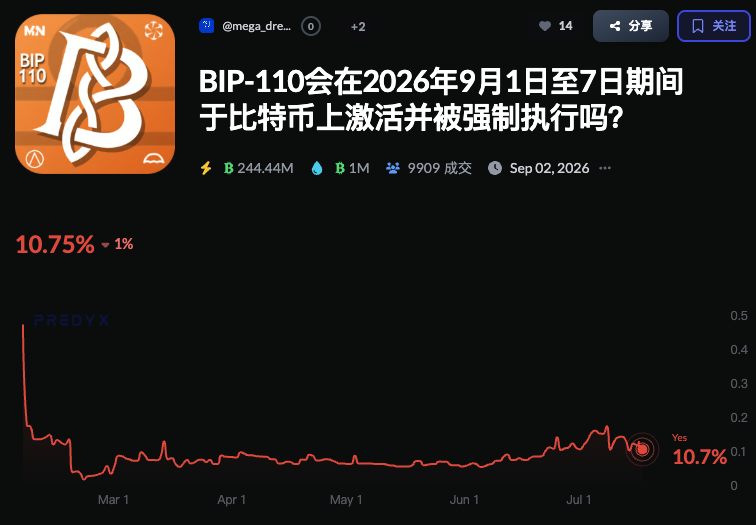
What Happens After BIP-110 Activates?
We can now consider some hypothetical scenarios for what happens after BIP-110 is finally forced to activate at block height 965,664 (late August to early September).
The first scenario is as described above: upon reaching the activation height, BIP-110 nodes reject main chain blocks, but without a sufficient proportion of miners producing new blocks compliant with BIP-110 rules, the block generation speed on the BIP-110 chain would be extremely slow, eventually stopping growth.
The second scenario involves a certain proportion of miners supporting BIP-110. BIP-110 supporters believe they have an "asymmetric advantage" because BIP-110's rules are stricter. While BIP-110 nodes would reject blocks containing non-compliant data (like inscriptions), non-BIP-110 nodes (mainstream Core nodes) would still view blocks produced by BIP-110 nodes as valid.
Moreover, inscription transaction proportions in Bitcoin block space have currently dropped to 5%, with over 95% being traditional Bitcoin transfer transactions. BIP-110 nodes could still receive a large number of mainstream blocks. This is why Luke Dashjr believes BIP-110 could eventually become the "longest chain" and unify the network.
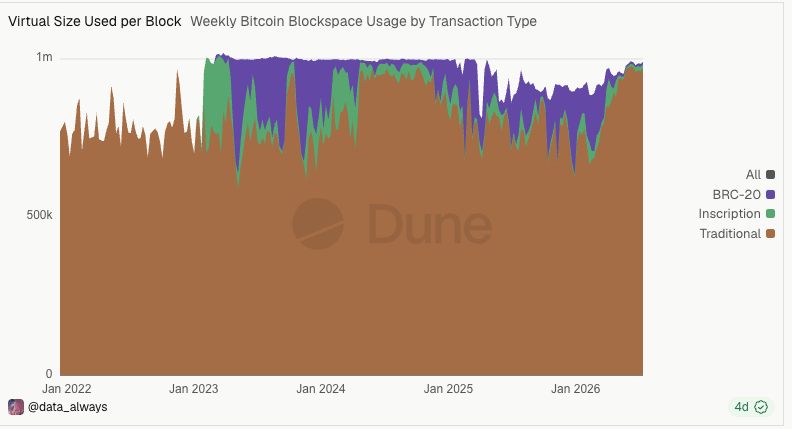
Proportion of different transaction types using Bitcoin block space
The third scenario is that a certain proportion of miners support BIP-110, but their total hashrate remains unable to surpass the existing majority chain. Typically, miners are extremely rational because their machines start consuming electricity fees the moment they turn on. In competition between two chains, miners would weigh the pros and cons. Miners on the BIP-110 chain would be more likely to abandon sunk costs (the mining rewards on the minority chain) and join the majority chain, because the minority chain not only lags in length but also accumulates fewer Bitcoin rewards. This would ultimately lead to the first scenario.
So, what happens if we assume Luke Dashjr has exceptional persuasive power and miners become irrational, continuing to mine on the BIP-110 chain? This chain would continue to operate independently, albeit potentially with very slow block times. Miners would essentially be working for passion, engaging in pointless energy consumption. The most rational outcome in this case would be that the BIP-110 chain permanently forks into an independent chain under BIP-110 supporters, "manually" adjusting block difficulty and issuing a new network token.
However, Luke Dashjr has repeatedly emphasized his rejection of a BIP-110 hard fork, stating that the time for such measures has not yet come. Water can carry a boat, but it can also overturn it. At that point, Luke Dashjr might also be swept along by the will of the crowd, with the arrow already on the string and no choice but to shoot.
Therefore, the minority chain run by BIP-110 supporters could technically continue to operate, but it would likely struggle to thrive. This depends on economic and ecosystem factors, including support from wallets, exchanges, and users. There are many such examples on the Bitcoin network, and most end in failure. Even if one succeeds, its ceiling is likely no higher than independent coins like BCH or BSV.


