中本聪が訴訟に巻き込まれる?837億ドル相当のBTCが「合法的に受け取り請求」される可能性


- 核心的な見解:Noah Doeという偽名の原告がニューヨーク州裁判所に訴訟を提起し、同州の遺失物法に基づき、39,069の休眠ビットコインアドレス(サトシ・ナカモトのアドレスとみられるものを含む)にある約370万BTCの所有権を主張しようとしている。この事件の本質は、法律上の確認判決を得るための「所有権の瑕疵」であり、規制対象となる取引所においてカストディ機関に対抗するためのものであって、直接秘密鍵を入手したり、ビットコインを移動させたりするものではない。
- 重要な要素:
- 原告はニューヨーク州の個人財産法第7条B項を利用し、公開アドレスが記録されたUSBメモリを警察に遺失物として届け出た。また、専門家を雇い、各アドレスの評価額を10ドル未満とすることで、最短の「拾得から1年後に所有権が移転する」手続きを適用しようとしている。
- 被告のアドレスには、サトシ・ナカモト(Patoshi)とみられるアドレス(約109.6万BTC)、マウントゴックス(Mt. Gox)のハッキングに関連するアドレス(7.9万BTC)、その他の休眠アドレス(約262万BTC)が含まれており、総額は約2935億ドルに上る。
- 訴訟のリスクとして、たとえ原告が秘密鍵を入手できなくても、勝訴判決で得た確認判決は「所有権の瑕疵」として機能する。関連するビットコインが中央集権型取引所やカストディ機関に移動した場合、原告はこの判決を根拠にこれらの機関に対抗でき、資産の凍結や所有権紛争を引き起こす可能性がある。
- データ分析によると、原告のアドレスは、Kleiman対Wright訴訟でCraig Wrightが所有を主張した16,404の初期アドレスと99.7%の重複があり、原告がこれに関連している可能性が示唆されている。
- 事件には多くの疑問点がある。遺失物法は、公開ブロックチェーン上で秘密鍵を物理的に保持していないアドレスには適用されないこと。明らかに事実に反する評価(1アドレスあたり平均約750万ドル相当のビットコインを保有)。原告の匿名性と、被告に身元の公開を強制しようとする行為が自己矛盾していること。
Original article from Galaxy
Translation / Odaily Planet Daily Golem (@web3_golem)
Who would have thought that even Satoshi Nakamoto, the creator of Bitcoin, could face a lawsuit, with the "ownership" of wallet addresses potentially being taken away. And you, reading this article right now, could also be one of the "defendants," if you own any dormant Bitcoin addresses.
In March of this year, the New York State Supreme Court accepted a lawsuit: the plaintiffs are seeking to establish ownership of over 3.7 million Bitcoin (worth approximately $274 billion) associated with 39,069 Bitcoin addresses. The plaintiffs are pseudonymously named Noah Doe and two unnamed Wyoming limited liability companies (pseudonymously "ABC Company" and "XYZ Company").
The plaintiffs are asking the New York State Supreme Court to confirm, via a declaratory judgment action under New York's lost property law, that they own these dormant addresses. More importantly, among these 39,069 addresses are those suspected to belong to Bitcoin creator Satoshi Nakamoto (totaling 21,744 addresses holding approximately 1.09 million Bitcoin, worth about $83.7 billion at current prices).
Simply put, an anonymous individual and their Wyoming-registered company are trying to get a New York court to rule that Satoshi Nakamoto's Bitcoin (and many other cryptocurrencies) are lost property, and that they deserve legal ownership for having "found" them. Galaxy has analyzed the plaintiffs' potential motives and identities, the impact on Bitcoin, and the likelihood of the plaintiffs winning.
Odaily Planet Daily has compiled and translated the full text below. Enjoy~
Case Overview and Breakdown of Plaintiffs' Strategy
The plaintiffs have applied to the New York State Supreme Court, requesting a declaration that they own the 39,069 dormant Bitcoin addresses and all assets within them. The legal basis is a declaratory judgment confirming ownership under Section 3001 of the New York Civil Practice Law and Rules, rooted in New York's lost property law, Article 7-B of the Personal Property Law. This statute allows a finder of lost property who turns it over to the police, and whose claim is not disputed by the owner within a specified waiting period, to eventually acquire ownership. The plaintiffs are trying to apply this old framework to Bitcoin.
The specific strategy is this: Noah Doe, as the finder, deposits a USB drive containing the addresses (not private keys or proof of address ownership, just the public addresses) with the 17th Precinct of the New York City Police Department, serving as the act of turning over the lost property to the police. Subsequently, he sends an OP_RETURN notification on the Bitcoin blockchain and issues a press release, serving as efforts to contact the owners. Finally, an expert values each address at less than $10, pushing the entire case into the fastest procedure under this statute.
It is important to note that, even if the plaintiffs win completely, they would only receive a piece of paper, a court declaration. That's it. They would not receive any private keys and would not be able to transfer any Bitcoin.
The real value of a New York judgment lies elsewhere. It would act as a "title defect": if these Bitcoin ever appear on any regulated platform, the plaintiffs could present this document to challenge the exchange or custodian. This is the potential risk this case poses to Bitcoin holders, and why this seemingly outlandish lawsuit still warrants careful scrutiny.
Case Timeline
The following timeline includes two parts: one is the plaintiffs' narrative of discovering the addresses, and the other is the procedural history of the case in court.
- October 2024: Noah Doe claims he discovered a "security issue" with certain addresses and developed an "algorithm" to identify abandoned addresses. (In reality, these addresses had no "security problem").
- December 26, 2024: Noah Doe "finds" approximately 1,625 addresses for the first time. A USB drive with these addresses is delivered to the 17th Precinct on January 1, 2025.
- February 2025: Noah Doe hires Salomon Brothers Strategic Advisors as consultants.
- March 31 and April 14, 2025: Noah Doe "finds" an additional 546 addresses and 39,911 addresses respectively. After each "finding," a USB drive containing the addresses is delivered to the police precinct.
- June 30 – July 10, 2025: Noah Doe sends "abandonment notifications" to each address via OP_RETURN.
- August 7, 2025: A press release is issued to global media, covered by CoinDesk, Bitcoinist, Yahoo Finance, Investing.com, and Galaxy Digital's research report.
- August 2025 – February 2026: Salomon Brothers receives threatening emails, including over 50 containing only the numbers "4 8 15 16 23 42," demanding $1.5 million and 50 Bitcoin.
- October 10, 2025: The 90-day claim period for owners expires.
- December 2025: Noah Doe transfers these addresses to ABC Company and places 98% of the interest into an irrevocable trust; ABC Company transfers 17.7% of the interest to XYZ Company.
- March 11, 2026: Original summons and complaint are filed. Judge Arlene P. Bruce annotates the original order for appearance.
- March 23, 2026: Judge Emily Morales-Minerva recuses herself from the case.
- March 25 – April 17, 2026: Judge Carlos J. Voltron signs orders allowing the use of pseudonyms and authorizing alternative service via OP_RETURN (without notifying the opposing party).
- May 1, 2026: The first amended complaint expands the defendants to 1 through 39,069, attaching a complete list of addresses.
- May 21–22, 2026: On-chain execution service: 98 batch transactions in Bitcoin blocks 950,446 to 950,576.
- May 22, 2026: Judge Carlos J. Voltron files an affidavit of service, including verification reports for each batch and 39,069 lines of verification details (Documents 27-29).
Plaintiffs' Legal Basis and Strategy
Article 7-B of the New York Personal Property Law (Sections 251-258) establishes a summary lost property system. It provides two different paths for a finder to acquire ownership, and the plaintiffs in this case invoke both paths.
- Path A: Custody (Sections 252, 253/254, 257(1)). Section 252 requires a finder of lost property valued at $20 or more to return it to the owner or deliver it to the police within 10 days. Sections 253(7) and 254 specify the police custody period based on the item's value: 3 months for items under $100, 6 months for $100-$500, 1 year for $500-$5,000, and 3 years for items valued at $5,000 or more.
- Path B: Under $10 shortcut (Section 257(2)). For lost items valued under $10, if the finder "has made reasonable efforts to find and return the item to the owner but has been unsuccessful," ownership vests in the finder after one year, without requiring police delivery.
The complaint's (unnamed) "independent expert" values each address at less than $10 "as is," arguing there is little chance of recovery. This valuation governs the case's procedural timeline by placing each address under the uniform one-year vesting period of Section 257(2). It also makes Path A's timeline shorter, as items under $100 only require police impoundment for three months under Section 254.
Plaintiffs' Arguments
The complaint lists several arguments by the plaintiffs, each one dependent on the previous.
- These addresses are lost property. Addresses are considered property, like bank accounts. Under this view, losing a private key does not destroy the property; the contents are merely "lost" and can be recovered by a finder.
- Noah Doe is the finder, and custody by the NYPD complies with relevant statutes. Section 252 of Article 7-B requires the finder to deliver the lost property to the police. The plaintiffs argue that their delivery of the USB drive containing the address list to the 17th Precinct satisfies this requirement.
- Ownership has vested in the finder. For property valued under $10, Section 257(2) states that ownership vests in the finder one year after finding, provided they have made reasonable efforts to locate the owner but failed. The OP_RETURN notifications, press release, and 90-day claim period are considered reasonable efforts.
- These addresses have been abandoned. Noah Doe's "algorithm" identifies addresses that have been in his custody, inactive for at least five years, and untouched during significant price increases. Approximately 424 owners who responded by moving tokens were removed from the list; the remaining 39,069 non-responsive owners became defendants.
- Notification via OP_RETURN is legal. Since the alleged owners are unknown and unlocatable, the court authorized alternative service under CPLR Section 308(5), directing on-chain notices to each address, linking to the complaint.
- Plaintiffs may sue anonymously. Given the known risks of kidnapping faced by large Bitcoin holders, the plaintiffs were permitted to sue under pseudonyms.
Who Are the Owners?
Galaxy used their Bitcoin full node and internal research database to analyze the addresses that plaintiff Noah Doe claims to have "found."
As of May 25, 2026, the 39,069 "Noah Doe addresses" held 3,799,629 Bitcoin, worth approximately $293.5 billion at $77,245 per Bitcoin. This value is not evenly distributed but concentrated in several distinct groups, each telling a different story.
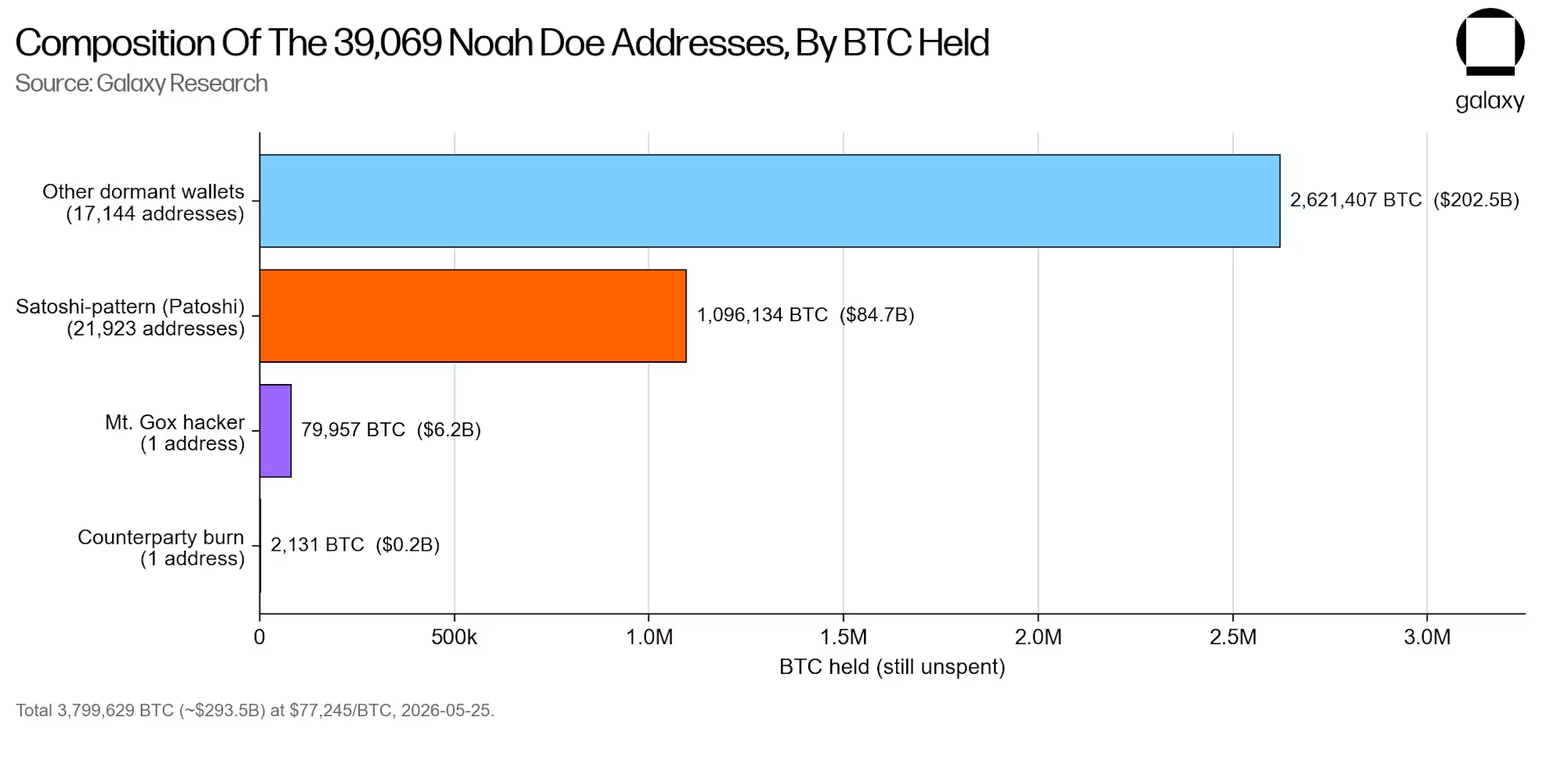
Composition of Noah Doe's "found" addresses
Satoshi (Patoshi) Addresses
Includes 21,923 addresses, holding approximately 1,096,134 Bitcoin (≈ $84.7 billion). These are early mined Bitcoin, linked to Bitcoin's creator through the "Patoshi" nonce pattern; they have never moved.
Mt. Gox Hacker Address
Just 1 address, holding approximately 79,957 Bitcoin (≈ $6.2 billion). This is John Doe #1; these Bitcoin were stolen from the early exchange Mt. Gox and have been untouched since 2011. They are disputed property, tracked by investigators for years.
Counterparty Burn Address
Just 1 address, holding approximately 2,131 Bitcoin (≈ $160 million). This is John Doe #104, a provably unspendable "burn" address, which no one has ever held the key for, as, by design, no such key exists.
Other Dormant Addresses
7,144 addresses, holding approximately 2,621,407 Bitcoin (≈ $202.5 billion). These addresses contain a large amount of Bitcoin from the early adopter and exchange era that has not moved for years.
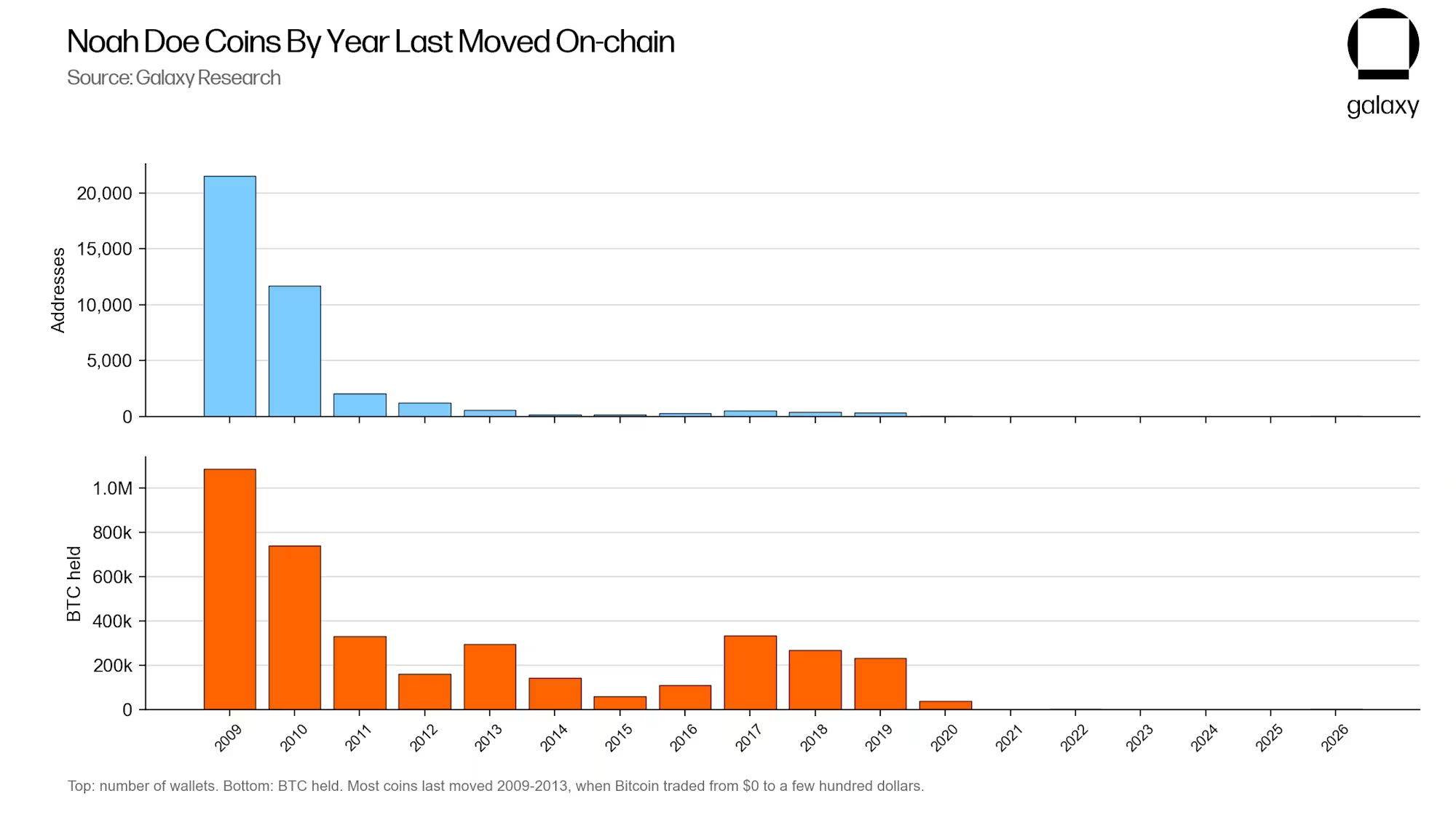
This dormancy has a long history. If we sort each address by the year of its last on-chain movement, most Bitcoin's last movement dates to Bitcoin's early years. The vast majority of these Bitcoin last transacted between 2009 and 2013, a period when Bitcoin's price surged from near zero to a few hundred dollars.
However, many of these addresses have been previously claimed. In the Kleiman v. Wright case (S.D. Fla., 2018), Australian businessman Craig Wright filed a list of 16,404 early block addresses he claimed belonged to him, as part of his subsequently dismissed claim to be Satoshi Nakamoto.
We compared the Bitcoin addresses claimed by Wright in the Kleiman lawsuit with the Noah Doe addresses to see the overlap.
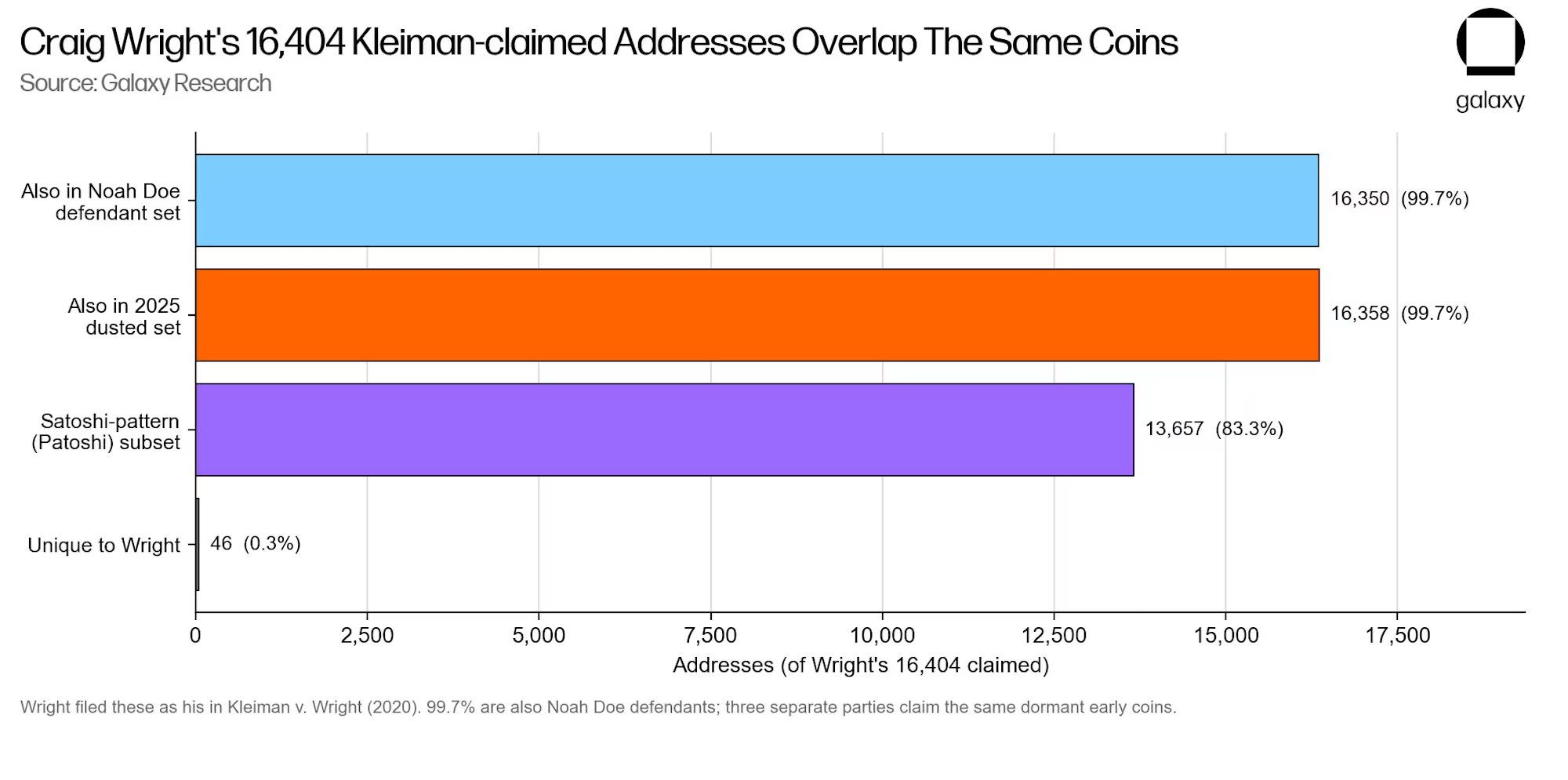
Overlap between Noah Doe and Craig Wright addresses
The overlap is almost perfect: 16,350 out of Wright's 16,404 claimed addresses (99.7%) are also claimed by the Noah Doe defendants, holding approximately 817,513 Bitcoin. We cannot determine if Craig Wright has any connection to the Noah Doe case, but the overlap remains noteworthy. Craig Wright has been trying to claim these Bitcoin through litigation for years but was found in contempt by a UK court in 2024.
Suspicious Aspects of the Case
While we are not lawyers, based solely on the court record and relevant statutes, this case has several red flags.
Does Lost Property Law Apply?
Before getting to valuation or service issues, there is a more fundamental question. Lost property law is designed for physical items a finder picks up, holds, and delivers to the police. Noah Doe never held these coins or their keys. He merely looked at public addresses on a ledger, addresses anyone can read. Viewing a public address is far from possessing lost property. Delivering a USB drive containing a list of addresses to the police is fundamentally different from actually turning over the lost property.
The statute envisions a finder who can return the item if the owner comes forward. But here, the finder never possessed the coins and cannot hand them over to anyone – neither to the police who supposedly hold them in custody, nor to a claimant owner. The core issue goes far beyond ownership; losing a private key does not divest the true owner of any rights. The Bitcoin still sits on the blockchain, and the real key holder can move them at any time, which hundreds of Bitcoin owners who lost their keys are actively doing.
It is obvious that ownership cannot be effectively transferred to a finder who can never access the asset.
Unbelievable Valuation
The average holding in a Noah Doe address is 97.25 Bitcoin, worth approximately $7.5 million; the median is 50.00 Bitcoin, worth approximately $3.86 million. Compared to these numbers, the claim that each address is worth less than $10 is completely untenable. It is merely a tactic to push these assets through the legal process at the fastest possible speed.
Two further details undermine this valuation. The expert who proposed the "under $10" figure is unnamed in the filings. Thus, this single number dictating the entire timeline cannot be scrutinized or challenged. If the logic of "as-is recoverable value" is applied universally, almost all Bitcoin held by users in self-custody would have a value close to zero, which contradicts how any user treats their Bitcoin, especially the plaintiffs who went to great lengths to file this lawsuit.
Anonymity of the Parties
Noah Doe's use of anonymity in this case is also suspicious. The request for anonymity is supposedly to avoid being targeted as a large holder, yet the very relief sought would force the actual address holders to reveal their identities to defend their cryptocurrency. The plaintiffs want the protection they seek to deny to all defendants.
Even if an individual can present a genuine personal safety argument, that doctrine exists to protect natural persons. ABC Company and XYZ Company are shell LLCs. A company has no physical entity to be threatened and no privacy to be exposed. Therefore, the fear of extortion logic does not apply to them. It is utterly unreasonable to allow two companies to claim hundreds of billions of dollars in property using shell company names.
Moreover, New York State does not favor anonymous entities. New York courts rarely allow pseudonyms, and while New York historically allowed anonymous LLC ownership, the state's LLC Transparency Act now mandates beneficial ownership disclosure, although federal regulations have narrowed its scope to foreign-formed LLCs.
H2: Future Direction of the Lawsuit
Even if we set aside these details, the audacity of this lawsuit becomes apparent. It is utterly inconceivable that a New York court would award legal ownership of approximately $293 billion worth of Bitcoin (including some belonging to Satoshi Nakamoto) to anonymous individuals based on a dubious "lost property