






Solana和Hyperliquid最忠实的卫兵,互相骂了起来


- 核心的な見解:Kyle SamaniとArthur Hayesなどのコミュニティメンバーが「HYPE vs SOL」をめぐって激しい議論を展開。核心的な論点は、暗号プロジェクトは分散化を優先すべきか、それとも製品成長を優先すべきかという点にある。Hyperliquidの台頭は、Solanaが掲げる「インターネットの資本市場」というナラティブに挑戦している。
- 重要な要素:
- SamaniはHyperliquidの高度な中央集権性と規制リスクを批判し、その本質はマーケティングチームを持たない「Binance 2.0」であると非難。さらに、米国司法省と同様の告発に直面する可能性があると主張した。
- Hayesなどのコミュニティメンバーは強く反論。HayesはHYPEが残り7ヶ月間で仮想通貨トップ10の他のトークンをアウトパフォームすると賭け、100 HYPEの賞金をかけてSamaniを標的とした創作コンテストを提案した。
- Solanaの核心的なロジックは、効率的なオンチェーン金融インフラを構築し、流動性を自然に集めることにある。一方Hyperliquidは、コアニーズから直接アプローチし、無期限先物(パーペチュアル)を通じてポジティブな循環(トレーダー増加→手数料増加→HYPE買い戻し→価格上昇→さらなる資本流入)を生み出している。
- Hyperliquidのキャッシュフロー能力はSolanaを含むパブリックチェーンエコシステムを既に上回っており、無期限先物から現物、予測市場などへと拡大を続けている。「インターネットの資本市場」というナラティブにより適合し、Solanaの市場におけるナラティブの領域を奪いつつある。
- Samaniの批判のレトリック(分散化の疑問視、規制リスクの指摘)は、かつてイーサリアム陣営がSolanaを批判した手法と非常に類似しており、立場の「ダブルスタンダード」を示している。Solanaの台頭時には効率性の優先を強調していたが、今では分散化を理由にHyperliquidを疑問視している。
Original | Odaily Planet Daily (@OdailyChina)
Author | Azuma (@azuma_eth)

As HYPE continues to hit new highs, a debate has erupted on X over "HYPE vs SOL."
At the center of the verbal war is Kyle Samani, the former co-founder and managing partner of Multicoin Capital and a leading figure in the Solana community (see: The Man Who Championed SOL, Exiting the Crypto World). On the outside, besieging him, are devout "believers" of Hyperliquid, led by BitMEX co-founder Arthur Hayes.
The War of Words Between 'S Guards' and 'H Guards'
Over the past weekend, Samani himself posted extensively on X, launching a high-intensity attack against Hyperliquid, criticizing the project for still being highly centralized in nature and for having serious regulatory issues.
At 6:30 AM on May 30, Samani wrote: "Hyperliquid is essentially just a Binance 2.0 without a marketing team (poor Binance, caught in the crossfire...). They've made thousands of technical decisions in architecture that are only suitable for centralized environments, not for a permissionless, decentralized one. Now, they're many steps behind on this path. Furthermore, no legitimate US company will ever work with them going forward."
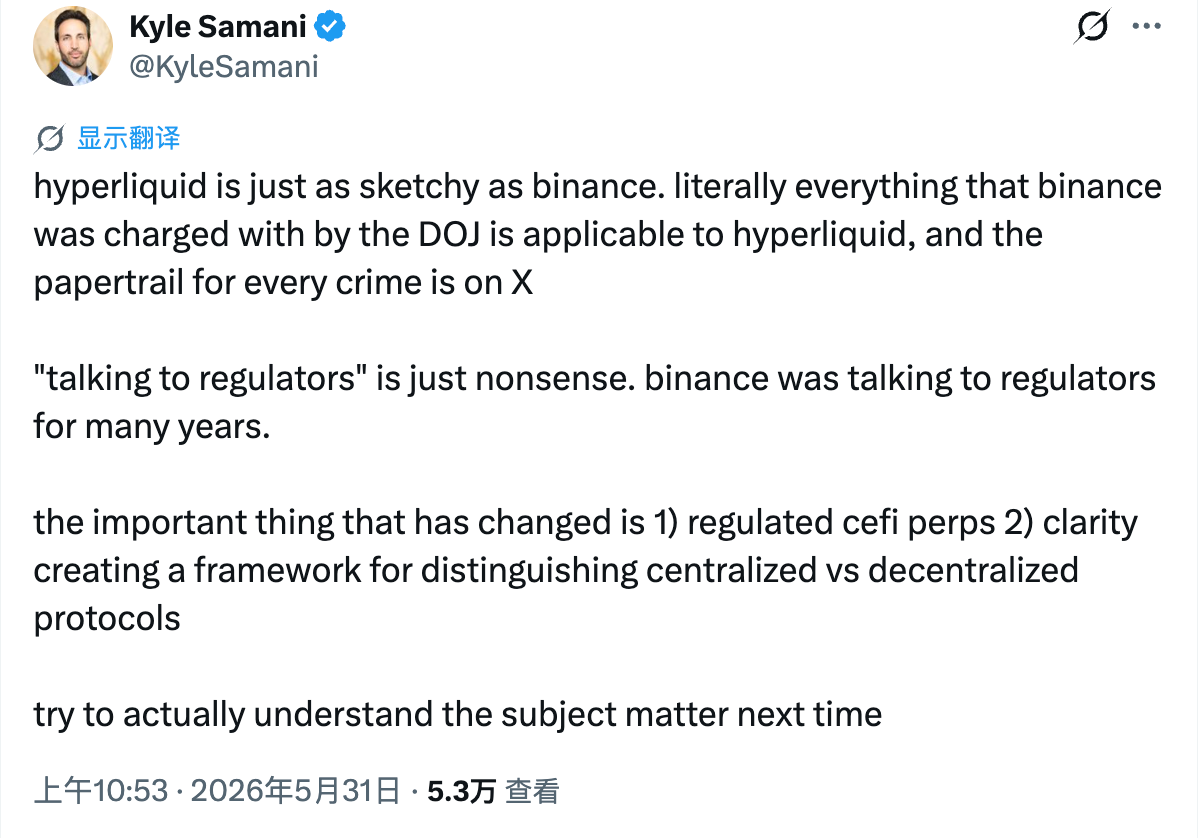
At 10:53 AM on May 31, Samani added: "Hyperliquid is just as suspect as Binance (caught in the crossfire again...). All the charges the US Department of Justice brought against Binance could apply to Hyperliquid, with evidence for each crime documented. The so-called 'communication with regulators' is pure nonsense. Binance has also been communicating with regulators for years..."
While attacking Hyperliquid, Samani also took the opportunity to take another jab at his old rival, ETH, calling it "credibly neutral but technically flawed," in other words, "basically useless"...
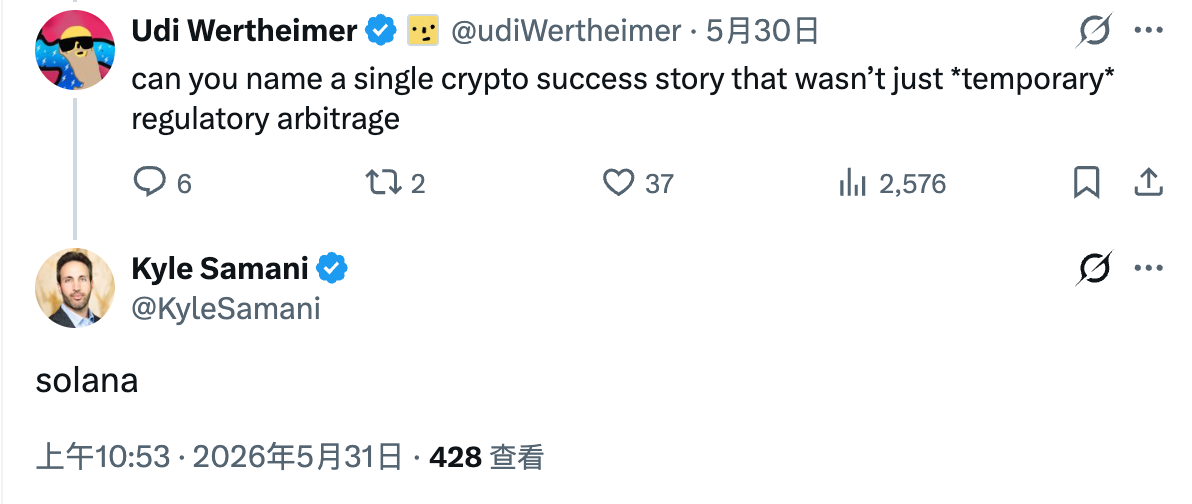
Finally, when asked by renowned Bitcoin developer Udi Wertheimer which token he considered a success story, Samani gave the unsurprising answer – Solana.
Unsurprisingly, Samani's comments drew fierce rebuttals from the community, especially given HYPE's current strength. Investors like Hayes, developers like Wertheimer, and traders like Ansem all pushed back against Samani's views with varying degrees of intensity.
Hayes's rebuttal was the most direct. On May 31, Hayes posted a "sarcastic" message aimed at Samani: "Before this cycle ends, HYPE should at least surpass SOL."
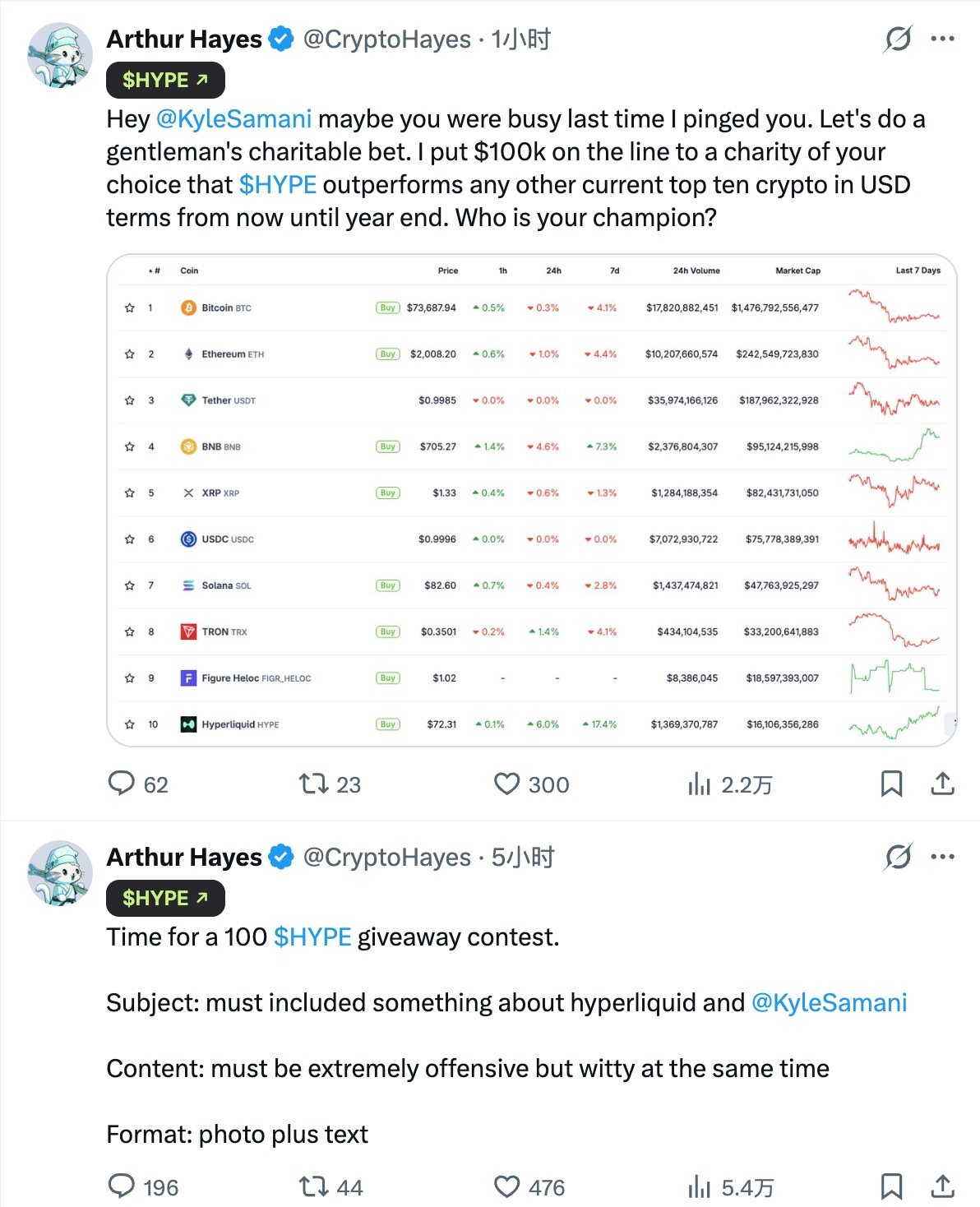
Earlier today, Hayes posted again, suggesting creating a content contest with a prize pool of 100 HYPE, asking participants to respond to Samani humorously and offensively... At the same time, Hayes directly called out Samani, offering a $100,000 bet that HYPE would outperform the other tokens in the top 10 of the crypto rankings for the remaining seven months of the year.
The Narrative Conflict Between Solana and Hyperliquid
Over the past few years, Solana's greatest success has been building a high-speed, low-cost on-chain financial infrastructure. From Memes, DeFi, to AI Agents, various assets and applications have chosen to launch and trade on Solana. Its core logic is that liquidity will aggregate towards the most efficient markets.
However, Hyperliquid goes a step further on this logic.
Unlike Solana, which provides infrastructure and waits for applications and liquidity to grow organically, Hyperliquid directly targets the core need of the crypto industry – trading. It accumulates users, fee revenue, and liquidity through its perpetual contract market, and then gradually expands into spot trading, equity tokens, prediction markets, and more financial products.
From the results, Hyperliquid has formed an extremely rare positive flywheel: more traders bring more fee revenue; more revenue drives HYPE buybacks and ecosystem incentives; rising HYPE prices attract more capital; more capital further enhances platform liquidity and trading depth. The cash flow generated by this flywheel has even surpassed that of public chain ecosystems like Solana.
In recent years, Solana's core narrative has been the "Internet of Capital Markets." However, as users, assets, liquidity, and pricing power continuously shift towards Hyperliquid, the latter now seems to fit this narrative far better than Solana. In other words, Hyperliquid seems to have become what Solana aspired to be.
As Solana's most loyal standard-bearer, Samani is clearly unhappy to see this situation unfold.
Samani's Tactic: Using the Arguments Once Used Against Solana Against Hyperliquid
Observing Samani's recent attack on Hyperliquid closely reveals a rather dramatic phenomenon.
In the past debates between Ethereum and Solana, the most common attack method from the Ethereum camp was questioning Solana's degree of decentralization: high validator node threshold, high hardware requirements, frequent network outages, over-reliance on a few core institutions... In the eyes of many Ethereum supporters, although Solana is fast, it essentially sacrifices decentralization for performance.
The Solana camp's response has been quite simple – users don't care about that. For the vast majority of users, what they need is faster confirmation speeds, lower fees, and a better product experience, not a research report on node distribution.
In a sense, Solana's rise itself is a huge victory for the "efficiency-first" approach. However, now that Hyperliquid is vying for market attention, Samani has raised the banner that the Ethereum camp once loved to wave.
Centralization, regulatory risk, censorship resistance... These accusations even sound somewhat familiar, except the former "defendant" was Solana, and now it has become Hyperliquid.
This seems somewhat "hypocritical," but in Samani's eyes, Solana likely represents the optimal balance point – Ethereum is sufficiently decentralized but too cumbersome; Hyperliquid is extremely smooth and seamless but essentially resembles a CEX; Solana, on the other hand, seems just right in every way...
In a sense, the essence of this debate is not a competition between HYPE and SOL, but the decade-old fundamental question in the crypto industry: should we prioritize decentralization, or should we prioritize products and growth?
Years ago, Ethereum and Solana debated this issue endlessly. Now, Solana and Hyperliquid find themselves in the same position.
Only this time, facing a more aggressive opponent, Solana's believers have become the ones raising the banner of "decentralization."


