






AnthropicとOpenAI、自らの手でIPO前の株式トークンのロジックを断ち切る


- コア見解:AnthropicとOpenAIが相次いで、取締役会の承認を得ていない株式譲渡(SPVを通じた間接保有を含む)を認めないと声明を発表した。これにより、IPO前の株式トークン市場は急落し、この種のトークンに内在する法的リスクが明らかになり、業界の「バブル崩壊」を引き起こす可能性がある。
- 重要な要素:
- AnthropicとOpenAIはともに、取締役会の同意がない株式譲渡は無効であり、買い手の株主としての権利を認めず、SPV(特別目的会社)による自社株式の取得を明確に禁止すると発表した。
- 市場に出回っているIPO前株式トークン(Prestock上のANTHROPIC、OPENAIなど)は多くがSPVスキームに基づいており、その価値はSPVが保有する原株の有効性に依存する。会社側が承認しなければ、トークンの価値はゼロになる可能性がある。
- SPVの「入れ子」構造はリスクを増大させる。多層にわたる入れ子構造は法的な透明性が低く、管理手数料が段階的に収益を目減りさせ、さらにどの階層の株式権利が無効と判断されてもバリューチェーンは崩壊する。
- 市場の反応は激しく、ANTHROPICトークンは1日で20.62%下落して1082ドルとなり、OPENAIトークンは26.82%下落して1440ドルとなり、投資家は権利確定のリスクに恐慌状態となった。
- IPO前の契約商品(実際の株式を保有せず、IPO価格を賭けるもの)は、価格変動に依存しており株式価値に裏付けられていないため、影響は比較的小さい。
- 業界内の見解は分かれている。一方は、大手企業によるSPV締め出しはIPO前トークンのロジックを終わらせると見ており、他方は、投資家は非公式な経路での取引リスクを当然負うべきだと主張する。
- 今回の事件は投機家へのリスク教育として機能し、規制のない状態で成長してきたIPO前株式トークン市場に線引きをし、「バブルを崩壊させる」一助となると見られている。
Original: Odaily Planet Daily (@OdailyChina)
Author: Azuma (@azuma_eth)

The pre-IPO stock token market has just experienced a violent shakeup. The epicenter of this earthquake came from statements made by two major AI companies: Anthropic and OpenAI.
Anthropic and OpenAI Both Say They "Won't Recognize" Unauthorized Sales
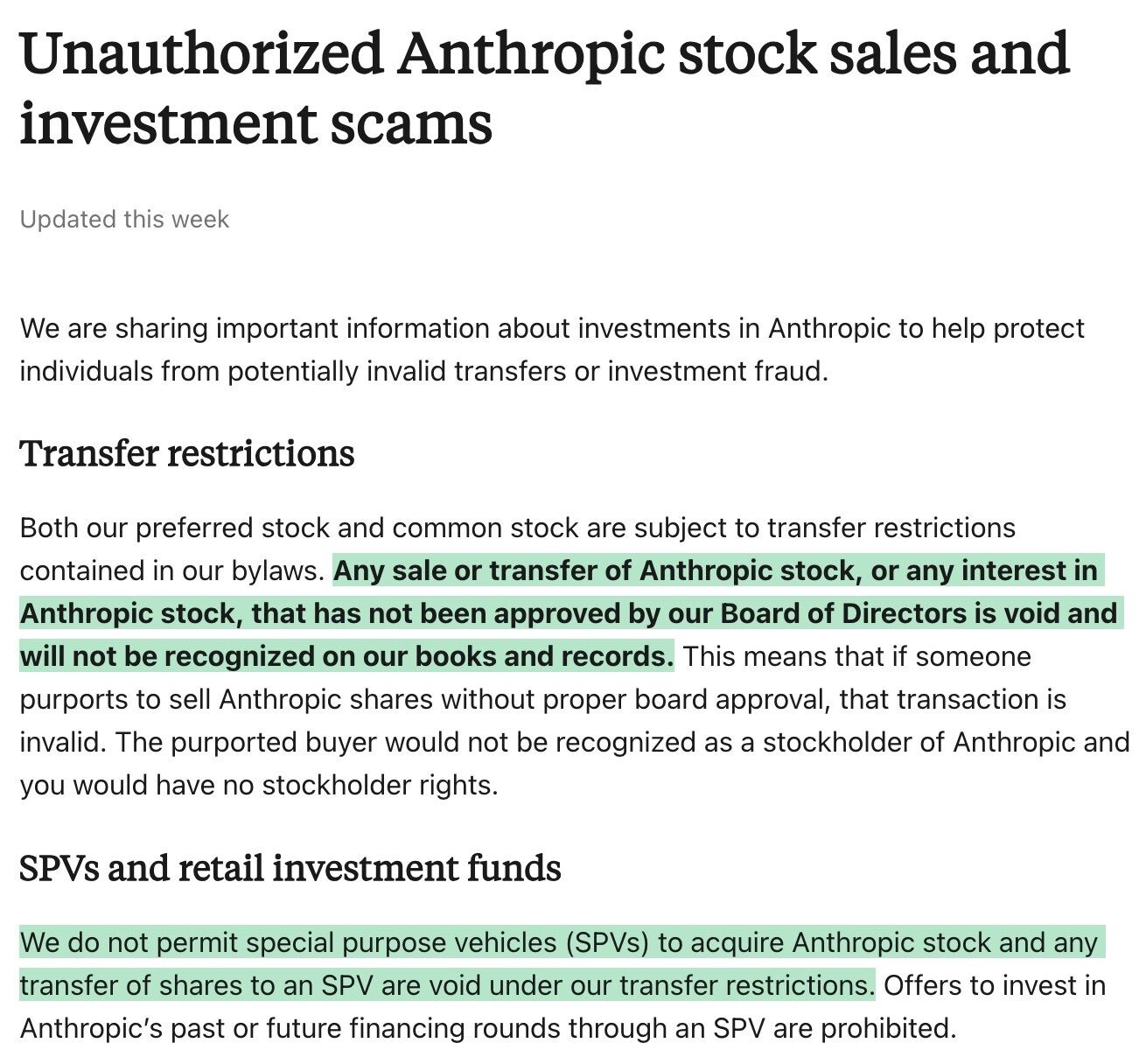
Today, Anthropic updated an official statement released in February, titled "Unauthorized Anthropic Stock Sales and Investment Scams."
In the article, Anthropic explicitly stated: "Any sale or transfer of Anthropic stock, or any disposition of rights to Anthropic stock, that is not approved by our Board of Directors is void (note the use of the word 'void') and will not be recognized on the company's books and records. This means that if someone sells Anthropic stock without the Board's approval, the transaction will be deemed invalid. The so-called buyer will not be recognized as an Anthropic shareholder and will not have any shareholder rights."
Shortly after Anthropic updated its statement, OpenAI also followed suit, announcing: "All equity interests are subject to transfer restrictions. No shares may be transferred, directly or indirectly, without the company's written consent. Any sale made without such consent is not only unauthorized but is also void."
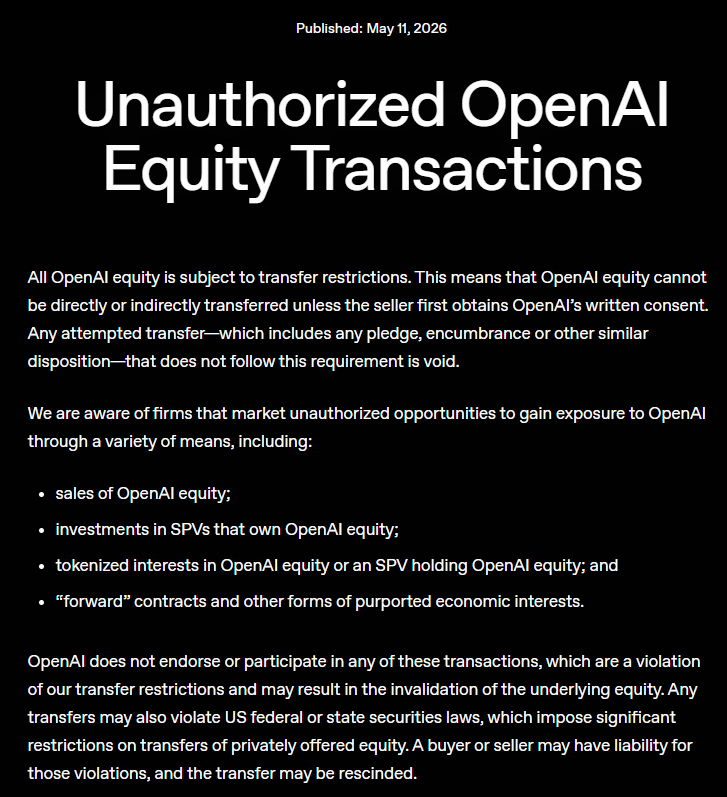
In their announcements, both Anthropic and OpenAI explained that the company's preferred and common stock are subject to transfer restrictions stipulated in the company's charter; therefore, all stock transfers require board approval.
Anthropic also specifically emphasized that the company does not allow "Special Purpose Vehicles" (SPVs) to acquire Anthropic shares, and any transfer of shares to an SPV violates the company's transfer restrictions... certain investment funds might claim to offer indirect channels to invest in Anthropic stock, but these funds are likely attempting to circumvent transfer restrictions. Therefore, any third party claiming to sell Anthropic stock to the public – whether through direct sales, forward contracts, stock tokens, or other mechanisms – may be engaged in fraud, or be offering an investment of no value due to Anthropic's transfer restrictions.
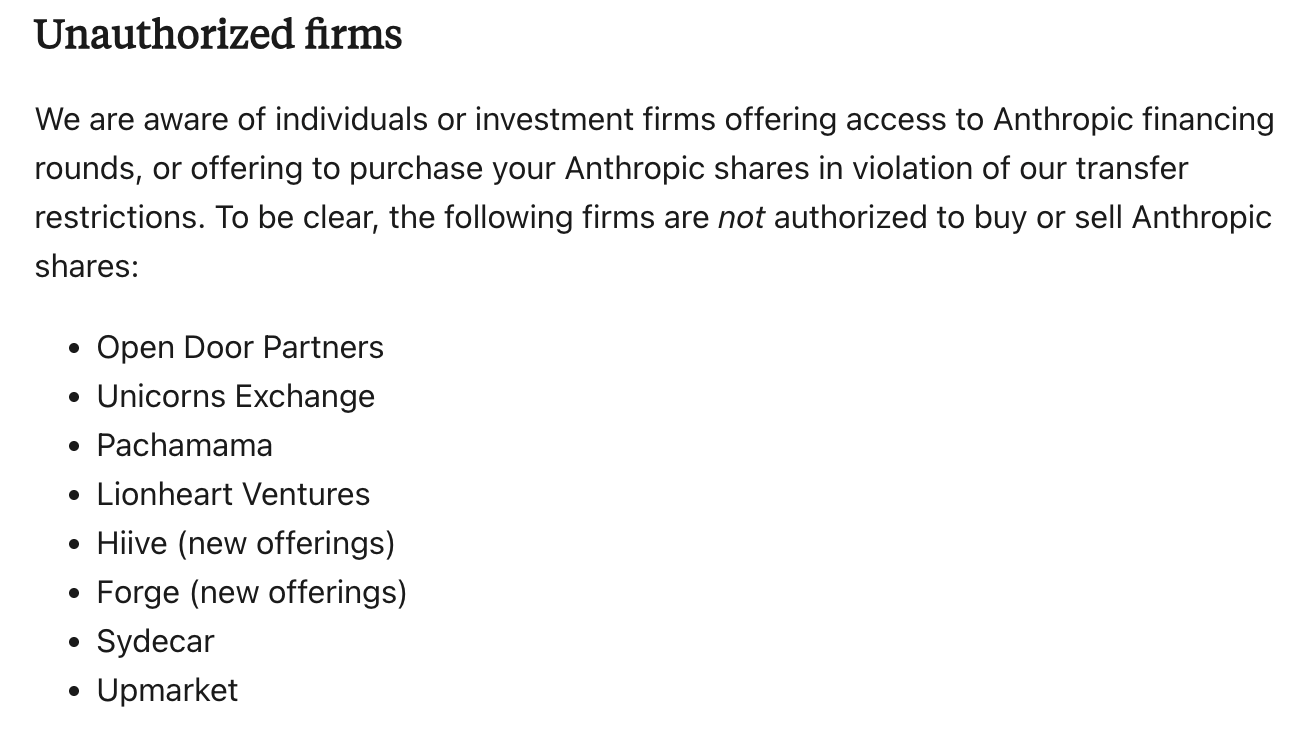
- Note from Odaily: The image shows unauthorized equity transfer platforms named by Anthropic.
What is an SPV?
To understand why this update has had such a huge impact on the pre-IPO stock token market, one must first understand what an SPV is.
In traditional pre-IPO stock trading, directly transferring original shares is extremely difficult. It is not only restricted by the company's charter but also involves complex legal procedures. It is in this context that SPVs were created.
An SPV is a separate legal entity established for a specific transaction or investment purpose. It can be understood as a "shell company specifically used to hold a certain asset." Multiple investors can contribute capital to the same SPV, thereby indirectly holding shares of a particular company or a class of assets. This achieves purposes such as concentrated shareholding, lowering entry barriers, and optimizing legal and tax structures. SPVs are particularly common in popular pre-IPO stock transactions. Since many high-profile companies are often unwilling to directly bring in a large number of small shareholders, institutions will typically establish an SPV first, which then makes a unified investment in the target company.
For example, what the market calls "participating in the share subscription of Anthropic or OpenAI early" essentially means that investors first contribute capital to a certain SPV, which then consistently purchases the unlisted equity of Anthropic.
Currently, most pre-IPO stock token platforms on the market (such as Prestock) use an SPV structure.
- The platform or its partner will register an SPV in a certain jurisdiction. The sole task of this SPV is to buy Anthropic's original shares on the secondary market (usually from employees or early investors);
- The platform then issues derivative tokens on the blockchain (e.g., ANTHROPIC or OPENAI). These tokens are defined in the legal agreement as a "claim to the economic benefits of this SPV";
- In theory, the token should be pegged 1:1 to the original stock. For every 1 token issued, the off-chain SPV should hold the corresponding share of stock.
But the problem now is that Anthropic and OpenAI have clearly stated they "do not recognize unauthorized stock transfers." This means that if an SPV transfers stock without the board's nod (and it's basically impossible for them to nod), the stock held by that SPV could be considered invalid in the eyes of Anthropic and OpenAI. If the stock held by the SPV is invalid, then the "economic benefits" claimed by the on-chain token become worthless.
The "Matryoshka Doll" Risk of SPVs
A major reason why Anthropic and OpenAI are so opposed to SPVs is the emerging risk of over-financialization of these SPVs, driven by the sustained frenzy surrounding their pre-IPO stock tokens (Anthropic's pre-IPO valuation once soared to $1.4 trillion, far exceeding its last funding round valuation).
Among the issues, the most concerning is the "Matryoshka doll" problem of SPVs. Many investors buying pre-IPO stock tokens think they are buying company shares, but in reality, they only have a claim to the economic benefits of a particular SPV. More alarmingly, many SPVs do not directly hold Anthropic's original shares; instead, they are nested two or three layers deep within other SPVs.
This "Matryoshka doll" structure is, in fact, very dangerous.
- Legal Transparency Issues: With each additional layer, the authenticity of the underlying asset becomes more blurred. It's very difficult for investors to confirm whether the SPV at the lowest level has actually obtained the company's board approval for the transfer.
- Management Fee Erosion: Each layer of SPV charges management fees, performance fees, and dividends. After skimming at each level, the actual returns for investors are severely diluted.
- Risk of Total Loss: If the equity transfer at any single layer is deemed "invalid" by Anthropic, the entire value chain could instantly collapse.
Whether for reputational reasons or investor protection, Anthropic and OpenAI are clearly unwilling to see this situation continue.
Pre-IPO Stock Tokens Plunge, Contracts Relatively Stable
Once the announcements from Anthropic and OpenAI began to circulate, the market reacted immediately.
On PreStocks, the ANTHROPIC token experienced a sharp decline, briefly falling below $1,000. As of 12:00, it was trading at $1,082, a significant single-day drop of 20.62%. The OPENAI token was trading at $1,440, down 26.82% for the day.
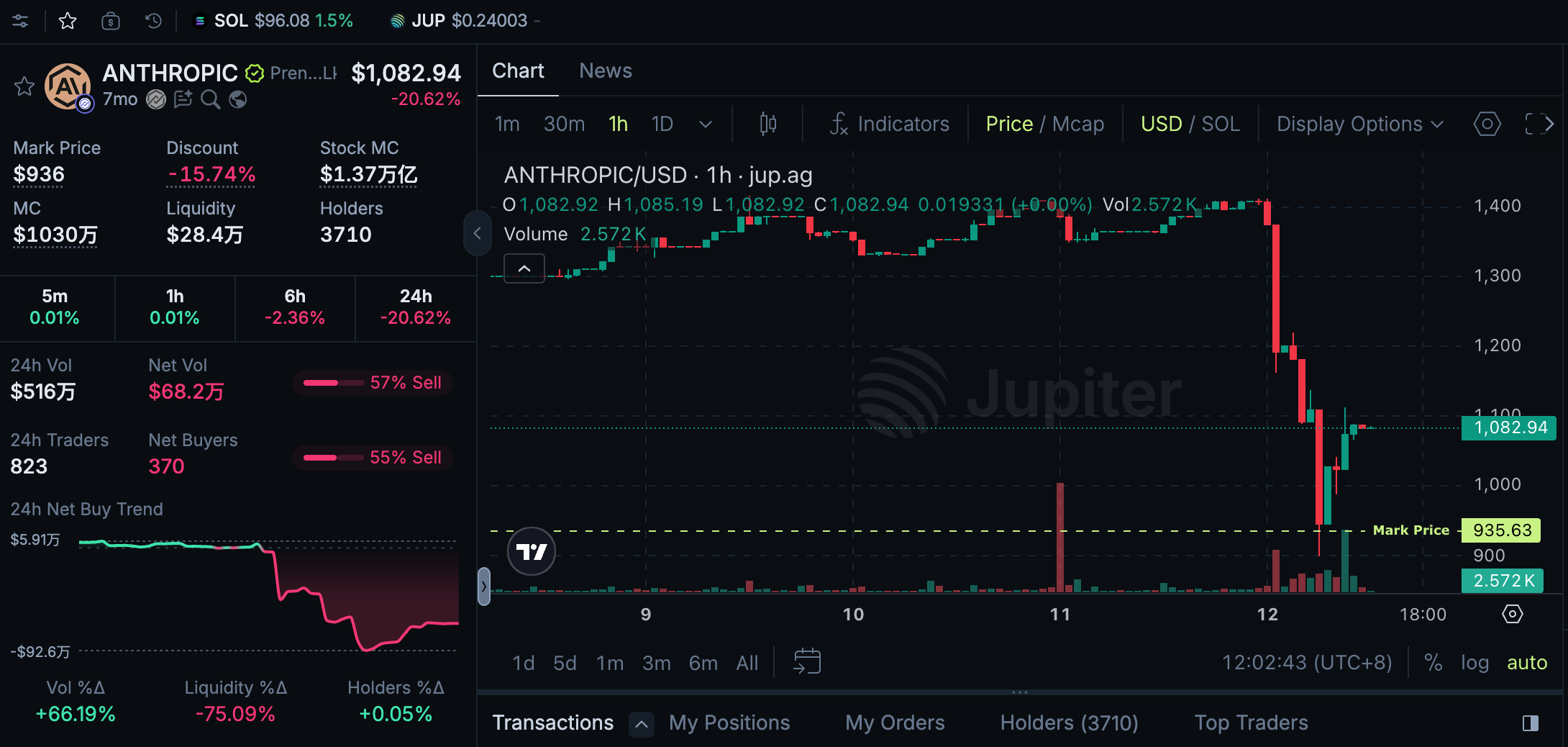
Investor panic is easy to understand. Since Anthropic and OpenAI have clearly stated they won't recognize unauthorized shareholding, the "equity" behind these tokens now has a probability of becoming "worthless paper," and holders may face huge costs related to confirming their rights and legal litigation.
Interestingly, while pre-IPO stock tokens came under pressure, another type of pre-IPO trading product performed relatively steadily: pre-IPO contracts relying entirely on two-way market speculation. The reason for this situation is that these products essentially do not hold any real stock. The restrictions imposed by Anthropic and OpenAI have no impact on them. They are merely "bilateral bets" on the future IPO price, relying on the price games between buyers and sellers.
Predictions for Future Direction
Faced with the "denial" stance of Anthropic and OpenAI, two distinct voices have emerged within the industry.
Some believe the logic of pre-IPO stock trading is dead. If leading giants like Anthropic and OpenAI spearhead the suppression of SPVs, other major companies may follow suit. With the support of equity being shaken, it is questionable whether so-called pre-IPO stock tokens still hold any value.
However, another group, including Rivet founder Nick Abouzeid, believes this is not a cause for alarm. Trading pre-IPO stock tokens through unofficial channels has always been a gamble, and buyers should have had the "awakening that the company won't recognize it" from day one. You lack the opportunity for direct investment; obtaining that opportunity through other means inevitably involves bearing some risk.
In summary, at a time when premiums on pre-IPO stock tokens are continuously expanding and market sentiment is gradually turning euphoric, the statements from Anthropic and OpenAI have undoubtedly thrown cold water on the entire sector.
Over the past few months, more and more investors have begun to view pre-IPO stock tokens as a "low-barrier channel to participate in the growth of top-tier AI companies." The valuations of some AI-themed pre-IPO stock tokens have clearly detached from reality, even sparking frenetic trading far above their last funding round valuations. In this context, Anthropic and OpenAI's public "anti-fraud" efforts are, to some extent, redefining the boundaries of this rapidly growing new market.
For speculators, this is a risk education; but for the long-term development of the industry, the market might just need such a moment of "de-bubbling."


