






特朗普次子的比特币游戏:自己大赚1亿美元,散户暴亏5亿


- 核心见解:フォーブスの調査で明らかになった、エリック・トランプ氏がトランプの名声を利用してビットコイン企業「アメリカン・ビットコイン」を高値で売れる資産に仕立て上げた手法。株式の増発により資金を調達し、効率的なマイニングではなくビットコインを購入。この結果、エリック氏個人の資産は約9000万ドル増加した一方、一般投資家は累計で約5億ドルの損失を被り、同社の実質的なマイニングコストは公称値を大きく上回ることが判明した。
- 重要ポイント:
- マーケティングによる虚偽のイメージ戦略:エリック氏はマイニングコストを約5万7000ドル/枚と主張するが、設備費やマーケティング費などを含めた実質コストは約9万2000ドル/枚と高騰している。さらに、同社が保有するビットコインの約7割はマイニングによるものではなく、株式売却による購入である。
- 異例の資金調達構造:同社はマイニング機器の代金支払いのため、3090ビットコインを担保に差し出しているが、そのうち自社で採掘したのは約1800枚のみ。仮にビットコイン価格が反発しなければ、今後採掘されるビットコインはすべて機器費用の返済に充てられることになる。
- 巨額の株主資金損失:2025年3月時点で、同社は株式売却により累計約5億2500万ドルを投じてビットコインを購入したが、その時価総額は約3億9000万ドルにとどまり、直接的な損失は1億3500万ドルに上る。
- 個人と投資家の利益相反:エリック氏は一族のブランド力と裁定取引を利用して株価を押し上げ、個人資産は1億9000万ドルから2億8000万ドルに増加した。しかし、同社の株価は最高値から92%下落し、個人投資家は約5億ドルの損失を被った。
- 圧力と外部との関係:同社CEOはアラブ首長国連邦の政府系ファンドであるADQ及びTAQAと接触し、海外からの資金調達による救済を模索。また、UAEの首長はこれまでにトランプ家のプロジェクトに約3億7500万ドルを送金していた。
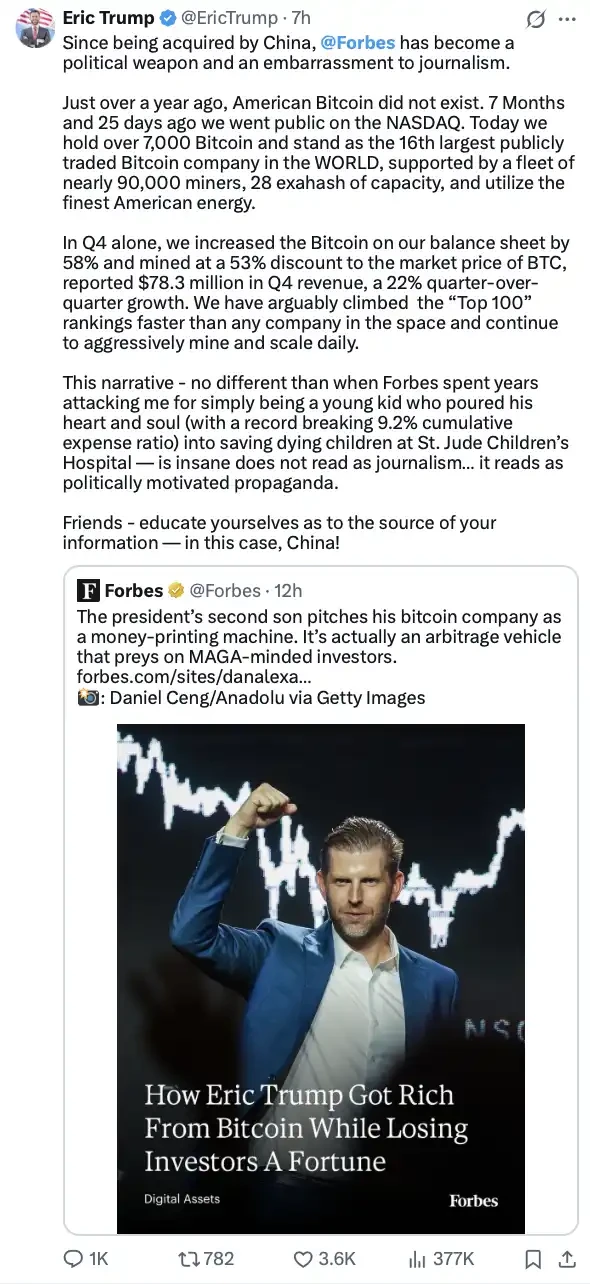
Original title: How Eric Trump Got Rich From Bitcoin While Losing Investors A Fortune
Original author: Dan Alexander, Forbes
Original translation: Peggy, BlockBeats
Editor's note: The Trump family has a hereditary skill: bluffing and making things seem bigger than they are.
This time, Eric Trump brought this method into the crypto space. He packaged his Bitcoin company as a "money printer," claiming it could mine Bitcoin at roughly half the market price.
But when Forbes reporter Dan Alexander opened the books, a different story emerged: 70% of the company's Bitcoin holdings were not mined but purchased through share dilution; the real all-in cost was far higher than Eric's claimed figure; and the financing structure that made the balance sheet look stronger could also mean that all the Bitcoin the company has mined so far will eventually be used in bulk to pay for mining equipment bills.
The numbers ultimately point to a more direct conclusion: Eric's personal wealth increased by about $90 million, while ordinary investors collectively lost about $500 million.
After the report was published, Eric Trump quickly fired back on X, accusing Forbes of being acquired by China, calling the report politically motivated propaganda, and citing operational data to refute it: 7,000 Bitcoins, nearly 90,000 mining machines, and Q4 revenue of $78.3 million. Along the way, he also brought up a twenty-year-old story about fundraising for a children's hospital, trying to prove that Forbes has always targeted him, a "good guy."
Only one thing he never directly addressed: where did that $500 million go?
The following is the original text:
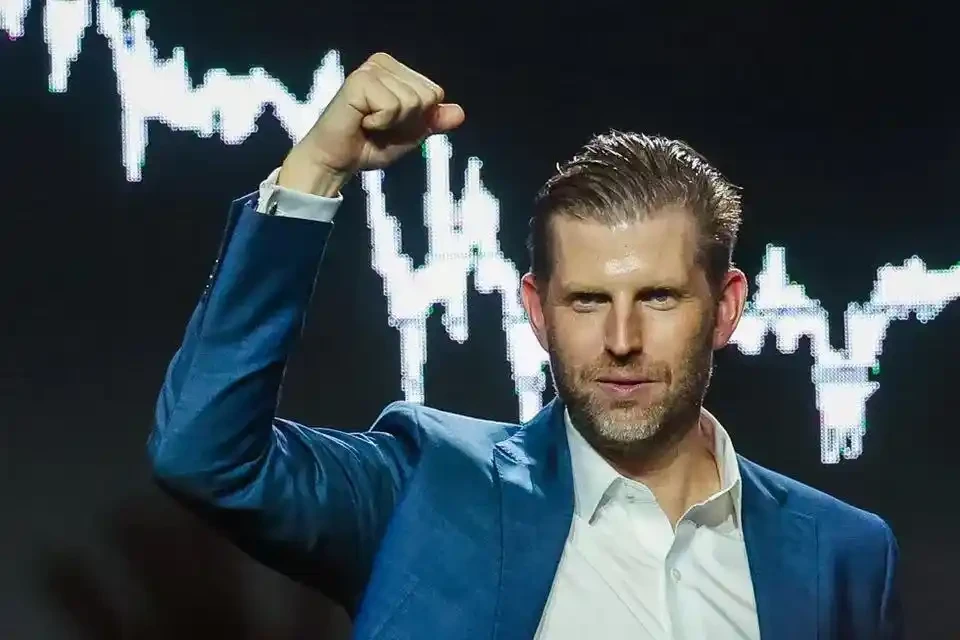
Eric Trump riling up a crowd. Photo: Daniel Ceng/Anadolu via Getty Images
The ability to rouse a crowd isn't just useful in politics. Just ask Eric Trump: his Bitcoin company attracted a large following, and then dumped overpriced stock on them.
In February this year, Eric Trump appeared energized on an earnings call, ready to do what the Trumps do best: sell.
"We are quickly becoming the leader in the Bitcoin world, and I truly believe we have the strongest brand," Eric said, thanking "Mike (Ho), Asher (Genoot), Matt (Prusak), and everyone at American Bitcoin."
Note: Mike Ho is CEO of American Bitcoin and concurrently serves as Chief Strategy Officer of Hut 8. Asher Genoot is Executive Chairman of American Bitcoin, co-founder of Hut 8, and brokered the deal with the Trump family. Matt Prusak is President of American Bitcoin, a former Hut 8 employee seconded from the company.
That ending is quite telling. Saying "everyone" is a stretch because American Bitcoin hardly has anyone else.
According to the annual report filed a month after the earnings call, the company had only two full-time official employees, presumably CEO Mike Ho and President Matt Prusak. Maybe a few others – Ho is also an executive at another company; someone who worked in Ho's investor relations department there for less than a year now lists themselves as "Chief of Staff" at American Bitcoin on LinkedIn; another woman says she has been the company's social media manager since January. (Executive Chairman Asher Genoot, Ho, and three independent directors form a five-person board.)
The Trump family figured out a long time ago that there is money to be made in making things sound bigger than they are.
Donald's father, Fred Trump, allegedly defrauded regulators by inflating project costs for profit. Donald Trump inflated asset values to banks and media like Forbes, eventually being found guilty of fraud by a New York judge. Eric was also caught up in that case, being barred from serving as an officer or director of any New York-registered company for two years. Despite this, he started anew, incorporating in Delaware and basing operations in Florida, marketing his company in a way that would make his forebears proud.
Note: Fred Trump was a New York real estate developer and father of Donald Trump, who allegedly falsified construction costs to extract higher profits.
Eric Trump's latest Bitcoin venture might be selling more of a story than a real business. According to him, American Bitcoin can mine Bitcoin at roughly half the market price, a true "money printer." But a closer look at the numbers raises questions about whether the company can even be profitable at mining, let alone maintain such astonishing margins. Representatives for Eric Trump, the Trump Organization, and American Bitcoin did not respond to multiple requests for comment from Forbes. Many people trust the president's son, and real money has been bet. When American Bitcoin hit the public market on September 3, 2025, it had about $270 million worth of Bitcoin on its balance sheet, but investors gave it a market cap of $13.2 billion.
Over the past eight months, American Bitcoin has continuously used this wildly inflated valuation to sell stock and buy more Bitcoin. The heavily diluted stock price has now fallen 92% from its peak. Eric Trump, who initially entered the deal with seemingly little cost, remains flush, his estimated personal wealth ballooning from about $190 million to $280 million through financial alchemy. Other insiders have also profited handsomely. In contrast, ordinary investors who listened to the sales pitch and bought in with real money have suffered estimated total losses of $500 million.
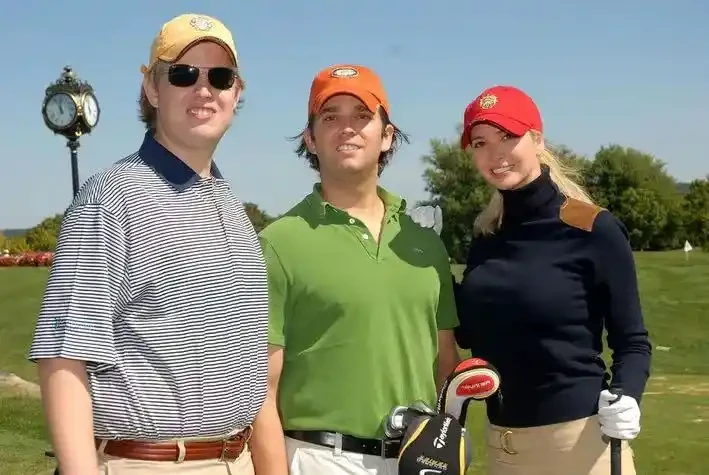
Eric Trump (left) in his early years, cultivating a charitable image, soon after college raising funds at his father's golf course for St. Jude Children's Research Hospital. Photo: Bobby Bank/WireImage
Eric Trump's first truly independent project wasn't an apartment building, but a charity.
In 2006, he graduated from Georgetown University with a degree in finance and management, full of desire to change the world. At the time, his older brother Don Jr. and sister Ivanka were already at Trump Tower working on real estate projects. Driving on the New Jersey Turnpike one day, Eric later recalled in a Forbes interview, a different idea popped into his head: how could he truly make a difference in the world? Thus began his earliest entrepreneurial venture – a non-profit called the "Eric Trump Foundation."
The organization did a lot of good. It was more of a fundraising platform than an operating charity, funneling over $16 million to St. Jude Children's Research Hospital. But as time passed, the organization, and Eric himself, became increasingly "Trumpified."
Documents obtained by Forbes through open records requests (despite objections from the non-profit's legal team) reveal a pattern of dishonest fundraising pitches, weak governance, and chaotic finances. Eric claimed to donors that he kept costs minimal, directing almost all funds to St. Jude, partly because his father provided Trump properties for events for free and celebrities agreed to perform "pro bono." But checks and invoices obtained by Forbes show: over $500,000 went to other charities, over $500,000 went to Trump-owned businesses, at least $90,000 was paid to various performers, and over $35,000 was paid to a car service – with passengers including Eric's mother, a "Real Housewives" cast member, and a van full of people headed to Hooters.
In his daily work at his father's company, Eric was mainly involved in the hotel business early on, learning a lot, including a key lesson: making money by branding a business is much easier than actually building one.
The Trump Organization defaulted on a loan for its Chicago hotel in 2008, put its Atlantic City portfolio into bankruptcy protection in 2009, and its Washington D.C. hotel lost money for years. Eventually, the Trumps pivoted their hotel empire expansion towards what the industry calls the "asset-light" model, shifting focus from development to management and branding.
Eric's other training ground was his father's golf course portfolio, where he saw the beauty of unconventional financing structures. In the 1980s and 90s, golf clubs often took deposits from members upon joining, promising to return the money interest-free after thirty years. These liabilities on the books scared off many potential buyers when properties were for sale. But Donald Trump was unfazed, eventually taking on about $250 million of such liabilities, acquiring over a dozen golf properties across the country while valuing these liabilities at zero on his personal balance sheet for years. By the time the repayments were due, the properties' value far exceeded the amounts owed.
In January 2017, Donald Trump entered the White House, and Eric and his brother Don Jr. took over the father's asset portfolio. Eric seemed to have few plans of his own, just wanting to keep things as they were. "We're not a company that sells assets," he told Forbes in February 2017 from his 25th-floor office in Trump Tower. "We buy, and we make them beautiful." The Trump brothers tried new ventures, including launching two mid-range hotel brands, with little success. Facing operational struggles and their father's dwindling cash reserves, they did a lot of what Eric said they wouldn't do over the next seven years: selling assets, estimated to total about $411 million.
Then, a new money-making opportunity arrived: the 2024 election.
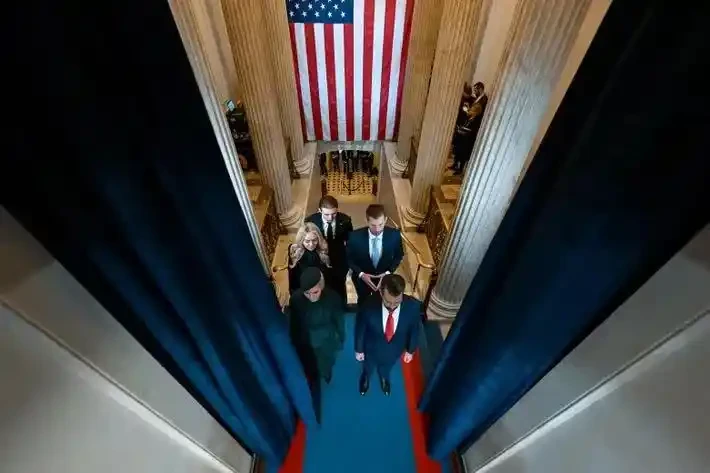
Returning to the White House meant business opportunities. President Trump's children attend his second inauguration on January 20, 2025. Photo: Kenny Holston-Pool/Getty Images
Just two weeks after Donald Trump defeated Kamala Harris, the company that would eventually become American Bitcoin was quietly incorporated in Delaware. It wasn't initially a crypto play. Dubai developer Hussain Sajwani, who had partnered with the Trumps on a golf project in Dubai, appeared at Mar-a-Lago, announcing a $20 billion plan to build data centers in the US, riding the AI wave. "That man knows what he's doing," the President-elect praised. Within weeks, Trump's two sons disclosed plans to follow this strategy, naming the company "American Data Centers," which Eric Trump called "crucial to the development of America's AI infrastructure."
A month later, he changed course. Introduced by mutual friends, Eric and Don Jr. met two entrepreneurs: Asher Genoot and Mike Ho. They already owned a company similar to what the Trump brothers envisioned – data center giant Hut 8, with exposure to AI and significant Bitcoin mining hashrate. Soon after the AI wave hit, the Bitcoin reward for solving a mathematical problem halved, drastically increasing mining costs. Industry-wide, hashrate shifted towards AI, and Hut 8's institutional investors pressured Genoot to follow the trend.
However, Genoot and Ho, with their backgrounds in branding and arbitrage, devised a more creative solution: use the equity of 20% of their Bitcoin mining rigs as bait to convince the Trump brothers to drop the data center plan. Then, leveraging the involvement of the First Family, package these rigs into a public company, igniting a hype machine powered by the Trump aura.
This deal structure seemed tailor-made for someone familiar with the hotel business. While machines hummed day and night, American Bitcoin operated more like an asset-light hotel brand: Hut 8 owned the property, operated the data center, handled back-office tasks, and even provided executives – Prusak was ex-Hut 8, Ho still works there as CSO while being CEO of American Bitcoin. This allowed the Trump brothers to focus on their strength: selling.
"I'll never forget telling them, 'Listen, the name has to have two words,'" Eric Trump later recalled in a CoinDesk video interview. "'It has to have 'America'. It has to have 'Bitcoin'.' And one of the guys said, 'Eric, you've got American Bitcoin. That's the name.'"
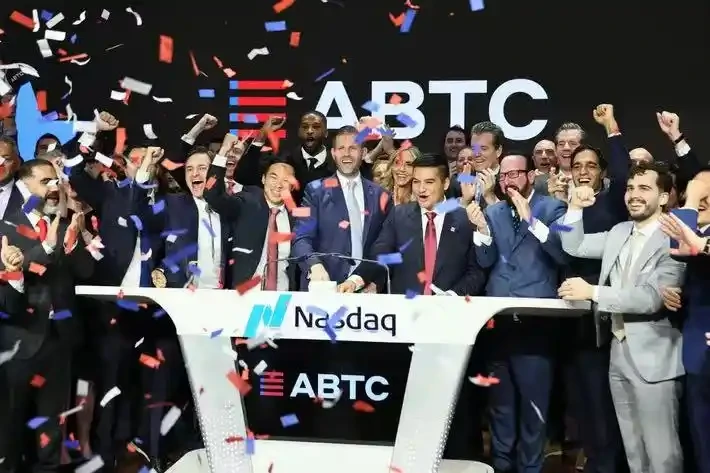
On the day American Bitcoin went public, investor enthusiasm was high, once pushing Eric Trump's estimated personal wealth above $1 billion. Photo: Michael M. Santiago/Getty Images
Ever since Eric Trump entered the crypto space, he has been telling a myth about why he got into it. "Every bank in this country has blacklisted me," he said at a conference in Wyoming last August. "Because my father is a political figure, we got de-banked," he added about a week later in Hong Kong. "Every major bank started closing our accounts," he claimed in Palm Beach earlier this year. "You know what we did? We went out and got into decentralized finance, because we realized that is the future of finance."
But that's not how it happened.
It's true that Capital One and JPMorgan Chase closed some Trump accounts in 2021, six years after Donald Trump entered politics. By then, the President's reputation was tarnished by the Capitol riot and a sweeping investigation by the New York Attorney General, which eventually led a court to find the Trump Organization had committed fraud and was likely to do so again.
Even so, plenty of banks were still willing to work with the Trumps – even JPMorgan, soon after closing some accounts, participated in refinancing two of the largest loans in the Trump portfolio. Trump left the White House strapped for cash and highly leveraged, needing big lenders, and he got their support: Between January 2021 and mid-2022, with help from sons Eric and Don Jr., the former president refinanced nearly $700 million in debt as part of a comprehensive balance sheet restructuring.
So, why did Trump really get into crypto? A more plausible explanation is he smelled an opportunity to extend his brand licensing business, selling non-fungible tokens (NFTs) like sneakers and guitars. He started with NFT trading cards, digital images depicting Trump as a superhero. They sold out in a day, netting the former president over $7 million in cash and crypto – money that mattered dearly for someone facing a nearly $500 million fraud judgment. (An appeals judge later overturned the judgment over a dispute about the fine amount but did not reject the finding that Trump had committed fraud.) Subsequent crypto projects brought in hundreds of millions more in liquidity, fueling the First Family's bets, including an independent plan announced last May to spend about $2 billion on crypto through Trump Media and Technology Group.
In 2025, hoarding Bitcoin became the year's hottest trade. Over 200 public companies rushed to copy the playbook of Michael Saylor's Strategy, which amassed over $50 billion in Bitcoin, saw its market cap soar during the price surge, and recently plunged along with it. American Bitcoin stood out in this frenzy, for obvious reasons: the First Family connection. But on the day American Bitcoin hit the public market on September 3, 2025, Eric Trump served up a more data-driven pitch on an X Spaces chat. "Our actual cost to mine Bitcoin every day is about $57,000, $58,000 a coin," he said, noting the market price was roughly double, "Our fundamentals couldn't be better."
It was a compelling narrative, even if the speaker had a history of overlooking inconvenient expenses while hosting charity fundraisers. Fifty-something thousand dollars indeed covered American Bitcoin's operational costs for the rigs. But including other expenses – equipment purchases, marketing, and capital allocation – the all-in cost climbs much higher, to around $92,000 per coin based on values at the time, only profitable if crypto prices stay high.
Including depreciation is particularly crucial in American Bitcoin's case because it utilizes an unconventional financing strategy from Hut 8. Between August and September 2025, American Bitcoin spent roughly $330 million to upgrade its mining fleet. But instead of paying cash immediately, it pledged a quantity of Bitcoin, securing an option over how to pay eventually: if Bitcoin's price rose, the company could pay ~$330 million in cash and redeem the pledged Bitcoin; if the price fell, it could simply hand over the pledged crypto in settlement.
Since that large purchase, Bitcoin has fallen about 30%. This means, currently, American Bitcoin will likely pay for the equipment with its pledged crypto assets. The problem: American Bitcoin pledged a total of 3,090 Bitcoin (as of March 25th), while the company has only mined an estimated 1,800 Bitcoin so far. In other words, if the price doesn't recover, every Bitcoin the company has ever mined will be used to pay for the equipment costs as the options expire around August 2027, leaving it with nothing.
Investors might not understand this. The company has about 15 months to decide whether to pay in crypto or cash, and during that time, the mined Bitcoin stays on the balance sheet. This makes American Bitcoin look far more robust than it actually is. The company markets this Bitcoin hoard to investors as a core selling point while downplaying the fact that all or most of it will eventually be used to pay for the machines that mined it.
Beyond marketing appeal, it's easy to see why the Trump family likes this payment method – they built a portfolio of golf courses using similar unconventional financing. They bet then and won because the asset values actually went up.

Eric Trump has become a regular at major global crypto conferences, pictured here at an event in Hong Kong. Photo: Daniel Ceng/Anadolu via Getty Images
About 70% of the cryptocurrency held by American Bitcoin wasn't mined at all. It was obtained by selling stock and buying Bitcoin directly on the open market. This is American Bitcoin's core


