Legendary investor Druckenmiller's rare "exit": nearly liquidated all equities, shorted copper, and now the sole objective is capital preservation


- Core Viewpoint: Druckenmiller has liquidated his equity positions and entered "capital preservation mode" due to a comprehensive reversal in the macro environment (the Fed turning hawkish, commodities peaking, credit spreads widening), but his long-term judgment on AI remains unchanged, believing that the next phase of opportunity lies in "selling tasks" rather than "selling compute."
- Key Elements:
- The bullish thesis from the start of the year (rates at 3.5%, rate cut expectations, copper prices hitting new highs, narrowing spreads) has all reversed; long and short equity positions are largely squared, holding only a small amount of dollars and short copper.
- He candidly admits a lack of conviction on the direction of the next 12 months—rare in his 50-year career—and his proactive exit is risk management rather than surrender.
- He does not use VaR or stress testing, relying instead on P&L performance as the core risk control signal, and believes in the cycle of "hot hand/cold hand" states.
- The AI opportunity is shifting to the application layer: top labs can bypass token pricing and directly enter vertical tracks such as cybersecurity and healthcare to "sell tasks."
- He flags two slow-moving variables: the degradation of K-12 education compounded by tightening immigration, and the possibility that fiscal reform over the next decade may be forced by a financial market crisis.
- Ten-year predictions: nuclear fusion 20%, space data centers ≥70%, and cancer becoming a manageable disease within 10 years.
Original Author: Long Yue
Original Source: Wallstreetcn
Legendary investor Stan Druckenmiller has publicly stated that he has now nearly liquidated his equity positions and entered "capital preservation mode"—a rare主动 exit in his 50-year investing career.
On November 18, 2026, Druckenmiller spoke with Iliana Bouzali, Morgan Stanley's global head of derivatives, at the TomorrowX Summit in Austin, Texas. He said bluntly that today's macroeconomic environment has "completely flipped" compared with January of this year: the Fed has shifted from rate cuts to rate hikes, commodities have turned from rising to falling, credit spreads have continued to widen, and market visibility is lower than at any point in his career. "I can't remember any period when I had so little conviction about where things are headed over the next 12 months," he said.
Just nine months ago, Druckenmiller was aggressively bullish within the same conversation framework—long equities, long copper, short Treasuries, and betting on a healthcare breakout. Now, that portfolio has almost been reduced to zero. Describing his current positioning, he said: stock longs and shorts are basically flat, he holds a small dollar position, and he is short copper. Overall, he has entered "capital preservation mode" (we're in capital preservation.).
His phone auto-reply is said to contain just a few short words: "Don't talk to me. I'm not playing."
He also revealed that he believes the next big opportunity in AI lies in "selling tasks" rather than "selling compute"—once top AI labs possess the world's most powerful intelligence, they can completely bypass the token pricing model, move directly into vertical tracks such as cybersecurity and healthcare, and build their own business empires.
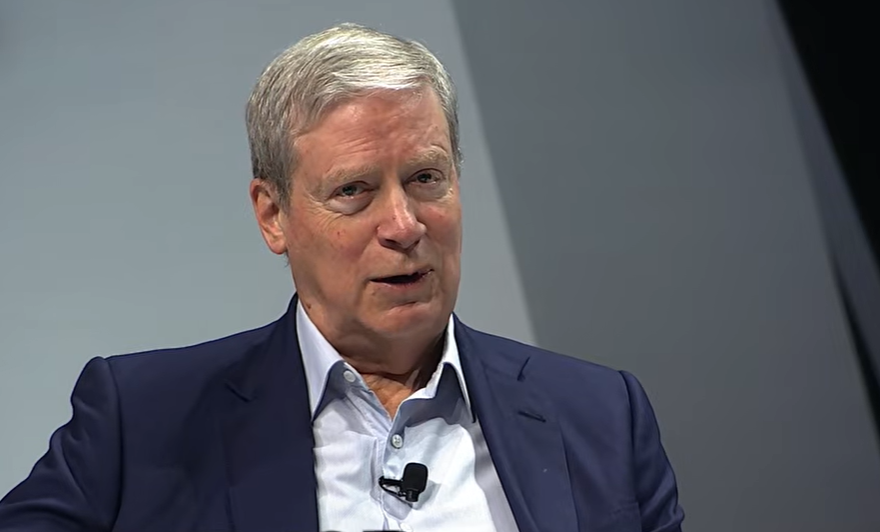
The Bullish Logic From January Has Completely Collapsed
Druckenmiller's judgment in January of this year was built on a complete macro framework: a federal funds rate of 3.5%, nominal growth of 6%, and monetary policy that was in fact extremely loose; the Fed's dot plot indicated more rate cuts within the year; commodities such as copper were breaking to new highs; the market advance-decline line was continuing to hit new highs; and credit spreads were extremely tight.
"With monetary policy this loose, a recession within 6 to 12 months seemed to me almost impossible," he said. At the time, he was also bullish on accelerating AI capex, went long equities, long copper, and short Treasuries as a hedge, and was optimistic on the healthcare sector.
However, about a month later, the "US tariffs" event disrupted the rhythm. He admitted that there was panic selling at the time, but he quickly bought back afterward, and in the process completed a natural cleansing of the portfolio—positions without substantial upside potential were cleared out, while the logic for AI infrastructure-related holdings became even clearer.
By today, in November, he listed one by one every condition that had supported the bullish thesis and pointed out that they had all reversed: the Fed is no longer cutting rates but instead raising them; he mentioned a person who had worked alongside him for 15 years, who was deeply dissatisfied with the zero-interest-rate policy of the past 15 years and even more unhappy with inflation exceeding the target for five consecutive years, hinting that the policy orientation within the Fed had undergone a fundamental shift.Commodities have turned from breaking to new highs to peaking and rolling over, and he is now short copper; the stock market advance-decline line peaked as early as August 14, even though the index high came in October; and credit spreads have continued to widen.
"You should get my point. Everything is exactly the opposite of what it was then," he said.
"I'm Not Playing!" A Deliberate Exit at a Moment of Confusion
Faced with this situation, Druckenmiller's choice is to step back. His equity positions are basically flat after longs and shorts offset each other, he holds a small dollar position, and overall he is in a wait-and-see state.Bouzali joked that he had set up an "auto-reply" button in Zoom calls, with only one sentence: "Don't talk to me. I'm not playing." He did not deny it.
He explained that this deliberate exit is not an admission of defeat, but rather a manifestation of his consistent risk management logic. His investment framework spans four major asset classes—commodities, bonds, equities, and rates—which means he never needs to maintain persistent exposure to any single category. "Bonds and currencies often have their biggest moves during equity bear markets," he said, which makes him more willing to sit still in equities and instead look for opportunities in other macro tools.
He also admitted that he does not use VaR and does not do stress tests; the core signal of his risk management is whether P&L itself performs as expected. "When markets fall into chaos and enter a bear market phase, all correlations fail," he said. "Some very talented people painfully proved that this year when they shorted software and went long AI infrastructure."
He also talked about his belief in "winning streaks and losing streaks"—he believes that momentum cycles in investing far exceed random distribution, and identifying whether one is currently in a "hot hand" or "cold hand" state is one of the most important parts of this job.
"When I'm in good form, I swing big; when I'm in bad form, I only make small bets, wait for my average cost to recover, and then decide whether to scale back up." He characterized the current period as a "rest" that could last two days or six months.

From Selling Shovels to Selling Services: The Second Half of AI?
Despite the overall contraction in positioning, Druckenmiller's long-term judgment on AI remains unshaken.He made clear that he will not short innovation in this field, partly because the relevant names are already oversold and positioning has already been flushed out.
His judgment on the next stage of AI centers on "use cases" rather than "infrastructure." He believes there may be tactical trading opportunities in the AI infrastructure sector, but it will no longer be the main engine it was over the past four years. The real opportunity, in his view, lies in the top AI labs themselves.
His logic is this: labs that control the world's top intelligence have no reason to remain in a business model that charges by token. "If you have the most powerful intelligence in the world, you can start selling tasks rather than selling tokens, and you can build your own businesses," he said.
He named cybersecurity as the most intuitive example: "Who can compete with these people in cybersecurity? They created these problems, so now they are the ones who can use swarms of agents to protect us." Healthcare is also within his sights.
He summarized the judgment in one sentence:"Sell tasks, not tokens."
Fiscal Risk and Education Concerns: Slow-Moving Variables Underway
When asked which important trends are currently happening "quietly," Druckenmiller raised two structural issues he has long followed.
The first is the continued deterioration of US K-12 education. He pointed out that the United States has long offset this weakness by attracting top talent from overseas. "I'll bet that eight of the top ten tech companies were founded or led by immigrants." But he worries that tightening immigration policy is threatening this compensating mechanism, and that the two problems together have not yet attracted enough policy attention.
The second is the fiscal problem. As early as 2011 to 2012, he traveled to major universities trying to persuade young people to pay attention to intergenerational fiscal unfairness, but almost no one listened. He cited the old saying: "How does bankruptcy happen? Gradually, then suddenly." He believes the United States will most likely experience a fiscal reform within the next 10 years forced by a financial market crisis. "It will be a very different kind of crisis from the one we have now." He also said he is cautiously optimistic that reform will eventually happen.
A 10-Year Prediction: Nuclear Fusion, Space Data Centers, Curing Cancer
Druckenmiller also offered three 10-year predictions, each with a probability he considers reasonable:
- Nuclear fusion: a 20% probability of being achieved within 10 years, or at least of clearly seeing that "we're going to get there."
- Space data centers: saying this in Austin, he gave it a probability of "at least 70%."
- Curing cancer: he served on the board of Memorial Sloan Kettering Cancer Center for 30 years and witnessed the evolution from gene sequencing and immunotherapy to AI."I think we will cure cancer. I think it will become a manageable disease. I'm talking about within 10 years, not 20."
What Makes a Top Investor
At the end of the conversation, Druckenmiller shared his judgment on the qualities of investors. He believes the gap between top investors and good investors lies in four things: an almost pathological passion for the business, an intense desire to learn, a "pathological" will to win, and strict self-discipline. "Every time you buy, there is a seller on the other side. If you don't have an extraordinary level of work commitment, you will lose in this industry," he said.
He also talked about a common trap among highly intelligent people: loving their own thesis so much that they forget the second half of the saying "put all your eggs in one basket, and then watch that basket." "They can have a great thesis and it can be a great bet, but things do change, and they just can't adjust as quickly as others."
He also mentioned one of his most painful lessons: in January 2000, he sold Nasdaq, only to buy it back on the day of the peak. "I don't think I was more than an hour late to the top." Asked what he learned from it, his answer was: "Nothing. I knew at the time I shouldn't do it, but I just couldn't control myself."
The full transcript of the interview is as follows:
Stan Druckenmiller: Why He Is "Sitting Still" Now | TomorrowX Summit
November 18, 2026
Legendary investor and Duquesne Family Office CEO Stan Druckenmiller spoke with Morgan Stanley's Iliana Bouzali on the main stage of the TomorrowX Summit in Austin.
Stan shared why, after 50 years of investing, he has never had so little certainty; and where his focus now lies: AI use cases rather than infrastructure, why leading labs can sell "tasks" rather than "tokens," and how swarms of AI agents can help cybersecurity defense.He also talked about the moment he realized AI was the most important event in American business history, his bold predictions for the next decade—from nuclear fusion and space data centers to curing cancer within ten years—and what distinguishes top investors from good ones.
Chapter One: How Gavin Baker Predicted the AI Boom
Iliana: Stan, hello.
Stan: Iliana, hello. Gavin, thank you for giving us a reason to get together again. Our last conversation was about nine months ago.
Before we begin, I know time is tight, but I want to tell a short story about Iliana and Gavin. Iliana runs global derivatives at Morgan Stanley. She would organize Zoom calls, and at the time our group was called the "macro legends"—which, in my view, would more accurately be called the "macro has-beens."
About a month after ChatGPT launched, we had a Zoom meeting. All those so-called "macro legends" were sounding off about rates and other topics. Then a person I had never met—Gavin—joined the meeting and said: "You're all kidding yourselves. The most important thing in American business history is happening, and you're here haggling over trivialities."
Chapter Two: Looking Back at the January Portfolio
Stan (cont.): Gavin, I want to thank you, because that was the starting point of everything. You anticipated the whole thing, its depth and breadth. I also want to thank Iliana, because without you I would never have met Gavin. Thank you both.
Iliana: You're welcome. I looked back at our similar conversation in January, when the audience was smaller. At that time you were bullish on the economy, long equities, short Treasuries as a hedge, long copper, and convinced that healthcare would stand out. How much of those positions do you still hold today?
Stan: Basically almost all flat.
Looking back at that January interview, it was a special period. In my career, sometimes I see things very clearly, and sometimes I have no sense of direction at all. When I see clearly, I like to swing big; when I don't, I sometimes sit almost entirely still.
At that time, the economy was very strong. More importantly, from a forward-looking perspective, the federal funds rate was 3.5%, nominal growth was 6%, and monetary policy was extremely loose. Based on the so-called Fed dot plot, more rate cuts were expected during the year. Commodities—including copper—were breaking to new highs. The advance-decline line and other technical indicators I use to observe the market were also hitting new highs. Credit spreads were very, very tight.
So, with monetary policy excessively loose, a recession in the next 6 to 12 months was almost impossible. In addition, the previous autumn, Claude Code had just generated excitement among insiders about accelerating AI. We were quite optimistic about capex, and all of this made us very bullish on equities and the economy.
Unfortunately, about a month later, a so-called "trade war" broke out. I panicked, and we sold a batch of positions. But it turned out to be a blessing in disguise—because when we bought back (quickly), the trend of AI infrastructure taking off across the board became clearer than ever. This also cleaned out portfolio holdings that would not rise substantially.
Chapter Three: Why Everything Has Reversed
Stan (cont.): Now let's look at today's situation.
The economy is still strong, but every other aspect I just mentioned has completely reversed. The Fed is not cutting rates but raising them—there has been a policy shift at the Fed. There is a person I know who sat beside me for 15 years. He was unhappy with the monetary easing, deficits, and everything that followed over the past 15 years, and even more indignant that inflation has been above target for five consecutive years.
So we are currently in a monetary tightening cycle. Commodities that were breaking to new highs in January now appear to have peaked and are moving lower—in fact, we are already short copper. The advance-decline line was still hitting new highs when we did that interview, but its peak actually occurred as early as August 14, even though the high for the broad index came in October. Credit spreads are widening.
I think you get the point—everything now is the exact opposite of then. So we are neither long equities nor short equities.
Chapter Four: I'm Sitting Still
Stan (cont.): I admit I like being short. But for the reason most people came to this conference, I would never dare short the technological innovation and all the progress being discussed here. Moreover, many of the relevant names are already oversold, and positioning is tactically very low.
So my choice is the same as always—when I have no certainty, I step aside and watch. I've been doing this for, my God, 50 years now. I don't remember any period when I had so little grasp of where things would go over the next 12 months. This is completely different from last January.
Just as you teased me on the Zoom call the other day—you said: "Stan