Strategy's Removal from MSCI: Will BlackRock's 12.3 Million Shares Really Hit the Market?


- Key Takeaways: MSCI will remove Strategy from its relevant indices on November 30, fueling market expectations of selling pressure, but ETFs can adjust their holdings through various mechanisms such as representative sampling, swap contracts, and share redemptions, making it difficult to accurately infer the actual scale of selling from public holdings filings.
- Key Points:
- MSCI removed Strategy from the MSCI USA Index under its new rule on "non-operating" companies, effective December 1, with the special index adjustment announced on November 18.
- BlackRock's MLRG, URTH, and ACWI funds collectively reported holding 123,000 Strategy shares as of November 13, valued at approximately $13.74 million, but all employ representative sampling and are not forced to liquidate in one go.
- The Europe-listed MUSD tracks the same index through total return swap contracts, and its counterparty adjustments are not reflected in fund filings, making it impossible to calculate selling volume based on fund size and index weight.
- Strategy states that funds tracking the MSCI Global Investable Market Index collectively hold approximately 13 million of its shares, representing 3.1% of basic shares outstanding—far larger than the sample in this article.
- Changes in ETF size and the share redemption mechanism can cause Strategy stock to leave funds outside of exchanges; holdings filings only show results and do not reflect the method of selling or subsequent disposition.
- Index removal may weaken demand for Strategy stock and reduce the financing appeal of issuing securities to buy Bitcoin, but it does not require the company to sell any Bitcoin.
Original author: Andjela Radmilac
Original compilation: Chopper, Foresight News
Buying an index fund is essentially paying a manager to track a specific basket of stocks. MSCI constructs these indices and sets the rules for their constituents, while firms like BlackRock manage the funds that track them.
After November 30, MSCI will remove Strategy from several of its indices. From then on, the portfolios that funds tracking these indices must follow will no longer include Michael Saylor's bitcoin-hoarding company.
Investors expect selling pressure, which is easy to understand. Once a fund that bought Strategy to track an index sees the stock removed, the reason to hold it disappears. But two BlackRock funds tracking the same MSCI index illustrate precisely why we cannot simply add up the shares they hold and treat the total as a single sell order.
One fund holds Strategy stock directly, while the other obtains the index's returns through contracts with financial institutions. Both managers must adjust to the same change, but they don't have to do so through the same trades.
Through their fund documents and public holdings, we can trace part of this adjustment, including the 123,000 Strategy shares BlackRock reported holding on November 13. What we won't know is exactly how many shares will be sold by month-end.
Buying the stock, or the stock's performance?
MSCI's indices combine stocks that meet a set of rules (such as company size and location) and assign each stock a weight in the index's total value.
The larger a stock's weight, the greater its impact on the index's performance. The index becomes the benchmark, or performance target, for the funds that track it.
The MSCI USA Index covers large- and mid-cap U.S. companies. Strategy's Class A shares are scheduled to be removed at the close on November 30, with the change effective December 1. MSCI introduced new eligibility rules for companies it classifies as "non-operating," and Strategy is one of the stocks selected for removal.
Other adjustments to MSCI's specialized index versions are scheduled to be announced on November 18.
BlackRock's iShares MSCI USA ETF (ticker MLRG) tracks the aforementioned U.S. index. As an ETF, investors buy and sell shares on an exchange while the manager handles investments within the fund. Its public holdings show it held 5,227 Strategy shares on November 13, worth about $583,000.
MLRG uses what is known as representative sampling. The manager selects a set of investments whose performance approximates the index but does not commit to holding every stock on the list at all times.
The fund's prospectus states that it intends to invest all or substantially all of its assets in index constituents, allocated roughly according to index weights. The document also permits holding some out-of-index investments when they help track index performance, including arrangements made for anticipated constituent changes.
This gives the manager some flexibility while keeping the fund anchored to its performance target. Strategy's exit constitutes a reason to adjust the portfolio, but the document does not require selling all 5,227 shares reported on November 13 at the close on November 30.
BlackRock has another fund tracking the exact same index: the iShares MSCI USA Swap UCITS ETF, traded in Europe under the ticker MUSD. This fund holds a separate basket of developed-market stocks and uses contracts called total return swaps.
According to its investor documents, the fund exchanges the performance of this stock basket with financial institutions for the performance of the MSCI USA Index.
You are still buying a fund designed to track MSCI USA, but the link is achieved through contracts rather than by replicating the index constituents one by one in a portfolio. When Strategy exits the index, it no longer contributes to the index performance these contracts are meant to deliver.
But that doesn't tell us whether MUSD holds Strategy in its own stock basket, nor whether it will sell any shares.
The counterparties to these contracts may also adjust their investments to manage the risk they bear. Their trades are not disclosed in fund documents, so multiplying MUSD's assets under management by Strategy's index weight won't reveal how many shares this fund must sell.
The Strategy holdings we can actually count
BlackRock's iShares MSCI World ETF (URTH) tracks companies in developed markets (including the U.S.) and reported holding 29,300 Strategy shares on November 13, worth about $3.3 million.
Its iShares MSCI ACWI ETF tracks developed- and emerging-market companies and reported holding 88,500 shares on the same day, worth about $9.9 million. These broader indices include the U.S. portion, so Strategy's removal from the MSCI USA Index will affect them as well.
Together with MLRG, these three funds held a combined 123,000 Strategy shares worth $13.74 million. We are looking at three identifiable fund portfolios on a specific day, not all funds affected by MSCI's decision.
Both URTH and ACWI use representative sampling, so their managers also have some discretion in matching the index.
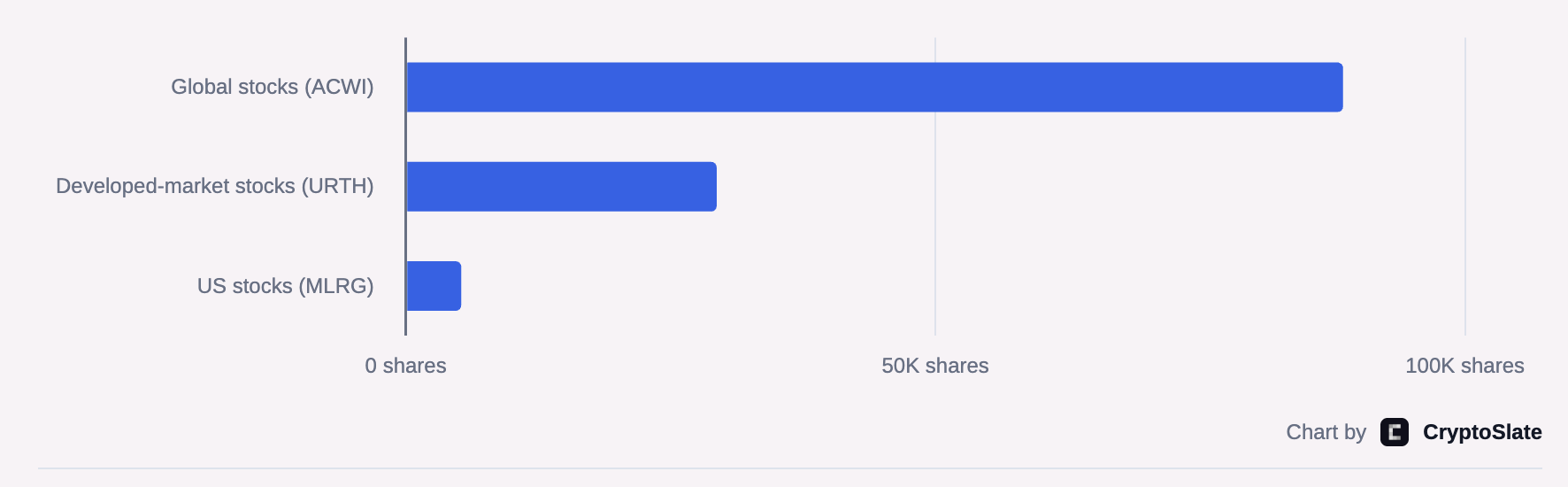
Based on filings dated November 13, 2026, three BlackRock funds held a combined 123,000 Strategy shares
The iShares ESG Advanced MSCI USA ETF (USXF) tracks a version of MSCI USA that applies additional screening rules to constituents. It reported holding 16,100 Strategy shares on November 13; but as of November 17, the standard index announcement could not determine how this specialized version would adjust.
MSCI's announcements for these specialized indices are scheduled for November 18, so USXF was not included in the three-fund total above.
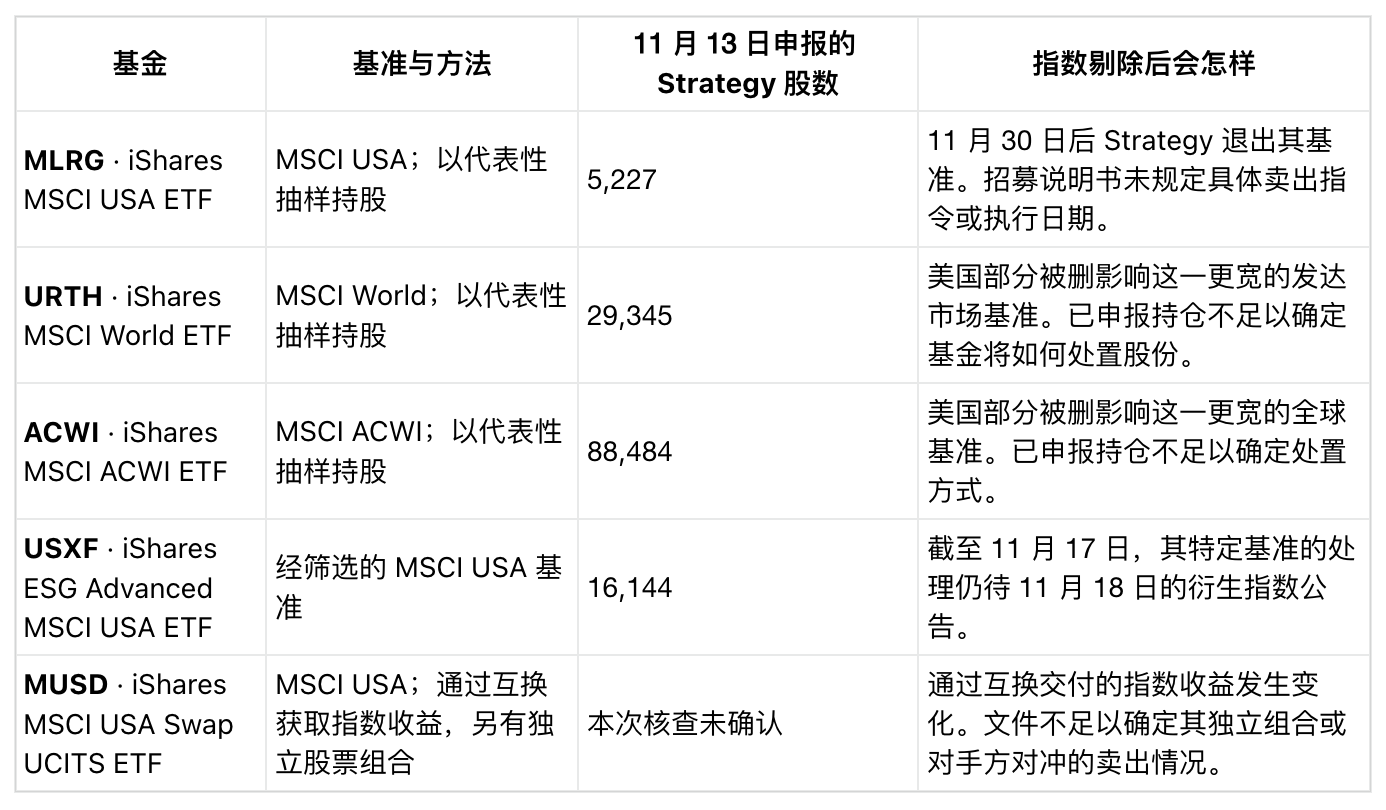
Investors holding Strategy through other index-linked funds do not automatically face the same change. For example, Invesco QQQ tracks the Nasdaq-100, which has its own index provider and inclusion rules.
Managers hired to pick stocks themselves can also continue to evaluate Strategy by their own standards, as can investors who hold its shares directly.
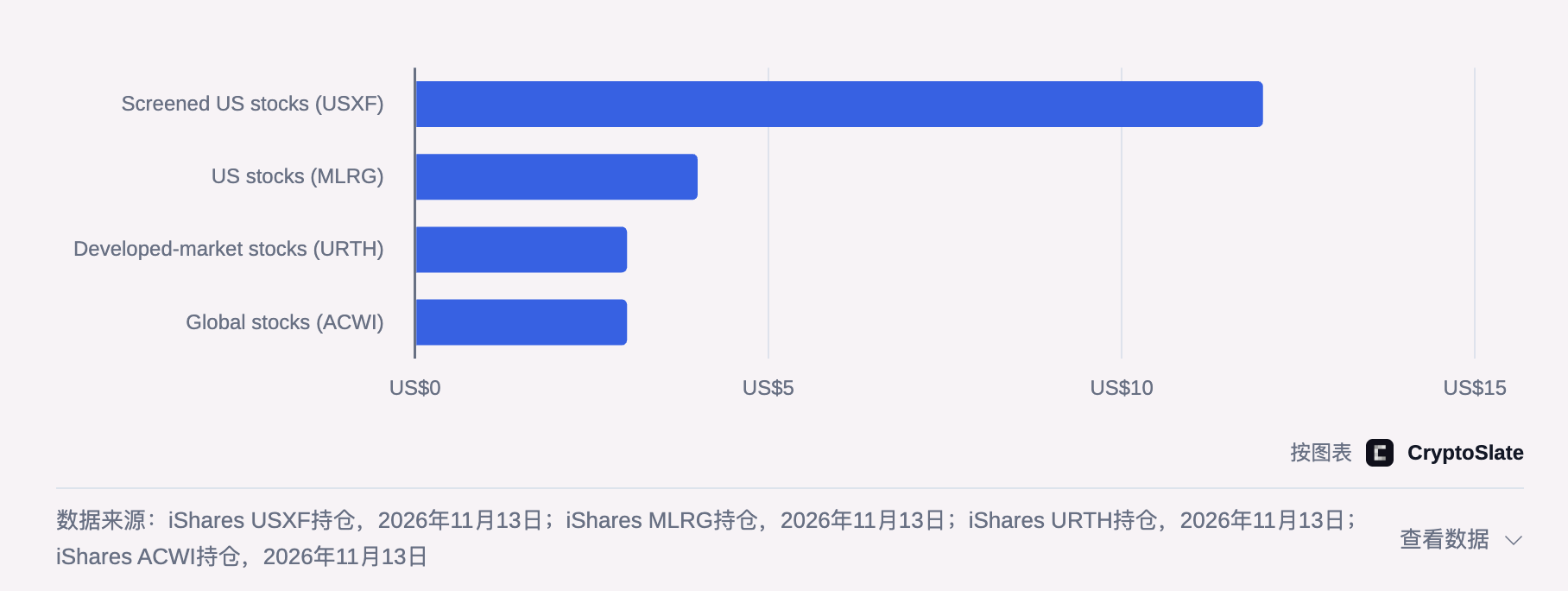
How much of every $10,000 in assets these funds have invested in Strategy
In response to MSCI's consultation, Strategy said that funds tracking the firm's global investable indices hold a combined roughly 13 million of its shares, equivalent to 3.1% of its basic shares outstanding.
That is a much larger sample than the three funds in this article, but the public statement did not list specific funds or provide an observation date for the current holdings.
Fewer holdings doesn't mean someone is selling
After the index adjustment, daily holdings filings will let us compare these funds' prior holdings with their subsequent holdings. These filings can show that a given portfolio holds fewer Strategy shares, but they may not show how or why those shares were reduced.
ETFs grow and shrink as investors create or redeem shares. When a fund grows, its Strategy holdings may increase simply because it needs more of the underlying stocks.
Comparing Strategy share counts with the fund's own share count helps distinguish "changes in fund size" from "changes in Strategy's weight in the portfolio." When an ETF shrinks, some shares may leave through the share redemption process. Financial institutions can return fund shares to the ETF in exchange for the underlying securities.
In this way, Strategy shares can leave an ETF without the fund selling them on an exchange, and the institutions receiving those shares then decide what to do with them. The next holdings filing will only record a smaller position, without telling us those subsequent decisions.
MUSD adds another layer of limited observability, because its contracts deliver index performance directly. Its counterparties may adjust investments as Strategy exits, but tracking only the fund's stock holdings won't reflect those adjustments.
Even if we can see holdings changes, comparing two dates cannot show how much of Strategy's stock price moves were driven by MSCI, especially when investors can trade ahead of announced changes.
Strategy will ultimately lose its place in these funds' performance targets. That may weaken demand for its stock and make a company that funds bitcoin purchases by issuing securities less attractive when raising capital. Then again, index removal does not require Strategy itself to sell any bitcoin.