The Quantum Computing Era: Are Crypto Assets Still Safe? Starting from Ethereum's Post-Quantum Roadmap


- Core Viewpoint: The threat of quantum computing to blockchain has moved from theoretical speculation to the engineering implementation stage. The Ethereum Foundation has set the goal of achieving full post-quantum resistance at the L1 level by the end of 2029. Cryptographic migration requires years of advance planning, and the role of wallets will evolve from private key management tools into long-term asset security management infrastructure.
- Key Elements:
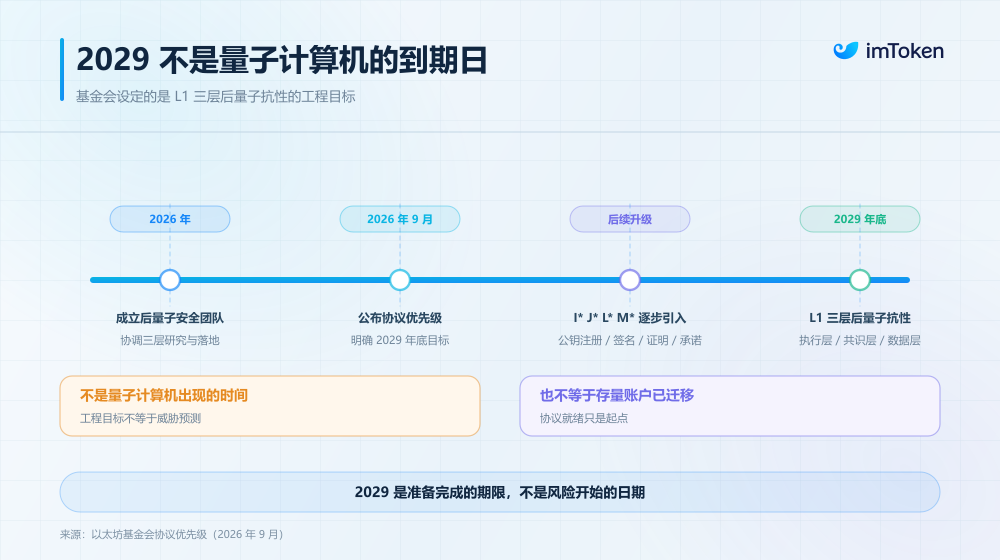
- The Ethereum Foundation has established a dedicated Post-Quantum Security team, planning to achieve full post-quantum resistance across the execution layer, consensus layer, and data layer by December 2029.
- Elliptic curve signatures such as ECDSA and BLS are the first to be affected—Shor's algorithm can theoretically derive private keys in polynomial time; whereas hash functions like Keccak-256 are more resilient because Grover's algorithm only provides a quadratic speedup.
- Only EOA accounts that have initiated on-chain transactions expose their full public keys; cold wallet addresses that have never signed externally remain protected by the one-wayness of hashing, so the risk is not evenly distributed.
- At the execution layer, EIP-8141 is advancing native account abstraction to enable key rotation, and EIP-8288 uses recursive STARK aggregation to compress post-quantum signatures; at the consensus layer, leanXMSS hash-based signatures and leanVM aggregation schemes are being explored.
- KZG polynomial commitments and some SNARKs that rely on elliptic curve pairings also face quantum risks. Hash-based STARKs offer stronger post-quantum security properties, and migration needs to extend to L2 and Rollups.
- The core challenge of user migration lies in preserving the relationship between original account addresses and assets. Users need to proactively authorize new keys to take over while the existing system is still secure, and remain vigilant against new types of attacks that exploit quantum panic to induce mnemonic phrase leaks.
If one day a quantum computer could, in an extremely short time, derive a private key from a public key already exposed on-chain, would the crypto asset security system built on cryptography today still hold?
For a long time, discussions in the crypto industry about quantum computing remained largely at the level of theoretical speculation—acknowledging that the elliptic curve cryptography widely used by mainstream blockchains such as Bitcoin and Ethereum could someday be broken by quantum computers with sufficient computing power, but that this was still fairly remote.
In fact, by 2026, this issue has formally entered the engineering implementation phase—the Ethereum Foundation has not only established a dedicated post-quantum security research team, but also set the end of 2029 as the engineering target for Ethereum L1 to achieve full post-quantum resistance across the execution layer, consensus layer, and data layer in its latest protocol roadmap.
For an open network with hundreds of millions of accounts, massive asset scale, and a complex application ecosystem, replacing the cryptographic system is far from a simple software upgrade.
Especially from the perspective of ordinary users, the real challenge often lies not in "how to generate a new quantum-resistant private key," but in how to safely and seamlessly retain control of existing accounts and assets during the process of switching signature algorithms.
1. What Is Quantum Computing Really Threatening?
To understand the impact of quantum computing on crypto assets, we first need to break down the blockchain security system.
Ethereum currently relies mainly on four types of cryptographic components to operate, serving accounts, consensus, data availability, and application-layer proofs respectively. They solve different problems, and their exposure to quantum computing risks is not equal:
- ECDSA: the elliptic curve digital signature algorithm used by ordinary user accounts, used to prove ownership of the transaction initiator;
- BLS: the signature algorithm used by Ethereum's PoS consensus layer, which can efficiently aggregate the votes of hundreds of thousands of validators into a single signature;
- ZK-proof systems: zero-knowledge proof systems used by applications such as Rollups;
- KZG: a polynomial commitment scheme used for Blob and Rollup data availability (DA) verification;
Among them, the first to be affected are asymmetric cryptography systems based on the elliptic curve discrete logarithm problem, such as ECDSA and BLS.
As is well known, for traditional computers, deriving a private key from a public key is computationally almost infeasible, but a fault-tolerant quantum computer running Shor's algorithm can theoretically solve the elliptic curve discrete logarithm problem in polynomial time, thereby breaking the security of public key cryptography such as ECDSA and BLS that relies on related mathematical assumptions.
Once the private key is recovered, an attacker does not need to steal the mnemonic or breach the wallet client to directly forge valid signatures and transfer assets. Similarly, validator keys, protocol multisig management permissions, and cross-chain bridge control keys all face similar long-term challenges.
By comparison, hash functions such as Keccak-256 are more resilient to quantum computing. Although Grover's algorithm can provide a quadratic speedup, it will not, like Shor's algorithm, directly turn an exponentially hard security problem into one solvable in polynomial time.
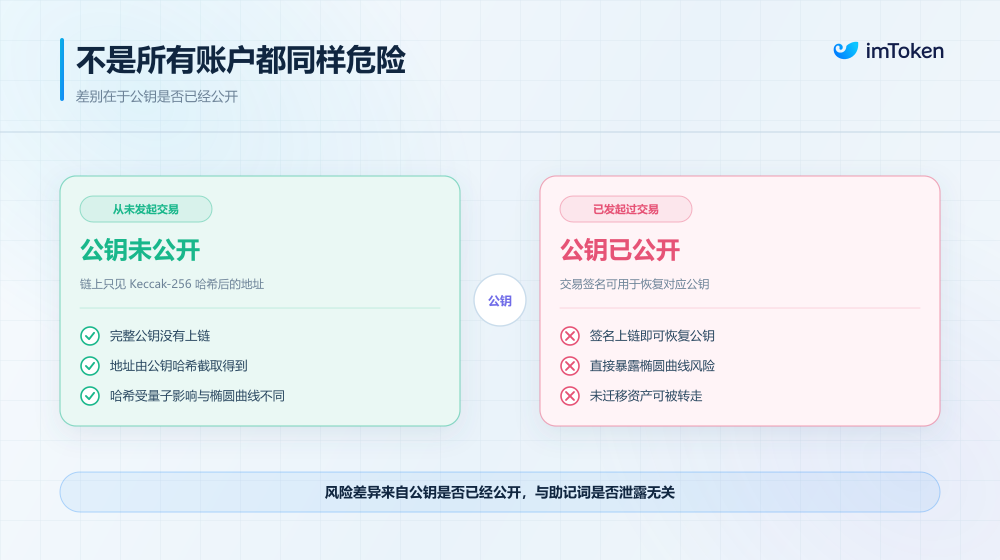
This also leads to a key detail that is often overlooked: not all Ethereum accounts are at equal risk in the face of quantum threats.
The address of an ordinary Ethereum EOA is derived by taking the public key, hashing it with Keccak-256, and truncating the result.
Therefore, if one of your cold wallets has never initiated any on-chain transaction externally and has never publicly exposed a signature off-chain, then only the hashed address is recorded on-chain, and the full public key has never been exposed, so it remains protected by the one-way nature of hashing; however, as long as that address has initiated even a single transfer or contract authorization, an attacker can recover the full public key from the publicly available transaction signature, directly exposing it to the risk of elliptic curves being broken in the future.
Of course, at this stage, no quantum computer with cryptographic cracking capability has yet appeared globally, and ordinary users have no need to panic and move assets because of this.
The Ethereum Foundation's post-quantum team has also emphasized repeatedly that fault-tolerant quantum computers with real threat capability still need to overcome enormous engineering gaps in hardware scale and quantum error correction (Further reading: "What Exactly Does Quantum Computing Threaten? A Crypto User's Guide to the Post-Quantum Era").
But the problem is that cryptographic migration itself takes years, and if we wait until the threat truly appears to begin preparations, it may already be too late.
2. What Preparations Is Ethereum Making?
In 2026, the Ethereum Foundation established a dedicated Post-Quantum Security team responsible for coordinating research and engineering implementation of post-quantum cryptography at the protocol layer.
Rather than simply looking for a new signature algorithm, Ethereum is attempting to advance the upgrade of its cryptographic system simultaneously across three directions: the execution layer, the consensus layer, and the data layer.
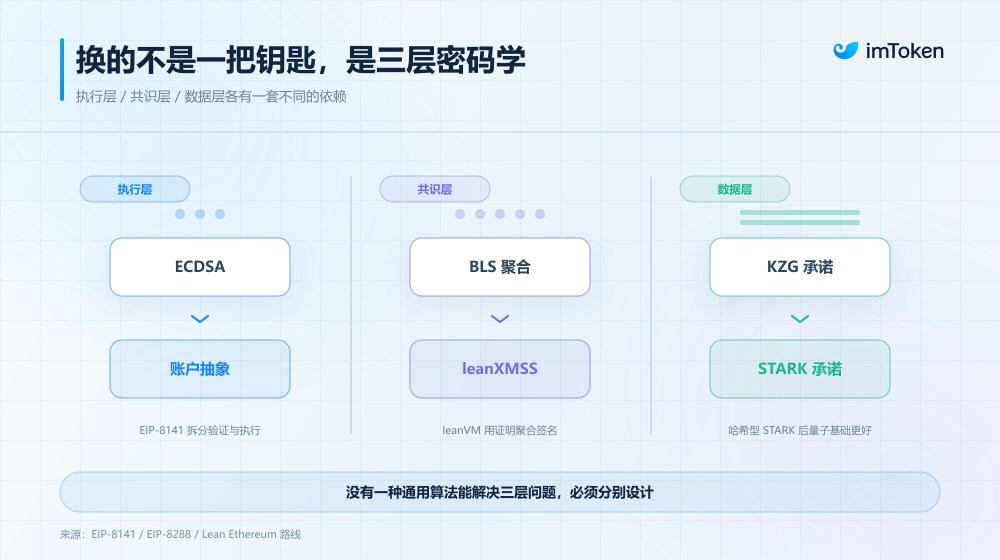
1. Execution Layer: Freeing Accounts from Permanent Binding to a Single Private Key
For ordinary users, the most direct change comes from the execution layer.
The account authorization logic of traditional Ethereum EOAs is relatively fixed: users generate signatures through secp256k1 private keys, and the network verifies whether the signatures are valid through ECDSA.
This design is simple enough and has been verified over the long term, but it tightly binds account identity to a specific signature system. If ECDSA is no longer secure in the future, users will need to switch signature algorithms, but simply changing to a new private key often means generating a new account address, and the original assets, contract interaction records, and application relationships may also need to be migrated again.
This is clearly not an ideal solution.
To break this constraint, Ethereum is accelerating the push for native account abstraction, the most representative of which is EIP-8141 (Further reading: "Native Account Abstraction + Quantum Resistance: Why Hasn't EIP-8141 Become the Headliner of Ethereum's Hegotá?").
It attempts to split transaction verification, actual execution, and gas payment into different execution stages, allowing accounts to determine whether a transaction is valid through programmable logic, thereby helping accounts gradually break free from fixed dependence on ECDSA private keys, enabling native key rotation, and leaving room for introducing different signature verification algorithms in the future.
At the same time, Ethereum is also researching post-quantum signature verification precompiles, so that smart contracts and account verification logic can more efficiently natively verify new signature types.
But this is only the first step. Because post-quantum signatures are usually much larger than traditional ECDSA/BLS signatures, Ethereum also needs to address the resulting data and computational cost issues. For example, EIP-8288 proposes using recursive STARK aggregation to compress the verification results of large numbers of post-quantum signatures into more compact proofs, thereby reducing on-chain data and verification burdens.
2. Consensus Layer: Replacing Traditional BLS with Hash-Based Signatures
In addition to the execution layer, the consensus layer is even more central to the underlying PoS operating mechanism of the Ethereum network.
Current PoS consensus relies heavily on the aggregation properties of BLS signatures. If directly replaced with ordinary post-quantum signatures, the enormous signature size would significantly increase P2P network propagation, storage, and verification costs among nodes.
To this end, Ethereum's Lean Ethereum roadmap proposes two noteworthy technical directions.
- leanXMSS: a hash-based post-quantum signature scheme, planned to replace the BLS signatures currently used by validators, eliminating elliptic curve dependence at the root;
- leanVM: a minimalist zero-knowledge virtual machine designed specifically for efficiently aggregating post-quantum signatures, attempting to use quantum-resistant zero-knowledge proofs such as recursive STARKs to compress the hash signatures of large numbers of validators into compact proofs, safeguarding consensus performance while ensuring quantum-resistant security;
This also shows that there is no one-size-fits-all general algorithm for post-quantum upgrades; validator consensus and ordinary user wallets each need to match the most suitable cryptographic tools.
3. Data Layer: KZG and ZK Proofs Also Need to Consider Quantum Security
In addition to account signatures and validator signatures, the data layer also faces long-term challenges.
Ethereum has made extensive use of the KZG polynomial commitment mechanism in recent years, especially for Blob and Rollup data availability, and the security of KZG depends on mathematical assumptions related to elliptic curve pairings, so the future impact of quantum computing also needs to be considered.
In addition, at the application layer, some ZK proofs used by systems such as Rollups have similar issues, especially some SNARKs that rely on elliptic curve pairings, whose security assumptions may also be affected by Shor's algorithm; by comparison, STARKs built on hash functions do not rely on the elliptic curve discrete logarithm assumption and therefore have better post-quantum security properties.
This means that post-quantum migration is not just an issue for Ethereum L1; in the future it will also need to gradually extend to L2s, Rollups, and various on-chain applications.
Looking at the timeline, in the protocol priorities published by the Ethereum Foundation in September 2026, it explicitly proposed striving to achieve post-quantum resistance across the execution layer, consensus layer, and data layer of Ethereum L1 before December 2029, and subsequent upgrade milestones will also gradually introduce infrastructure such as post-quantum public key registration, signature verification, consensus proofs, and data commitments.
This will be a long-term project involving the entire ecosystem.
3. How Can Users Securely Complete Asset Migration?
If the first two sections discussed how Ethereum is solving the underlying cryptographic problems, then for ordinary users, what is most worth paying attention to is actually when the existing signature system needs to be upgraded, what should our wallets do?
This is far more complex than regenerating a private key.
The first issue to solve is account identity.
For traditional EOAs, there is a direct mathematical relationship between the account address and the public key. If users directly use a new post-quantum key system, they usually need to generate a new account identity and then transfer the original assets over.
But this brings a series of problems. In addition to ETH and ERC-20 tokens, users may also hold NFTs, deposits and positions in DeFi protocols, and assets on different L2 networks. Some applications also record permissions, points, historical interactions, and identity relationships based on user addresses.
If every cryptographic upgrade requires changing the account address, users would have to re-handle these assets and application relationships, and the migration cost would be very high.
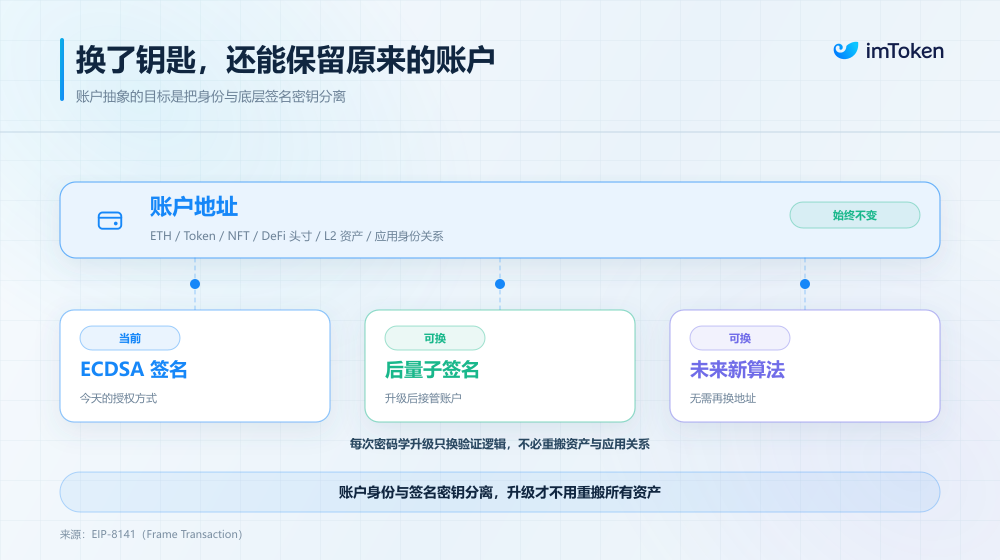
Therefore, the importance of account abstraction becomes apparent: it can separate account identity from the underlying signing key as much as possible, allowing accounts to determine who has the right to control assets through programmable verification logic.
Theoretically, this means users may in the future have the opportunity to change the underlying signature algorithm while retaining the original account address, without having to move all assets to another address.
This is also one of the capabilities that EIP-8141 hopes to provide.
Second is migration between old and new keys. An ideal migration process should be for the user to proactively authorize a new post-quantum key to take over the account while the existing cryptographic system is still secure.
For example, the wallet can first generate a new post-quantum key in a secure environment, and then authorize an update to the account's verification rules through a valid signature from the existing account.
If the original ECDSA private key is still secure, this process can proceed according to the normal account upgrade flow, but if a quantum computer already has the ability to crack existing private keys, the situation is completely different.
At that point, both attackers and the real user may have the ability to forge signatures for the original account, and it will be difficult for the system to determine who the legitimate owner is based solely on the old key.
This is also why migrating in advance is so important.
In addition, there is another category of even more troublesome accounts—wallets that have not been used for a long time, whose private keys have been lost, or whose owners simply do not know that an upgrade is needed. These accounts may still hold large amounts of assets but cannot proactively complete migration.
For such assets, whether they should be allowed to remain at the original addresses, or whether measures such as freezing should be taken in the future through protocol governance, remains controversial.
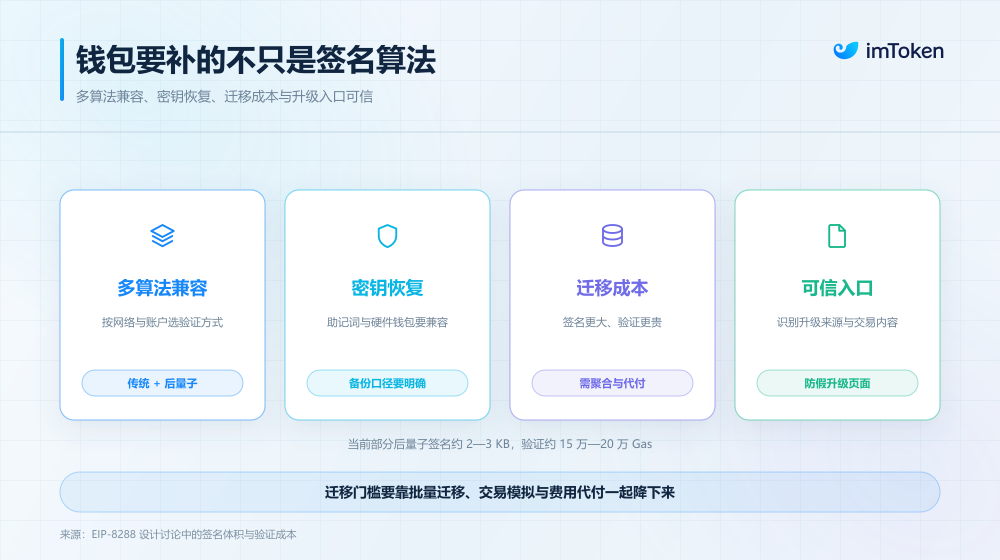
Finally, and most easily overlooked, is that the secure migration process itself must not become a new attack vector.
When the entire industry begins discussing quantum threats, attackers are very likely to exploit users' panic to create so-called "quantum security upgrade," "private key verification," or "asset migration" pages, tricking users into entering mnemonics or signing malicious authorizations.
Therefore, in the future, wallets must not only provide migration tools, but also enable users to clearly identify the source of upgrades, verify transaction contents, and confirm exactly which assets the new authorization logic controls.
Final Thoughts
As of today, quantum computing is still far from reaching the level where it can directly threaten the cryptographic systems of mainstream blockchains.
But this does not mean the industry can ignore it.
The post-quantum roadmap Ethereum is advancing actually also shows that the future of blockchain security should not be built on the assumption that a particular cryptographic algorithm will never be broken, but on the ability of the entire system to continuously upgrade and migrate securely.
For ordinary users, the role of wallets will also change accordingly.
In the past, the core job of a wallet was to help users generate, store, and use private keys; in the future, it will also need to help users understand account risks, manage keys under different cryptographic systems, and securely complete account upgrades when necessary.
This is not just a change of signature algorithm, but an evolution of the wallet from a private key management tool into long-term asset security management infrastructure.
At least today, users do not yet need to rush to migrate assets because of quantum computing, but for wallet developers and the entire crypto industry, the time that truly deserves advance preparation has already begun.