Variational raises $110M in new funding: Could small-cap contracts be the key to challenging Hyperliquid?


- Core Viewpoint: Against the backdrop of a slowdown in crypto industry fundraising, perpetual DEX protocol Variational has completed a $110 million Series B round at a valuation of $1.5 billion. Its zero-fee model and multi-source liquidity integration have made traditional asset contracts its main source of trading volume, and it is seen as a potential force challenging Hyperliquid.
- Key Elements:
- The Series B round was led by Bain Capital Crypto, with participation from Dragonfly Capital and others; following a $50 million Series A in May this year, the two rounds bring cumulative funding to $160 million.
- The platform is deployed on Arbitrum. Its core product Omni adopts a zero-trading-fee model with built-in market maker OLP quotes and connects to multi-source liquidity including traditional finance and crypto-native market makers.
- Since traditional asset contracts launched in September, cumulative trading volume has exceeded $80 billion; over the past month, trading volume has surpassed $61.7 billion, with open interest above $680 million, ranking third among Perp DEXs.
- Among the top five Perp DEXs by open interest, Variational is the only platform that has not yet launched a token.
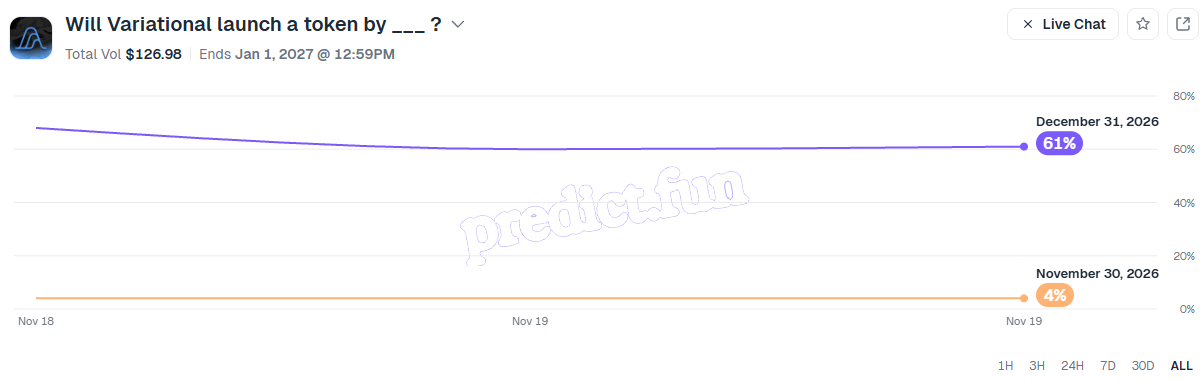
- The team says VAR still plans to conduct its TGE within the year, but prediction markets give only a 61% probability of a token launch before December 31.
- For Hyperliquid's small-cap contracts, the median order amount near market price has fallen 82% over the past year, and thinner order books provide Variational with an opportunity to capture that portion of trading volume.
Original | Odaily(@OdailyChina)
Author | Asher(@Asher_0210)
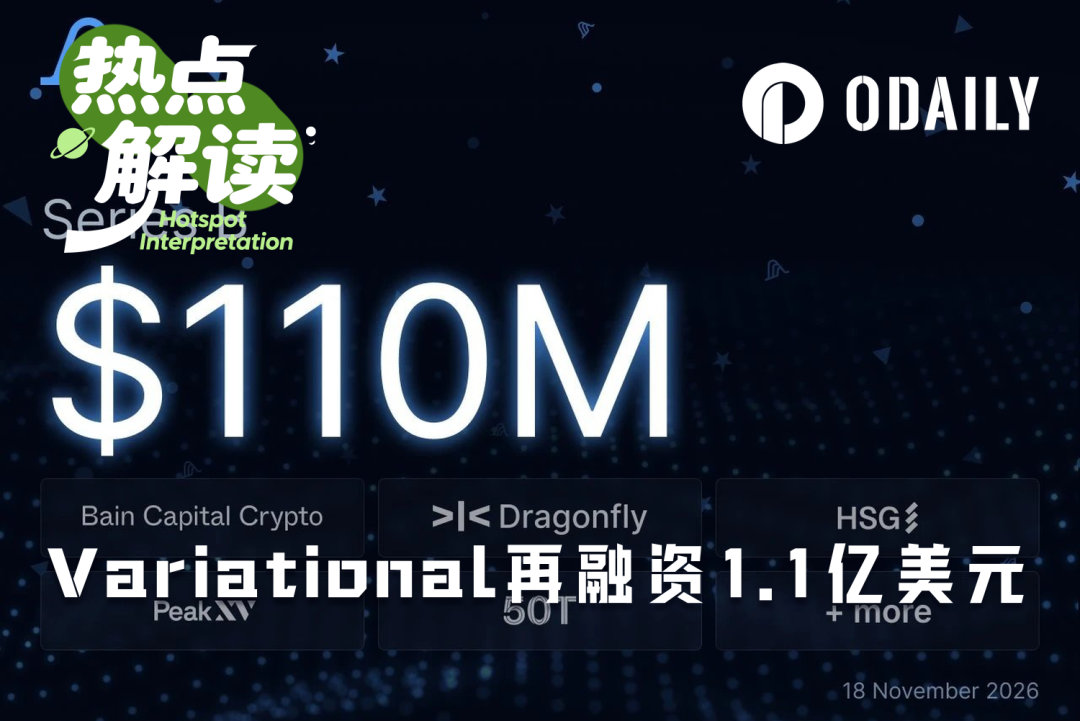
Crypto industry fundraising has slowed, yet Variational, a Perp DEX protocol that has not yet launched a token, announced last night that it has closed a $110 million Series B round at a post-money valuation of $1.5 billion. The round was led by Bain Capital Crypto, with participation from Dragonfly Capital, HSG, Peak XV, and 50T Funds.
In May of this year, Dragonfly had just led Variational's $50 million Series A. Half a year later, Dragonfly participated again, with the Series B amount more than double that of the Series A. Across the two rounds, Variational has raised $160 million this year.
A platform that started out in crypto perpetuals now derives more than half of its daily trading volume from traditional markets such as equities, indices, and gold. How has Variational brought these trades on-chain?
Variational: A Zero-Fee Perp DEX Deployed on Arbitrum
Variational is a Perp DEX platform deployed on Arbitrum, headquartered in the Cayman Islands, with Omni as its core product. Simply put, users can trade major crypto assets such as BTC, ETH, and SOL on Variational, as well as perpetual contract markets for long-tail assets, equities, commodities, volatility indices, and more.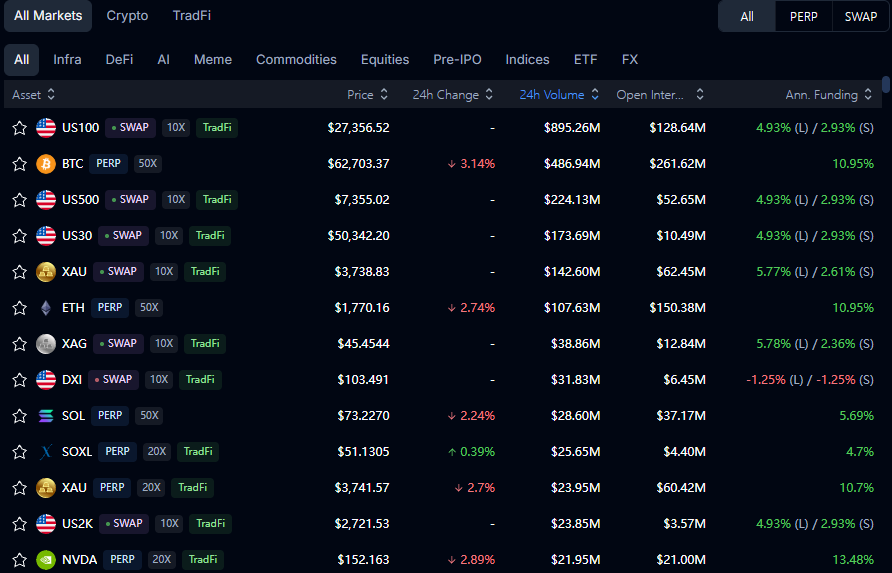
Compared with most Perp DEXs, Variational's most obvious feature is zero trading fees. When users trade on Omni, the platform charges no standard trading fee; the main costs come from spreads, slippage, funding rates, and deposit/withdrawal fees.
In addition, Variational adopts a broker-like model to access multi-source liquidity, including traditional finance market makers, crypto-native market makers, and major trading platforms. Specifically, when a user places an order, Omni's built-in market maker OLP quotes prices directly and takes on the trade, then hedges in external markets as needed.
This way, even if a new market has just launched on Omni, as long as there is sufficient liquidity in external markets, OLP can quote prices to users without waiting for buy and sell orders on the platform to accumulate gradually. Traditional assets have become the most actively traded category under this model. Since launching in September this year, cumulative trading volume for Omni's traditional asset contracts has exceeded $80 billion.
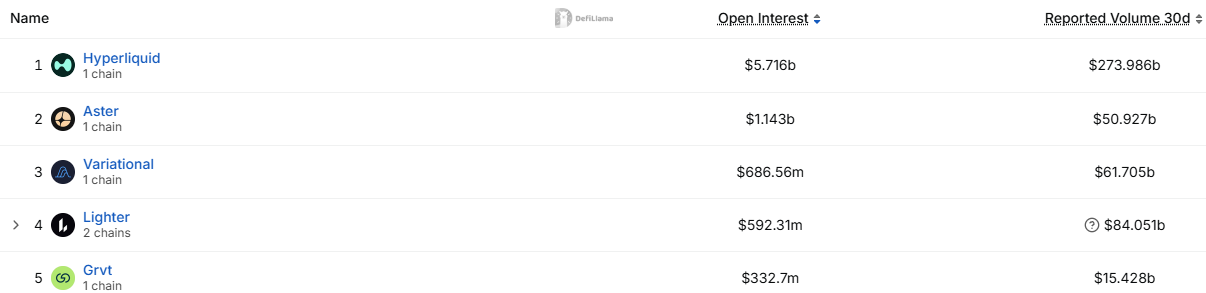
According to DefiLlama data, Variational's trading volume over the past month has exceeded $61.7 billion, with current open interest above $680 million, ranking third in the Perp DEX sector. Notably, among the top five Perp DEXs by open interest, Variational is the only platform that has not yet launched a token.
The Team Still Plans a TGE Within the Year, but Prediction Markets Give It Only a 60% Chance
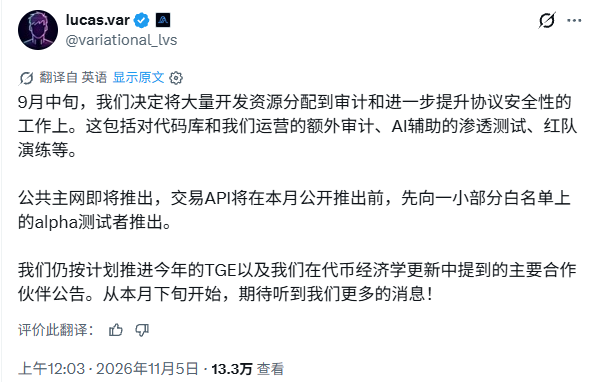
Back in September, when Variational unveiled its tokenomics, it said the TGE for VAR was scheduled for the fourth quarter of 2026. On November 5, Variational co-founder Lucas Schuermann posted on X that VAR is still planned to launch within the year, the previously mentioned major partnership will also be announced as planned, and the team expects to disclose more progress starting in late November.
But prediction markets are not optimistic about VAR's TGE this year. According to predict.fun data, the probability of Variational launching its token by December 31 is only 61%, while the probability of a launch by November 30 is 4%. Judging by these two time points, the market leans toward VAR launching in December, while also leaving considerable room for a delay into next year.
For points farmers, the TGE date also determines when points issuance stops. Variational originally planned to end its points campaign at the end of the third quarter and issue VAR shortly afterward. As the major strategic partnership progressed, the project adjusted its token launch timeline, and the points campaign will also extend until the TGE, continuing to distribute 150,000 points per week.
Based on third-party dashboard estimates, roughly 10.3 million to 10.5 million points had been issued by mid-November. If VAR launches at the end of December, total points are expected to rise to about 11.3 million to 11.4 million. Based on the estimated total points at the end of December, if VAR's FDV is $1 billion, $1.5 billion, and $2 billion, the theoretical value per point would be approximately $28, $42, and $56, respectively.
Small-Cap Perpetuals May Be Variational's Breakthrough in Challenging Hyperliquid
In the past, even when trading small-cap tokens, larger orders still had a chance to fill on Hyperliquid at prices close to market. Today, that advantage is fading. HyperIndex compared 38 small-cap perpetual contracts and found that over the past year, the median order size available for execution near market price on Hyperliquid fell 82%, while Binance and OKX fell 61% and 78%, respectively, over the same period.
As order books for small-cap tokens on Hyperliquid thin out, the same large order may need to sweep through more price levels to fill, giving Variational an opportunity to capture this trading volume. How much market share this $110 million raise can bring Variational depends on whether Omni can raise position limits on more small-cap tokens, reduce execution costs for large orders, and still allow traders to close positions at reasonable prices when the market is highly volatile.