


Jensen Huang Controversy and Massive Chip Investigation: How Will the $4.8 Billion Storm Reshape Nvidia's Stock Price and the Future of AI?


Overview
NVIDIA (NASDAQ: NVDA) co-founder and CEO Jensen Huang sent an internal letter to all employees on November 8, 2026, acknowledging an extramarital affair, while the company's board of directors simultaneously launched an independent investigation into whether he had become a target of a foreign intelligence agency. This triggered a significant governance and compliance discount in the short term, causing NVIDIA's stock to fall as much as 5.22% to $176.64 in pre-market trading on Monday, November 9 (based on the previous day's closing market cap of $4.498 trillion, the pre-market market cap shrank by approximately $195 billion to $235 billion). However, this event will not reverse the global artificial intelligence (AI) infrastructure capex cycle. The core fact determining the boundary of the butterfly effect is that this controversy is essentially an interweaving of personal moral failings with a compliance review of $4.8 billion in Southeast Asian computing power subleasing, rather than a technical rupture in NVIDIA's underlying architecture or Vera Rubin mass production progress. Over the next two weeks, the true direction of NVIDIA's stock price will be jointly determined by the fiscal 2027 third-quarter earnings report to be released after market close on November 17 (official revenue guidance of $108 billion) and the tone set by the closed-door briefings of three major U.S. congressional committees on November 18.
Key Points
The reason Jensen Huang's scandal has caused shockwaves on Wall Street and in Washington beyond the scope of ordinary executive personal conduct is that media reports pointed the other party in the affair to Alice Huang, former managing director of Singapore data center company Megaspeed International, while U.S. regulators are investigating whether entities under that company circumvented China export controls by purchasing at least $4.8 billion worth of NVIDIA AI chip equipment between June 2024 and February 2026. In terms of how the incident is characterized, NVIDIA's board of directors established an investigation committee on November 8 led by independent directors and outside independent legal counsel, explicitly stating that there is currently no reason to believe that U.S. national security or NVIDIA trade secrets have been compromised, and reaffirming confidence in Jensen Huang continuing as CEO. U.S. President Donald Trump also publicly supported Jensen Huang remaining in his position the same day. From the perspective of supply chain transmission, AI capital expenditures by North American hyperscale cloud providers such as Microsoft, Google, Meta, and Oracle are driven by returns on computing power investment and will not cut orders due to a single executive's personal life controversy. What is truly affected is the approval process for secondary cloud service providers (Neo-Cloud) relying on cross-border computing power leasing in Southeast Asia, as well as the potential ownership division expectations for Jensen Huang's approximately $162.2 billion in NVIDIA equity holdings under extreme family law dispute scenarios.
Timeline and Fact-Checking: Distinguishing Confirmed Facts, Company Claims, and Unverified Rumors
In sharp market moves driven by sudden events, the secondary market often conflates personal lifestyle apologies, multinational commercial compliance investigations, and unverified espionage allegations. To accurately assess risk exposure, investors first need to strictly categorize information as of November 9, 2026 into three buckets based on the CNA event timeline and official disclosures from all parties: confirmed facts, claims by the company and involved parties, and information that remains undisclosed or unverified.
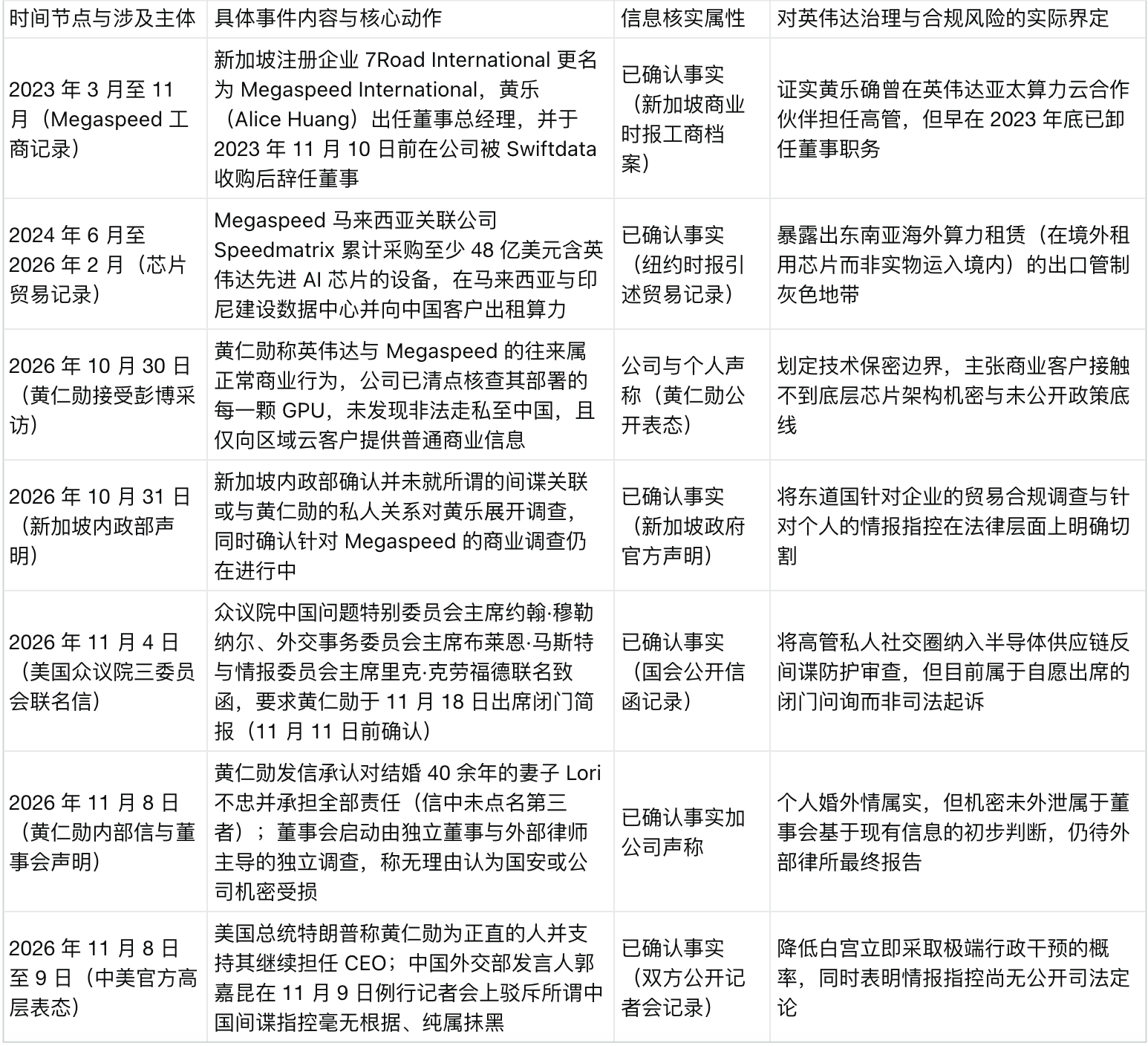
As shown in the table above, according to the CNBC internal letter report and the CBS board investigation report, Jensen Huang's statement in his November 8 letter to employees that "I was unfaithful to my wife, my actions hurt her and our children, and there is no excuse for that" is a clear acknowledgment of personal family moral responsibility. Meanwhile, the claim cited by The New York Times and the Financial Times the same day from an anonymous intelligence memo that "Alice Huang was suspected of being recruited to probe the bottom line of chip export controls" falls under intelligence community suspicions that have not been confirmed through independent judicial proceedings (the Chinese Foreign Ministry's routine response formally denied it on November 9).
In addition, regarding the widely discussed online claim that "a divorce under California's community property system could lead Jensen Huang to divide more than $62.5 billion in NVIDIA stock," this also needs to be distinguished between hypothetical scenarios and institutional facts: Jensen Huang's current net worth is estimated by Forbes at approximately $162.2 billion (99% in NVIDIA stock, with a stake of about 3.5%). He met his wife Lori Huang at Oregon State University and has been married for over 40 years. However, as of November 9, neither party had filed any divorce proceedings, and Jensen Huang explicitly stated in the letter that he is committed to repairing the family trauma. Even under extreme assumptions of a equity split, based on historical precedents of Amazon founder Jeff Bezos and Bill Gates, marital property agreements for tech giant founders typically preserve existing voting rights entrustment arrangements and would not trigger direct secondary market selling.
The Four Transmission Mechanisms of the Butterfly Effect: From the $62.6 Billion Equity Cloud to Southeast Asian Computing Cloud Compliance Review
Although allegations of technical secret leakage have not been substantiated, as the head of the world's computing power leader with a market cap of approximately $4.5 trillion, Jensen Huang's incident has still released chain reactions to NVIDIA's valuation and the global AI supply chain through four specific paths.
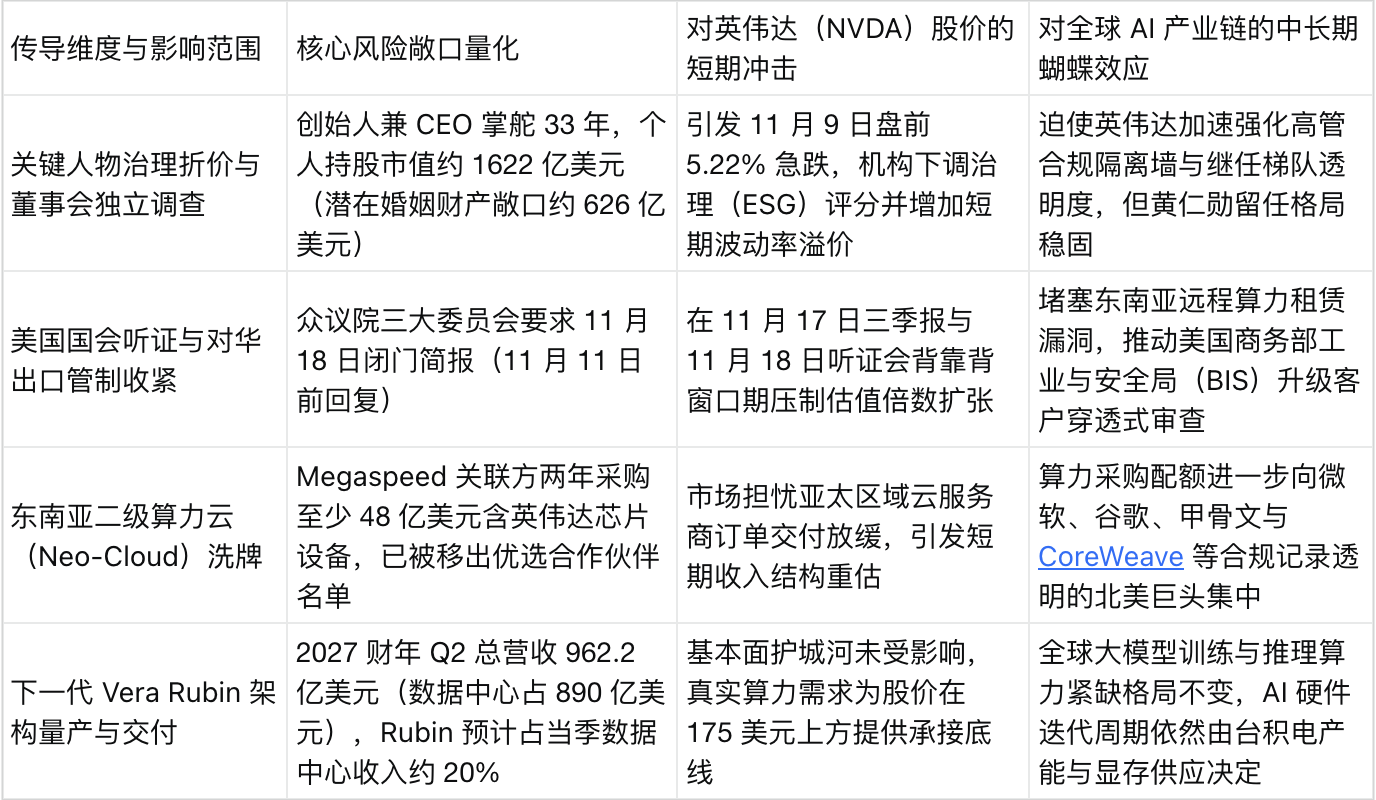
The first transmission path is Key-Man Governance Risk. Since founding NVIDIA in 1993, the now 63-year-old Jensen Huang has served as CEO for 33 consecutive years, and his personal brand is highly tied to NVIDIA's ecosystem influence (affected by this controversy, Jensen Huang's daughter, NVIDIA robotics product marketing director Madison Huang, has canceled a business trip to South Korea originally scheduled to begin on November 8). However, unlike the cases of former Intel CEO Brian Krzanich, former McDonald's CEO Steve Easterbrook, or former BP CEO Bernard Looney, who resigned between 2018 and 2023 for violating company internal workplace relationship rules, Jensen Huang's case involves an outside businessperson, does not violate the company's internal employee relationship prohibition, and Benzinga's pre-market quote and statements confirm that President Trump has expressed support for him staying on and welcomed him on an upcoming Asia trip. Therefore, the probability of Jensen Huang being forced out is extremely low.
The second path, and the one that truly produces a substantive butterfly effect on the AI industry, is the escalation of the regulatory storm over Southeast Asian secondary cloud computing (Neo-Cloud). According to the $4.8 billion chip procurement records disclosed, Megaspeed established a sister company Speedmatrix in Johor, Malaysia, in early 2024 and purchased at least $4.8 billion worth of advanced AI equipment搭载 NVIDIA chips between June 2024 and February 2026, building data centers in Malaysia and Indonesia for Chinese tech companies to remotely access computing power through cross-border cloud leasing. Although providing overseas cloud leasing without physically shipping chips into China was previously in a legal gray area, according to the Forbes Middle East report on the congressional letter, the three major House committees elevated such commercial contacts to a national security concern in their November 4 joint letter. As of November 8, NVIDIA had removed Megaspeed from its official list of preferred cloud partners. This move signals that future end-customer穿透式 KYC reviews by the U.S. Department of Commerce on secondary cloud service providers in Singapore, Malaysia, Indonesia, and the Middle East will be comprehensively tightened, and global high-end GPU allocations will accelerate their return to licensed hyperscale cloud providers in North America.
NVIDIA Stock Price Reaction and the November 17 $108 Billion Earnings Test: Can Fundamentals Offset Off-Market Negative News?
To assess where this off-market controversy will push NVIDIA's stock price, the current pre-market decline must be quantitatively compared within NVIDIA's technical structure over the past week and the upcoming fiscal 2027 third-quarter earnings report (scheduled for release after market close on November 17, 2026, Eastern Time). Investors can track intraday volume and valuation multiple changes through the NVIDIA real-time stock price dashboard and the NVIDIA business structure guide.
According to the Investing.com historical price table, NVIDIA's stock had just experienced severe volatility triggered by the midterm elections in the first week of November: it closed at $206.69 on November 3, fell 3.17% to $200.13 on November 4, plunged 9.26% to $181.60 with the semiconductor sector on November 5 (with volume expanding to 306.13 million shares), then rebounded 2.78% to close at $186.64 on Friday, November 6 (after-hours trading once rose to $188.55). After the internal letter and board investigation news broke on Sunday, November 8, in pre-market trading on Monday, November 9, from 04:05 to 05:15 ET, NVDA gapped lower, hitting an intraday low of $176.64 (down 5.36% from Friday's close of $186.64, and down 6.32% from Friday's after-hours high), and was trading around $178.45 to $178.60 as of 05:15 ET (down approximately 4.31% to 4.39% from Friday's close).
A time coincidence worthy of high vigilance: NVIDIA is scheduled to release its fiscal 2027 third-quarter earnings report for the period ended October 25 on Tuesday, November 17, 2026, while the date for the three major congressional committees requesting Jensen Huang to attend a closed-door briefing at the Rayburn House Office Building in Washington is exactly the next day (November 18, with attendance confirmation required by November 11). This means that within the next eight trading days, fundamental earnings data and congressional hearing expectations will collide head-on.
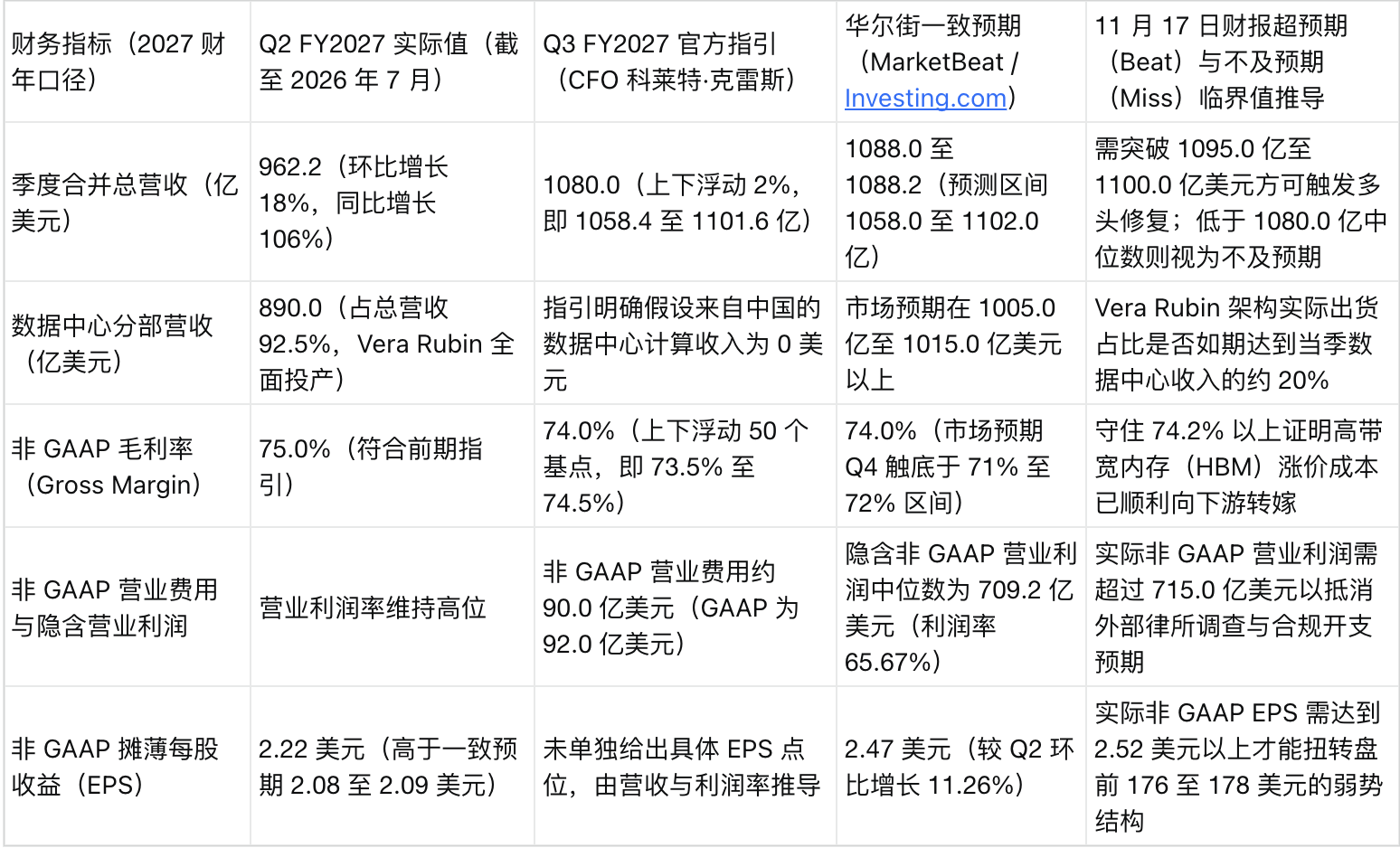
The data in the table above is compiled from the MarketBeat Q3 consensus expectations, the $108 billion earnings guidance breakdown, as well as previously published NVIDIA Q2 earnings review and Vera Rubin mass production and margin analysis.
Two hard conclusions directly serving trading decisions can be drawn from the arithmetic derivation in the table. First, in the $108 billion third-quarter revenue guidance NVIDIA officially provided at the end of August, the company had already explicitly assumed "data center computing chip revenue from the China market at $0." This means that even if the Megaspeed incident prompts the U.S. government to further block Southeast Asian subleasing channels, it will not directly cut compliant revenue within NVIDIA's official guidance baseline. As long as the four major North American cloud providers and sovereign AI customers maintain strong pull on the new Vera Rubin architecture (pushing actual Q3 revenue above the $108.82 billion consensus and above $110 billion), fundamental buying should be sufficient to recover the sentiment gap caused by the executive personal conduct controversy.
Second, with the current trailing P/E ratio having compressed to approximately 23.59x amid the stock price pullback (based on recent EPS of $7.91, a 52-week high of $243.37, and a 52-week low of $164.27), the $175.00 to $176.64 range constitutes the bulls' first technical defense line. Because key news from this round of executive investigation, the November 11 congressional attendance confirmation deadline, the November 17 after-hours Q3 report, and the November 18 congressional closed-door briefing often breaks outside regular U.S. stock trading hours (09:30 to 16:00 EST), cross-market investors can use the 24/7 derivative tools provided by MEXC to manage two-way exposure to NVIDIA contracts, flexibly executing risk hedges or dip-buying positioning during pre-market and after-hours headline shockwaves using zero-maker-fee limit orders.
MEXC Editorial Team Exclusive View
Stripping away the media curiosity surrounding Jensen Huang's private life, the real lesson this controversy holds for financial markets is this: when a company's market cap swells to $4.5 trillion, quarterly revenue approaches $108 billion, and it becomes the core chokepoint of great-power technological competition, its founder's private social radius itself already constitutes a systemic risk exposure for geopolitics and corporate governance.
The roughly 5% pre-market decline on November 9 (erasing approximately $200 billion in market cap) was not pricing an extramarital affair apology letter, but rather provisioning a discount for two potential tail risks that have not yet materialized: first, whether the November 18 closed-door hearing of the three major U.S. House committees will use the Megaspeed two-year, $4.8 billion chip procurement case to force the U.S. Department of Commerce to impose quota freezes and transaction-by-transaction licensing on all Southeast Asian and Middle Eastern computing cloud partners; second, whether the outside independent legal counsel hired by NVIDIA's board will discover any communication records during the review that violate internal compliance procedures for export controls.
However, portraying this incident as "the butterfly effect that pricks the AI industry bubble" completely deviates from industrial arithmetic. The underlying driver of the AI computing cycle is the rigid capital expenditure by global enterprises on large model training and inference infrastructure, as well as the generational energy efficiency leap of the Vera Rubin architecture compared to Blackwell. As long as NVIDIA's board confirms that the company's trade secrets and chip architecture security are intact, Jensen Huang remains firmly in the CEO seat, and the November 17 Q3 report proves that revenue can surpass the $108.82 billion consensus and defend the 74% gross margin baseline, the short-term governance discount will be digested by earnings growth, just as multiple tech giant executive controversies have been historically. Over the next ten days, the three time anchors most worth watching in priority order are: Jensen Huang's formal response to the congressional attendance request on November 11, the fiscal 2028 initial growth guidance after market close on November 17, and the bipartisan statements following the November 18 congressional closed-door briefing.
Frequently Asked Questions
What are the core facts of the Jensen Huang affair, and how did NVIDIA's board respond?
On November 8, 2026, NVIDIA co-founder and CEO Jensen Huang sent an internal email to all employees acknowledging infidelity to his wife of over 40 years, Lori, apologizing to his family and employees and accepting full responsibility (the letter did not name the specific woman involved). On the same





