


Why Did the 2026 US Midterm Elections Trigger a $2.9 Trillion US Stock Selloff? An Analysis of the Outlook for AI Stocks and Tesla


Overview
On November 3, 2026, the U.S. midterm elections saw the Democratic Party sweep control of both chambers of Congress and win key gubernatorial seats including Texas, prompting U.S. stocks—after a brief relief rally on November 4—to erupt on November 5 in the most violent single-day selloff since April 2025, wiping out approximately $2.9 trillion in market value across the entire market in a single day, with the Nasdaq Composite plunging 5.52% into correction territory, AI chip stocks tumbling an average of 12.97%, and Tesla and SpaceX collectively shedding approximately $424 billion over the two trading days following the election. However, AI stocks and Tesla will not enter an unbounded one-way collapse as a result: the federal-level national data center moratorium bill still requires presidential signature and is unlikely to clear the legislative threshold, while what truly constitutes a substantive constraint is the slowdown in environmental review and grid approvals at the local level in states like Texas. This means that compute leaders led by NVIDIA will face fundamental divergence during the earnings verification period on November 17, while Tesla, after falling to the $338.15 to $350.00 support band, will see its subsequent trajectory depend on the substantive actions of the January congressional hearings next year and the delivery performance of its autonomous driving and energy storage businesses.
Key Takeaways
The impact of the midterm elections on U.S. stocks exhibited a distinct two-stage structural divergence. On the first trading day after the election results were initially settled on November 4, the resolution of political uncertainty briefly drove the Dow Jones Industrial Average up 3.04% (1,575.38 points) to 53,362.57 points, with the S&P 500 rising 1.58% to 7,688.73 points; but just one day later, as the market assessed in depth the chain effects of the Democratic Party controlling both chambers of the 120th Congress and Texas Governor-elect Gina Hinojosa's pledge to suspend approvals for new data centers, the S&P 500 plunged 4.36% (334.89 points) on November 5 to close at 7,353.73 points, the Nasdaq Composite plummeted 5.52% (1,421.52 points) to close at 24,315.00 points, and the CBOE Volatility Index (VIX) surged 40% in a single day. In this selloff, the hardest hit were the AI compute chain heavily dependent on power infrastructure expansion and the Musk-affiliated companies deeply tied to Republican campaign funding: Goldman Sachs estimates that short-term construction moratoriums at the state and local levels could affect approximately 45% of planned new data center capacity across the United States, directly triggering a repricing of the fulfillment pace of the $895 billion in compute procurement commitments in Anthropic's IPO prospectus; meanwhile, Tesla's stock fell from $398.50 on November 3 before the election for two consecutive days to $343.69 (a cumulative decline of 13.75%). By contrast, ride-hailing leader Uber, whose profit model does not depend on heavy-asset data center land grabs, performed steadily on November 4 after delivering third-quarter gross bookings up 20% year-over-year to $59.8 billion and non-GAAP earnings per share up 35% to $0.88, confirming that post-election U.S. stocks are not in a broad bear market but rather undergoing a dramatic valuation reshuffle centered on regulatory exposure and capital expenditure returns.
Post-Election 48-Hour U.S. Stock Review: From Wednesday's Relief Rally to Thursday's $2.9 Trillion AI Selloff
Reviewing the market trajectory over the two trading days following Election Day (November 3), one can clearly see how Wall Street institutions rapidly shifted from trading the elimination of macroeconomic uncertainty to trading industry regulation and infrastructure bottlenecks.
On November 4 (Wednesday), the market initially followed the historical seasonal pattern of post-midterm election stock market gains. As vote counts quickly became clear without a weeks-long counting stalemate, the 10-year U.S. Treasury yield fell back to 4.12%, traditional industrials, financials and defensive sectors led the broader market, driving the Dow Jones Industrial Average to a two-month high. However, even amid Wednesday's broad market rally, Tesla and SpaceX—with highly concentrated political exposure—were already down more than 3.5% in pre-market trading, sending an early structural warning signal.
By November 5 (Thursday), the selloff spread across the entire technology and semiconductor sector. According to Associated Press closing statistics, the S&P 500 fell 4.36% that day to close at 7,353.73 points, the Dow Jones fell 3.44% (1,833.06 points) to close at 51,523.06 points, the Nasdaq Composite fell 5.52% to close at 24,315.00 points (more than 10% below its all-time closing high, officially entering technical correction territory), and the Russell 2000 small-cap index also fell 4.4% to 2,729.89 points. The combined market value of the Magnificent Seven tech giants shed more than $1 trillion on Thursday alone, while BlackRock's iShares Semiconductor ETF (SOXX) plunged more than 12% in a single day, marking its largest one-day decline since March 2020.
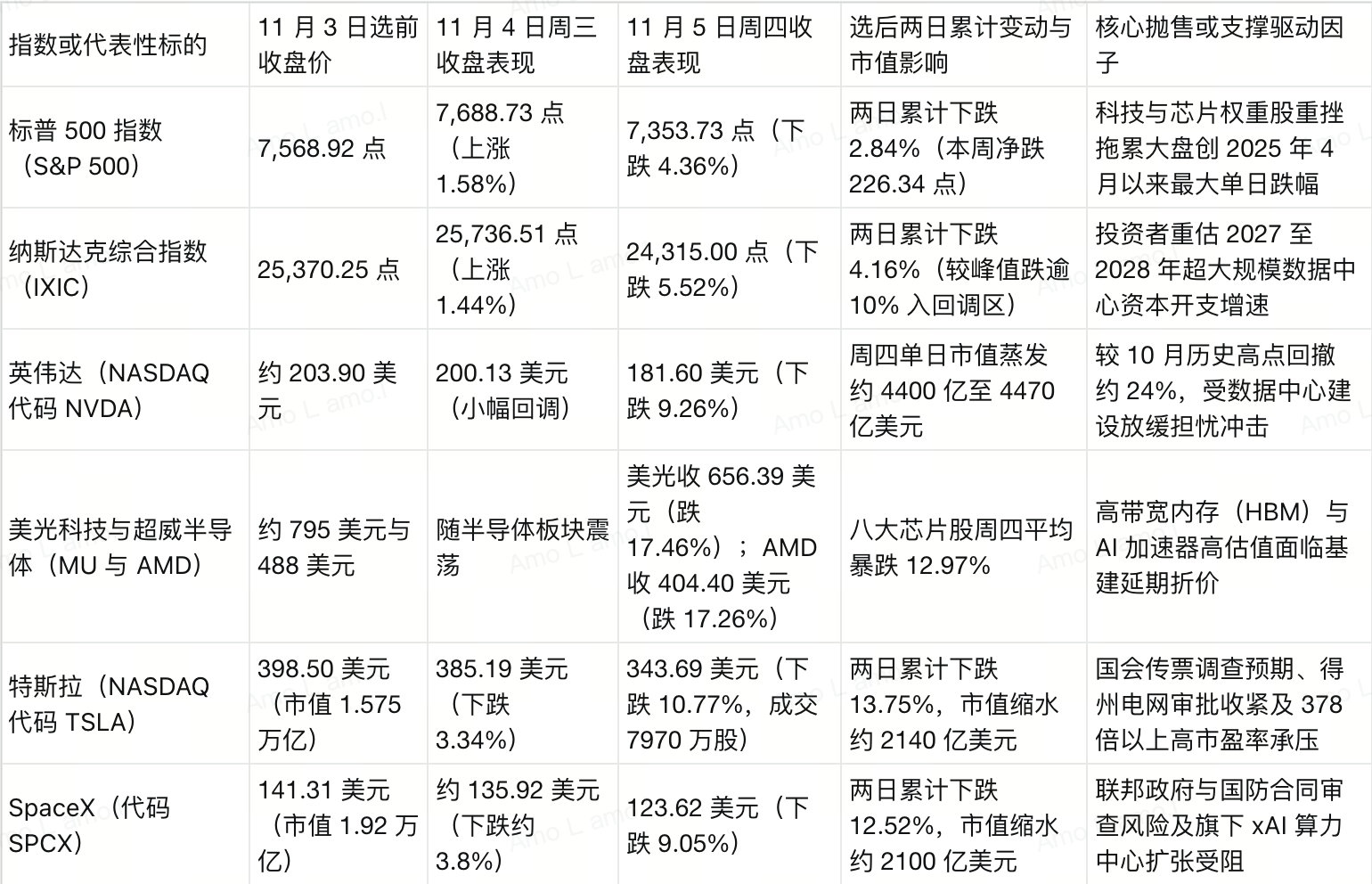
The table above summarizes verified data from StockTitan chip stock closing statistics and MLQ market cap loss statistics. In Thursday's chip stock selloff, memory and compute hardware were the hardest hit: SanDisk plunged 22.3%, Micron Technology fell 17.46% to $656.39, Advanced Micro Devices (AMD) fell 17.26% to $404.40, Western Digital fell 16.5%, Marvell Technology fell 16.43% to $133.55, Arm fell 13.08% to $166.72, Broadcom fell 10.43% to $291.53, Intel fell 10.33% to $52.25, Qualcomm fell 9.49% to $156.75, and TSMC's U.S.-listed shares fell 10.8%. On the downstream data center operations and power side, CoreWeave fell another 9.8% on Thursday after dropping 7% on Wednesday, Bitcoin miner and compute operator Cipher Mining—heavily dependent on the Texas grid—plunged 17%, and data center power equipment maker GE Vernova fell 7.5%.
Why Did the Democratic Victory Precisely Strike AI Compute Stocks? The Real Boundaries of Federal Legislation and State Moratoriums
The direct trigger for Thursday's $2.9 trillion AI selloff was the market's sudden realization that the election results had changed the land, water and power approval environment for U.S. data center expansion. According to exit poll data reported by Data Center Dynamics, as many as 56% of American voters said that rising residential electricity bills and water consumption caused by AI data centers were a key or major factor in their congressional voting decisions, and voters across multiple locations nationwide overwhelmingly supported restricting the disorderly expansion of data centers in local referenda.
When analyzing how policy risks transmit to listed company financials, investors must strictly distinguish between "the political posture of federal legislation" and "the actual implementation of state-level executive orders":
At the federal legislative level, Senator Bernie Sanders and Representative Alexandria Ocasio-Cortez previously introduced bills in the 119th Congress calling for a national moratorium on new AI data centers (the Senate version being S. 4214, submitted to the Senate Commerce, Science and Transportation Committee in March 2026; the House version being H.R. 9442, submitted to the House Energy and Commerce Committee and Foreign Affairs Committee in June 2026), and Senators Edward Markey and Ron Wyden also separately proposed draft frameworks for energy environmental assessment and the elimination of federal tax incentives. Although the Democratic Party's sweep of both chambers of the 120th Congress (convening in January 2027) means these proposals will receive formal hearing opportunities—and Senator Elizabeth Warren has already sent a letter to Anthropic CEO Dario Amodei questioning the risk disclosures in the prospectus—S. 4214 and H.R. 9442 will automatically expire at the end of the 119th Congress, and even if reintroduced next year and passed by both chambers, they cannot bypass President Donald Trump's veto power. By contrast, what truly has bipartisan consensus at the federal level is the "electricity cost allocation mechanism": the House previously passed the "Ratepayer Protection Act" (H.R. 9340) on September 16, 2026, by an overwhelming margin of 417 to 3, mandating that new large data centers with loads above 100 megawatts bear the costs of new generation and transmission upgrades themselves (for a complete breakdown of how the Democratic data center bills impact the valuation logic of AI unicorns, please refer to U.S. Stock Crash and Anthropic IPO Questions).
What truly makes Wall Street compute models uneasy are the state moratoriums that can take effect without presidential signature. According to Wells Fargo statistics, Texas alone accounts for 27% of the total planned new data center capacity nationwide. Democratic Governor-elect Gina Hinojosa—who pulled off an upset victory over incumbent Governor Greg Abbott in this midterm election and will take office on January 19, 2027—explicitly pledged during her campaign to immediately suspend approvals for new data centers upon taking office, until the Texas legislature passes legislation eliminating industry tax breaks, granting local communities veto power, and ensuring residents' electricity bills are not shifted onto them; newly elected Democratic governors in Georgia and Ohio have also issued similar calls for construction moratoriums, following the example of New York Governor Kathy Hochul's signing of a one-year statewide moratorium on hyperscale data center permits in July 2026. Goldman Sachs accordingly estimates that short-term moratorium measures at the state and local levels could affect approximately 45% of planned data center expansion projects nationwide.
This 45% slowdown in infrastructure approvals directly exposes the accounting time lag between upstream AI labs and chip suppliers. According to the Anthropic Prospectus Financial Breakdown, Anthropic disclosed in its S-1 filing for a Nasdaq listing submitted on October 26, 2026, that the company achieved recognized revenue of $16.3 billion in the first half of 2026 (a 14-fold year-over-year increase, including second-quarter revenue of $11.6 billion and operating profit of $974 million), but at the same time carries long-term compute and infrastructure procurement contract commitments of up to $895 billion. Customers' long-term capital expenditure commitments do not equal chipmakers' currently recognizable accounting revenue: once approval freezes in Texas, New York, Ohio and Georgia push data center energization timelines from 2027 to 2028, the delivery schedules for upstream GPUs and memory chips will be forced to stretch out—this is precisely the core micro logic behind Thursday's semiconductor index plunge of more than 12%.
Tesla and SpaceX Shed $424 Billion in Two Days: Breakdown of Four Negative Factors and Current Valuation
Beyond the broad tech selloff, Elon Musk's two listed companies Tesla (TSLA) and SpaceX (SPCX) suffered even more violent targeted selling. According to Gotrade Tesla trading data and closing records, Tesla's stock fell from $398.50 on November 3 to $343.69 on November 5 (down 3.34% on Wednesday, plunging 10.77% on heavy volume Thursday, with Thursday's single-day trading volume reaching 79.7 million shares, 2.15 times the 30-day average of 37.1 million shares), with market cap falling from approximately $1.575 trillion to $1.361 trillion over two days, a shrinkage of approximately $214 billion; SpaceX, which completed the largest IPO in history at $75 billion in June this year at an offering price of $135, saw its stock fall from $141.31 on November 3 to $123.62 on November 5 (a two-day decline of 12.52%, down 9.05% on Thursday alone), with market cap falling from approximately $1.92 trillion to $1.71 trillion, a shrinkage of approximately $210 billion. Calculated on a daily closing price basis, the two companies collectively evaporated approximately $424 billion in market value over the two trading days (on an intraday low basis, this once reached $450 billion to $456 billion).
The four negative factors driving Tesla's underperformance relative to the broader market can be quantified one by one:
The first negative factor is the congressional investigation and subpoena risk brought about by high-dollar political donations. According to statistics from The New York Times and Federal Election Commission records, Musk donated a cumulative approximately $474 million to political action committees supporting Republican candidates during the 2026 midterm election cycle (including $216 million to his America PAC plus an additional $77 million in the first half of October, $168 million to the Senate Leadership Fund, and $30 million to the House Leadership Fund, with nearly $224 million invested in Texas alone). With the Democratic Party retaking both chambers of Congress, Democratic Representative Robert Garcia—who is set to become Chairman of the House Oversight Committee—has publicly stated he will launch an investigation, and Senator Ted Cruz also confirmed on a podcast that Democrats have signaled they will use congressional subpoena power, focusing on conflicts of interest during Musk's previous tenure at the Department of Government Efficiency (DOGE), the billions of dollars in federal and defense contracts obtained by SpaceX, and safety regulatory data on Full Self-Driving (FSD).
The second negative factor is the direct constraint of Texas's data center moratorium on xAI's compute and Tesla's energy storage business. SpaceX acquired xAI, the artificial intelligence company founded by Musk, in February 2026 at a combined valuation of $1.25 trillion, and disclosed in its latest quarterly report for the period ended September 30, 2026, that it already possesses 1.7 gigawatts (GW) of nameplate compute capacity; meanwhile, SpaceX currently still owes Tesla $729 million, primarily for the purchase of Megapack giant energy storage batteries supporting data center grids. The data center approval moratorium and elimination of tax breaks pushed by Texas Governor-elect Hinojosa not only threaten SpaceX and xAI's supercomputing cluster expansion in Texas (even prompting Musk to joke on social media that space data centers look attractive), but also directly affect Tesla's energy storage division's order delivery expectations.
The third negative factor is rising regulatory resistance to the potential merger of Tesla and SpaceX. Tesla and SpaceX each disclosed in recent quarterly regulatory filings that they have established Special Committees to evaluate deeper cooperation including a potential business combination. In an environment where the Democratic Party controls Congress's various antitrust and regulatory committees, a transaction combining an electric vehicle manufacturer, a defense and space launch contractor, the Starlink satellite communications network, and xAI's large-model infrastructure into a single monolithic entity would face extremely stringent congressional hearings and antitrust review.
The fourth negative factor is the elevated valuation multiples and the backdrop of insider selling. According to Morningstar valuation statistics and GuruFocus insider trading records, although Tesla delivered solid results in the third quarter of 2026 (released October 21)—486,532 vehicle deliveries, $28.05 billion in revenue, automotive gross margin excluding regulatory credits recovering to 18.1%, and adjusted earnings per share of $





