


Why Did Apple Stock Fall Despite Q4 Earnings Beat? Breaking Down Gross Margin Guidance and Holiday Quarter Profit Concerns


Overview
The reason for the decline lies not in the reported quarter, but in the guidance for the December quarter, the core of which is that gross margin and expenses both turned unfavorable at the same time. Apple's gross margin guidance for the holiday quarter is 45% to 46%, while the just-reported fourth-quarter gross margin was 47.9%, of which about 1 percentage point came from a one-time benefit from tariff refunds, or about 46.9% excluding that. Calculated at the midpoint of guidance of 45.5%, that is a quarter-over-quarter decline of about 1.4 percentage points. Meanwhile, operating expense guidance is $20.4 billion to $20.8 billion, up 11% to 13% year over year, higher than the 7% to 10% revenue growth guidance, and under any combination of the two ranges, expense growth outpaces revenue.
The reported quarter itself beat expectations. Revenue of $114.48 billion was 0.97% above the $113.38 billion expectation, and earnings per share of $2.10 was 5.53% above the $1.99 expectation. But tariff refunds contributed $0.05 to earnings per share, or $2.05 excluding that, narrowing the beat to 3.02%, roughly half the headline figure.
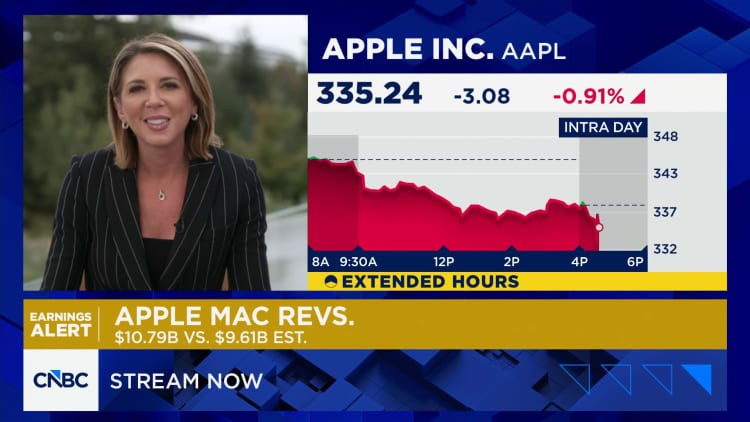
The stock closed the regular session on November 2 at $338.32, down 1.83%, then fell further to $328.85 after hours, a cumulative decline of 4.58% from the previous trading day's close of $344.63. The price reaction discussed in this article occurred during the after-hours session.
Key Takeaways
Fiscal 2026 fourth-quarter revenue was $114.48 billion, up 12% year over year, and diluted earnings per share were $2.10, up 14% year over year, both September-quarter records; full-year revenue of $479 billion was an all-time high. iPhone revenue was $57.6 billion, up 17% year over year, services revenue was $31.6 billion, up 10% year over year and a record high, Mac grew 24%, while iPad and wearables declined 10% and 8%, respectively. The company's gross margin was 47.9%, product gross margin was 37.2%, and services gross margin was 76%. Guidance for the December quarter is revenue growth of 7% to 10% year over year, services growth of 8% to 9%, gross margin of 45% to 46%, and operating expenses of $20.4 billion to $20.8 billion. This is the first earnings report since John Ternus took over as chief executive officer.
Actual Results vs. Expectations

Product revenue totaled $82.9 billion, up 12% year over year. Net income was $30.7 billion, a net margin of 26.8%; operating cash flow was $28.1 billion, and the company returned $28 billion to shareholders during the quarter. The board declared a quarterly dividend of $0.27 per share, payable on November 16 to shareholders of record on November 12.
Behind the 17% iPhone growth, Chief Operating Officer Sabih Khan said on the earnings call that the iPhone Duo is currently supply-constrained. Ternus called the product "the most transformative iPhone since the original." Supply constraints are a positive signal on the demand side, but they also mean the quarter's revenue did not fully reflect demand.
Excluding One-Time Gains, the Beat Halves
Tariff refunds had two effects on this quarter's results: they raised the company's gross margin by about 1 percentage point and contributed $0.05 to diluted earnings per share. This is a non-recurring item and should be excluded when assessing operating performance.
Excluding it, earnings per share were $2.05, still above the $1.99 consensus, but the beat narrowed from 5.53% to 3.02%; gross margin was about 46.9%, rather than the headline 47.9%. Revenue was not affected by the item, and the 0.97% beat was modest to begin with.
This difference becomes important when interpreting the December-quarter guidance. Using the headline 47.9% as the baseline, guidance of 45% to 46% implies a quarter-over-quarter decline of 1.9 to 2.9 percentage points; using the adjusted 46.9% as the baseline, the decline is 0.9 to 1.9 percentage points. The latter is the true magnitude of the change at the operating level, while the former overstates the deterioration. Either way, the direction is down.
The Real Problem Is the December-Quarter Guidance
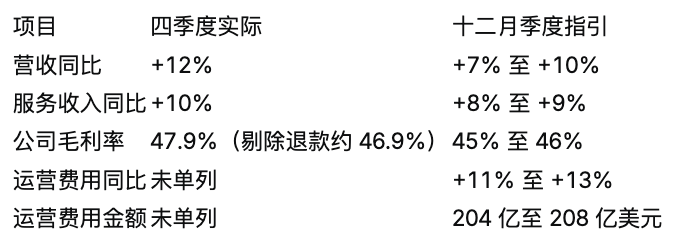
Based on the prior-year December quarter revenue of $143.8 billion, growth of 7% to 10% corresponds to $153.9 billion to $158.2 billion. Chief Financial Officer Kevan Parekh said on the call that this is expected to be the highest-revenue quarter in the company's history. That statement holds, but it describes scale rather than profitability.
Combining the three guidance items: the revenue range corresponds to a 45% to 46% gross margin, implying gross profit of $69.2 billion to $72.8 billion; after deducting operating expenses of $20.4 billion to $20.8 billion, implied operating income is $48.4 billion to $52.4 billion, corresponding to an operating margin of 31.5% to 33.1%.
More noteworthy is the relationship between expense and revenue growth. Revenue guidance is for growth of 7% to 10%, while expense guidance is for growth of 11% to 13%, and under any combination of the two ranges, expense growth is 1 to 6 percentage points faster than revenue. A decline in gross margin occurring alongside expense growth outpacing revenue constitutes a double squeeze on operating income, which is the part that cannot be detected by looking only at the phrase "record revenue."
The deceleration in services revenue is the third clue. Services actually grew 10% in the fourth quarter, and guidance for the December quarter is 8% to 9%. Services gross margin is 76%, far above the 37.2% for products, so a slowdown in services growth itself will drag down overall gross margin, in the same direction as the impact of memory costs.
Why Memory Costs Are More Lethal in the Holiday Quarter
The main reason for the gross margin decline is memory prices. Ternus said on the call: "The memory pricing situation we're seeing now is unprecedented." He said memory costs will rise in the December quarter, partially offset by price increases, carried-over inventory, and lower costs for non-memory components. Parekh further explained that, at the midpoint of guidance, most of the quarter-over-quarter gross margin decline comes from higher memory costs.
The reason memory costs have a greater impact in the holiday quarter is related to the revenue mix. iPhone accounted for 50.3% of total revenue in the fourth quarter, while in the prior-year December quarter, iPhone revenue was $85.27 billion, or 59.3% of that quarter's $143.8 billion in revenue. Memory costs are included in hardware bill of materials, so the higher the share of device revenue in a quarter, the more pronounced the erosion of overall gross margin from rising unit costs. The December quarter happens to be the quarter with the highest device weighting.
In terms of magnitude, based on the guided revenue range, 1 percentage point of gross margin equates to $1.54 billion to $1.58 billion. By comparison, the $0.05 per-share earnings contribution from this quarter's tariff refunds is much smaller. The market's reaction to guidance was stronger than its reaction to the results, and this magnitude comparison provides an explanation.
The second factor is Siri AI. Parekh explained that its cloud costs will be included in the cost of sales for the services business, while hardware revenue needs to be deferred over the device lifecycle, both of which will pressure gross margin. He stressed that this accounting treatment is not new: "consistent with how we've always treated Maps, Siri, and iCloud." This means the impact is structural and will persist, rather than being a one-time adjustment.
Metrics to Watch Next Quarter
The previous earnings preview focused on whether the company could deliver this quarter, but the criteria for judging the next report have changed, with the focus shifting from growth to three profitability metrics.
First, where actual gross margin falls within the 45% to 46% range, and whether management provides a timing judgment on when memory costs peak. Second, the actual year-over-year growth rate of operating expenses, and if it is below the low end of the 11% guidance, that would indicate room for adjustment on the expense side. Third, whether services revenue can hold the 8% to 9% guidance, as this segment operates at a 76% gross margin and has the greatest leverage on overall profitability.
When the supply constraints on the iPhone Duo will ease is the fourth point to watch. If supply tightness continues into the December quarter, it could limit achievement of the high end of revenue guidance; if it eases, then the focus should be on whether price increases can cover rising memory costs.
Trading Arrangements After Earnings
Apple's price reaction occurred during the U.S. after-hours session, when liquidity in regular stock trading is limited. AAPL perpetual contracts settled in USDT can be traded during that session, with leverage of 1x to 100x, each contract corresponding to 0.01 shares, a minimum order amount of 3.3404 USDT, and a maximum of 220,466.4 USDT for both market and limit orders per order. Volatility in the underlying asset increases significantly around earnings, and liquidation risk rises accordingly under high leverage. For contract quotes and complete trading rules, see the AAPL perpetual contract page.
James Mitchell's Exclusive View
This earnings report is a classic case of the rule that "results reflect the past, guidance reflects the future." Every number in the fourth quarter holds up: revenue and earnings per share both beat expectations, full-year revenue hit an all-time high, iPhone grew 17%, and services set a record. But what the stock price reacted to was the December quarter, and in the December-quarter guidance, two things deteriorated at the same time: gross margin declined and expense growth outpaced revenue growth. The market prices future profits, not past profits.
I believe what is truly underestimated is not memory costs themselves, but their persistence. Ternus used the word "unprecedented" to describe current memory pricing, and the hedges Apple can deploy, including price increases, carried-over inventory, and lower costs for non-memory components, all have clear limits: inventory will run out, there is limited room for price cuts on non-memory components, and price increases are constrained by competition. This means that if memory prices remain at current levels, the impact will extend from the December quarter into subsequent quarters, rather than being a hurdle that can be stepped over. This is also why whether management provides a timing judgment on memory costs is more important than where gross margin falls within the range.
The accounting treatment of Siri AI is another variable worth tracking continuously. Cloud costs are included in services cost of sales, and hardware revenue is deferred over the lifecycle, and neither is one-time. The services business operates at a 76% gross margin and is the pillar of Apple's overall profitability, and the新增 cloud costs directly affect that pillar. The scale of the impact has not yet been disclosed, and this is one of the most important numbers to look for in the next earnings report. Viewed together with memory costs, Apple is facing a reset of its gross margin structure, not a single-quarter fluctuation.
Frequently Asked Questions
Did Apple's fourth-quarter results actually beat expectations?
Yes. Revenue of $114.48 billion was 0.97% above the $113.38 billion expectation, and earnings per share of $2.10 was 5.53% above the $1.99 expectation. However, $0.05 of that came from the one-time tariff refund item, and excluding it, earnings per share were $2.05, narrowing the beat to 3.02%.
Why would the stock fall even though results beat expectations?
The market was pricing the December-quarter guidance. Gross margin guidance of 45% to 46% is below this quarter's roughly 46.9% after excluding one-time gains; operating expense guidance of 11% to 13% year-over-year growth is above the 7% to 10% revenue growth guidance, and the two together constitute a double squeeze on operating income.
How much did the stock fall?
It closed the regular session on November 2 at $338.32, down 1.83%, then fell further to $328.85 after hours, a cumulative decline of 4.58% from the previous trading day's close of $344.63. The main decline occurred during the after-hours session, that is, during and after the earnings call.
What is the main reason for the gross margin decline?
Rising memory costs. Chief Executive Officer John Ternus called the current memory pricing situation "unprecedented," and Chief Financial Officer Kevan Parekh said that, at the midpoint of guidance, most of the quarter-over-quarter gross margin decline comes from memory costs. A secondary factor is the cloud costs and hardware revenue deferral associated with Siri AI.
Why do memory costs have a greater impact in the holiday quarter?
Memory costs are included in hardware bill of materials, so the higher the share of device revenue in a quarter, the more pronounced the impact. iPhone accounted for 50.3% of total revenue in the fourth quarter, while in the prior-year December quarter iPhone accounted for 59.3%, the quarter with the highest device weighting.
How big was the impact of tariff refunds on the results?
They raised the company's gross margin by





