


Google Plunges 12.64% While Eli Lilly Hits Record High: The Market Begins to Run the Numbers on AI's Cash Flow


- Core View: AI demand shows no sign of cooling, but the market's pricing logic has shifted from "growth stories" to "cash returns." Giants whose capital expenditures continue to expand while free cash flow turns negative have faced valuation repricing, while sectors with clear profitability paths—healthcare, financials, and energy—have attracted capital favor.
- Key Elements:
- Google's Q3 revenue was $127.577 billion, up 25% year-over-year, with cloud revenue up 103%, but capital expenditures were $51.355 billion, up 114% year-over-year, free cash flow showed a net outflow of $9.065 billion, and the stock fell 12.64% in a single day, wiping out approximately $500 billion in market value.
- Amazon's AWS revenue grew 39.3% but slightly missed some expectations, free cash flow showed a net outflow of $42.4 billion over the past 12 months, and the company maintained its 2026 capital expenditure plan of $220 billion.
- The four giants' combined capital expenditures this year exceed $720 billion, roughly three times the level two years ago, with three of them seeing negative free cash flow; Meta posted its first negative quarterly free cash flow since going public.
- Eli Lilly's Q3 revenue was $24.397 billion, up 39% year-over-year, with Mounjaro and Zepbound together contributing about 66% of revenue, free cash flow showed a net inflow of $8.219 billion, the company raised its full-year guidance for the third time this year, and the stock rose 6.57% to a record high.
- Fund flow evidence: hedge funds increased healthcare sector holdings by $1.69 billion over two weeks while reducing semiconductor positions, and U.S. equity healthcare-themed funds saw net inflows of $4.72 billion over two weeks.
- Key upcoming catalysts: Nvidia's earnings report in mid-November will test computing demand, the next round of cloud giants' capital expenditure guidance will verify the return inflection point, and the Fed's December 9 policy meeting will affect valuations of distant cash flows.
1. Google Plunges 12.64%: The Faster AI Grows, the More the Market Worries About What?
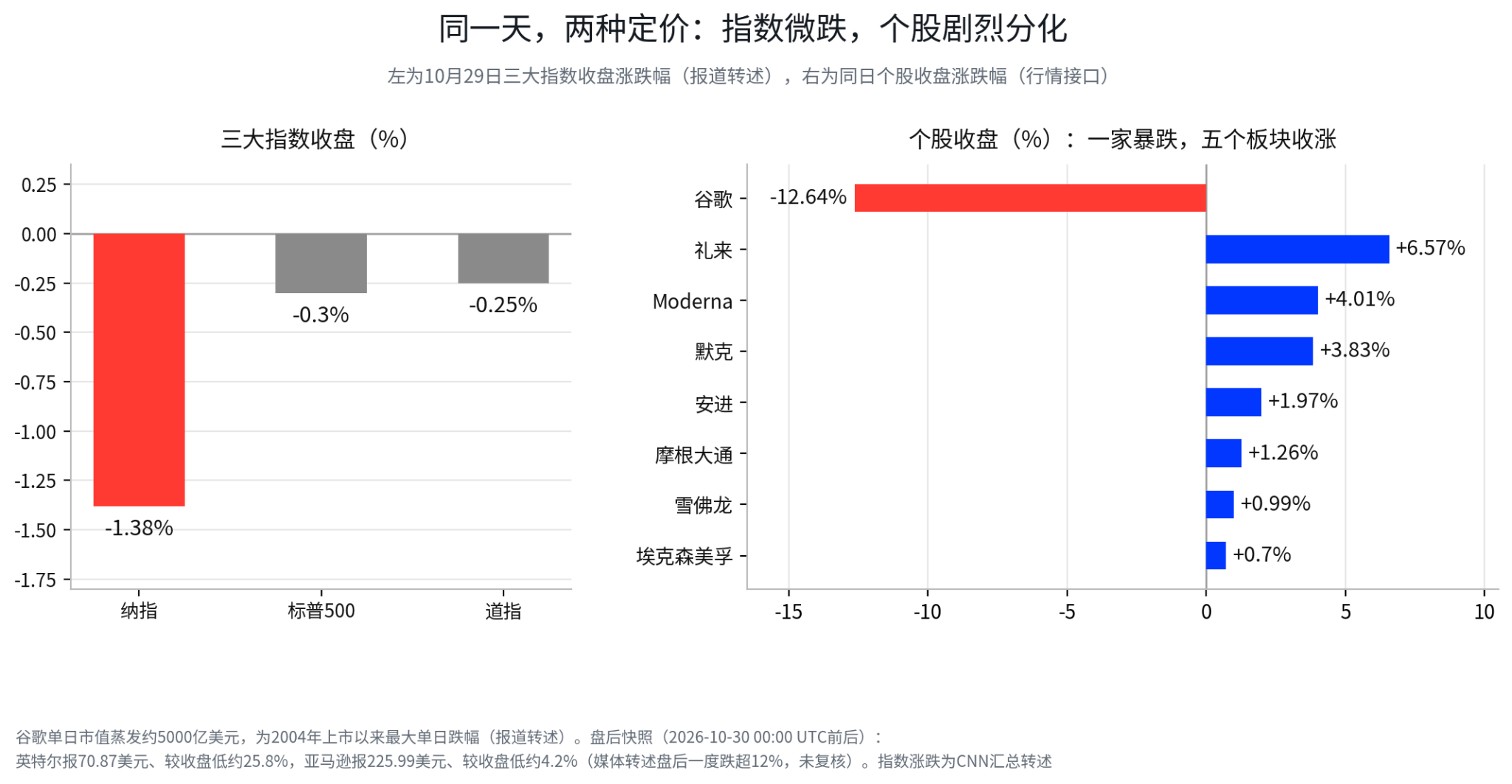
After the U.S. stock market closed on October 29, a clear divergence emerged between individual stocks and sectors. Google closed down 12.64%, shedding approximately $500 billion in market value in a single day—the largest one-day decline since its 2004 IPO (per media reports). Intel and Amazon subsequently released their earnings, and their after-hours share prices also fell significantly. In contrast to the weakness in tech stocks, Eli Lilly rose 6.57% to a record high, while the healthcare, financials, and energy sectors also posted broad gains. That day, the Nasdaq fell 1.38%, the S&P 500 dropped 0.30%, and the Dow declined 0.25% (per CNN summary), suggesting no widespread panic at the index level. What truly changed was the market's judgment about the earnings quality of different companies. Against the backdrop of ever-expanding AI investment, the market is increasingly focused on when these expenditures will translate into cash returns—a shift that played out across all market activity that day.
Google's revenue was actually not bad. Third-quarter revenue reached $127.577 billion, up 25% year-over-year, marking the 13th consecutive quarter of double-digit growth. Google Cloud revenue came in at $30.709 billion, up 103% year-over-year, significantly beating market expectations. This shows that enterprise demand for cloud computing and AI infrastructure remains robust, and the demand side of the AI supply chain has not shown any notable cooling. What truly disappointed the market was the slowing growth of the advertising business and the cash flow pressure from continuously expanding capital expenditures.
The problem with the advertising business is that users are searching more frequently, but monetization has not kept pace. Third-quarter search and other advertising revenue was $63.35 billion, up 12% year-over-year, below market expectations of nearly $65 billion, with growth decelerating sharply from 17% in the previous quarter. Google also disclosed that search volume year-over-year growth has reached its highest level in nearly five years—users have not reduced their searches, yet the growth in search volume has not translated into a proportional increase in advertising revenue. According to reports from The Economist and other media, advertising monetization efficiency for some AI-mode queries is lower than that of traditional search results pages. As users gradually become accustomed to getting answers directly through AI, Google needs to address not just how to get more people to use AI, but also how to maintain the commercial value of its advertising business under new interaction paradigms.
Compared to the slowdown in advertising growth, the cash flow pressure from capital expenditures is the core issue behind this decline. Google's third-quarter capital expenditures reached $51.355 billion, up approximately 114% year-over-year, exceeding operating cash flow of $42.290 billion for the quarter. Free cash flow thus turned negative at $9.065 billion, while the market had previously expected a slight net inflow of approximately $2.7 billion. More notably, this is no longer a one-off fluctuation. Google's second-quarter free cash flow was negative $5.855 billion, compared to a net inflow of $24.461 billion in the same period last year—the cash flow gap is widening. Management also stated that capital expenditures in 2027 will continue to exceed 2026 levels, without providing a clear timeline for peak investment or when spending will top out.

Increased capital expenditures are not inherently a bad thing. For cloud computing and AI infrastructure companies, building data centers ahead of schedule, purchasing servers, and expanding network capacity are important means of competing for long-term market share. The key is whether the additional investment can generate sufficient revenue and profit. If the cloud business continues to grow rapidly and profit margins improve with scale, then the current cash flow pressure may simply be a temporary phenomenon during an expansion cycle. But if capital expenditures consistently outpace operating cash flow and cloud revenue growth cannot translate into corresponding cash returns, investors will have to reassess the company's future free cash flow and return on capital. The valuation repricing Google experienced this time is actually about the payback period for AI investment, not about AI capabilities themselves.
2. Intel and Amazon: Both Fell After Hours, but the Underlying Issues Are Different
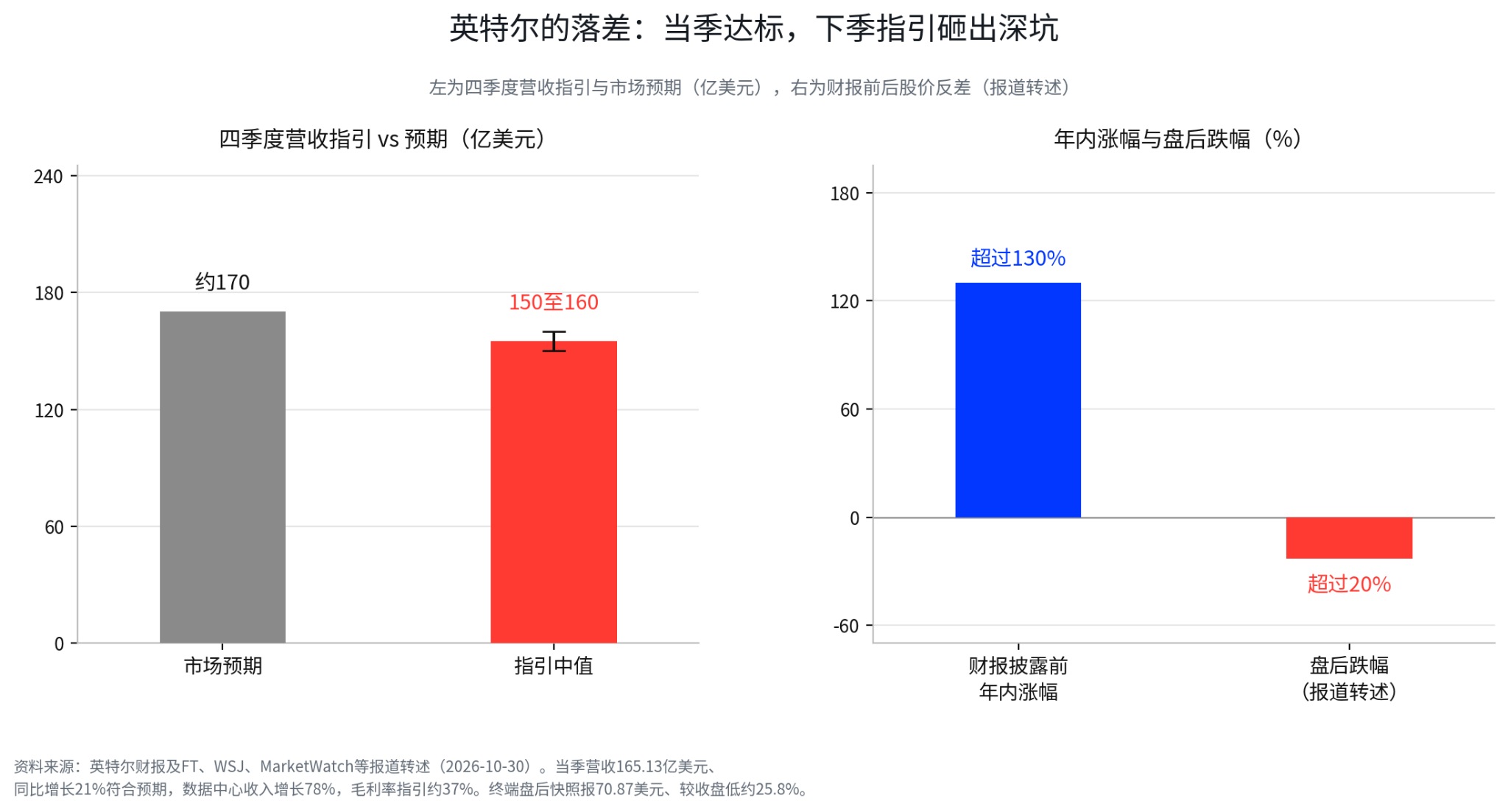
Both Intel and Amazon were weak after hours, but the pressures need to be viewed separately. Intel fell more than 20% at one point after hours, but its quarterly results were actually not bad: third-quarter revenue was $16.513 billion, up 21% year-over-year, with data center revenue up 78%, indicating that demand for AI inference server chips is materializing. What really pressured the stock was fourth-quarter guidance: revenue of $15 billion to $16 billion, below Wall Street expectations of approximately $17 billion, with gross margin guidance cut to 37%. Management's explanations included weak PC demand potentially continuing into the first half of 2027, rising memory chip prices driving up costs, and an accident at its Israeli factory expected to impact fourth-quarter revenue by approximately $300 million.
More critically, expectations were too high. Before earnings, Intel had already risen over 130% year-to-date; meeting expectations for the quarter was not enough—any guidance below expectations could easily trigger profit-taking. After-hours shares fell more than 20% at one point, with a terminal snapshot at $70.87, approximately 25.8% below the closing price. So this decline is more of a guidance shock combined with valuation adjustment under high expectations, and cannot simply be attributed to AI capital expenditure repricing. However, it also shows that the market's tolerance for AI supply chain assets is declining: AI concepts or long-term demand alone can no longer command a valuation premium—companies need to deliver on actual results and earnings guidance.
Amazon fell more than 7% at one point after hours. Amazon faces the same capital return problem as Google, with pressure concentrated on three things: revenue, cash flow, and capital expenditures. Third-quarter total revenue was $201.9 billion, slightly below market expectations. AWS revenue was $46 billion, up 39.3% year-over-year, higher than the previous quarter's 37%, but still short of the 40%+ that some institutions had hoped for; holiday season sales guidance was also weak, raising concerns about short-term revenue growth. More important than revenue is cash flow. Operating cash flow over the past 12 months was $168.3 billion, up 29% year-over-year, but free cash flow was negative $42.4 billion. The gap between the two comes almost entirely from capital expenditures on data centers and other investments consuming operating cash.
Amazon has not pulled back on investment, maintaining its 2026 capital expenditure plan of $220 billion, with CEO Jassy stating that spending will increase significantly in 2027. For investors, AWS still has strong growth momentum, but achieving returns will require continued substantial investment going forward. Revenue missing expectations, weak holiday guidance, deeply negative free cash flow, and expectations of further capital expenditure expansion collectively constitute the main pressure after earnings. After-hours shares fell more than 7% at one point, with media reports citing declines of over 12%, and a terminal snapshot at $225.99, approximately 4.2% below the closing price.
Looking at Google and Amazon together, what the market is worried about has changed. AI demand is not the problem—the issue is that infrastructure construction may be entering a phase where investment scale keeps growing while the payback period remains unclear. According to statistics from The New York Times and other media, combined capital expenditures by Google, Amazon, Microsoft, and Meta this year will exceed $720 billion, roughly three times the level two years ago; three of the four companies have already seen free cash flow turn negative, and Meta also recorded its first negative quarterly free cash flow since going public. As upstream suppliers and cloud service providers continue to expand investment, the market will naturally ask: with such massive capital expenditures, how much return can ultimately be created for shareholders?
3. Eli Lilly Hits Record High: The Market Begins to Reprice Cash Flow Certainty
While tech giants were busy explaining capital expenditures and investment returns, Eli Lilly delivered a completely different earnings report. Third-quarter revenue was $24.397 billion, up 39% year-over-year, above market expectations of approximately $22.6 billion. Adjusted earnings per share came in at $7.48, also beating market expectations of $6.49. Core growth still came from GLP-1 drugs: Mounjaro global revenue reached $10.72 billion, up 65% year-over-year, and Zepbound revenue was $5.35 billion, up 49% year-over-year, with the two products together contributing approximately 66% of quarterly revenue. As sales continued to exceed expectations, the company raised its full-year revenue guidance from the previous $85 billion to $87 billion range to $91 billion to $92 billion—the third upward revision this year (per company earnings and media reports).
The difference between Eli Lilly and Google is not in growth rate but in how growth is realized. Google needs to first invest tens of billions of dollars to build data centers and purchase equipment, then gradually recoup costs through cloud services and AI products. Eli Lilly's core revenue comes directly from drug sales and prescription demand that have already occurred. The company's third-quarter free cash flow was a net inflow of $8.219 billion, with volume growth of 53%; despite factors such as insurance coverage access causing net prices to decline by approximately 15%, volume growth was still sufficient to drive overall revenue growth of 39%. At a stage when the market is beginning to re-examine corporate return on capital, a business model like Eli Lilly's that can directly convert product demand into revenue and cash flow naturally attracts more capital attention.
Of course, strong cash flow performance does not mean Eli Lilly is free of valuation risk. Its trailing P/E ratio was previously estimated at approximately 45x—not cheap—and insurance coverage access could continue to pressure net prices, while competition in the weight-loss drug market could affect future market share. For investors looking to track Eli Lilly, the key things to watch going forward are whether prescription volume and sales growth can continue, whether net price declines begin to outpace volume growth, and whether revenue guidance and free cash flow continue to corroborate each other. Especially after the stock has already hit a record high, investors should not chase short-term gains solely based on capital inflows into the healthcare sector—they still need to wait for volume-price data and earnings expectations to provide further support.
4. Capital Has Not Left U.S. Stocks—It Is Rechoosing Where to Source Earnings
Google falling and Eli Lilly rising is not just about two stocks—similar shifts were visible at the sector level that day. The healthcare sector stood out, with Moderna up 4.01%, Merck up 3.83%, and Amgen up 1.97%. Most financial stocks closed higher, with JPMorgan up 1.26%. Energy stocks also edged up, with ExxonMobil up 0.70% and Chevron up 0.99% (per market data). Brent crude and WTI held near $114 and $102, respectively (per media reports), but energy stocks did not see gains commensurate with oil prices, suggesting that what capital was looking for that day was not just geopolitical premium but also the operating cash flow that energy companies can already deliver.
Healthcare, financials, and energy make money in different ways, but they share one thing in common: it is relatively easy to see where revenue and cash flow come from. Pharma relies on drug sales and prescription demand, banks on interest spreads, trading, and credit, and energy on oil prices, production, and cost control. They each have their own risks—banks fear deteriorating credit quality, energy fears falling oil prices, and pharma fears drug pricing and competitive pressure. But compared to tech companies still massively expanding AI infrastructure, the earnings realization path for these businesses is easier to estimate. At a stage when investors are refocusing on current cash flow, this "clarity" itself attracts capital.
Institutional fund flow data provides corroborating evidence. Goldman Sachs positioning tracking shows that over the past two weeks, hedge funds collectively increased healthcare sector holdings by $1.69 billion while reducing semiconductor positions. EPFR data shows that U.S. healthcare-themed funds saw net inflows of $4.72 billion over the past two weeks, with the pace of inflows at a relatively high level this year. However, two weeks of inflows are not enough to prove the market has shifted long-term from tech to healthcare. A more reasonable interpretation is that institutions are increasing allocations to sectors with relatively visible earnings, such as healthcare. Going forward, the key questions are whether healthcare funds can continue to attract capital and whether semiconductor reductions will further expand. Baird strategists share a similar view: fluctuations in the AI narrative do not mean the market's overall growth logic has been broken—capital may spread from a handful of giants whose valuations are supported by high capital expenditures to assets with more diversified earnings sources.
Therefore, the current market should not be simply understood as "AI vs. non-AI" capital confrontation. AI demand remains robust—Google Cloud revenue growth of 103% and Amazon AWS growth of 39.3% both show that enterprise demand for cloud computing and AI compute has not disappeared. What has changed is that the market is beginning to distinguish between "the industry has demand" and "companies can make money." Compute suppliers can generate revenue from orders and product sales, but that does not mean all cloud service providers can recoup data center construction costs in the short term. Going forward, those most likely to sustain valuation premiums are companies that can prove their investments ultimately translate into profit and free cash flow—not necessarily those with the largest AI investment scale.
5. Three Upcoming Milestones Will Determine How the Market Continues to Screen AI Assets
For investors, more valuable than guessing when Google will rebound is tracking three upcoming milestones that can validate market judgments. The first is Nvidia's earnings in mid-November, which will directly test whether AI compute demand remains strong. Data center revenue, orders and deliveries, and whether gross margins can remain stable are all metrics to watch. If revenue and orders continue to beat expectations, it would indicate that AI infrastructure demand remains supported, and earnings expectations for the compute supply chain would not be easily revised downward. But if order growth slows markedly, or gross margins are affected by product mix and competitive pressure, the market may further lower its expectations for AI hardware growth. Nvidia beating expectations does not mean the cloud giants' investment return problem is automatically resolved—compute suppliers making money and cloud service providers recouping capital expenditures remain two distinct financial issues.
The second milestone is the next round of capital expenditure guidance from cloud giants, which may be more important than revenue growth alone. For Google, Amazon, Microsoft, and Meta, investors need to observe capital expenditures, cloud revenue, operating margins, and free cash flow together. If cloud revenue continues to grow, capital expenditure growth gradually slows, and operating cash flow begins to better cover investment spending, it would suggest that AI infrastructure construction may be moving from an investment phase to a return phase, and tech stocks could regain valuation support. Conversely, if companies continue to raise capital expenditure plans while cloud growth does not improve in tandem and the free cash flow gap further widens, then even if share prices rebound, it cannot be concluded that valuation pressure has been resolved.
The third milestone is the Federal Reserve's policy meeting on December 9, which will affect the relative valuation of cash flows across different time horizons. When interest rates remain elevated, profits that can only be realized years from now are worth relatively less when discounted to present value, making high-valuation growth stocks that depend on distant returns more vulnerable to pressure, while companies with relatively stable earnings and dividends may gain a relative advantage. At that time, it will be necessary to consider the rate decision, dot plot, Powell's remarks, and changes in U.S. Treasury yields to judge whether the cost of capital will rise further. However, rate cuts are not necessarily bullish for tech stocks either—if cuts are triggered by a rapid economic slowdown, corporate revenue and earnings expectations may be revised downward simultaneously, and valuation improvements may not offset fundamental deterioration.
6. What Directions and Indicators Is the Market Watching?
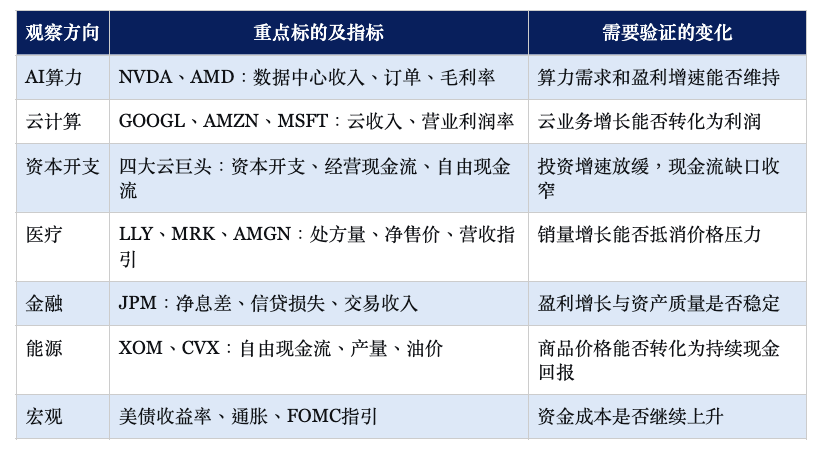
From a directional perspective, the observation scope can currently be divided into three groups. The first group is AI infrastructure and cloud computing leaders, where the focus is not simply on the magnitude of stock price pullbacks but on separately validating compute demand and capital returns. For Nvidia and AMD, the main things to watch are orders, data center revenue, and gross margins; for cloud giants, the focus should be on cloud revenue growth, profit margins, capital expenditures, and free cash flow. The second group is healthcare assets, with key metrics including GLP-1 product prescription volume, net prices, and full-year guidance; for other pharmaceutical companies, earnings sustainability should be judged in conjunction with their respective product pipelines and sales performance. The third group is financial and energy assets: for JPMorgan (JPM), track net interest margin, credit losses, and trading revenue; for traditional energy, focus on oil prices, production, capital discipline, and free cash flow.
These directions are not suitable for simple categorization as a single type of defensive allocation. Eli Lilly still carries valuation and competition risks, banks must contend with credit cycles, and energy companies are affected by oil price volatility. A more reasonable approach is to build watchlists based on each company's earnings drivers and, in conjunction with earnings reports and fund flow changes, determine whether it is worth increasing allocation weights.
Overall, the core change in this market cycle is that investors are raising their requirements for AI commercial returns—capital has not abandoned AI. As long as compute demand continues to grow, the long-term investment opportunities in the AI industry will not disappear because of one or two earnings reports. But for companies with continuously expanding capital expenditures and unimproved cash flow, the





