


Solana 2026: Ecosystem and Market Strategy Research


As of October 24, 2026, Solana leads all public chains in both on-chain transaction volume and application revenue, and is also in a leading position in the x402 AI agent payments space.
On almost every other metric, Solana also ranks in the top three, including RWA value and holder count, stablecoin supply, and total value locked (TVL).
Tokenized stock holders on Solana have reached 1.57 million, up 56.5% over the past month. Stablecoin supply peaked at $17.4 billion in late September, nearly 5x what it was two years ago; RWA value also hit a new high of $4.6 billion.
This report was written by Y Strategy, a market firm focused on where the crypto market is headed. We examine Solana as a go-to-market system: where demand comes from, how products reach users, which metrics Solana has taught the market to watch, and why builders keep choosing to launch here.
The core question we focus on is: how do these elements reinforce one another, and what parts of Solana's approach can other ecosystems realistically learn from. Throughout this report, we distinguish between its existing activity and our interpretation of the strategy behind it.
On Solana, a transaction costs far less than 1 cent, and confirmation takes far less than 1 second. This combination has made Solana the main venue for on-chain trading, with assets traded ranging from meme coins and stablecoins to, increasingly, tokenized stocks. On October 24, Solana processed about 145 million non-vote transactions; the chain carries about $15.8 billion in stablecoins, along with some of the most well-known applications in crypto, including Phantom, Jupiter, Pump, and Raydium.
Data sources: DefiLlama, RWA.xyz, Artemis, Solscan, and Blockworks, as of October 24, 2026.
Key Moments of the Past Few Years
- 2019 — Solana completed a $20 million funding round led by Multicoin Capital.
- 2020 — Mainnet beta launched. $SOL was priced at $0.22 in the CoinList public auction, and traded below $1 for months after the TGE.
- 2021 — Solana Labs completed a roughly $314 million funding round led by a16z and Polychain Capital. $SOL reached $259.
- 2022 — The Wormhole bridge was exploited, losing $320 million. FTX and Alameda collapsed and entered bankruptcy proceedings, and their large SOL holdings dragged the price down to about $10.
- 2023 — A year of rebuilding. Solana continued funding builders through the bear market and shipped core upgrades.
- 2024 — Pump launched, and the meme coin era began. Solana started to become the public chain with the highest on-chain trading volume.
- January 2025 — The $TRUMP meme coin launched on Solana. SOL hit an all-time high of $293.
- October 2025 — $BSOL listed, becoming the first U.S. spot Solana ETF.
- 2026 — In March, the U.S. Securities and Exchange Commission (SEC) and Commodity Futures Trading Commission (CFTC) jointly classified SOL as a digital commodity. BlackRock filed to issue tokenized fund shares on Solana, Western Union launched a dollar token on-chain, and wrapped XRP went live.
Already familiar with Solana? Skip straight to Part 2.
Part 1: Where Solana Stands Today
In the 30 days ending October 24, 2026, Solana's decentralized exchanges (DEXs) averaged about $2.2 billion in daily trading volume, and users paid about $14.4 million per day in fees to use Solana and its applications, of which network fees accounted for only about 6% (DefiLlama).
Solana Leads All Public Chains in Application Revenue
In application revenue — the share of fees received by apps — Solana leads all public chains. Over the past 30 days, its application revenue was about $158 million: 2.1x Hyperliquid, 2.9x Ethereum, 6.1x BNB Chain, and 7.5x Robinhood Chain (DefiLlama, 30 days ending October 24, 2026). Transaction fees on Solana are low, so more of the value accrues at the application layer.
Architecture: How Solana Works Today
Solana processes about 167 million non-vote transactions per day, equivalent to about 1,930 per second (Solscan, 30 days ending October 24, 2026). This throughput, combined with a base fee fixed by the protocol, keeps transaction costs low.
Recent upgrades:
- Faster block times — cut from 0.4 seconds to 0.25 seconds, then to 0.2 seconds; 200-millisecond block times went live on mainnet on October 9, 2026.
- Larger transaction capacity — the amount of data a single transaction can carry expanded to 3.3x the previous limit (September 2026).
- Firedancer — a new validator client developed by Jump (May 2026).
All of these upgrades serve the markets Solana wants to host. Whether it's AI agents paying amounts far below 1 cent, or tokenized assets that need millisecond settlement, both require a blockchain capable of functioning as financial infrastructure — which is exactly Solana's goal.
Who Backs Solana
Solana has raised more than $330 million across disclosed funding rounds, with investors including a16z, Polychain, and Multicoin; this includes a $1.7 million public token sale on CoinList in March 2020.
Its institutional backers are no longer limited to venture capital firms. Spot SOL ETFs now trade in the U.S., including BSOL, GSOL, FSOL, VSOL, and TSOL; DAT companies such as Forward Industries and Upexi also hold SOL on their balance sheets.
Part 2: Where Activity Is Concentrated
Solana's 2026 Ecosystem Map
Trading is the core of the Solana ecosystem, but the ecosystem spans far more than trading. The main categories include:
- Token launchpads — Pump, StonkFun
- Decentralized exchanges (DEXs) — Raydium, Meteora, PumpSwap, Orca
- Aggregators and trading terminals — Jupiter, Axiom
- Perpetuals — Phoenix, Jupiter Perps, GMTrade, Pacifica
- Lending — Kamino, Jupiter Lend
- Wallets — Phantom, Solflare, and wallets built directly into apps
- Real-world assets (RWA) and tokenized stocks — xStocks, Backpack Securities, Ondo, PreStocks
- Stablecoins / payments / digital banking — USDC, USDT, PYUSD, Solana Pay, KAST, Avici
- Others — collectibles (Collector Crypt), DePIN (Helium), staking (Jito, Sanctum)
The most popular project category is trading infrastructure, including launchpads, exchanges, and trading terminals. Ranked by revenue, the top five applications are Pump, Collector Crypt, Axiom, StonkFun, and fomo. Four of them are token trading apps, while Collector Crypt is a tokenized trading card (TCG) marketplace (DefiLlama, 30 days ending October 24, 2026).
The diversity of what's traded goes beyond the impression of Solana as a meme coin chain. In Q3 2026, SOL-stablecoin pairs accounted for the largest share of DEX trading volume at about 40%; meme coins made up about 30%; the rest was split among stablecoin swaps, external tokens, project tokens, and tokenized assets. Tokenized assets remain small in scale, but their trading volume has hit new highs for seven consecutive quarters, reaching $8.1 billion in Q3; September alone reached $4.9 billion, roughly triple August and the highest-volume month to date (Blockworks).
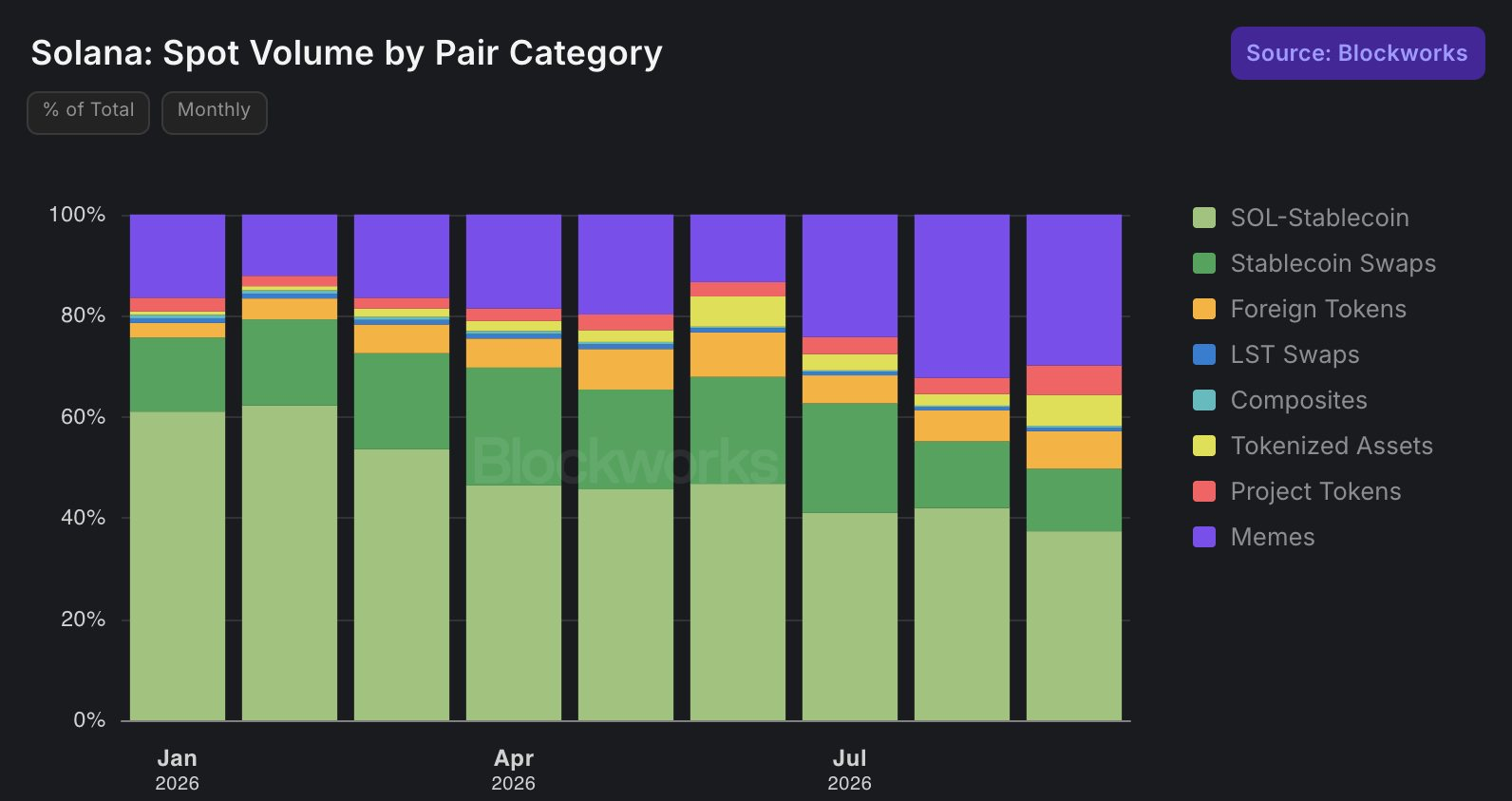
Share of Solana spot trading volume by pair type, January–September 2026
Solana's Heavyweight Applications
All data in this section comes from DefiLlama for the 30 days ending October 24, 2026.
1. Pump — one-click token launches via bonding curves: no code, no liquidity setup, and a market for the token the moment it's created. Tokens that gain enough attention "graduate" from the launch phase into Pump's own exchange.
By revenue, Pump is the top application on Solana: over the past 30 days, pump.fun and PumpSwap together generated about $62 million in revenue, nearly 40% of all application revenue on the chain. Across all blockchains, it is also the third-highest-revenue application, behind only stablecoin issuers Tether and Circle.
2. Phantom — the most widely used Solana wallet, with an onboarding flow that lets people outside crypto actually get started. Swaps, staking, perpetuals, prediction markets, and buy buttons are all built in. It takes a small fee on in-wallet swaps and has not issued a token.
Phantom generates more revenue than any other wallet on any blockchain: $7.1 million over the past 30 days, roughly double MetaMask's $3.6 million.
3. Jupiter — the default trading entry point on Solana, routing orders across Solana exchanges to get the best price; it now also offers perpetuals, lending, and liquid staking.
Over the past 30 days, Jupiter routed about 47% of Solana aggregator volume and about 19% of all-chain aggregator volume ($13.1 billion). That makes it the largest aggregator in the world, and it runs only on Solana.
4. Raydium — after tokens "graduate" from launchpads, they enter real liquidity pools on this exchange. Its LaunchLab product also powers other launchpads, including StonkFun.
Over the past 30 days, Raydium processed $6.5 billion in trading volume and retained $3.7 million in revenue, since most fees go to liquidity providers and launchpads. About 60% of that revenue ($2.24 million) was used to buy back RAY.
Together, these four applications cover the mainstream path from discovering a project to forming liquidity. Phantom is the entry point, Pump handles the creation and trading of new tokens, Jupiter handles order routing, and Raydium turns attention into tradable liquidity pools.
From Sign-Up to First Trade in Under a Minute
In the past, getting on-chain meant registering an exchange account, completing identity verification (KYC), setting up a separate wallet, saving a seed phrase, and then transferring funds. Today, new users can log in with a social account, pay with Apple Pay inside apps like Moonshot, or fund directly in Phantom via Phantom Cash, and start trading in under a minute. The wallet is created automatically in the background at sign-up, with no separate setup required.
Tokenization and Beyond: Solana's Direction in 2026
In tokenized stocks, Solana has consistently been the main trading venue. Until mid-2026, it settled the vast majority of on-chain spot volume. Since then, competition in this space has intensified: Robinhood Chain and BNB Chain both launched stock trading venues this year, and volume is now spread across multiple chains. Solana still has one of the largest holder bases, with 1.57 million tokenized stock holders, second only to BNB Chain (Blockworks, October 2026).
Key protocols include Backpack Securities, which uses the Sunrise protocol, as well as Ondo Global Markets, PreStocks, and xStocks.
Part of this comes down to economics. Solana's low fees make small positions, frequent trading, and retail holding genuinely viable, so people can trade tokenized stocks around the clock just like crypto assets.
One illustration: after the tokenized $GRND (Grindr) launched on Solana on September 10, it generated $31 million in trading volume in under 24 hours. The day before, Grindr traded about $16.6 million on the New York Stock Exchange, against an average daily volume of close to $25 million.
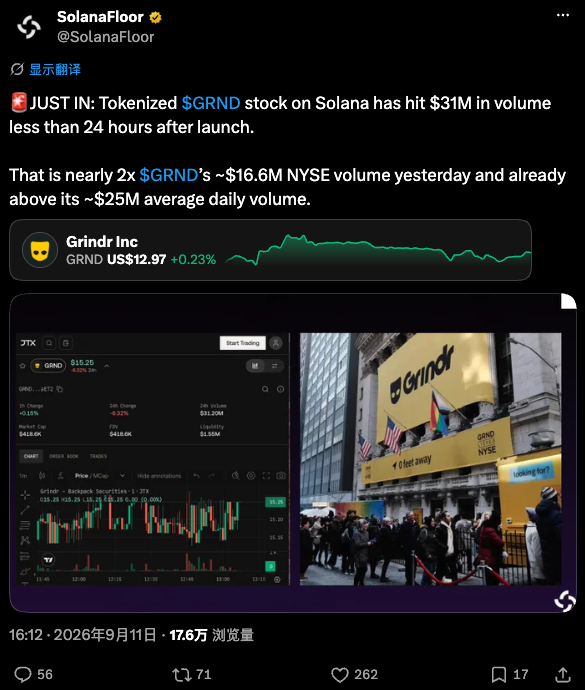
Why StonkFun Broke Out
StonkFun best captures Solana in 2026, because it combines the two most important things on this chain: token launches and tokenized stocks.
It is a token launchpad where new coins can choose any asset designated by the creator as their quote asset, including tokenized stocks and ETFs, rather than being limited to SOL or USDC. Its own token, $STONK, was launched with SPYx — a tokenized S&P 500 product — as its quote asset. Within just two months, StonkFun became the second-highest-revenue launchpad across all chains, behind only Pump, with $16.7 million in revenue over the past 30 days (DefiLlama, as of October 19, 2026).
In September, it out-earned both Pump's launchpad and Pons on Robinhood Chain on nine separate days, peaking at $2.3 million on the 11th. On a full-month basis, Pump still leads (DefiLlama).
We examined why it was able to spread so quickly (data from StonkFun, as of October 21, 2026):
- A one-sentence differentiator — launch a meme coin quoted in the S&P 500.
- A verifiable positive flywheel — platform revenue is used to buy back and burn $STONK, and revenue, buyback, and burn data can all be viewed on a public dashboard. Cumulative revenue is $35.5 million, about 60% of which goes to buybacks: $21.2 million bought back to date, and burned $STONK is worth $26.4 million at current prices.
- Rewards built into the product — each token can distribute yield to its own holders in its quote asset via transfer taxes or liquidity pool fees. Nearly $90 million has been distributed to date, with reward funding coming from each token's own transfer tax or liquidity pool fees rather than StonkFun's revenue.
- Ecosystem integration and support — in early September, after StonkFun went live with its integration into Raydium's LaunchLab, $STONK rose about 250%, reaching a $140 million market cap; Solana also publicly backed StonkFun by replying to its posts.
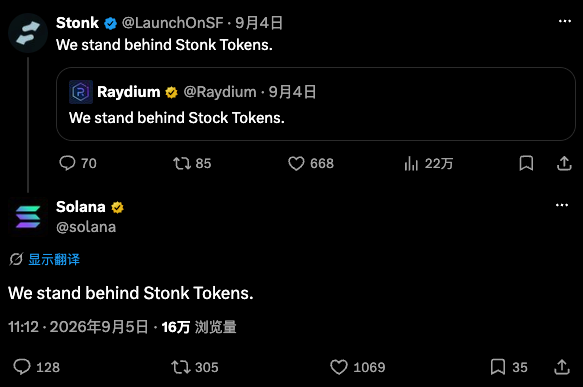
StonkFun combined a simple, easy-to-grasp product differentiator, transparent and verifiable revenue, a token tied to revenue, and distribution channels from the broader ecosystem.
Part 3: Where Solana Is Headed
The Token Supercycle
Meme coins brought Solana a large retail audience, trading activity, and network adoption, and they still do. What has changed is everything around the system. Solana calls this the "Internet Capital Markets": from stocks and funds to dollars and agent payments, anything can be issued and traded on-chain, running 24/7, without limits on transaction size.
In 2026, Solana is moving further toward a "token supercycle": stablecoins, tokenized assets, payments, and AI-driven activity are all migrating on-chain, and AI is accelerating demand for capital, collaboration, and real-time settlement.
Solana's core thesis is that, relative to the scale of global assets, the RWA market is still tiny, so the room for growth is enormous. The Foundation is allocating resources accordingly, hiring for stablecoins, AI, and institutional business, and centering flagship events like Breakpoint London around this narrative.
Wall Street Enters
- Tokenized funds and credit — industry giants have already launched products: BlackRock's BUIDL, Franklin Templeton's BENJI, and a $50 million commercial paper issued by JPMorgan and settled on Solana. In addition, through a new partnership with Allfunds, one of the world's largest fund distribution platforms, funds issued on Solana will be able to reach more than 3,300 institutions in the Allfunds network starting in Q4 2026.
- More stocks, launched faster — covering pre-IPO companies, supporting 24/7 minting and redemption, and able to list corresponding assets the same day a stock debuts on Nasdaq.
- Payments — Visa settles USDC with U.S. banks on Solana; Western Union has launched its own dollar token on Solana; Solana Pay is being piloted at more than 330,000 merchants in South Korea; Samsung Wallet is also adding USDC transfers via Solana, for up to 82 million Galaxy devices in the U





