


Utah Indicts Kalshi and Its Founder on 14 Criminal Felony Charges in Undercover Sting Operation


- Key Takeaways: Utah has, for the first time, filed criminal charges against prediction market platform Kalshi and its founder, prompting the federal CFTC to sue Utah in return. The conflict between federal and state authorities over jurisdiction of prediction markets has now entered the judicial ruling phase.
- Key Elements:
- Utah filed 14 criminal charges, including 1 second-degree felony and 12 third-degree felonies, based on evidence gathered from 12 undercover agent-placed bets.
- Utah's civil lawsuit seeks disgorgement of up to $60 million in ill-gotten gains, claiming there are over 30,000 Kalshi accounts in the state.
- The CFTC sued Utah, asserting that the Commodity Exchange Act grants it priority jurisdiction over designated contract markets—this marks a similar action against the 10th state.
- In August, a federal court ruled that the CEA does not preempt state anti-gambling laws; Kalshi has appealed to the Tenth Circuit Court of Appeals, and proceedings are ongoing.
- The New York Attorney General sued Kalshi seeking $36 billion in damages; Kalshi litigation has now involved approximately 20 states.
Original | Odaily@OdailyChina)
Author | Wenser (@wenser 2010 )
Prediction market trading volumes continue to climb, but the battle between the U.S. federal government and individual states over regulatory authority on prediction platforms has entered a white-hot phase.
On October 20, Utah filed a civil lawsuit against prediction market platform Kalshi and its affiliates, seeking the recovery of up to $60 million in illegal profits. On October 27, the U.S. Commodity Futures Trading Commission (CFTC) formally filed suit in the U.S. District Court for the District of Utah, requesting that the court block Utah from taking enforcement action against Kalshi.
On October 28, Utah Attorney General Derek Brown filed 14 criminal charges against Kalshi and its co-founders Tarek Mansour (CEO) and Luana Lopes Lara (COO), including one second-degree felony, twelve third-degree felonies, and one Class A misdemeanor. The charges stem from an undercover operation in September of this year in which investigators from the Utah Attorney General's Office used a local Utah IP address to place bets on Kalshi.
Regardless of the outcome, this marks the first time in history that a prediction market platform and its founding members have jointly been brought to a criminal defendant's dock, and it may signal that the nearly two-year-long disputes and conflicts over jurisdiction, the nature of event contracts, and the compliance boundaries of prediction markets are about to enter the judicial adjudication phase.
Utah's "Sting Operation": Undercover Agents Placed 12 Bets, Leading to 14 Criminal Charges
The authority that brought these criminal charges against Kalshi and its co-founders is none other than the office directly engaged in a jurisdictional conflict with the CFTC—namely, Utah Attorney General Derek Brown. The 14 criminal charges center primarily on "engaging in illegal gambling activities," including:
- 1 second-degree felony: pattern of unlawful activity;
- 12 third-degree felonies: promoting online gambling (corresponding to the 12 bets placed by the undercover agents mentioned above);
- 1 Class A misdemeanor: general gambling promotion.
It is worth noting that under Utah law, a second-degree felony carries a sentence of 1 to 15 years in prison, and each third-degree felony carries up to 5 years; the "pattern of unlawful activity" provision also allows the court to impose fines proportional to illegal proceeds.
Kalshi Seeks Exclusive CFTC Jurisdiction; Utah Insists on State-Level Gambling Authority
In February of this year, Kalshi took the lead in suing Utah Governor Spencer Cox, Attorney General Derek Brown, and others, asking the federal court to rule that the Commodity Exchange Act (CEA), the legal basis for CFTC enforcement, preempts state anti-gambling laws and to bar state enforcement.
Kalshi's response is not an overreaction—Utah, like Hawaii, has some of the strictest anti-gambling laws in the United States. The state prohibits all forms of legal gambling; everything from casinos and lotteries to sports betting is illegal. This stance is deeply influenced by The Church of Jesus Christ of Latter-day Saints (the Mormon Church), which has over 2 million members in Utah and considers gambling a vice that leads to addiction, selfishness, and destructive behavior. Mormons wield strong political influence in the state, and nearly all senior political positions are held by members of the faith. Governor Spencer Cox has repeatedly publicly criticized prediction markets and plans to amend the state constitution to include prediction markets within the legal definition of gambling.
In August, Judge Robert J. Shelby of the U.S. District Court for the District of Utah issued a summary judgment in favor of Utah, ruling that the CEA does not preempt Utah's anti-gambling laws (particularly as applied to sports event contracts). The court held that gambling has long been an area of traditional state regulation, that Congress did not intend to strip states of their authority when it passed the Dodd-Frank Act, and that federal regulation and state enforcement do not necessarily conflict.
In October, Utah Attorney General Derek Brown filed a civil suit in state court, alleging that Kalshi and its affiliates (including a Susquehanna-related trading firm) were illegally operating gambling in Utah. He sought to halt their activities, recover an estimated $30 million to $60 million in profits derived from Utah accounts, shut down operations, prohibit trading on five categories of event contracts (elections, politics, culture, sports, and "mentions"), mandate the use of a court-approved geolocation service provider, and characterize Kalshi's operations as a "public nuisance." He also stated that Kalshi's platform has over 30,000 accounts in Utah and handles enormous trading volume.
Subsequently, the "CFTC vs. Utah" drama mentioned at the beginning of this article officially unfolded.
CFTC Chairman Michael Selig formally sued Utah and Derek Brown in federal court, seeking to block Utah from enforcing against a CFTC-registered market. This is the tenth U.S. state against which the CFTC has taken similar action. The agency's core argument is that the CEA has processing priority over swaps and Designated Contract Market (DCM) transactions, and that state law cannot override a federally authorized system established by Congress.
On the other side, Utah's reasoning also appears well-founded. In a statement, Utah Attorney General Derek Brown said: "In Utah, gambling is illegal—whether you're placing a bet, organizing gambling activity, or promoting gambling. Calling it a 'prediction market' doesn't change its nature, and obtaining a federal registration doesn't put a company above the law."
Both sides maintain their positions, and the conflict has escalated. The 14 criminal charges filed by Utah actually originated from a "sting operation" conducted in September of this year.
Cracking Down on Prediction Markets: Utah Deploys Its "Sting Operation" Tactic
To make Kalshi recognize "the authority of state-level enforcement," Utah went so far as to use a "sting operation" strategy to prove Kalshi's illegal operations.
The main agencies driving this dispute are the Utah Attorney General's Office (led by Derek Brown) and the Utah Department of Public Safety's State Bureau of Investigation (responsible for the undercover investigation), which jointly lead Utah's civil and criminal enforcement efforts.
The factual basis for the allegations against Kalshi's illegal operations in Utah primarily comes from undercover agent Scott Eggerman, who in September of this year opened an account on the Kalshi platform using a Utah resident identity (Utah address, phone number, bank account, and IP address), then placed 12 bets on NFL/MLB/MLS/NHL and college football games, spending a total of $114.
The key point of contention is that the Kalshi platform collected corresponding transaction fees and allowed the operations to proceed—and this occurred after the August federal court ruling. Utah authorities therefore argue that Kalshi profited from the activity and that its founders, as controlling persons, should bear personal liability. This is also the first time a U.S. state has listed founders as criminal defendants (felonies potentially involving imprisonment), significantly elevating the executive liability risk for prediction market platforms.
The most perplexing aspect is that after the August ruling by the federal court in Utah, Kalshi immediately appealed to the Tenth Circuit Court of Appeals, and during the appeal, Kalshi's request for an injunction was denied. The substantive appeal before the Tenth Circuit is still ongoing, with no final opinion yet issued. According to public records, Kalshi and Utah are in the process of submitting briefs, with Utah's response brief due around mid-to-late October.
In other words, the state's criminal prosecution occurred while the federal appeal process had not yet reached a conclusion. Utah seized the timing gap and, leveraging the federal court's ruling, delivered an "enforcement strike" against Kalshi that was "procedurally valid and factually clear."
Kalshi Responds: Charges Are "Crazy Overreach," Utah Is Playing Politics
After Utah filed the criminal charges, Kalshi called them "crazy overreach" and accused Utah authorities of acting out of political motivation.
The company stated externally: "We look forward to stopping this in court, just as we did in Arizona."
In May of this year, a federal judge ruled to bar Arizona from enforcing its gambling laws (criminal or civil) against CFTC-registered Designated Contract Markets (DCMs, including Kalshi), finding that federal agencies have priority enforcement authority in this area. The case was subsequently appealed to the Ninth Circuit.
Looking at previous circuit court rulings, the situation is not optimistic for Kalshi: Only New Jersey has ruled that Kalshi falls under CFTC jurisdiction and is permitted to operate; other states—Nevada, Ohio, and Tennessee—have all ruled that state-level regulators have enforcement authority. Additionally, most states are still in litigation, leaving Kalshi in a "available but risky" state.
Most recently, on October 23, New York Attorney General Letitia James also sued Kalshi, seeking $36 billion in damages and demanding the shutdown of its operations in the state; a federal judge in New York had previously denied Kalshi's request to block state enforcement.
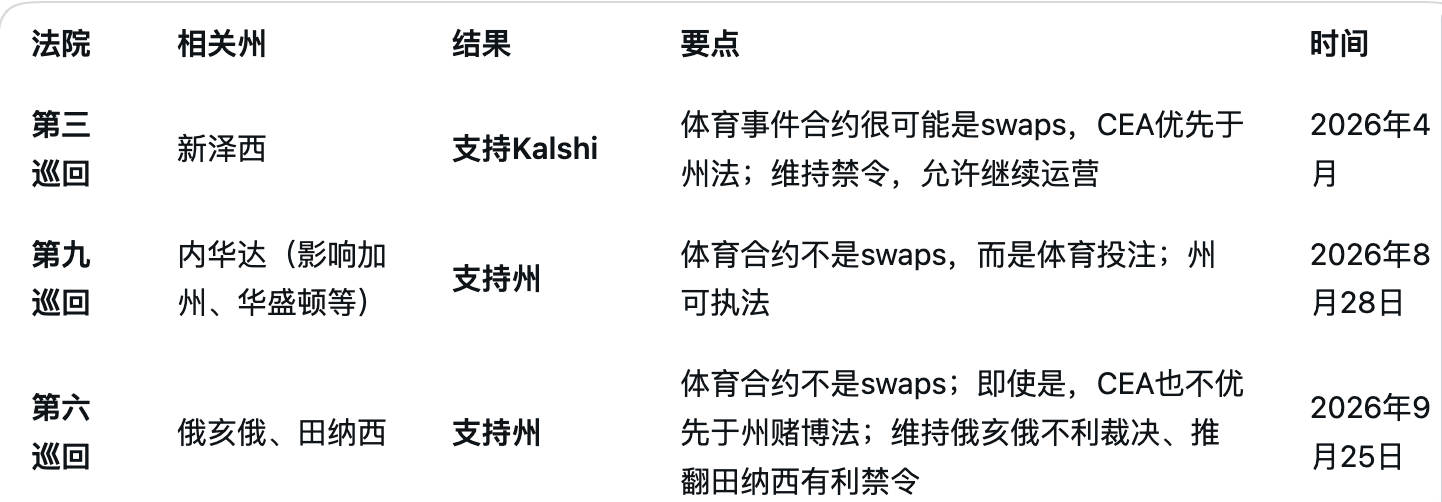
Currently, states where Kalshi's operations are restricted include Michigan (geolocation required, fines of up to $500,000 per day for violations), Nevada (sports, election, and entertainment contracts subject to geolocation), Washington (restrictions on sports, elections, politics, entertainment, culture, and technology/science, with only commodities, climate, economics, and finance markets remaining), and Massachusetts (sports contracts restricted, Kalshi appealing).
After the CFTC joined this "prediction market regulatory war" and Utah took the initiative to escalate the conflict, Kalshi-related litigation has expanded to involve approximately 20 states. How it will ultimately be resolved may still depend on a definitive ruling from the U.S. Supreme Court. Perhaps the Trump family can once again mobilize federal power—after all, Donald Trump Jr. is a strategic advisor to Kalshi.





