


Tiger Research: Banks No Longer Wait for Regulation: How Is Europe's MiCA Becoming the Implementation Standard for Stablecoins?


Key Takeaways
- This article is based on Tiger Research. While financial institutions that waited for regulatory finality are still weighing whether to enter the market, banks that completed their business architecture early have already locked in enterprise payment networks, opening a gap that latecomers will find hard to close. European banks that moved swiftly once the rules were established now hold a firmly entrenched first-mover advantage in the market.
- Waiting until legislation formally passes to begin business reviews is too late. Only banks that have already finalized their business model (whether issuing directly through the parent bank, issuing through a subsidiary, or acting as an infrastructure service provider) and have rigorously modeled the 30% segregated deposit requirement and the compliance costs at each regulatory stage will be able to launch services smoothly on the very first day the law takes effect.
- Without a whitepaper review mechanism under which management bears joint legal liability, and without a fully developed redemption and crisis recovery plan in advance, the product launch date will be postponed indefinitely even after the licensing application window formally opens.
- On the day regulation formally takes effect, banks will by no means start from the same line. While banks that passively waited for final legislation are still scrambling to prepare basic filing materials, banks that used MiCA as a benchmark to complete profitability analysis and finalize external partnerships will already be able to immediately onboard and capture real transaction flows.
- The door that regulation opens is equal for all banks, but market share will only flow to those first movers who complete their preparations first.
Why Look to Europe
While other regions around the world are still deliberating how to control stablecoin risks, Europe has already taken the lead through the Markets in Crypto-Assets Regulation (MiCA), setting clear market entry thresholds, reserve management rules, and statutory redemption obligations.
Once the regulatory framework was clearly in place, European banks entered the market aggressively without hesitation. Their practical experience has also become the most compelling real-world reference model for regulators in other countries and regions that have yet to issue clear regulatory guidance.
Given that waiting until regulation is fully finalized before acting will inevitably mean missing the window, commercial banks in countries and regions where stablecoin rules remain unclear must design their business models in advance before the relevant rules are formally introduced.
Running a stablecoin business is by no means as simple as minting tokens and obtaining a license. Before the law is finalized, banks need to make thorough preparations around three core decisions.
The first is the business model decision: banks must decide whether to issue tokens directly themselves or to provide derivative infrastructure services such as distribution and custody for other issuers.
The second is the reserve management framework: banks must determine how to segregate and invest reserve assets so as to fully satisfy the statutory regulatory requirements applicable to the issuing entity.
The third is the redemption mechanism and client protection: banks must develop detailed operational plans to ensure they can promptly repay principal to clients when redemption requests surge, and establish a standardized disclosure framework.
The universal benchmark reference for these three core decisions is precisely the regulatory detail that MiCA sets out for e-money tokens (EMTs, the category of stablecoins pegged to fiat currency).
This report provides an in-depth analysis of how Europe regulates the issuance of EMTs and related services, and outlines for commercial banks facing regulatory gaps the practical preparations they can begin right now. For each decision, we follow a consistent logic: the core decision that needs to be made now, the relevant specific provisions of MiCA, and the preliminary actions banks can advance in advance.
Because MiCA only defines the legal boundaries and does not make business model or monetization strategy choices on banks' behalf, Europe's early precedents are used here as tabletop exercises to systematically clarify the key choices that banks outside the EU must tackle one by one before domestic regulation is introduced.
First Decision: Issue Directly or Merely Provide Necessary Services
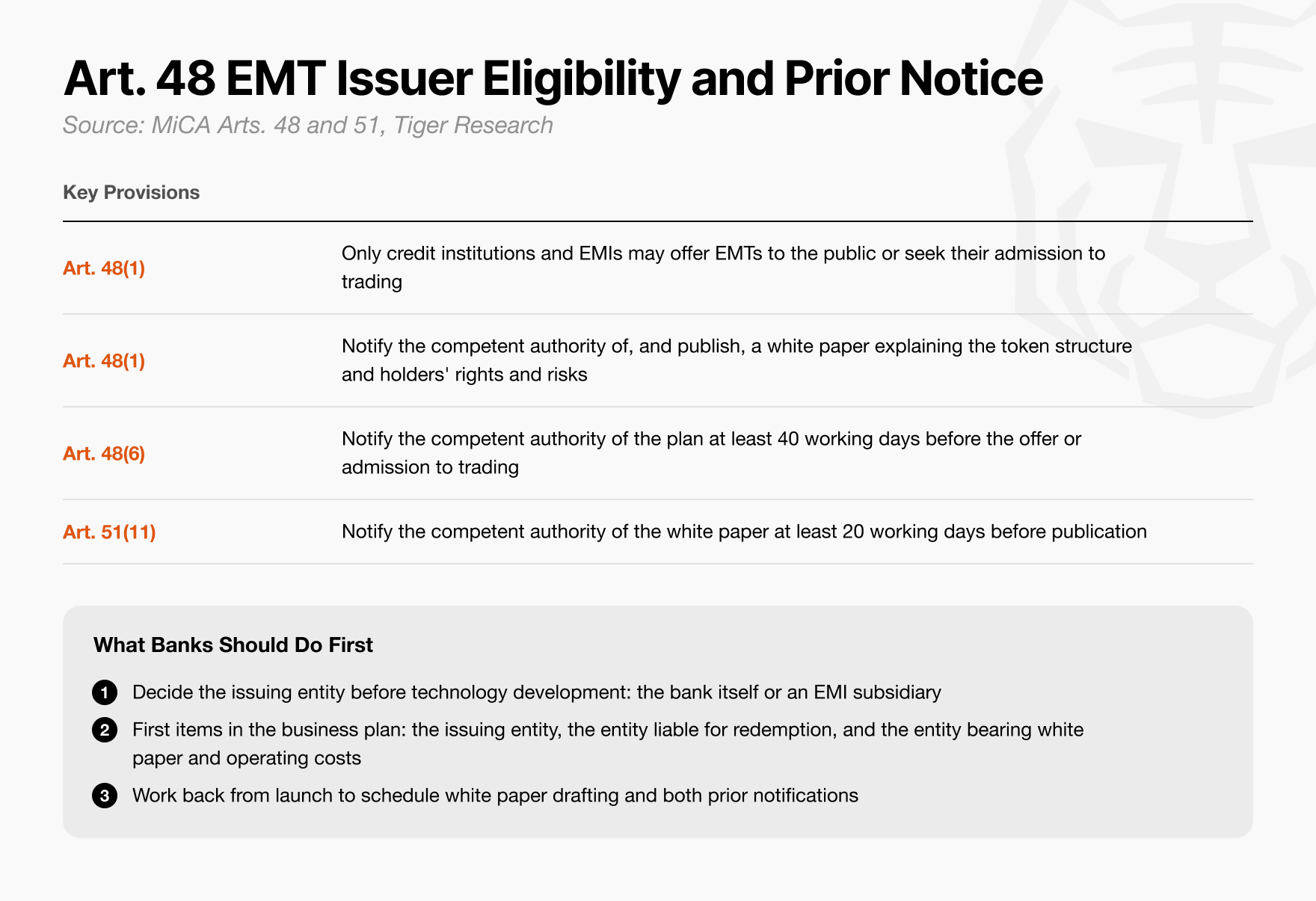
Figure: Comparison of the dual-track architecture of direct issuance by a bank versus issuance through an e-money institution (EMI) subsidiary
The top-level architecture design of the issuance business takes priority far above underlying technology selection.
Within the EU, only commercial banks and e-money institutions (EMIs) are authorized to issue EMTs. An e-money institution is a company that allows clients to make payments or transfers using funds loaded into an e-wallet or similar account. In addition to issuing directly through the parent bank, a bank can also set up a separate subsidiary, apply for an EMI license for it, and issue EMTs through that entity.
Both types of licenses permit stablecoin issuance, but the accompanying legal compliance and capital adequacy requirements differ fundamentally.
Therefore, banks must first establish a corporate governance framework and choose between direct issuance by the parent bank and issuance through a subsidiary based on their strategic intent: whether they wish to completely isolate the parent bank from potential prudential regulatory risks, or whether they wish to leverage the parent bank's deep and solid traditional banking reputation and infrastructure advantages to open up the market.
Before formal issuance, a stablecoin must also publicly release a crypto-asset whitepaper, a strict disclosure document equivalent to a prospectus for traditional financial products. Unless this whitepaper—covering the token's legal structure, issuance and redemption terms, and related risks—is completed and approved by the competent authority, the stablecoin may not be offered to the public or listed on any trading platform.
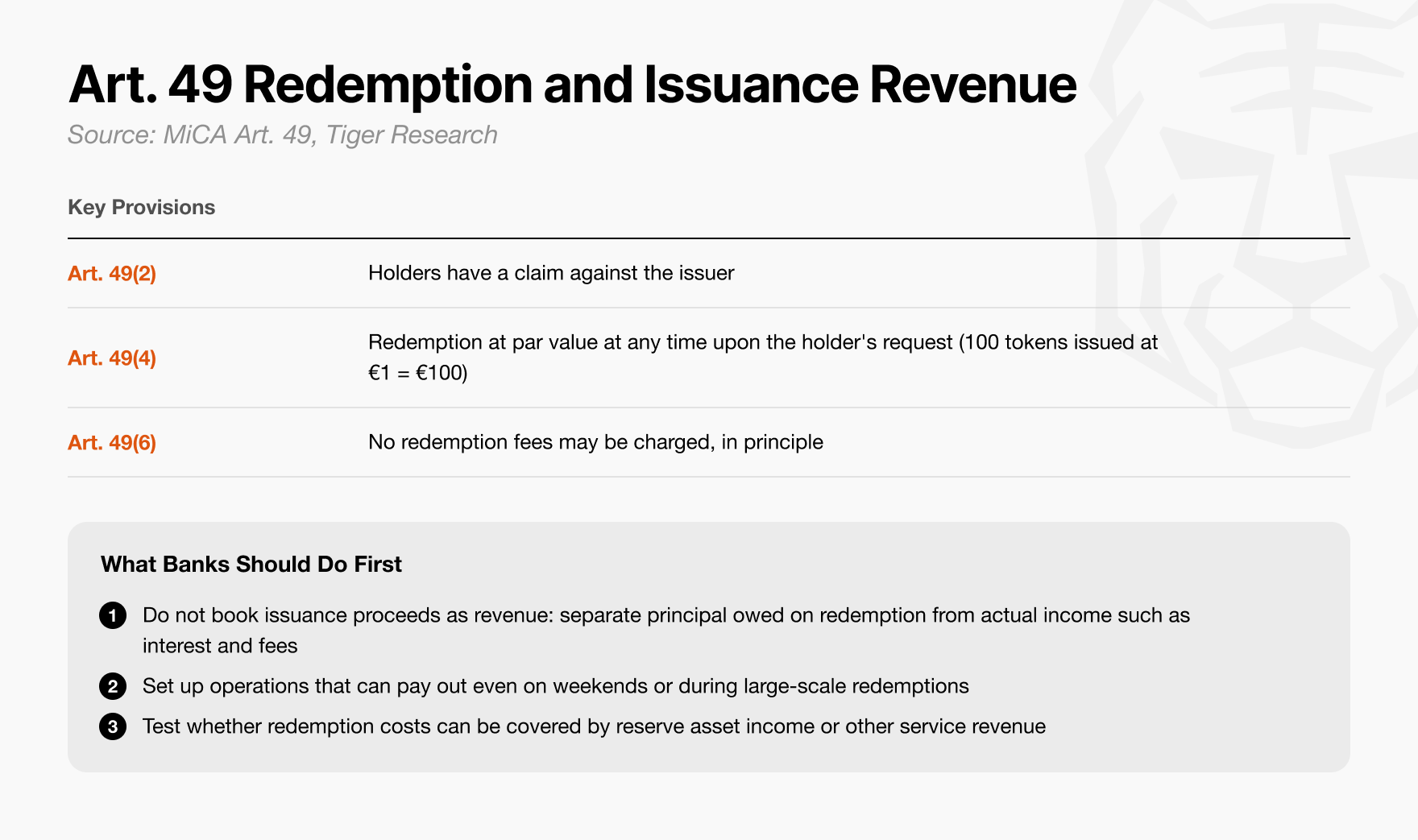
Figure: Core process of the redemption mechanism and commercial revenue model that must be put in place before a crypto-asset whitepaper is published
Before drafting the whitepaper, banks must design in advance the redemption process for returning client funds, as well as a commercial profitability model sufficient to support operating expenses.
Under Article 49 of MiCA, issuers must redeem in full at par value at any time upon request by token holders. Redemption may not carry any additional charges other than the actual necessary costs incurred, and these costs must be disclosed in detail in the whitepaper in advance.
Therefore, before writing the whitepaper, issuers must internally rigorously review redemption fees and clearing and settlement channels, and design a sustainable profitability model that does not rely on exit fees.
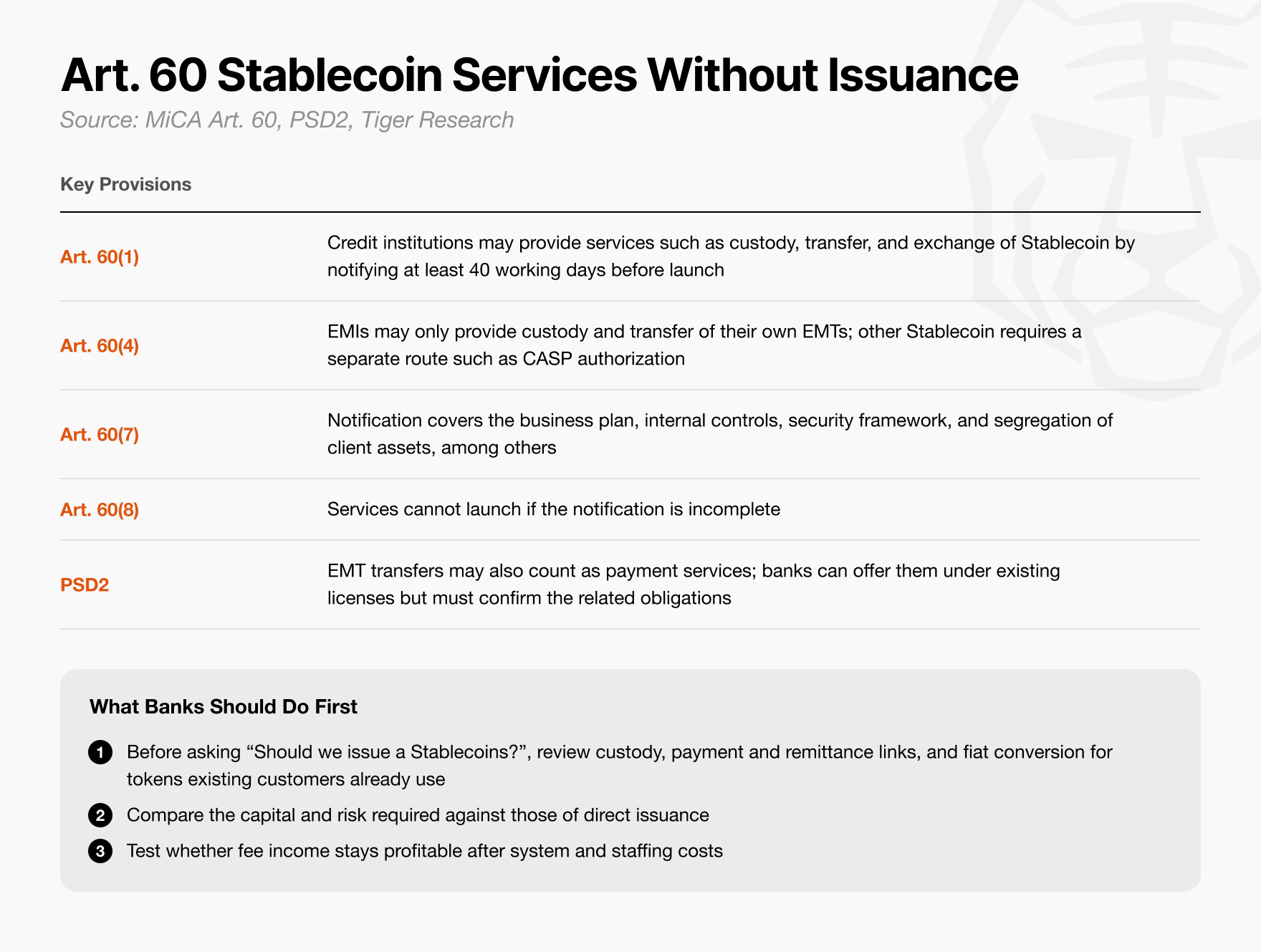
Figure: Stablecoin custody, distribution, and circulation service models that commercial banks can enter without issuing their own tokens
Even without issuing stablecoins themselves, commercial banks can still earn substantial revenue by providing derivative services.
MiCA does not require banks to issue their own stablecoins in order to participate in the stablecoin business. Banks can act as crypto-asset transfer service providers, sending and receiving tokens on behalf of clients, or as custody service providers, securely safeguarding token private keys.
Through these services, banks can both handle large volumes of client transactions and earn stable fee income, while completely avoiding the heavy capital and reserve regulatory burdens that fall directly on issuers.
However, the scope of business permitted differs markedly across institution types. Commercial banks, relying on their existing banking licenses, can directly conduct transfer and custody businesses simply by filing compliance notifications with regulators.
By contrast, e-money institutions (EMIs) may only provide custody services for EMTs they themselves issue, and may provide transfer services only when the transfer business meets the payment service standards defined in the relevant directive.
In addition, overlaps with the traditional payment regulatory framework must be carefully examined. Transferring tokens on behalf of clients is not only governed by MiCA but also falls within the scope of traditional payment services regulation.
Therefore, banks must verify in advance whether their target services meet the statutory definition of payment execution under the EU's Second Payment Services Directive (PSD2), and whether additional compliance filing procedures are required.
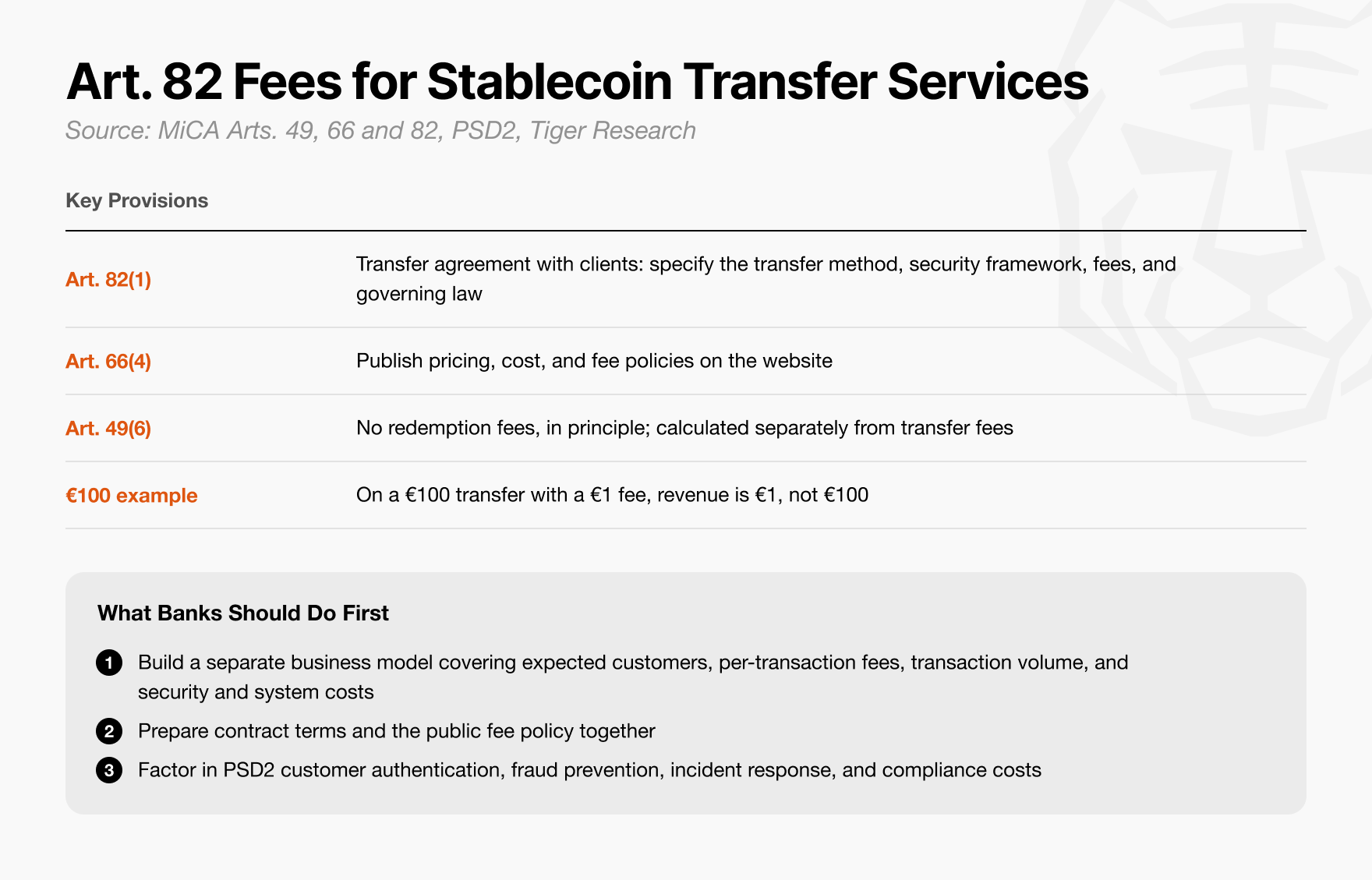
Figure: Overlap and compliance interface between stablecoin token transfer services and the traditional payment regulatory framework (PSD2)
The fee structure and break-even point of token transfer services must be rigorously modeled in advance.
Under MiCA, crypto-asset transfer service providers must clearly state in client service agreements the fee charged per transfer and the specific execution timeframe. If fees are set too high, clients will bypass the bank and use native on-chain transfers instead; if fees are set too low, the bank cannot cover underlying blockchain network gas fees and system hardware and software maintenance costs.
Therefore, banks must conduct stress tests in the early planning stage to verify whether their fee schemes for enterprise payments and cross-border remittances can fully cover network transaction friction costs and day-to-day operating expenses.
Given that redeeming stablecoins for fiat currency is in principle legally prohibited from carrying any additional fees, banks must also draw a clear operational line between transfer services that may legally charge fees and redemption services that are absolutely prohibited from charging fees, to prevent building a business model on fee logic that regulators may later rule illegal.
Reserve Management Decision: Match the Regulatory Status of the Issuing Entity
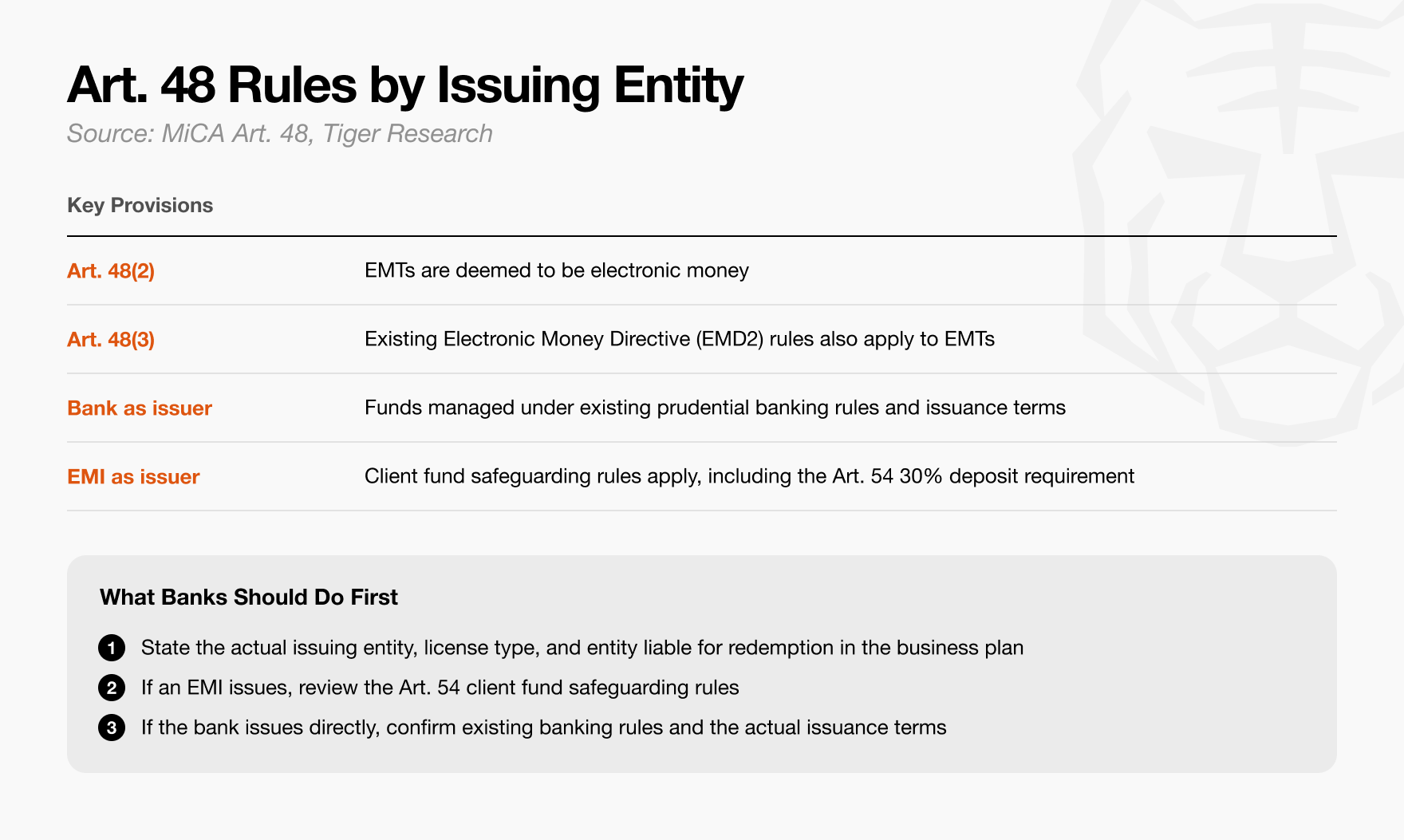
Figure: Reserve management rules and applicable legal frameworks corresponding to the regulatory status of different issuing entities
Before deciding how to manage client funds, banks must first confirm the specific regulatory rules applicable to the issuing entity.
Article 48 of MiCA explicitly treats EMTs as e-money, and directly applies the EU's E-Money Directive (EMD) in any respect not specifically provided for by MiCA.
However, reserve management rules differ substantially depending on the issuer's legal organizational form. Commercial banks issuing directly can manage client funds within their existing banking regulatory framework; but if a stablecoin is issued by an EMI subsidiary, client funds must be completely segregated from own assets from the very first day funds are received, and may only be invested in low-risk assets with extremely high safety and high liquidity.
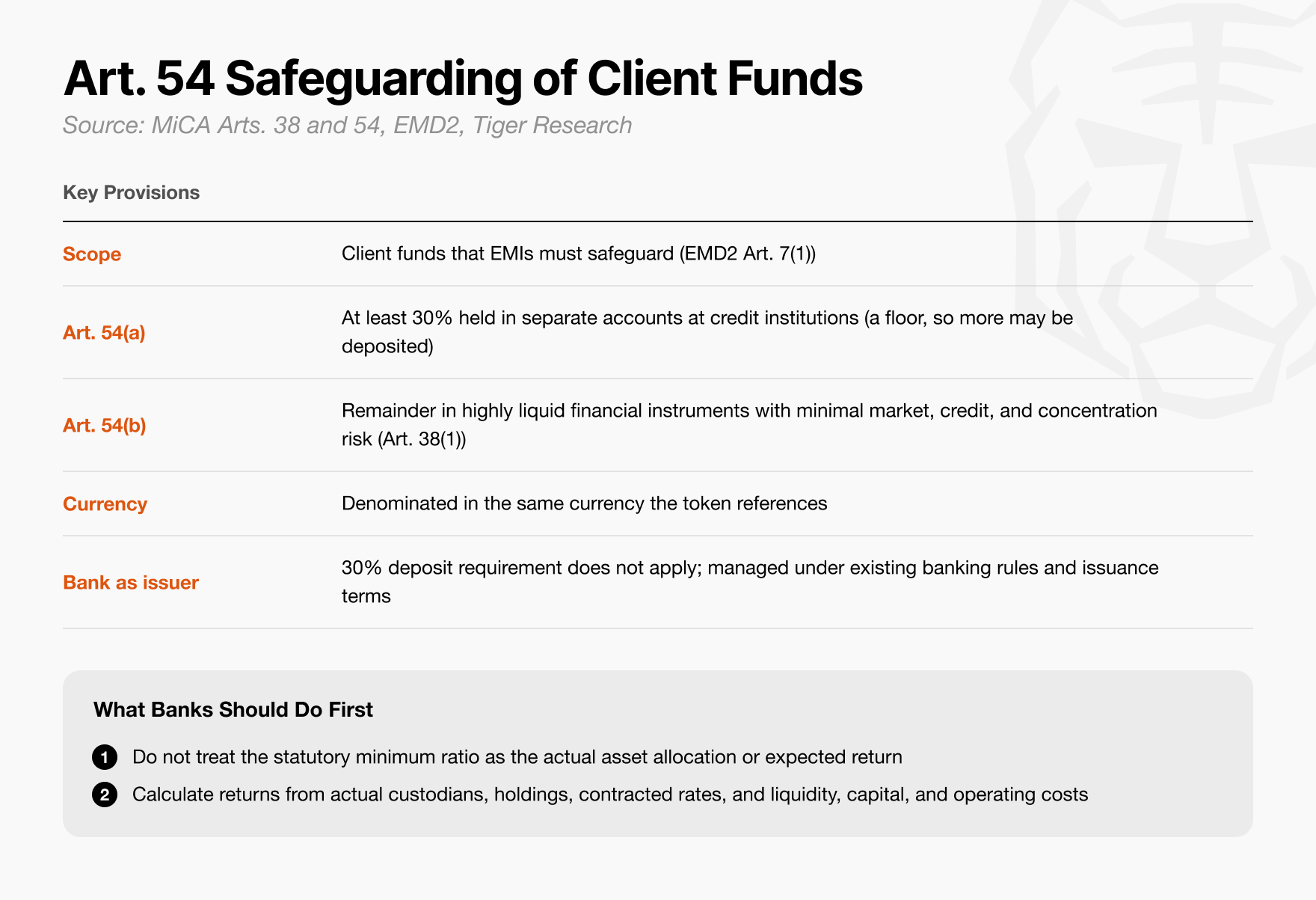
Figure: 30% segregated deposit and high-liquidity safe asset allocation ratio requirements when an e-money institution (EMI) issues a stablecoin
Banks must reasonably plan where client funds are held and their allocation ratios, and carefully model business viability against the macroeconomic interest rate environment.
Under the rigid requirements of Article 54 of MiCA, an e-money institution issuing EMTs must place at least 30% of the funds raised in segregated accounts with qualified credit institutions (commercial banks). The remaining funds may only be invested in safe, low-risk assets, such as government bonds in the same currency as the EMT's peg.
In a low-interest-rate environment, interest income from bank deposits and government bonds may struggle to cover high day-to-day compliance operating costs; and when market interest rates rise, managing portfolio duration and liquidity risk becomes significantly more difficult.
Therefore, before finalizing the reserve investment portfolio plan, banks must conduct comprehensive profit simulation exercises under different interest rate scenarios.
Banks issuing through an EMI subsidiary must formulate a detailed asset allocation strategy in advance, fully taking into account the credit concentration risk of deposit counterparties.
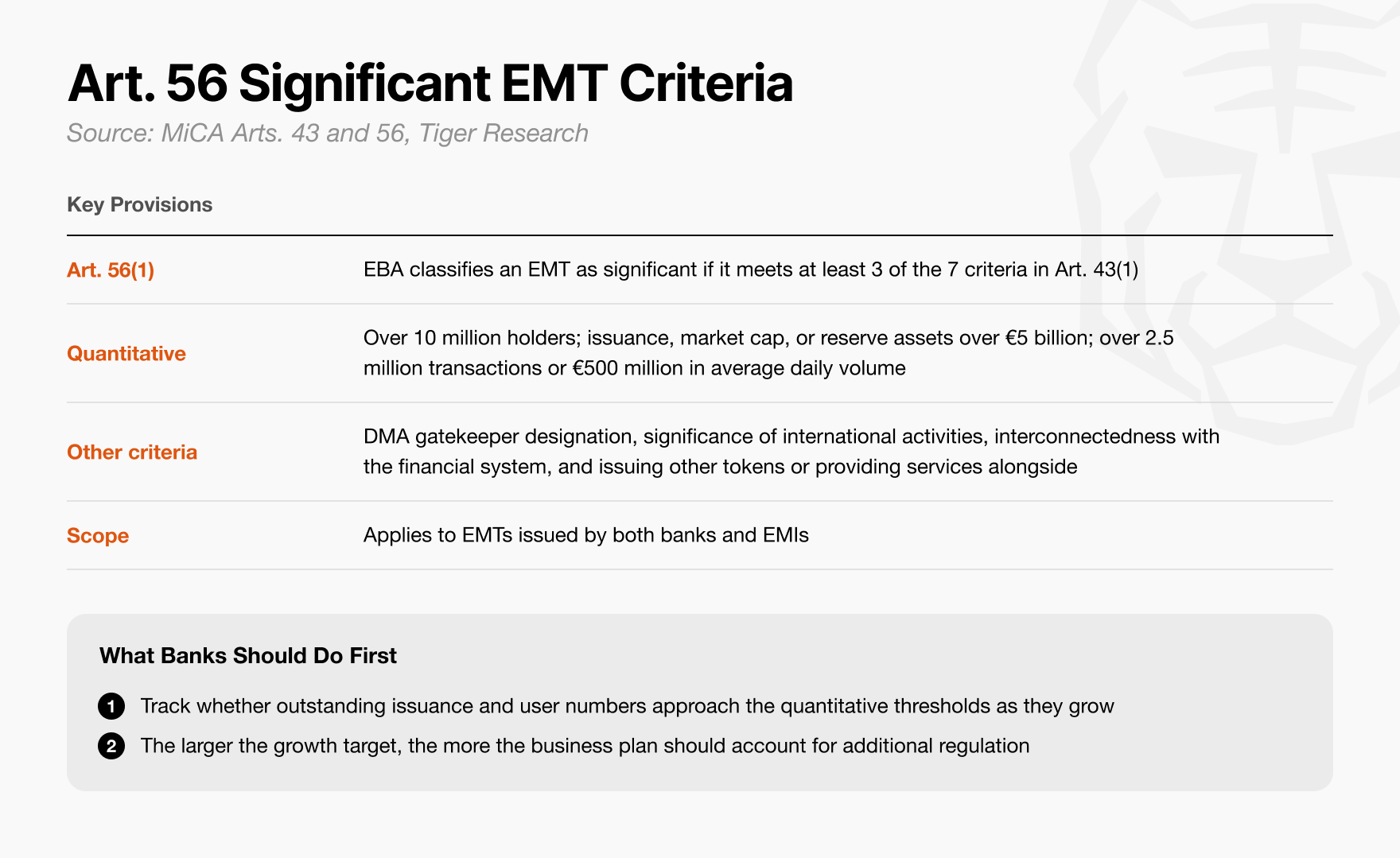
Figure: Core quantitative assessment indicators used by the European Banking Authority (EBA) to determine a "significant EMT"
Not all stablecoins will face the strictest regulatory shackles from launch, but compliance costs must be estimated in stages.
Under Article 56 of MiCA, if a stablecoin reaches specific quantitative thresholds in dimensions such as market capitalization, number of holders, or average daily transaction count, the European Banking Authority (EBA) will formally classify it as a "significant EMT."
Once labeled as such, the stablecoin will face stricter own-funds adequacy requirements, more intensive reserve regulatory scrutiny, and direct transfer to full EBA supervision.
Among the 45 EMTs currently notified to EU regulators, USDC is so far the only asset that meets the above criteria for a significant stablecoin.
However, once classified as a significant stablecoin, the regulatory burden increases precipitously. The minimum reserve ratio that must be held in segregated deposit accounts at commercial banks jumps directly from 30% to 60%, greatly tying up high-liquidity cash positions and severely narrowing the investment options for the remaining reserves.
At the same time, the own-funds threshold issuers must hold also rises steeply from 2% of average reserve assets for ordinary EMTs to at least 3%.
Therefore, banks' financial P&L models must adopt a phased, tiered design, strictly separating the minimum compliance costs in the early product phase from the heavy capital obligations that follow as scale expands.
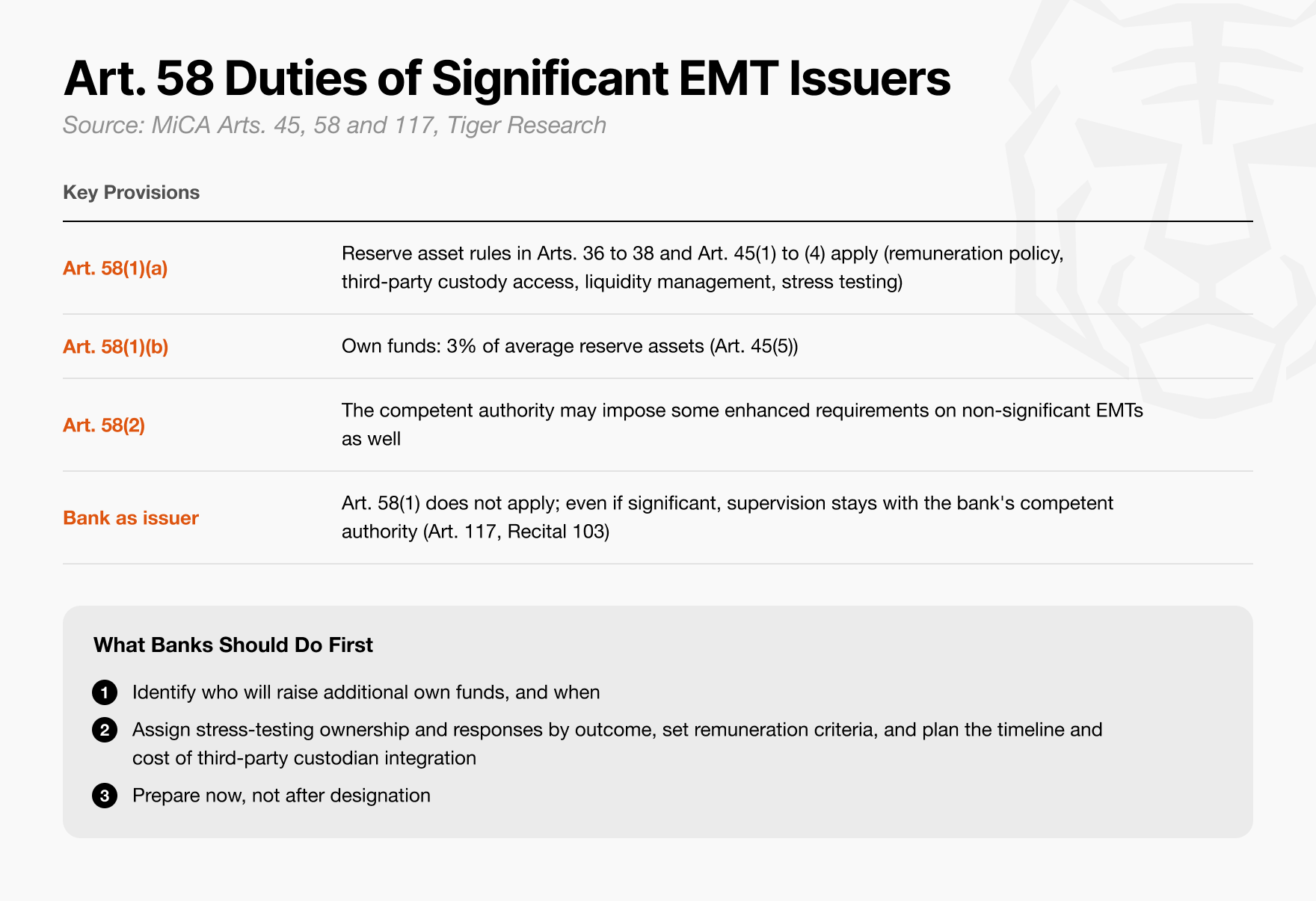
Figure: Phased escalation of capital adequacy and compliance costs for significant stablecoin issuers as business scale expands
When selecting the issuing entity, banks must factor in advance the potential subsequent costs of significant-asset classification, capital calls, and comprehensive risk management.
Under Article 58 of MiCA, an e-money institution issuing a significant EMT must hold own funds equal to at least 3% of average reserve assets, and is subject to additional liquidity buffer and risk management constraints.
If a commercial bank chooses to issue indirectly through an EMI subsidiary, as issuance scale expands rapidly, the subsidiary itself must independently meet this capital threshold, which will force the parent bank to continuously inject large amounts of additional capital.
By contrast, direct issuance by a commercial bank is exempt from the above additional capital obligations under Article 58(1). Banks can directly reuse their existing prudential capital adequacy framework and risk control systems, making direct parent-bank issuance an attractive strategic path worth prioritizing from the outset.
Redemption Mechanism and Client Communication Decision: Design Compliance Processes Holistically
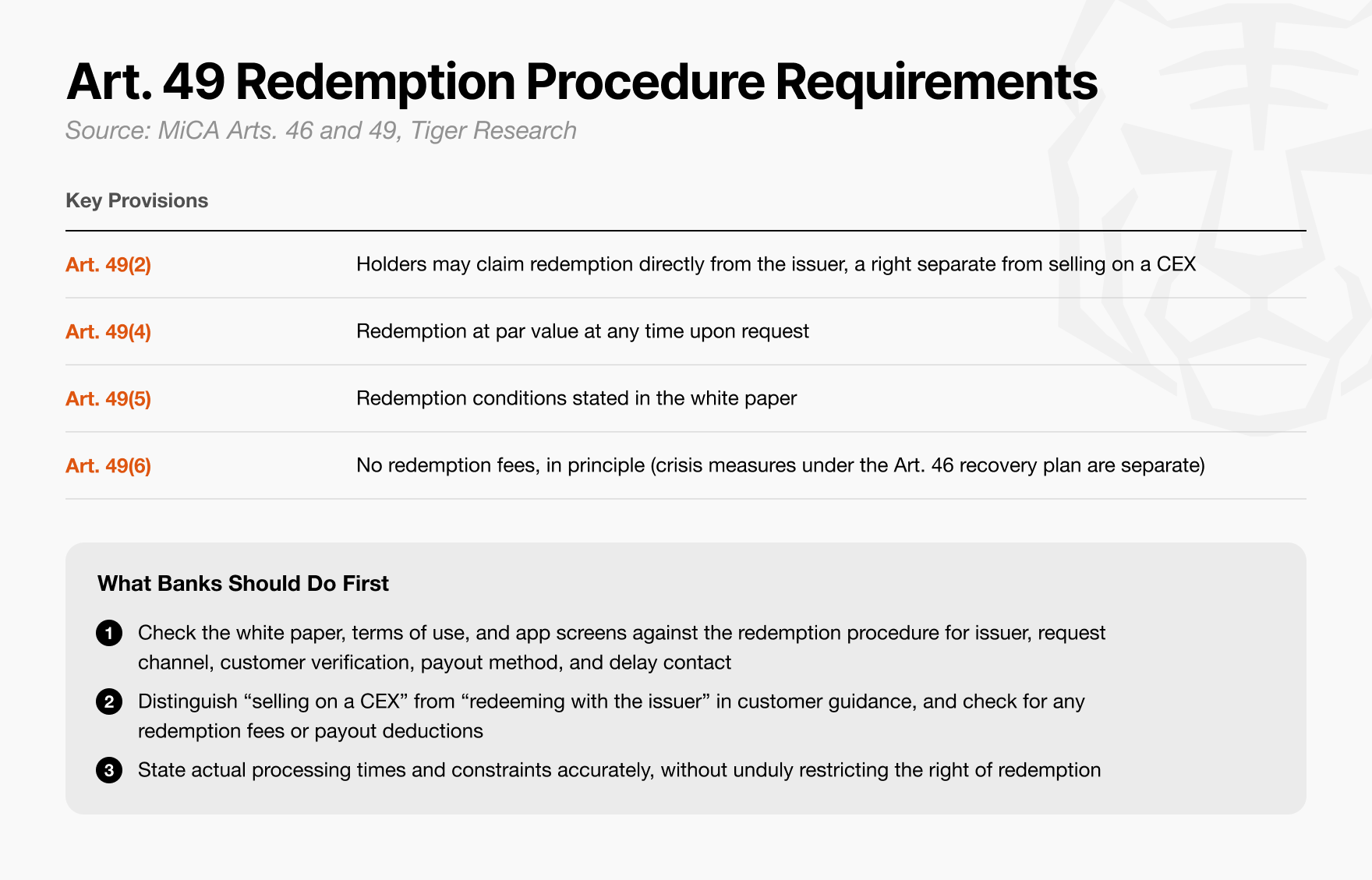
Figure: At-par redemption process at any time for e-money token holders and client guidance standards under the MiCA framework
Banks must design the redemption operational process and front-end client guidance as an integrated whole, ensuring that clients submitting redemption requests clearly understand the expectations for the entire process and smoothly recover their fiat funds with zero delay.
Under the hard constraints of Article 49 of MiCA, EMT holders have the right to require the issuer to redeem in full at par value at any time. The issuer must execute the redemption immediately without delay, must not attach any additional restrictive conditions, and must not charge any fees beyond the pre-disclosed actual costs.
At the operational level, commercial banks must clearly define standards and responsible personnel for each specific step





