


STRC's daily dividend payout is up for a vote tonight—can Strategy's "financing flywheel" restart?


- Key Takeaway: Strategy will hold a special shareholders' meeting on October 28 to vote on converting STRC and three other preferred stocks to daily dividend payouts. The core purpose is to reduce price disruption caused by dividend accrual and bring STRC closer to its $100 par value, thereby keeping the "financing flywheel" running. However, this adjustment can only improve cash flow granularity and cannot eliminate principal price risk.
- Key Elements:
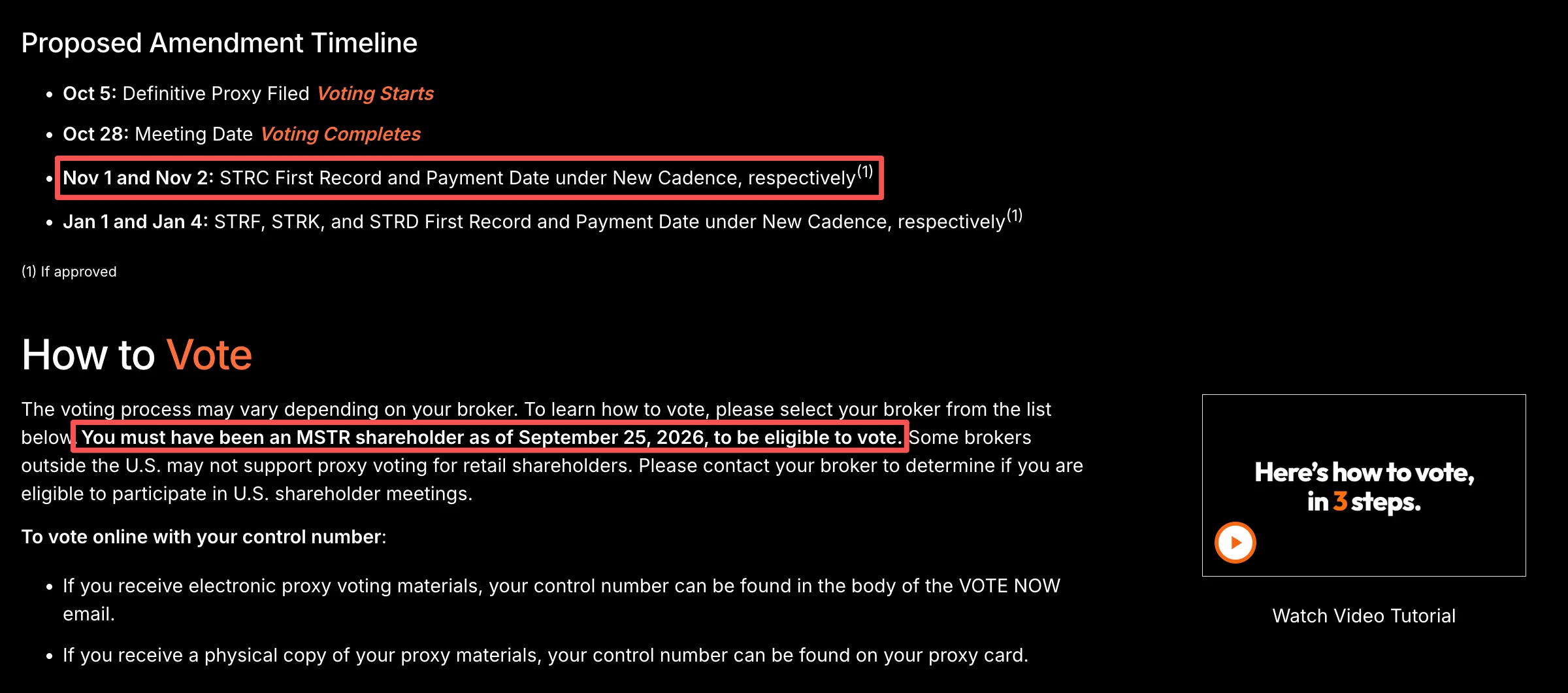
- If approved, STRC will have a daily record date starting November 1, with total dividends of $1.00 per share for November, corresponding to a 12% annualized yield; if not approved, $0.50 will be paid on November 15 as originally planned.
- STRC has not touched its $100 par value since mid-May, and on June 26 it once fell to $71.25, a record low since listing.
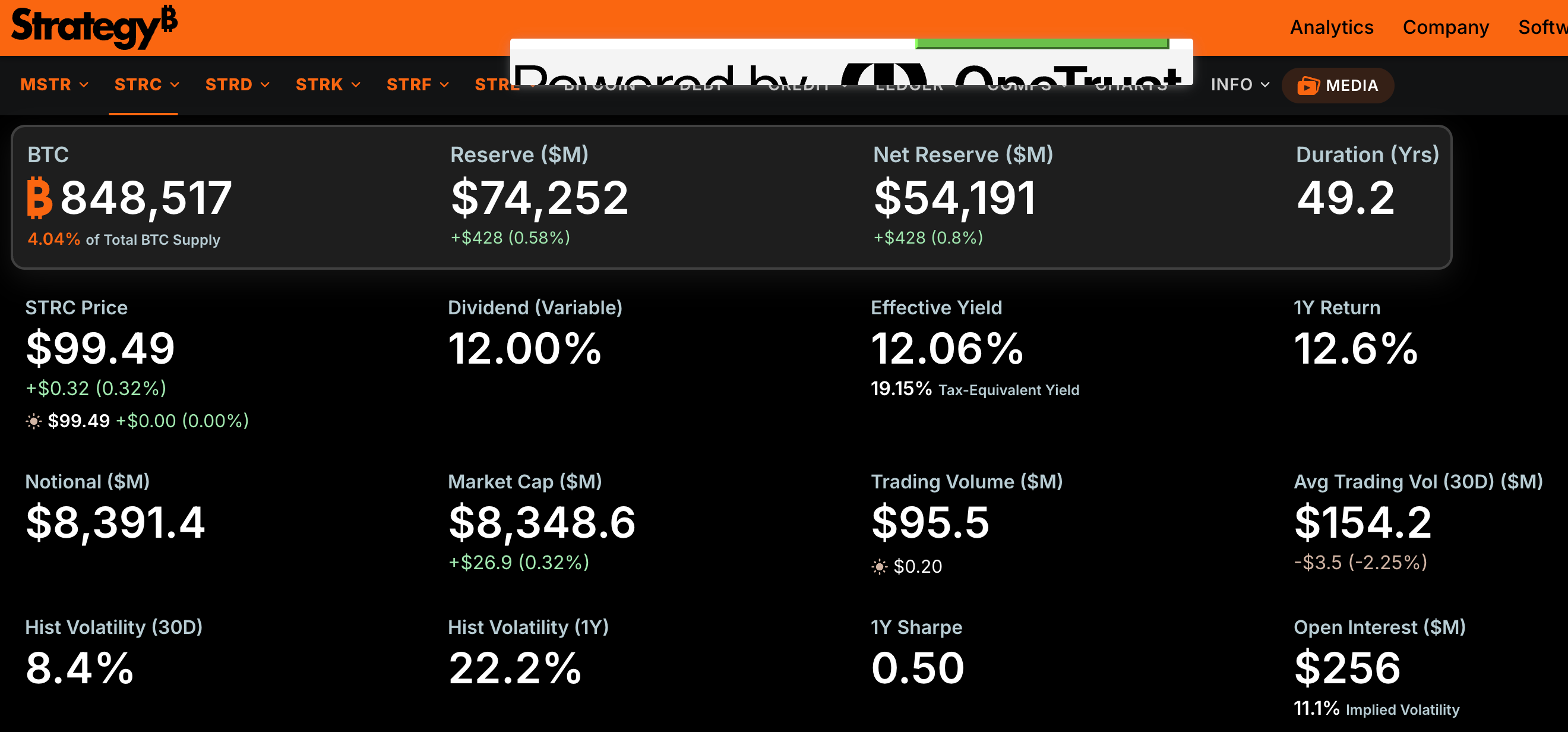
- As of October 25, Strategy holds 848,517 bitcoins, plus $4.83 billion in dedicated reserves and $242.4 million in available cash.
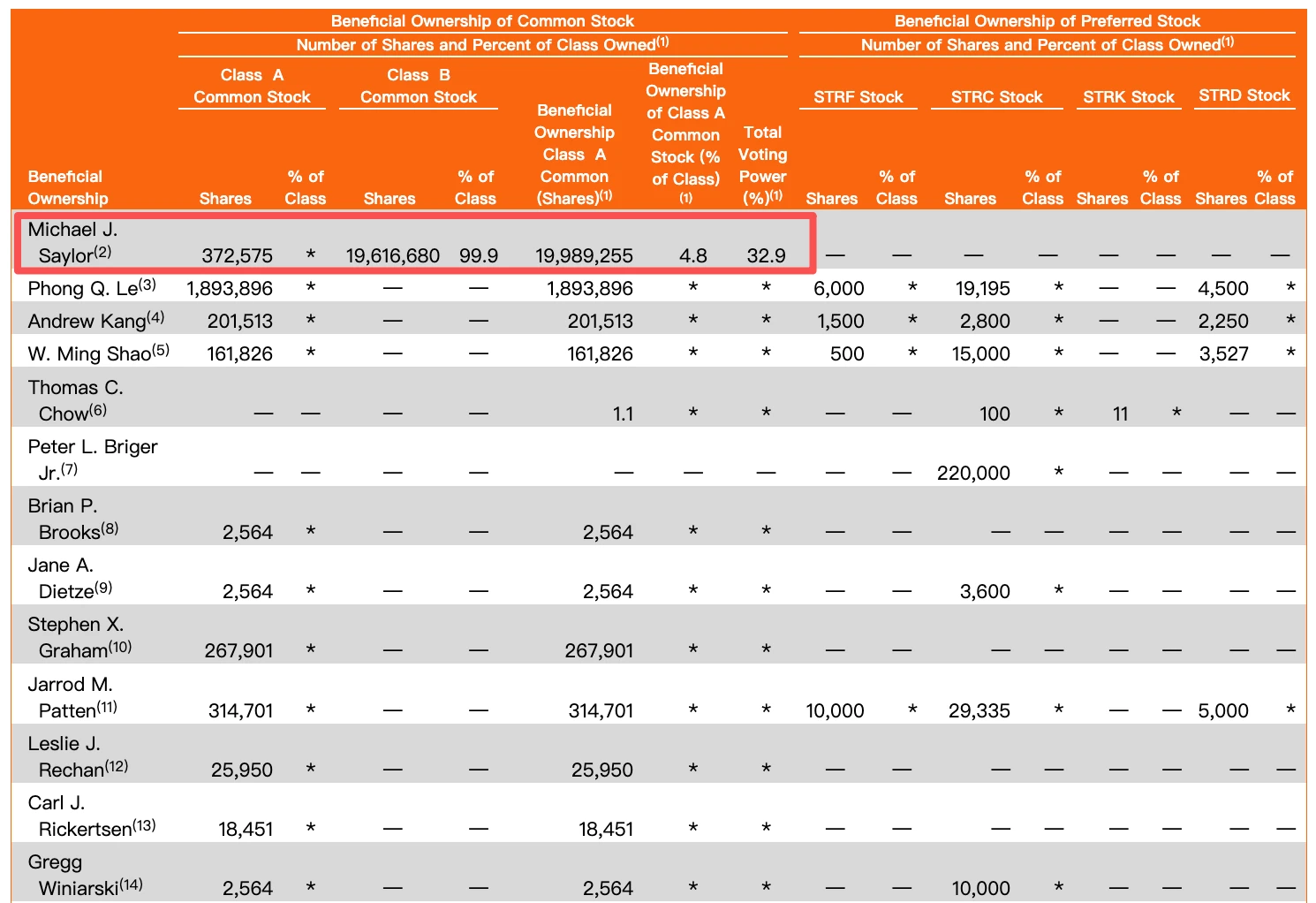
- The proposal requires majority support from the voting power of all outstanding common shares. Saylor controls 32.9% of voting power and still needs about 17.1% support from other shareholders; abstentions count as opposition.
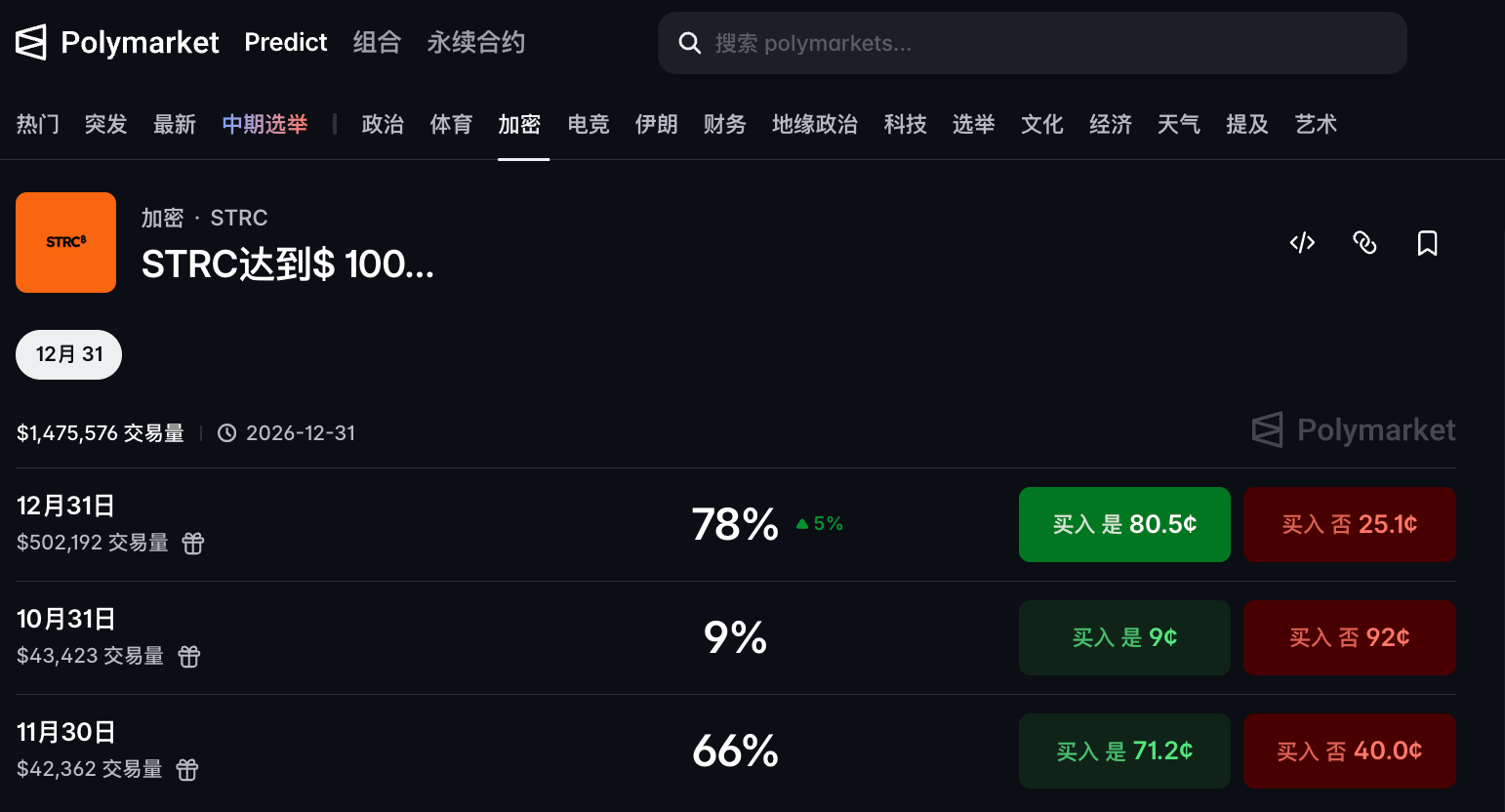
- Polymarket shows a 78% probability that STRC will reach $100 before year-end, 66% by the end of November, and only 9% by the end of this month.
- Daily dividends still require board declaration for each period and available distributable funds; daily payment does not equal rigid repayment, and DRIP support depends on brokerage channels.
- Strategy disclosed $193 million and $205 million of STRC buybacks on October 19 and 26, respectively, with the funds coming from the same pool used for bitcoin purchases.
Original | Odaily@OdailyChina)
Author | Wenser (@wenser 2010 )

At 10:00 PM Beijing time on October 28 (10:00 AM Eastern Time on October 28), Strategy's special shareholders' meeting will be held online to vote on whether to amend the designation certificates of its four preferred stocks—STRC, STRF, STRK, and STRD—to allow for a daily dividend record date. Voting has been open since the proxy statement was mailed on October 5, with remote voting closing at 11:59 PM Beijing time on October 28.
If the proposal passes, STRC will have a record date on every calendar day (including weekends and holidays) starting November 1, with dividends paid on the next business day, the first falling on November 2 at $0.03 or $0.04 per day, totaling $1.00 per share for November, corresponding to a 12% annualized yield. If it does not pass, $0.50 will be distributed on November 15 as originally planned, and holders cannot receive both dividends. STRF, STRK, and STRD, which originally paid quarterly, will switch to daily payments with the first record date on January 1, 2027, and the first payment on January 4, 2027.
In June of this year, Strategy had just changed STRC's dividend cycle from monthly to semi-monthly; five months later, as STRC approaches its $100 par value, the company wants to increase the frequency to daily. As of October 25, Strategy holds 848,517 bitcoins, with an additional $4.83 billion in reserves (dedicated to preferred stock dividends and debt interest) and $242.4 million in available cash.
Can daily dividends drive a new round of STRC financing and Strategy's common stock? This article will discuss the STRC daily dividend adjustment for readers' reference.
The Core Engine of the "Financing Flywheel" STRC Fell to as Low as $71
As one of Strategy's core financing tools, STRC has not touched its $100 par value since mid-May. In June, amid extremely pessimistic market sentiment, Bitcoin fell below $60,000, and STRC once dropped to $71.25 (June 26), hitting a record low since listing.
To reverse the stock price decline and improve operating liquidity, Strategy subsequently made its first "BTC sell operation" in three years. On one hand, the sale alleviated its passive position and freed it from the previous market expectation that "Strategy only buys, never sells"; on the other hand, selling BTC also indirectly proved that Strategy has sufficiently diversified funding methods to cope with a volatile market environment. At the same time, this move also desensitized the crypto market to the notion of "Strategy selling coins to crash the market" to a certain extent—killing multiple birds with one stone.
Subsequently, as Strategy bought more BTC and the market environment improved, the prices of BTC, Strategy's common stock (MSTR), and STRC all rebounded, and the cash flow on Strategy's balance sheet improved significantly. It can be said that "the toughest moment has passed."
As of press time, MSTR's stock price is around $141, and STRC's par value has returned to $99.49;as of October 25, 2026, Strategy holds 848,500 BTC and $5.1 billion in assets.
Probability of STRC Returning to $100 Par Value by Year-End Currently at 78%
Polymarket data shows that the probability of "STRC hitting $100 before December 31 this year" has risen to 78%; the probability of "achieving it by the end of November" is currently at 66%; and the probability of "achieving it by the end of this month" is only 9%.
It is evident that despite a gap of only about $0.50, prediction markets still do not hold much hope for STRC to return to its $100 par value in the short term.
Daily Dividend Vote About to Begin: MSTR Shareholders Vote, at Least 17% of Other Shareholders' Voting Rights Needed
According to Strategy's official voting page, the proposal requires majority support of all outstanding common stock voting rights, with abstentions and broker non-votes counted as opposition; preferred stock holders have no voting rights. Only common stockholders of record as of September 25 can vote: Class A shares have 1 vote per share, totaling 402,337,658 shares; Class B shares have 10 votes per share, totaling 19,640,250 shares, for a combined total of approximately 599 million votes.
According to the DEF 14A ownership table previously filed by Strategy with the SEC, Strategy Chairman Michael Saylor personally controls 32.9% of total voting rights; to pass the proposal by majority, it still needs the support of approximately 17.1% of other shareholders' voting rights.
It is worth noting that the October 28 voting meeting will be held online; even if the proposal passes, Strategy still needs to file amended designation certificates (STRC designations) with the Delaware Secretary of State before it can take effect; the proxy statement also includes a proposal authorizing the meeting to be adjourned to continue soliciting votes if there are insufficient votes; to smoothly execute the first dividend payment on November 2, it must be completed by 00:01 Eastern Time on November 1 at the latest.
The Pros and Cons of STRC Daily Dividends: Good for Stabilizing Price Disturbances, but Cannot Change Principal Risk
As an important part of Strategy's "financing flywheel," STRC has a tremendous impact on stabilizing market confidence, stabilizing MSTR's stock price, sustaining financing, and continuously buying BTC to gain appreciation capital.
Going forward, if daily dividends can be successfully implemented, it will have a certain positive effect on Strategy, STRC holders, MSTR holders, and BTC. On one hand, Strategy can use this to continue operating the financing flywheel, improve capital utilization, significantly improve liquidity, and reduce ex-dividend day volatility. On this point, Strategy explicitly stated that the intent is to suppress the price disturbance caused by dividend accrual, in order to keep STRC more stably close to its $100 par value; the preferred stock will be closer to a daily-settled cash account, attracting more investors to join, thereby increasing the safety cushion of Strategy's balance sheet, lowering financing costs, enhancing the company's credit, and consequently providing some support for BTC's price.
On the other hand, however, daily dividends are not a panacea; they also carry corresponding hidden risks or risk factors that are difficult to change.
First, the process and settlement of daily dividends cannot be omitted. Dividends still must be declared period by period by the company's board of directors and require legally distributable funds; daily payment does not equal rigid repayment; whether brokers support automatic daily dividend reinvestment (DRIP) depends on the brokerage channel entry point used by different users, and does not entirely mean a reduction in financing pressure;
Second, daily dividends improve cash flow granularity, not principal stability. They can weaken the gap on monthly ex-dividend days and dividend capture trading, but cannot turn a perpetual preferred stock into a money market fund. This point has been evidenced by BTC treasury company Strive, whose switch of dividend frequency from monthly to daily still failed to change SATA's short-term decline. In other words, daily dividends reduce the volatility of dividend investing and avoid speculative dividend trading around a fixed single day; but they essentially do not eliminate price risk—whether STRC investors' principal suffers losses still depends heavily on Strategy's corporate credit, BTC's price performance, and the crypto market's conditions and sentiment.
Third, daily dividends mean that Strategy's cash outflows will be more fragmented and frequent, inevitably increasing the financial and custodial operational burden. This is a necessary cost of operating as a public company and is difficult to avoid.
Fourth, Strategy's own capital structure has not changed significantly. Strategy disclosed on October 19 and 26 STRC buybacks of $193 million and $205 million, respectively, and the buyback funds were cash that could have been used to buy BTC or retained—the same capital pool from which preferred stock financing buys coins. If the daily dividend vote fails to pass as scheduled, combined with the impact of the Q3 earnings disclosure window on October 29, Strategy's flywheel narrative of "finance to buy BTC—wait for BTC appreciation—pay dividends from appreciated share—continue buying more BTC" will inevitably be questioned again in the short term, affecting investor sentiment and confidence, and conversely increasing the difficulty of subsequent financing.
Of course, from an investor's perspective, if STRC's par value subsequently returns to $100 and it truly becomes one of the first listed securities to accrue or pay dividends on a calendar-day basis, it may attract more DAT treasury listed companies to issue preferred stock to diversify financing channels, objectively promoting capital utilization efficiency for both investors and listed companies, driving a new round of capital inflows, and bringing a wave of incremental capital to the crypto market.
Currently, this "dividend cycle change" that has been brewing for nearly half a year carries a distinct "must succeed, cannot fail" undertone for Strategy and Michael Saylor. As for the outcome, we will likely know the answer very soon.





