


Falling with a floor, rising with a cap—BlackRock wants to attract "old money" with PBIT


- Core Viewpoint: BlackRock has filed for its third bitcoin-related ETF, PBIT, which employs a buffer structure combining call spread options with short-duration fixed income, capping the maximum loss per tranche at approximately 10% while also capping upside gains. It targets institutions and "old money" funds that want digital asset exposure but cannot withstand bitcoin's high volatility.
- Key Elements:
- PBIT is registered under the Investment Company Act of 1940 as a buffered actively managed ETF. It does not directly hold bitcoin or bitcoin ETPs, uses IBIT as the reference asset, with BNY Mellon serving as custodian and administrator, and is scheduled to launch in January 2027.
- The strategy consists of three parts: buying in-the-money call options with a strike price at approximately 90% of the initial price to gain participation and establish a loss floor of about 10%; selling higher-strike call options to collect premiums that offset costs but cap gains; and allocating to cash, money market funds, short-term Treasuries, and investment-grade bonds, using interest to subsidize option costs.
- Positions are split into three tranches that roll over on a staggered monthly basis, diluting the luck factor of opening positions at a single point in time. Investors ultimately receive a blended floor and cap.
- Return example: with an initial price of 100, a purchased strike of 90, and a sold strike of 125, if IBIT rises to 140, PBIT gains only about 25%; if it falls to 80 or even 40, the loss still stops at about 10%.
- This is BlackRock's third bitcoin ETF following the spot IBIT and the income-oriented BITA launched in June. Both new products limit upside—BITA to generate income, PBIT to limit losses. Similar buffer products have precedents such as Calamos CBOJ, FT Vest BFJA, and Innovator QBF.
- Market backdrop: U.S. spot bitcoin ETFs saw net inflows of approximately $3.52 billion in August, the highest single month this year, with total net assets rising from $76.29 billion at the end of July to $99.61 billion; September net inflows were approximately $2.6 billion, while October saw net outflows of approximately $200 million as of press time; IBIT's historical net inflows grew from approximately $63.1 billion at the end of August to $66.24 billion as of October 26.
Original | Odaily (@OdailyChina)
Author | jk

Recently, BlackRock's iShares Trust submitted Form 485APOS, proposing to launch the iShares Bitcoin Managed Protection ETF, with the proposed ticker PBIT.
The fund is a buffer ETF registered under the Investment Company Act of 1940. It does not directly hold Bitcoin or a Bitcoin ETP; instead, it uses IBIT as the reference asset, constructing a call spread through FLEX options (buying in-the-money call options and selling call options with a higher strike price), while allocating to short-duration fixed-income assets. The initial maximum loss for a single option tranche is approximately 10%, and upside gains are capped by the strike price of the sold call options.
In other words, this product has a downside floor and an upside cap, and can be said to be designed specifically for "old money" investors who want exposure to digital assets but do not want to take on too much risk. The product is scheduled to launch in January 2027. The listing exchange, issuance date, management fee, and total expense ratio have not yet been announced.
What Is PBIT?
PBIT is an actively managed ETF, with BlackRock Fund Advisors as the investment adviser. The investment objective stated in the prospectus is: to provide upside participation in IBIT and/or similar Bitcoin exposure while seeking a degree of downside protection.
The fund does not directly hold coins—it buys neither Bitcoin nor Bitcoin ETPs; all exposure comes from options. Custody and administration are handled by BNY Mellon. The management fee and total expense ratio are both left blank in the prospectus and have not yet been disclosed; regarding listing, the prospectus states effectiveness 75 days after filing, with the listing exchange and issuance date not yet specified.
Strategy Breakdown: Call Spread + Fixed Income
The prospectus calls this structure the "Bitcoin Managed Protection Strategy", consisting of three components.
The first step is buying in-the-money call options. For each tranche, the fund buys call options with a strike price below the initial price, used to gain Bitcoin participation and to provide protection once the price falls below that strike. The strike is typically set at approximately 90% of the initial price, so the initial maximum loss for a single tranche is approximately 10%.
The second step is selling call options with a higher strike price. The premium received from the sold options is used to offset the purchase cost, at the price of capping upside: the strike price of the sold options determines the approximate ceiling on upside participation. The cap depends on market conditions at the time of opening the position, and the prospectus does not provide specific figures.
The third step is fixed-income cash management. The fund allocates capital to cash, money market funds, short-term Treasuries, and short-term investment-grade bonds, with interest used to offset option costs and partially hedge losses.
For readers unfamiliar with options, PBIT can be understood as a "discounted Bitcoin investment": when Bitcoin rises, you capture most of the gains; when it falls, losses are compressed within a limited range; the trade-off is that once the price rises above a certain level, the upside beyond that no longer belongs to you.
The fund does not hold Bitcoin. Most of its capital is placed in assets such as Treasuries and money market funds, while a portion is used to buy contracts called call options. The rule for such contracts is: at expiration, if the price of IBIT is above the agreed price (strike price), the holder receives the difference; if it is below the strike price, the contract expires worthless, and the maximum loss is the amount spent on the contract—no more. The strike price PBIT buys is only about 90% of the price at position opening, so as long as the price does not fall below this line, the fund's net value essentially moves in tandem with the Bitcoin ETF; once it falls below, the option value goes to zero, but the remaining capital is still in Treasuries, and losses stop at approximately 10%. This is the source of the downside floor.
The problem is that such a contract is not cheap in itself, because it is already close to "in the money" and therefore naturally expensive. To reduce costs, the fund simultaneously sells another call option with a higher strike price, with the specific level depending on market conditions at the time of opening. Selling the option brings in cash that exactly offsets the cost of buying the option. The trade-off is that the fund effectively promises the counterparty: if the price rises above that higher level, the excess belongs to the counterparty. So the fund's returns are capped there.
In other words, trading upside for a downside floor is a transaction: the floor is insurance bought with money, and the upside cap is the way the insurance premium is paid. Part of the premium is paid by giving up upside, and part is covered by interest from Treasuries and money market funds.
As for why the position is divided into three tranches: options have expiration dates, and if only one were used, the timing of entry would almost determine everything. Splitting the position into three, staggered monthly and rolled over, dilutes the luck factor. Different tranches have different floors and caps, and investors ultimately receive a blended result.
Return Example
Suppose at the time a tranche is opened, the IBIT price is 100, the fund buys a call with a strike of 90 and sells a call with a strike of 125 (hypothetical cap). Excluding fees and interest, the approximate outcomes for that tranche at expiration are as follows:
If IBIT rises to 140 at expiration, a 40% gain from the initial price, PBIT only captures about 25% in returns, because the gain is capped at 125. At that point, the value of the call the fund holds with a strike of 90 is 140 minus 90, equal to 50; but on the call it sold with a strike of 125, it must pay the counterparty 140 minus 125, equal to 15. Netting the two, the fund actually receives 35. Assuming the combined net cost of the two options is about 10, the return after deducting that is about 25, which is about 25% relative to the initial price of 100.
If it rises to 110, a 10% gain, the tranche also earns roughly 10%. If it falls to 80, a 20% decline, the tranche loses about 10%, already at the floor; even if it falls to 40, a 60% decline, the tranche's loss still stops at about 10%. The actual product is a combination of three tranches.
What Are PBIT's Advantages Over Spot ETFs?
Compared with spot ETFs such as IBIT, PBIT's core difference is that it exchanges a portion of uncertain Bitcoin upside for a downside floor.
By design, the initial maximum loss for a single tranche is approximately 10%, whereas spot ETFs and Bitcoin move in complete lockstep in price. This makes it easier for institutions and wealth management clients with drawdown constraints to allocate, because the predictable loss range can be directly incorporated into risk control frameworks.
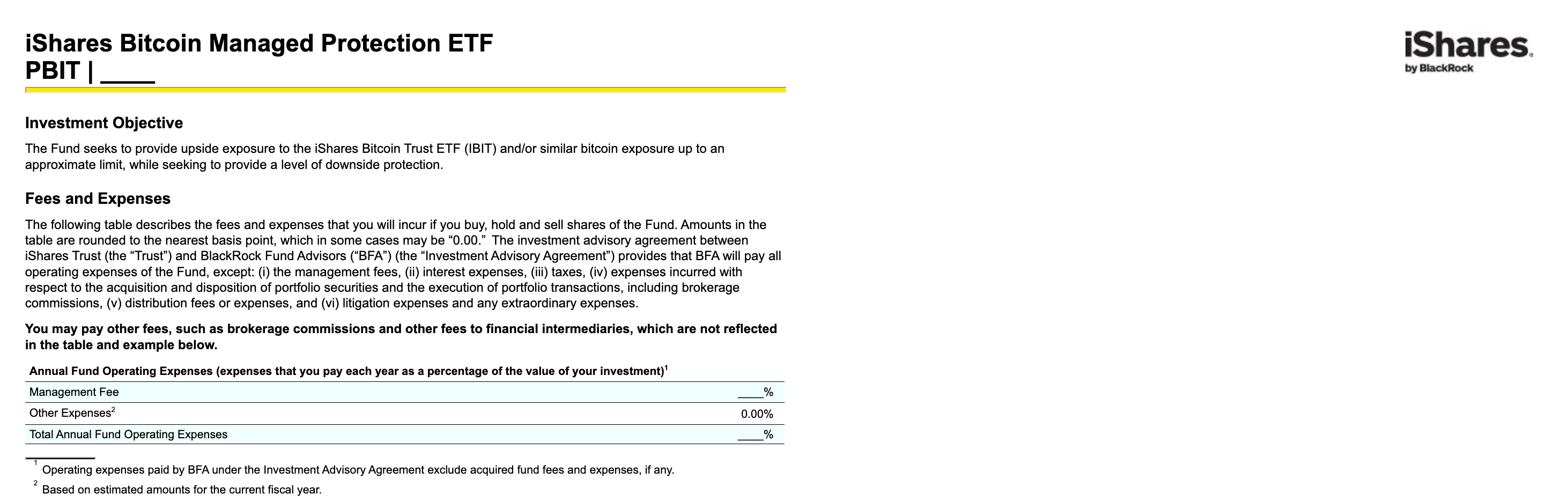
Registration statement filed by BlackRock, source: SEC
From a product design perspective, PBIT's potential buyers are likely institutions that have long taken a wait-and-see approach to digital assets, or institutions and family offices that are interested in allocating but cannot tolerate Bitcoin's extreme volatility.
For wait-and-see institutions, spot ETFs and Bitcoin assets have no limit on drawdowns, and their volatility is far higher than that of U.S. equities, making it difficult to provide an internally acceptable maximum loss figure; PBIT, by contrast, keeps the initial loss for a single tranche at approximately 10%, so the loss range can be estimated in advance and risk budgets are easier to design. Such capital wants a portion of Bitcoin's upside while avoiding being deeply trapped during downturns, and PBIT happens to offer a compromise that can be clearly explained to LPs.
BlackRock's Third Bitcoin ETF
Bloomberg Intelligence analyst James Seyffart noted that this is BlackRock's third Bitcoin-related ETF filing, calling it a "buffer" product in which investors must give up some upside in exchange for protection. The first two are the spot IBIT and the iShares Bitcoin Premium Income ETF (BITA), launched in June this year, which generates income by selling call options. Both new products limit Bitcoin's upside: BITA to generate income, and PBIT to limit losses.
There are precedents for similar products, including Calamos' CBOJ, FT Vest's BFJA, and Innovator's QBF.
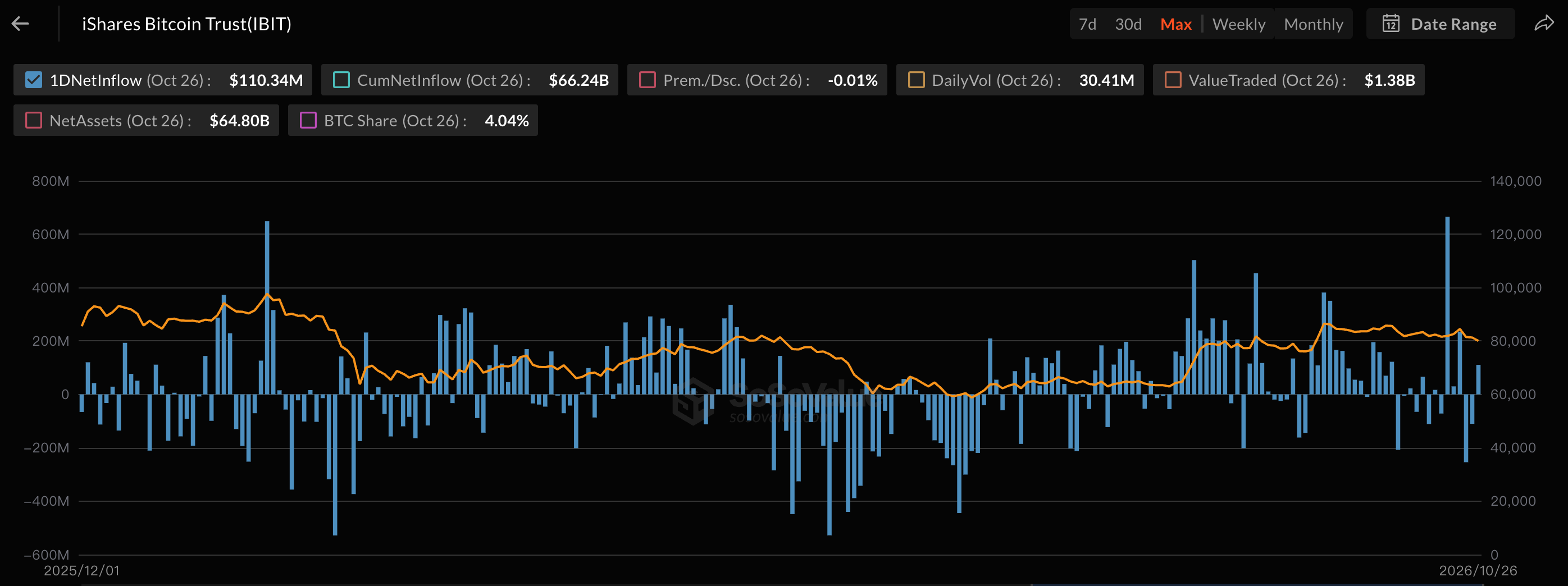
IBIT net inflows, source: Sosovalue
According to SoSoValue data, U.S. spot Bitcoin ETFs recorded net inflows of approximately $3.52 billion in August, the highest single month this year, with total ETF net assets rising from $76.29 billion at the end of July to $99.61 billion. September remained in net inflow, at approximately $2.6 billion; in October, as of publication, cumulative net outflows for the month were approximately $200 million. Among them, IBIT's historical net inflows were approximately $63.1 billion at the end of August and $66.24 billion on October 26, a cumulative net increase of approximately $3 billion over the two months.





