






Jensen Huang Steps In to "Save the Market": Backing CoreWeave, Says "AI Compute Relying Entirely on Two Labs" Is a Major Misreading


- Core Viewpoint: Jensen Huang responded to market doubts about ROI on AI compute investment, stating that betting trillions of dollars in compute buildout on the revenue of two AI labs is a miscalculation. Nvidia's compute demand is composed of three major segments: foundational computing, frontier labs, and thousands of startups.
- Key Elements:
- The world's top 20 tech stocks by market cap shed over $1 trillion this week, and CoreWeave's CDS spread once spiked to 1,194.5 basis points, implying a default probability of over 60%.
- Jensen Huang publicly endorsed CoreWeave, saying its cost of capital is declining and that it does not need Nvidia to backstop it. CoreWeave shares closed up 5.94% that day, defying the broader market decline.
- Nvidia's compute demand is roughly evenly split across three segments: foundational computing (non-AI), frontier labs (five or six, not two), and thousands of startups renting compute.
- Jensen Huang predicted that global AI infrastructure buildout will reach $3 trillion to $4 trillion annually by the end of this decade, and he would not be surprised if it reached $10 trillion over the longer term.
- Nvidia's market value per gigawatt of compute has risen from about $18 billion to over $40 billion, accounting for roughly 40% of CSP capital expenditure.
- By 2027, the bottleneck for compute buildout will be land, power, permits, and construction labor. Power scarcity will actually push customers toward Nvidia's platform, which delivers the highest output per watt.
Original author: Long Yue
Original source: Wallstreetcn
Global tech stocks suffered a massive sell-off this week, with the world's top 20 tech companies collectively shedding over $1 trillion in market value, as doubts over the returns on AI infrastructure investment intensified sharply.
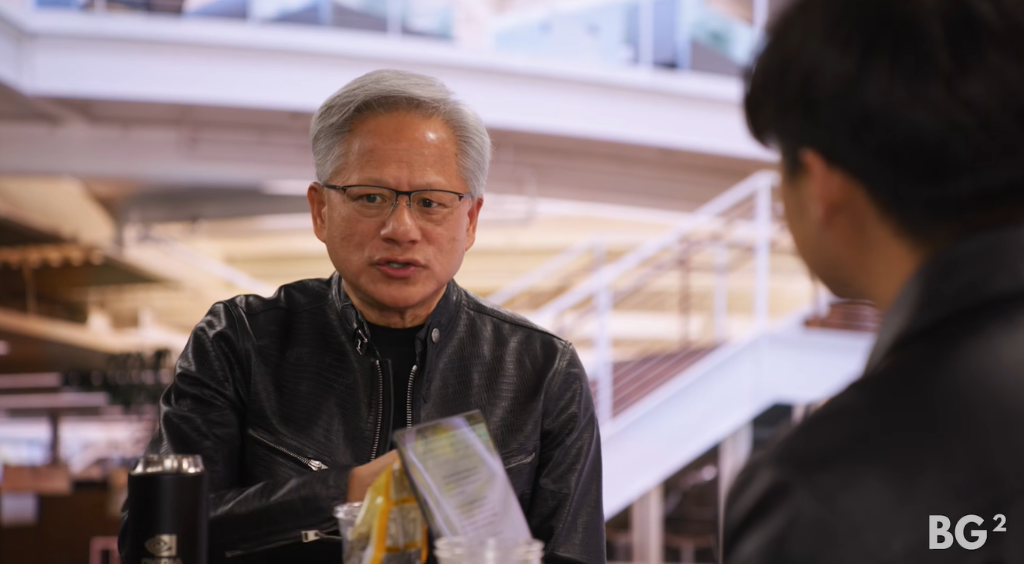
At this critical juncture, Nvidia CEO Jensen Huang made a series of moves—first publicly endorsing CoreWeave in an interview with Bloomberg in Stockholm, and then releasing a nearly 140-minute in-depth interview on the BG2 podcast, addressing the market's most central anxiety: who exactly will foot the bill for AI compute buildout?
Notably, Huang's interview on the well-known Silicon Valley investment podcast "BG2" was released at nearly 7 a.m. ET on October 15, ahead of the U.S. stock market open, just as Wall Street traders, analysts, and quant funds were nervously preparing for and responding to the market open.
In the Bloomberg interview, Huang made it clear that CoreWeave "does not need Nvidia to provide any backstop support," and said its "cost of capital is actually declining." These remarks directly drove a rebound in new cloud computing stocks intraday, with CoreWeave closing up 5.94% against the broader market trend that day. The Nasdaq index subsequently recovered all its losses, and Barron's, in a retrospective report, said the market "only needed a few reassuring words from the 'godfather of AI' Jensen Huang."
In the BG2 interview, Huang went further, directly pinpointing the market's core misjudgment: betting trillions of dollars in compute buildout on the revenue of just two AI labs is "asking the wrong question." He broke down Nvidia's compute demand into three roughly equal segments, with frontier labs accounting for only about one-quarter to one-third of it, and involving five or six institutions rather than the two the market typically recognizes. This judgment has direct market reference value for understanding the true logic of AI infrastructure investment.

The CoreWeave Turmoil
CoreWeave is one of the most closely watched pressure points in this round of tech stock sell-offs. According to ICE Data Services data, the five-year credit default swap (CDS) spread insuring against CoreWeave's debt default risk surged as much as 74.5 basis points intraday, hitting an intraday record high of 1194.5 basis points, with an implied five-year default probability exceeding 60%.
This signal put the market on high alert. CoreWeave has aggressively borrowed to expand its compute capacity, and Nvidia is both its equipment supplier and holds roughly a 10% stake as its second-largest shareholder. This "supplier financing the buyer, who then buys the supplier's products" circular financing structure has sparked widespread doubts about the financial sustainability of AI infrastructure expansion.
Huang's remarks in Stockholm directly counteracted the pricing in the credit market. "CoreWeave is getting stronger every day," he told Bloomberg. "I'm very optimistic. Their cost of capital is actually declining." He also made clear that Nvidia does not need to provide any form of backstop support for CoreWeave.
The weight of these words lies in Huang's dual identity—he is both CoreWeave's most important equipment supplier and its second-largest shareholder. The market's reaction was immediate: CoreWeave's stock closed up 5.94% that day, halting a two-day cumulative plunge of over 18%.
Breaking Down the Misjudgment: Compute Demand Goes Far Beyond Two Labs
One of the deeper reasons behind this week's market sell-off is systematic doubt about the returns on AI infrastructure investment—if OpenAI and Anthropic's revenue growth slows, who will pay for trillions of dollars in compute buildout?
In the BG2 interview, Huang characterized this logic as "asking the wrong question." He broke down Nvidia's compute demand into three roughly equal segments:
The first, about one-third, is foundational computing entirely unrelated to AI labs—molecular dynamics, physics simulation, quantum chemistry, classical machine learning (such as Visa and Mastercard's fraud detection), recommendation systems, and more. "Even with no AI at all, Nvidia wouldn't be zero," he said. "This business grows 30% to 40% a year."
The second, about one-quarter to one-third, is compute demand from frontier labs. But Huang emphasized that while the market typically sees only two, he sees five or six—Meta, Grok, Gemini, Anthropic, and others that are rising. "If you tell me that represents less than a third of our business, about a quarter, that's fine."
The third, also about one-third, is thousands of startups renting compute—which he likened to "the next-generation AWS." Of these companies, 80% use open-source models, building specialized intelligence in vertical domains like physical AI, biological AI, and materials science. "Think of this large cloud computing segment as the next-generation AWS," he said. "This is today's AWS, just oriented toward the future."
"Betting trillions of dollars in buildout on the revenue of two labs is a big mistake," Huang said. "I'm happy to work with them and support them. They will become one of the most important tech companies ever, and they will achieve brilliant success. But their revenue doesn't need to approach a trillion dollars for this to work."
The Underlying Logic of Accelerating Demand
In the interview, Huang systematically explained the internal mechanism of why compute demand won't decelerate linearly, but will continue to accelerate.
The core lies in the multiplication of two compounding factors. First, reasoning (thinking) is orders of magnitude more expensive than recitation-style generation—AI needs to explore multiple approaches, plan, reflect, prune, and retain "strategic options," which itself consumes enormous compute. Second, the more capable the model, the more scenarios it gets "hired" for. "It uses more compute to do the work, but it does it well, so we'll hire it to do more work," he said. "These two things compound, and demand accelerates rather than decelerates."
The key unlock last year, which Huang called "harness"—working memory management, knowledge graph construction (similar to offline compression during sleep), and tool use—these three things transformed large language models from "chatbots" into agents capable of doing real work in enterprises. "Coding was the first landing scenario," he said. "Design and creativity are the next wave."
In his view, OpenAI and Anthropic currently each have roughly only two to three gigawatts of compute, "which is a very small amount relative to the scale that's coming." And it was at such a small scale of compute that AI already solved the Navier-Stokes equations, one of the Millennium Prize mathematical problems. "This is the worst intelligence we will ever have from now on," he said. "From here, it only gets better."
Power Scarcity Reinforces Nvidia's Share, with 2027 Bottleneck in the Physical World
In the interview, Huang gave a clear judgment on the 2027 compute buildout bottleneck: demand will be "no less, only more," but land, permits, power, and construction labor will be the main obstacles.
According to BG2 host Brad Gerstner, citing SemiAnalysis data, 43 gigawatts of AI compute will be added next year, exceeding today's total global installed base, with another 40 gigawatts added the year after. Huang agreed with the demand-side assessment of this figure but pointed out that physical-world constraints will limit the actual pace of deployment. "Land, power, shells," he said. "This will be one of the most critical obstacles."
Notably, in Huang's framework, power scarcity actually becomes a driver for further increasing Nvidia's market share. His argument is that Nvidia's architecture delivers the highest tokens per watt globally, and the tighter power becomes, the more customers tend to choose the platform with the highest output per unit of energy. "When power is reduced, the quality of the compute you put in must be the highest," he said. "We are the most rentable, the most interchangeable, the most durable."
He further disclosed that the market value corresponding to each gigawatt of Nvidia compute has risen from about $18 billion to over $20 billion, now exceeding $40 billion, and still climbing. In global cloud service providers' (CSP) capital expenditure, Nvidia accounts for about 40%; on the non-CSP side (including on-premise deployments and new cloud computing), the share is about 80%. "Six years ago, our share of global capital expenditure was still in the single digits," he said.
By the End of This Decade: $3-4 Trillion in Annual Buildout, "10 Trillion Wouldn't Surprise Me at All"
In the interview, Huang laid out his framework for judging the long-term scale of AI infrastructure, which is also the core basis for his belief that the market underestimates the persistence of AI compute demand.
His calculation path is as follows: before AI emerged, global computing infrastructure buildout was about $500 billion annually, on a natural growth trajectory. Combined with the impact of Moore's Law ending—"if you want twice the transistors, no matter how long you wait, you'll pay twice the price"—the semiconductor industry was already on a path to becoming the world's largest industry. Add to that the new demand brought by AI and a new wave of entrepreneurship, "by the end of this decade, annual buildout will be between $3 trillion and $4 trillion, closer to $4 trillion, with pure computing at about $1.5 trillion," he said.
For a longer-term outlook, he said: "If someone tells me annual infrastructure construction and renewal reaches $10 trillion, I wouldn't be surprised at all."
On Nvidia's own financial strategy, Huang revealed that the company currently uses over 50% of its free cash flow for share buybacks, a figure that reached about 60% last quarter. He also mentioned two new growth vectors: enterprise software licensing (charging annual fees based on GPU count), and revenue-sharing (Revshare) arrangements with some cloud service providers—both paths are relatively independent of hardware sales, relying on Nvidia's massive installed base and ecosystem.





