STRK Defies the Trend with a 40% Surge: Can Quantum Resistance and an L1 Pivot Save Starknet?


- Core View: Starknet's CEO proposed a quantum-resistant upgrade and is considering a transition to an independent L1, triggering a counter-trend rally of over 40% in STRK. However, the network's actual revenue remains limited, and the surge may be short-term speculation.
- Key Elements:
- BTC fell below $80,500, while STRK surged over 40% against the trend, now trading at $0.0684.
- StarkWare has released a quantum-resistant roadmap and completed an experimental quantum-resistant transfer test on mainnet, with fees of approximately 6 cents.
- The CEO stated that transitioning to an independent L1 would allow full control over upgrades, with full quantum safety achievable as early as 2027—ahead of Ethereum's 2029 target.
- Starknet still relies on Ethereum for settlement and security, and its quantum-resistant upgrade is constrained by Ethereum's progress.
- Q2 averaged approximately 239,000 daily transactions and about 50,000 daily active addresses, with AVNU and Cartridge together contributing roughly 91% of transaction volume.
- Fee revenue over the past 24 hours was only $13,700, indicating a severe divergence between on-chain actual revenue and the token price surge.
Original | Odaily (@OdailyChina)
Author | Asher (@Asher_ 0210)
Last night, BTC continued to decline, briefly falling below $80,500, with mainstream altcoins broadly pulling back. STRK, however, surged against the trend, gaining over 40% at one point in the past 24 hours and currently trading at $0.0684.
This L2, which was mocked by the market earlier this year for having "only 8 daily active users and just 10 daily transactions," has suddenly become the center of attention. This rally was mainly driven by remarks from StarkWare CEO Eli Ben-Sasson. Yesterday afternoon, he proposed that to accelerate quantum-resistant upgrades, the team is considering spinning Starknet off from Ethereum and converting it into an independent L1. After the news spread on social media, STRK's price quickly surged.
Quantum resistance and L1 transition — can these two new narratives rewrite Starknet's "nobody uses it" predicament, or will they only bring a round of short-term speculation?

Quantum Resistance Narrative Heats Up, Starknet Already Has Mainnet Testing
As early as June 30 of this year, StarkWare had already released Starknet's quantum resistance roadmap, planning to advance security upgrades in three phases to address potential attack risks from future quantum computing. The underlying architecture based on STARK proofs provides the technical foundation for Starknet to pursue this upgrade.
Subsequently, StarkWare announced a mainnet transfer test. A wallet account using OpenZeppelin's experimental Falcon-512 quantum-resistant signature scheme completed a real transfer on Starknet, with a transaction fee of approximately 6 cents. The account remains an unaudited experimental version, primarily used for research and testing.
Quantum-resistant signatures address wallet security. When users transfer funds, they need to sign with a private key to authorize the transaction. If future quantum computers can crack traditional signature algorithms, attackers could forge authorizations and steal assets. Quantum-resistant signatures adopt different cryptographic schemes to defend against such attacks.
Starknet's advantage lies in the fact that wallets can directly upgrade their signature schemes. Each account is a smart contract that can set its own signature verification rules, enabling the introduction of quantum-resistant signatures while retaining the original address and assets, without the need for a network-wide hard fork.
However, a single experimental transfer does not mean the entire network has achieved quantum-resistant security. Beyond wallet signatures, there are other components of the network that need upgrading, and some of them depend on Ethereum.
Why Consider Transitioning to L1? Quantum-Resistant Upgrades Are Still Constrained by Ethereum
As an Ethereum L2, Starknet still relies on Ethereum for settlement and underlying security. Even after completing its own quantum-resistant upgrades, it still faces dependencies on Ethereum for data availability, bridging, and message passing, and cannot unilaterally decide the upgrade pace of all security components. Therefore, if it wants to complete comprehensive quantum-resistant upgrades sooner, Starknet needs to consider whether to continue relying on Ethereum.
Yesterday afternoon, Eli Ben-Sasson stated that the team is considering multiple options, including transitioning to L1, to address cryptographic risks that quantum computing and AI may bring. According to his assessment, if it can autonomously control the upgrade process, Starknet could potentially achieve full quantum security as early as 2027, earlier than the end-of-2029 target he mentioned for Ethereum.
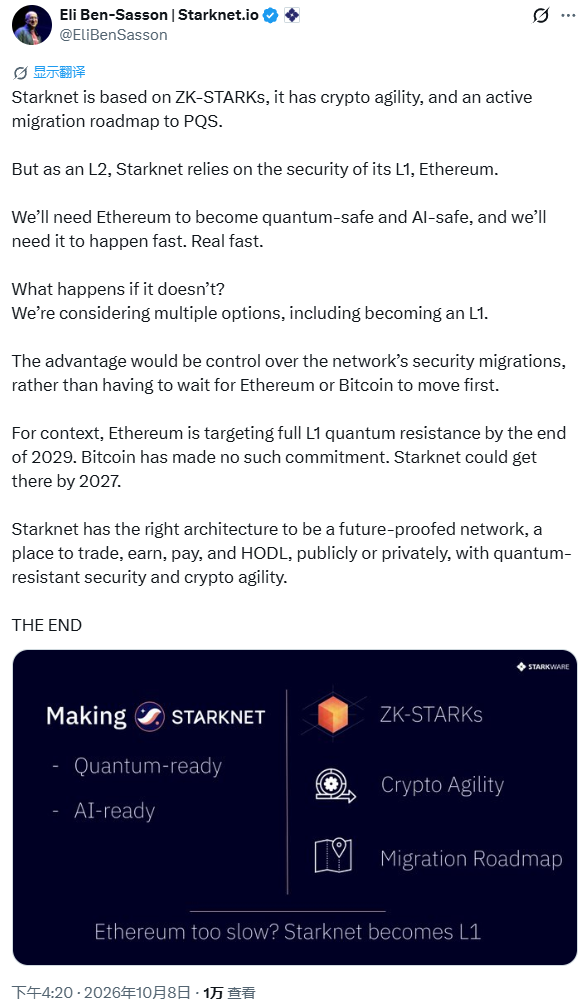
These remarks connected Starknet's previous quantum resistance exploration with the possibility of transitioning to an independent L1. The market now has a new expectation: this veteran L2 may no longer just scale Ethereum, but establish its own public chain and autonomously determine its security upgrade path. This has also become an important catalyst for STRK's rally against the trend.
However, the team has not yet decided whether to transition to L1, and completing full quantum-resistant upgrades by 2027 is only an expectation — the specific timeline remains to be confirmed.
Possibly Short-Term Speculation; Network Revenue Is the Real Test Ahead
Starknet's quantum resistance exploration has made tangible progress, and transitioning to an independent L1 has clear technical motivation. But currently, on one hand, there is an experimental solution that still needs auditing and promotion; on the other hand, there is an undecided transition discussion — there is still considerable work before full implementation.
The more realistic issue is that Starknet, in the eyes of many users, is still an L2 that "nobody uses." Quantum resistance and L1 transition can attract attention, but whether users are willing to move funds in and trade here long-term still depends on whether there are products worth using on-chain, sufficient liquidity, and a good enough trading experience.
According to Nansen's "Starknet H1 2026 Report," in Q2 of this year, Starknet's average daily transactions were approximately 239,000, with average daily active addresses of about 50,000. While it cannot be simply categorized as "unused," trading activity remains highly concentrated — AVNU and Cartridge together contributed about 91% of transaction volume, indicating strong ecosystem dependence on a few applications.
Beyond token price, on-chain usage and revenue growth deserve more attention. According to DefiLlama data, Starknet's fee revenue over the past 24 hours was only $13,700. Compared to STRK's over 30% gain, the chain's actual revenue still appears limited. At this stage, STRK's rally against the trend may just be "false prosperity" driven by a new narrative — a circulating market cap of nearly $500 million may already be quite high.

When Starknet's on-chain transactions continue to increase and bring sustained growth in fee revenue to the network, that may be the signal worth positioning for.