U.S. Treasuries are being sold off sharply, yet the tech sector keeps rising. What exactly is the market trading?


- Core View: The September 2026 U.S. Treasury selloff was primarily driven by rising real rates rather than inflation expectations. The market may be repricing for AI-driven economic growth and capital demand, but elevated term premiums mean the possibility of rising risk compensation also exists.
- Key Elements:
- The 10-year U.S. Treasury yield rose 54 basis points in a single month to 5.29%, of which real rates contributed 49 basis points while inflation compensation rose only 5 basis points.
- The semiconductor ETF (SMH) rose about 9.4% over the same period, while the equal-weighted S&P 500 fell about 4.8%, showing severe divergence between the tech sector and the broader market.
- Expanding AI infrastructure investment is driving up capital demand, with major cloud service providers continuing to invest in data centers, GPUs, and computing power buildout.
- The U.S. 10-year Treasury term premium rose to a roughly 12-year high, with risk compensation for holding long-term debt rising noticeably.
- The AI trade has a commercial loop yet to be validated: upstream chip suppliers have already profited, but profit improvement among downstream enterprises has yet to be broadly realized.
Editor's note: In September, the U.S. bond market experienced a round of severe selling. The 10-year Treasury yield rose from 4.75% to 5.29%, up 54 basis points in a single month, with some fixed-income assets falling between 2.3% and 5%. But if we break down the change in yields, we find an easily overlooked fact: over the same period, the 10-year real interest rate rose by about 49 basis points, while the market-implied inflation compensation rose by only about 5 basis points. In other words, this round of bond market selling was not primarily explained by rising inflation expectations—what actually changed dramatically was the real interest rate.
This raises a more complex question: why is the market willing to demand higher real returns? Typically, a rise in real interest rates may be related to stronger economic growth expectations, adjustments in the future monetary policy path, or higher risk compensation for holding long-term debt. What is more unusual is that while Treasuries fell sharply, AI-related tech stocks remained strong, with the semiconductor sector leading gains, while most other stocks came under clear pressure.
Harry Mamaysky, founder of QuantStreet Capital, offered an explanation in his latest monthly investment letter: the market may be repricing for stronger future economic growth and the capital demand generated by large tech companies' continued expansion of AI infrastructure. Under this framework, higher interest rates and strong AI stocks are not necessarily contradictory, because investors may believe that future earnings growth will be sufficient to offset the impact of higher financing costs and discount rates.
But this remains a market explanation yet to be verified. Rising real interest rates do not necessarily mean that growth prospects have improved, and changes in the term premium also imply that investors may be demanding higher risk compensation. For both the stock and bond markets, the key is to distinguish: does this round of rising interest rates reflect higher future economic returns, or does it mean that holding long-term assets has become more expensive and risky?
The following is a translation of the original article:
In September 2026, a rather unusual set of trends emerged in U.S. financial markets: Treasuries suffered a major sell-off, while tech stocks, especially the semiconductor sector, continued to rise.
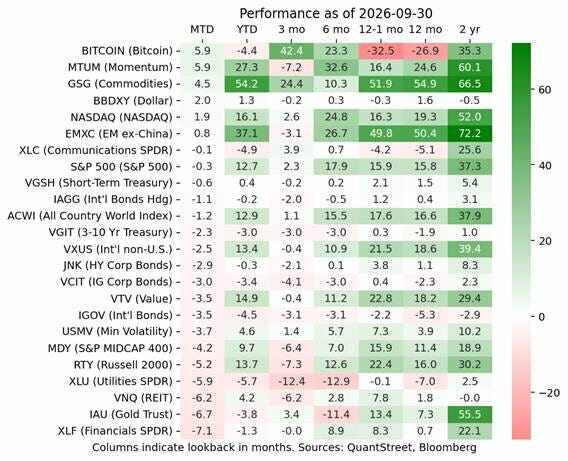
Major asset performance in September 2026: tech and momentum strategies were relatively strong, while many types of bonds and rate-sensitive assets came under pressure.
According to U.S. Treasury data, the 10-year Treasury yield rose from 4.75% at the end of August to 5.29% at the end of September, up 54 basis points in one month. QuantStreet Capital's statistics show that some U.S. fixed-income assets fell by 2.3% to 5% that month.
But the stock market did not experience a synchronized, broad decline. Bitcoin and momentum strategies with significant holdings in semiconductor and tech companies stood out, while the Nasdaq index continued to rise. At the same time, U.S. small- and mid-cap stocks, the equal-weighted S&P 500 index, and rate-sensitive sectors such as REITs, utilities, and financials were sold off.
Typically, a sharp rise in long-term interest rates raises corporate financing costs and lowers the discounted value of future profits, which is especially unfavorable for high-valuation stocks. But the divergence in the market this time suggests that investors may be pricing the future returns of different assets in very different ways.
QuantStreet founder Harry Mamaysky believes that to understand this round of market action, one must first answer a question: what exactly is the bond market trading?
1. The September surge in Treasury yields was really driven by real interest rates
From the perspective of yield structure, an important feature of the September Treasury sell-off was that nominal rates rose mainly in response to higher real interest rates, rather than a simultaneous surge in inflation compensation.
To understand this, one must first distinguish three concepts.
Nominal Yield is the Treasury yield investors typically see. It includes compensation for future inflation as well as required real returns and other risk factors.
Real Yield can be understood as the yield after subtracting inflation compensation. In the U.S. Treasury market, the yields on Treasury Inflation-Protected Securities (TIPS) are typically used to observe how the market prices real returns.
The difference between the two is the Breakeven Inflation Rate, often used as a reference indicator for the market's long-term inflation expectations. However, it also includes factors such as inflation risk and liquidity, and is not equivalent to a pure inflation forecast.
The change in Treasury yields in September can be further broken down. The 10-year nominal Treasury yield rose from 4.75% on August 31 to 5.29% on September 30, up 54 basis points. Of that, the real yield rose from 2.44% to 2.93%, up 49 basis points; implied inflation compensation rose only from 2.31% to 2.36%, up 5 basis points.
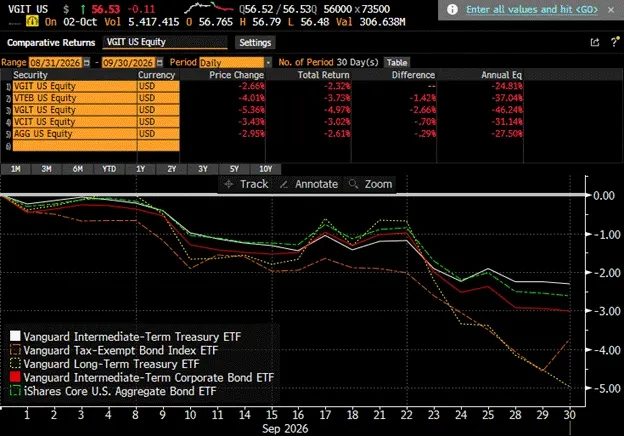
Performance of major U.S. bond ETFs in September: long-term Treasuries and some credit bonds came under clear selling pressure.
This means that more than 90% of the increase in the 10-year Treasury yield in September corresponded to a rise in real interest rates, rather than an increase in inflation compensation. At least from the breakdown of this market indicator, the main change in the September bond sell-off was not in inflation compensation, but in real interest rates.
This is especially important because rising real interest rates and rising inflation compensation often correspond to different economic explanations.
If the rise in yields mainly comes from inflation compensation, it may mean that investors are worried about future price increases and a decline in the purchasing power of money, and therefore demand higher nominal returns. But if the rise mainly comes from real interest rates, then one must further consider economic growth expectations, the future path of real policy rates, and the risk compensation investors require for holding long-term bonds.
This does not mean inflation risk has disappeared. The inflation level itself remains elevated, and oil prices, fiscal policy, and the Fed's rate path will also affect market expectations. But based on the yield changes in September, explaining this round of Treasury selling solely by "intensifying inflation concerns" is clearly insufficient.
2. It is not simply inflation worry—the market may be repricing economic growth and capital demand
Why did real interest rates rise significantly? In his investment letter, Mamaysky discussed several market explanations.
The first is that dollar credibility is being questioned. But the dollar actually appreciated in September, which does not fit the narrative of a broad crisis of confidence in dollar assets.
The second is that investors are beginning to worry about the U.S. government's debt-servicing capacity. The author believes that if the market's concerns about U.S. fiscal credit were mainly reflected through future inflation risk, long-term inflation compensation should have risen more noticeably, and the September data did not show this characteristic.
However, this does not rule out fiscal risk. Increased Treasury supply and higher risk compensation for holding debt could also push up long-term yields even with relatively stable inflation compensation.
By contrast, Mamaysky prefers to focus on another explanation: the market may be expecting stronger economic growth while repricing the growing capital demands of large tech companies.
The key variable here is AI. As investment in artificial intelligence infrastructure continues to expand, large cloud service providers (Hyperscalers) are investing enormous sums in building data centers, purchasing GPUs, expanding computing power, and deploying power and network infrastructure.
These expenditures first and foremost mean demand for capital.
From a macro perspective, if companies want to expand investment at the same time, while the long-term funds available for allocation do not increase in tandem, the price of capital may face upward pressure. At the same time, if investors believe AI will raise future economic productivity and create more corporate profits, they may correspondingly raise their required long-term real rate of return.
Both forces may be related to rising real interest rates, but the mechanisms are not exactly the same: the former emphasizes capital demand and financing conditions, while the latter emphasizes expectations for future economic returns.
Recent ING research also points in a similar direction, arguing that AI's impact on bond yields comes not only from tech companies issuing debt to finance themselves, but may also be reflected in real interest rates through productivity and long-term economic growth expectations.
However, such judgments remain market analysis rather than confirmed causality. A rise in real interest rates itself cannot prove that AI is driving faster U.S. economic growth, nor can it prove that AI financing demand is the dominant factor behind the Treasury sell-off.
For Mamaysky, the appeal of this explanation mainly comes from the stock market's reaction.
If the sharp rise in Treasury yields fully reflected deteriorating economic prospects, then the stock market would typically come under broader pressure as well. But in September, AI-related stocks such as semiconductors remained strong, showing that investors remain optimistic about the long-term growth of at least some tech companies.
This leads to a more interesting relationship between the bond and stock markets: higher real interest rates may be being priced by the market alongside higher future earnings expectations.
3. Why can AI stocks still rise when real interest rates are higher?
From the perspective of traditional valuation logic, rising long-term real interest rates are usually not good news for growth stocks.
Stock prices essentially depend on the value of future cash flows after discounting. The higher the return the market demands, the lower the value of a company's future profits converted into today's terms. For growth companies whose profits are concentrated in the future, this impact is usually even more pronounced.
But the performance of AI stocks in September suggests the market may be betting on another force.
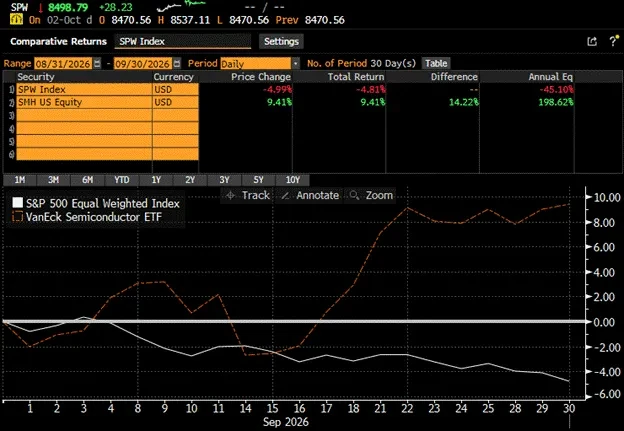
The semiconductor ETF (SMH) rose about 9.4% in September, while the equal-weighted S&P 500 index (SPW) fell about 4.8%, showing a clear divergence between the tech sector and the broader market.
Mamaysky interprets this as a "battle between numerator and denominator" in valuation: a rising discount rate pushes up the denominator, pressuring valuations; but expected future profit growth pushes up the numerator, which may offset some or even all of the negative impact. In other words, the market is not necessarily ignoring high rates, but may believe that future earnings growth brought by AI will be enough to cover higher capital costs.
In September, momentum ETFs with significant holdings in companies such as AMD, Micron, Intel, Cisco, and Applied Materials performed strongly, and semiconductors continued to be an important force driving the market higher.
This trend has some fundamental logic. AI infrastructure construction first requires chips, servers, and related equipment, so upstream suppliers in the industrial chain can obtain orders and revenue earlier.
But this also raises the author's biggest concern. Semiconductor stocks continued to rise, while the equal-weighted S&P 500 index was weak. This shows a clear divergence between capital's expectations for the earnings prospects of AI infrastructure suppliers and its expectations for the broader corporate sector.
Mamaysky refers to the broad group of companies beyond semiconductors as ROCS (Rest of the Corporate Sector).
In his view, the companies buying AI chips are willing to invest large sums because they believe they can obtain economic returns in the future through productivity gains. The market is also willing to provide financing in advance for these yet-to-be-realized profits.
Therefore, it is not surprising that not all industries are growing in sync at this stage. What is truly puzzling is that the stock market itself is forward-looking. If investors were already convinced that AI would significantly improve the future profitability of other companies, then these expectations should also gradually be reflected in the valuations of the relevant companies.
But the market in September did not show such broad gains. Chip suppliers are already making money, but the companies buying chips have not yet generally seen corresponding profit improvement. This means that the current AI trade has a business loop that still needs to be verified: the revenue obtained by upstream companies must ultimately be supported by economic value continuously created by downstream companies. If AI cannot create enough profit for the broader corporate sector, continuously increasing chip procurement, data center construction, and financing costs may gradually erode investment returns.
Mamaysky does not believe AI has already formed a bubble. He still believes in AI's long-term economic value, but thinks the market needs to see more evidence that AI's benefits are spreading from the tech industry to other companies.
Labor productivity data published by the U.S. Bureau of Labor Statistics has already shown some positive signs, with productivity growth in recent years above the long-term average since 2010. But this improvement cannot all be attributed to AI, let alone directly prove that companies have already obtained new profits sufficient to cover investment costs. From this perspective, the bond market and the stock market are actually waiting for the same answer: can future economic growth deliver the returns currently being priced in advance?
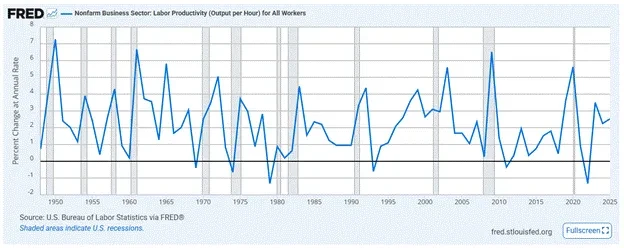
Historical changes in U.S. nonfarm business sector labor productivity.
4. Rising real interest rates are not necessarily a positive signal—the term premium is another risk
Interpreting the rise in Treasury yields as the market becoming more optimistic about economic growth can indeed explain some asset price performance. But this explanation still has an important limitation: a rise in real interest rates does not entirely equal an improvement in future economic growth expectations.
Long-term Treasury yields not only reflect investors' expectations for future short-term rates, but also include the Term Premium, which is the additional compensation investors demand for bearing risks such as long-term bond price volatility.
The term premium can reflect interest rate uncertainty, fiscal supply, market supply and demand, and other risk factors. Even if inflation compensation does not rise noticeably, long-term yields may still increase as long as investors are unwilling to lock up funds for the long term and demand higher risk compensation.
This distinction is especially important in the current market.
A Reuters market analysis on October 7 pointed out that the term premium on the U.S. 10-year Treasury has risen to about a 12-year high. This suggests that the rise in long-term yields may not only include economic growth expectations, but may also reflect investors' reassessment of fiscal policy, monetary policy, and the risks of holding long-term debt.
It should be emphasized that real interest rates and the term premium are not two independent indicators that can simply be added together. The TIPS real yield itself may also include a real term premium, so the roughly 49 basis point rise in real interest rates in September does not mean that all 49 basis points came from stronger growth expectations.
Two different drivers may have different effects on asset markets. If the rise in real interest rates mainly reflects improved economic growth expectations, then corporate future profits may rise in tandem, and some stocks can withstand higher discount rates.
But if the rise in real interest rates and long-term yields comes more from the term premium, then companies may face continuously rising financing costs without a corresponding improvement in future earnings. In that case, high rates would put more direct pressure on stock valuations, bond prices, and corporate investment.
This is also why one cannot conclude solely from the rise in AI stocks that this round of Treasury selling is definitely a positive signal for economic growth. For QuantStreet, the current market does not yet have enough evidence to support a full shift into any single asset.
The firm remains relatively overweight value stocks and low-volatility stocks, hoping to retain exposure to the broader corporate sector, while continuing to hold some tech stocks in portfolios with higher risk tolerance.
Bond allocation is also beginning to see slight adjustments. Mamaysky believes that when the 10-year Treasury yield reaches about 5.25%, the potential appeal of bonds has already improved somewhat. Therefore, QuantStreet has begun to moderately extend duration in low-risk portfolios, meaning increasing allocations to bonds that are more sensitive to interest rate changes.
But this does not mean the firm has fully turned bullish on long-duration bonds. Its models still do not favor longer-duration assets, and overall bond duration remains below the benchmark, though the underweight has narrowed somewhat.
The author also mentions that for suitable investors, some alternative assets such as evergreen private equity funds may provide a certain diversification role, but the liquidity and valuation risks of the relevant products still need to be considered separately.
These adjustments reflect a cautious attitude: long-term yields have begun to offer some appeal, but there is no clear answer yet as to whether the forces driving yields higher have dissipated.
Next, the market needs to watch three types of signals: first, how long-term real interest rates and the term premium change, in order to distinguish between growth expectations and risk compensation; second, whether AI investment is beginning to genuinely improve productivity, profit margins, and cash flow at non-tech companies; and finally, whether Fed policy expectations, fiscal financing needs, and long-term Treasury supply continue to put upward pressure on yields.
If economic growth and corporate earnings continue to improve, high real interest rates and strong stocks could coexist for a period of time. But if the term premium keeps rising while the returns on AI investment are slow to materialize, then tech stocks that currently appear able to withstand high rates will also face a more severe valuation test.
The most important signal from the September Treasury sell-off is not that inflation expectations are out of control again, but that the long-term real return investors demand has risen markedly.
The real unresolved question is: does this higher return requirement come from confidence that the future economy can create more profits, or is the risk of holding long-term assets increasing?
Both explanations can push up Treasury yields, but they imply very different market prospects for stocks, bonds, and the future of the AI investment cycle.