BiyaPay Market Watch: US September CPI Rises to 3.7%, Stocks and Bitcoin Under Pressure


- Key Takeaway: US September CPI rose more than expected, reinforcing expectations that interest rates will stay elevated, putting simultaneous pressure on US stocks and the crypto market. However, the core logic differs: US stocks need to digest valuation and profit pressures, while the crypto market faces liquidity tightening and leverage adjustments.
- Key Factors:
- September CPI rose 3.7% year-over-year, above the prior reading of 3.4%; core CPI rose to 2.6% year-over-year and 0.3% month-over-month, indicating inflation has not slowed significantly.
- Gasoline prices rose 9.1% month-over-month, contributing more than half of the overall increase, making energy transmission risk a focal point for the market.
- The S&P 500 fell 1.1%, the Nasdaq dropped 1.9%, and Bitcoin retreated to around $82,000, with tech stocks and crypto assets weakening in tandem.
- Pressure on US stocks stems from valuation adjustments and rising financing costs, with high-growth tech stocks more sensitive to rate expectations.
- The crypto market is affected by liquidity tightening and derivatives leverage, with ETF single-day net inflows of $175.7 million, but weekly net outflows still at $678.9 million.
- Going forward, US stocks will look to earnings and cash flow validation, while the crypto market will focus on the sustainability of ETF inflows and spot buying absorption capacity.
A single inflation report has forced US stocks and crypto markets to confront the same question once again — how much longer can funding costs stay elevated?
On October 14 (US Eastern Time), the US released its September CPI. BiyaPay market data showed that the S&P 500 closed down about 1.1% that day, the Nasdaq fell about 1.9%, and the Dow dropped about 0.1%, with tech stocks coming under more pronounced pressure. The crypto market was also hit, with Bitcoin falling back to around $82,000 at the time of relevant reports, while Ethereum weakened in tandem.
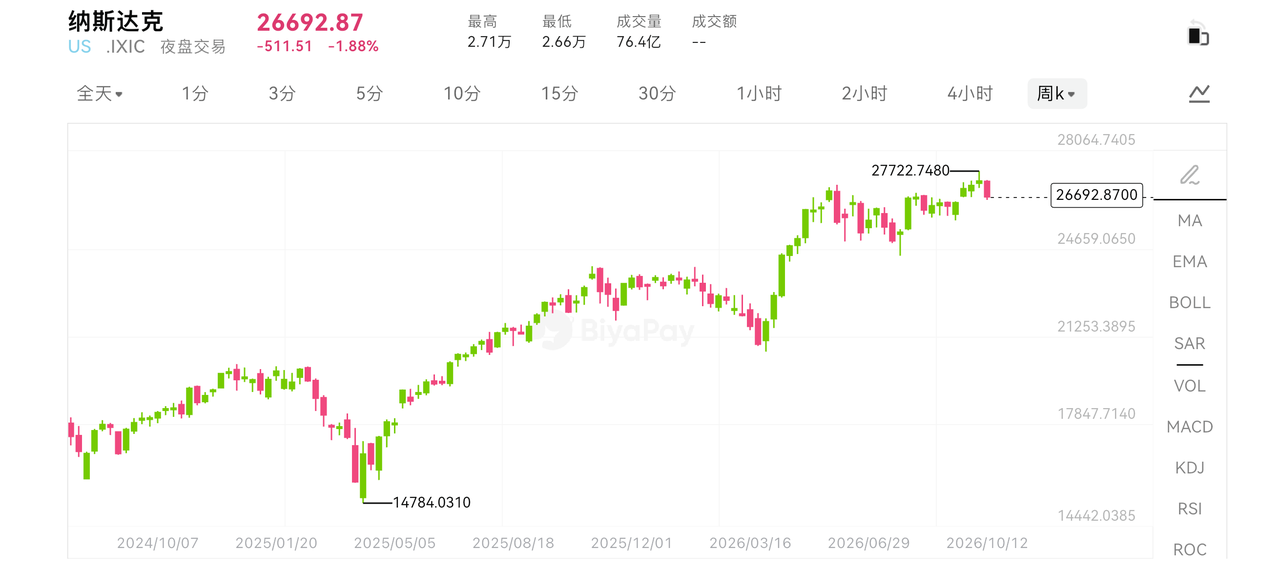
Both asset classes falling together does not mean the logic behind each is identical. US stocks need to recalculate how much future profits are worth and whether companies can absorb higher costs; Bitcoin and Ethereum are more focused on capital absorption and adjustments to leveraged positions. Understanding this difference is key to judging how the shock will continue to transmit.
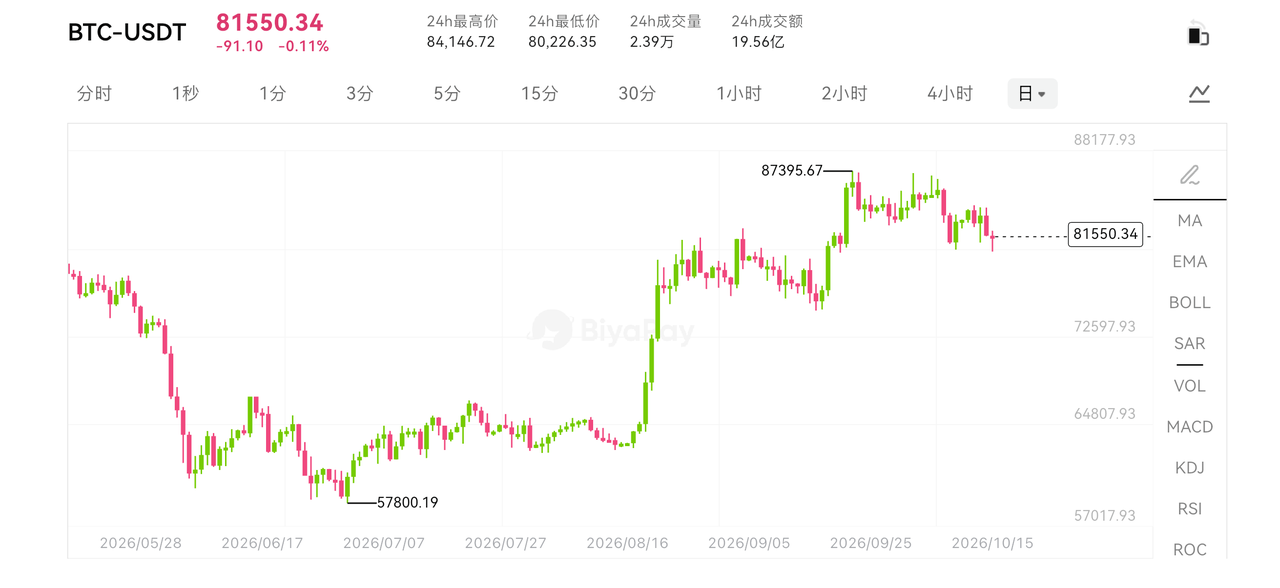
When observing such cross-market movements, price reactions can be compared separately against fundamental evidence. For example, BiyaPay, as a global one-stop asset allocation platform, covers US stocks, Hong Kong stocks, digital assets, and fiat currency exchange scenarios, with USDT as its core funding entry point. This allows users to view tech stocks alongside BTC and ETH trends within a single account, and then combine publicly available interest rate, earnings, and ETF fund flow data to distinguish whether the impact comes from company operations or from the market as a whole reducing risk exposure.
Gasoline Pushed CPI Higher, and Core Inflation Showed No Clear Sign of Easing
September CPI rose 3.7% year-over-year, up from 3.4% in August; on a seasonally adjusted basis, it rose 0.6% month-over-month. Gasoline prices climbed 9.1% month-over-month, contributing more than half of the overall price increase for the month and serving as the primary driver.
But this report cannot be attributed to energy alone. Excluding food and energy, core CPI rose from 2.4% to 2.6% year-over-year, with a 0.3% month-over-month increase, unchanged from August. This means core prices did not accelerate further, but also showed no obvious slowdown that the market had hoped to see.
For the market, the question is whether energy price increases will persist and whether transportation, production, and services costs will continue to be affected. If it is only a temporary disruption, subsequent price pressures may ease; if it gradually transmits to other categories, the case for faster rate cuts will weaken.
Rate hike expectations have also been affected. But a change in expectations does not equal a new rate decision having been made — CPI still needs to be assessed alongside employment, consumption, and other inflation indicators. What the market is adjusting now is its estimate of the rate path, not a simple confirmation of a definite outcome.
For US Stocks, Valuations Adjust First, Profits Face the Test Next
What US stocks bear most directly is valuation pressure. Stock prices reflect the present value of future cash flows, and when the market raises its expectations for future interest rates, the valuation it is willing to pay may decline even if corporate earnings forecasts remain unchanged for now. Tech companies with higher forward growth expectations are typically more sensitive to this, which helps explain why the Nasdaq underperformed the Dow that day.
But the impact of interest rates goes beyond valuations. Companies that rely on financing for expansion, face imminent debt maturities, or have weak cash flows may also come under real operational pressure. New financing becomes more expensive, raising the hurdle rate for project returns; refinancing old debt at higher rates can also erode profits. Companies with ample cash and fewer near-term debt maturities face relatively different direct constraints.
Energy price increases add another layer of divergence. Some upstream energy companies may benefit, while airlines, transportation, and manufacturing companies may face rising costs. Whether they can pass on costs to customers depends on competition and demand — it cannot be assumed that all companies can smoothly pass through higher costs. Therefore, rising CPI does not mean all sectors are equally affected; revenue structure and pricing power become more important.
For the AI supply chain, the market especially needs to distinguish between demand growth and return on investment. Chip orders and data center construction may continue to increase, but if financing costs rise and application revenue materializes slowly, customers' capital expenditure capacity will still be tested. Platform companies with more abundant capital and those relying on continuous financing to build computing power face different constraints.
This is also the focus of earnings season: whether revenue has grown only answers part of the question — whether profit margins can remain stable, whether cash collection keeps pace, and how much cash remains after capital expenditure will determine whether growth can offset valuation pressure. Strong demand and stock price pullbacks can occur simultaneously; one cannot conclude that industry demand has reversed based solely on a decline.
For Crypto, Liquidity Comes Under Pressure, and Leverage May Amplify Volatility
Bitcoin has no corporate profits to measure with a P/E ratio, but it still faces capital comparison. When the yield appeal of dollar-denominated assets increases and financing conditions tighten, the compensation the market demands for holding high-volatility assets also rises. Some capital may therefore reduce exposure, even if no new negative news has emerged specific to Bitcoin itself.
Derivatives positioning may also amplify this adjustment. If price declines trigger stop-losses or forced liquidations, selling pressure can increase in a short period; if gains were mainly driven by leverage with insufficient spot absorption, the impact of macroeconomic news is more likely to spread. However, one cannot assume large-scale liquidations occurred based solely on price declines — liquidation figures still require corresponding data support.
ETFs provide another observation clue. On October 13, US spot Bitcoin ETFs saw combined net inflows of about $175.7 million, but the week of October 5–9 still saw net outflows of about $678.9 million. A single-day return of inflows shows there is capital absorption, but it is not enough to prove that buying has formed a sustained trend, nor can it guarantee offsetting new selling pressure the next day.
This explains why "ETFs saw inflows" and "Bitcoin subsequently fell" are not contradictory. They correspond to different trading days, and market news was also changing. ETF net creations are only part of spot demand and cannot replace the full market's capital situation; ETF trading volume also does not equal net inflows, because turnover of existing shares does not necessarily bring in new buying.
BTC and ETH also need to be observed separately. The former's demand is more related to ETFs, corporate holdings, and the store-of-value narrative, while the latter also involves network usage, staking, and on-chain activity. A macroeconomic shock can pressure both simultaneously, but whether they can stabilize afterward still depends on their respective capital and usage demand — one cannot infer that long-term performance will necessarily be consistent based on a single synchronized decline.
For Subsequent Stabilization, US Stocks Look to Earnings, Crypto Looks to Absorption
After the inflation data, the two asset classes need different forms of validation. US stocks need to see whether companies can absorb valuation pressure with real profits and cash flows, especially companies with higher financing needs and larger capital expenditures. The crypto market needs to see whether ETF flows can improve consistently, whether spot buying follows through, and whether selling pressure can be absorbed after leverage adjustments.
If price pressures ease and rate expectations decline, both asset classes may find room to breathe. But if economic demand also weakens, US stocks will face earnings downgrades, and the crypto market may also be affected by declining risk appetite — it cannot be simply understood as "the weaker the data, the easier for prices to rise."
This CPI report has raised the market's requirements for growth and capital absorption once again. US stocks need to prove that future profits justify current valuations, and crypto needs to prove that buying can be sustained. After jointly bearing interest rate pressure, their respective fundamentals and capital structures will further differentiate their performance.