


New Draft 2026-10-19 18:46:09


- Core Viewpoint: Uniswap v4's upgradeable Hooks move token trading rules from the contract layer to the pool layer, allowing projects to modify trading logic without migrating users. This is spawning a new industry built around programmable market rules, but it also introduces governance trust risks.
- Key Elements:
- Hooks are smart contracts that execute additional instructions within the trading flow, supporting functions such as beforeSwap/afterSwap, and can enable features including dynamic fees, arbitrage profit redistribution, and whitelist access control.
- The Claus project implements upgradeable Hooks through a proxy contract architecture. On October 8, it switched its fee logic from FeeWeatherHook to FeePrivacyHook, with holders not needing to exchange for new tokens.
- Uniswap v4 recorded $39.7 billion in trading volume over the past 30 days, accounting for roughly half of Uniswap's total volume and contributing 64% of fees; on Robinhood Chain, only one-third of v4 pools have Hooks attached, yet they contribute 74.5% of trading volume.
- The StablePair Hook reached $3.1 billion in trading volume within four weeks of launch; Aztec raised approximately $59 million from over 17,000 bidders through an auction Hook; Spark has migrated $150 million in liquidity to v4.
- Solana takes a different path: the Token-2022 standard builds transfer Hooks directly into the token itself, and the Hooked platform offers 39 ready-made rule sets, but DEXs such as Raydium impose access restrictions on tokens with Hooks attached.
- The core value of upgradeable Hooks lies in reducing project trial-and-error costs, making them especially suitable for RWA scenarios such as tokenized securities where rules require continuous adjustment. However, who holds upgrade permissions and the scope of modifications are trust risks that users need to evaluate carefully.
Original author: Thejaswini M A
Original translation: Chopper, Foresight News
In early October, a Memecoin project on Ethereum called Claus replaced part of its "brain." Claus splits trading fees to fund buybacks, burns, liquidity injection, and rewards for NFT holders.
The token's financial operations are closely tied to the weather. Claus allocates trading fees to buybacks, burns, liquidity, and rewarding NFT holders. For a time, weather reports from London Heathrow Airport were used to decide how much money went to burning tokens and how much flowed back into the pool to support trading. Rainy days favored token burns, while sunny weather favored liquidity. If the weather data feed was interrupted, funds were split evenly.
The weather experiment was just one of many features of its trading pool. On October 6, the project team announced the removal of the arbitrage feature while retaining the token contract address, the trading pool, and all other features. This meant holders did not need to swap their tokens for a new version. The reason this was possible lies in the upgradeable Hook used by the Uniswap v4 trading pool.
A Hook is a piece of smart contract code that can attach additional instructions to the trading flow. Other developers use Hooks to adjust fees or put idle liquidity to work. Developers can build various differentiated markets inside an existing exchange without deploying a new decentralized exchange from scratch and persuading all users to migrate.
So by October 8, if you checked Uniswap's public Hook registry contract, the contract responsible for all of Claus's fee logic had switched from the old FeeWeatherHook to entirely new code, FeePrivacyHook.
The project team describes the token itself as an intelligent agent: the token is its body, and the upgradeable Uniswap v4 Hook is its brain. In the past, once a token's rules were written into the contract, all exchanges would permanently follow that fixed set of rules.
Hooks strip these rules out of the token contract and place them at the trading market layer. Some Hooks even support rewriting trading rules later on.
An entire new industry is taking shape around this technology. It has spawned a large number of interesting products, but it has also introduced considerable new risks of asset loss.
What Is a Hook?
Suppose ETH is quoted at $2,000 in one trading pool and $2,020 in another. A trading bot can buy in the low-priced pool and sell in the high-priced pool. After deducting fees and gas costs, the remaining profit is the arbitrage gain. This kind of arbitrage trading narrows the price gap between the two pools. Typically, arbitrage bots take all the profit, and the trading pool only earns trading fees.
Ordinary liquidity pools already have built-in rules for calculating trades and collecting fees. But developers may want to leave a portion of arbitrage profits to users. A Hook is a separate smart contract that executes additional instructions at specific points in a transaction. Some Hooks can use this logic to detect price gaps after a swap is completed and execute an arbitrage operation within the same transaction to close the gap. The captured arbitrage profit can then be distributed to liquidity providers, traders, and the project team that deployed the Hook.
In Uniswap v4, there is a shared contract called PoolManager that uniformly handles swaps and records the balances of each pool. All v4 pools on the same chain share this PoolManager, but each pool has its own independent liquidity and parameter settings.
When you swap ETH for CLAUS tokens, PoolManager calls the ETH/CLAUS pool to process the transaction. If that pool has a Hook, the system also determines when to trigger the Hook's execution.
A Hook can contain a beforeSwap function, meaning these instructions run before the transaction executes. For example, it can calculate the fee for this swap or verify whether the trader has trading permission. There is also an afterSwap function, which means instructions execute after the transaction is completed, and can trigger token buybacks or record the updated price. A Hook can use one of these functions alone, enable both, or be combined with other functions related to adding/removing liquidity.
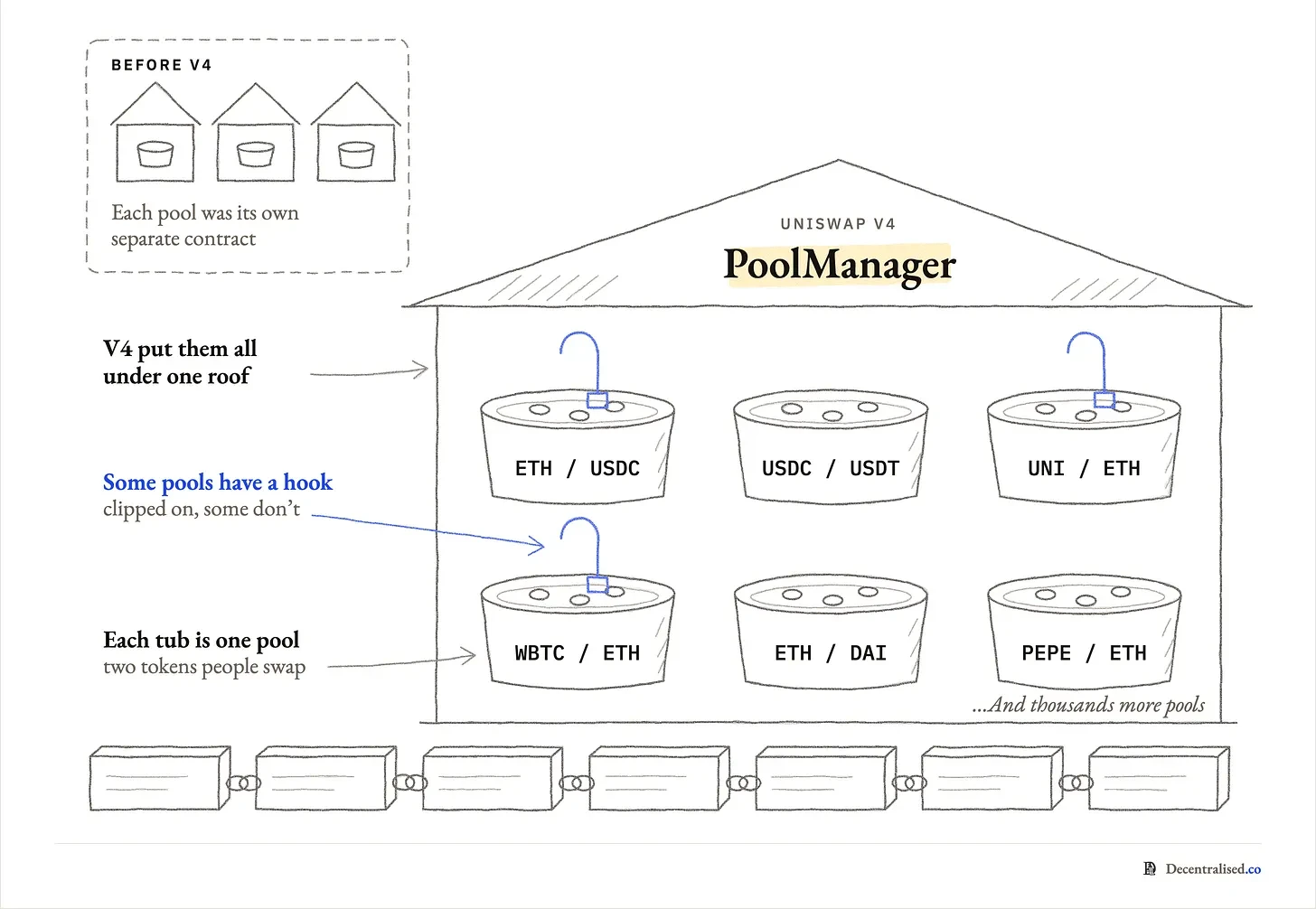
These instructions do not need to be changed frequently. A single Hook can use the same set of rules for years, such as setting aside a fixed portion of fees as rewards.
A trading pool can also operate without a Hook attached, in which case PoolManager processes trades according to v4 standard logic. Hooks are intended for developers who want to customize trading logic.
The difficulty lies in replacing the instruction logic later on. When a pool is created, the Hook contract address is written into its configuration, and PoolManager relies on this address to call the corresponding contract. In the Uniswap v4 design, this address is a permanent part of the pool's identity. Deploying a Hook with an entirely new address will not automatically bind to an existing old trading pool.
Without an upgrade mechanism, using a new Hook would require creating a new trading pool and migrating liquidity over.
Claus adopted an upgradeable architecture to circumvent this problem. Its Hook is divided into two parts: one contract retains a permanent address for the pool to call; a second contract holds the actual instruction code that executes. The first contract is called a proxy.
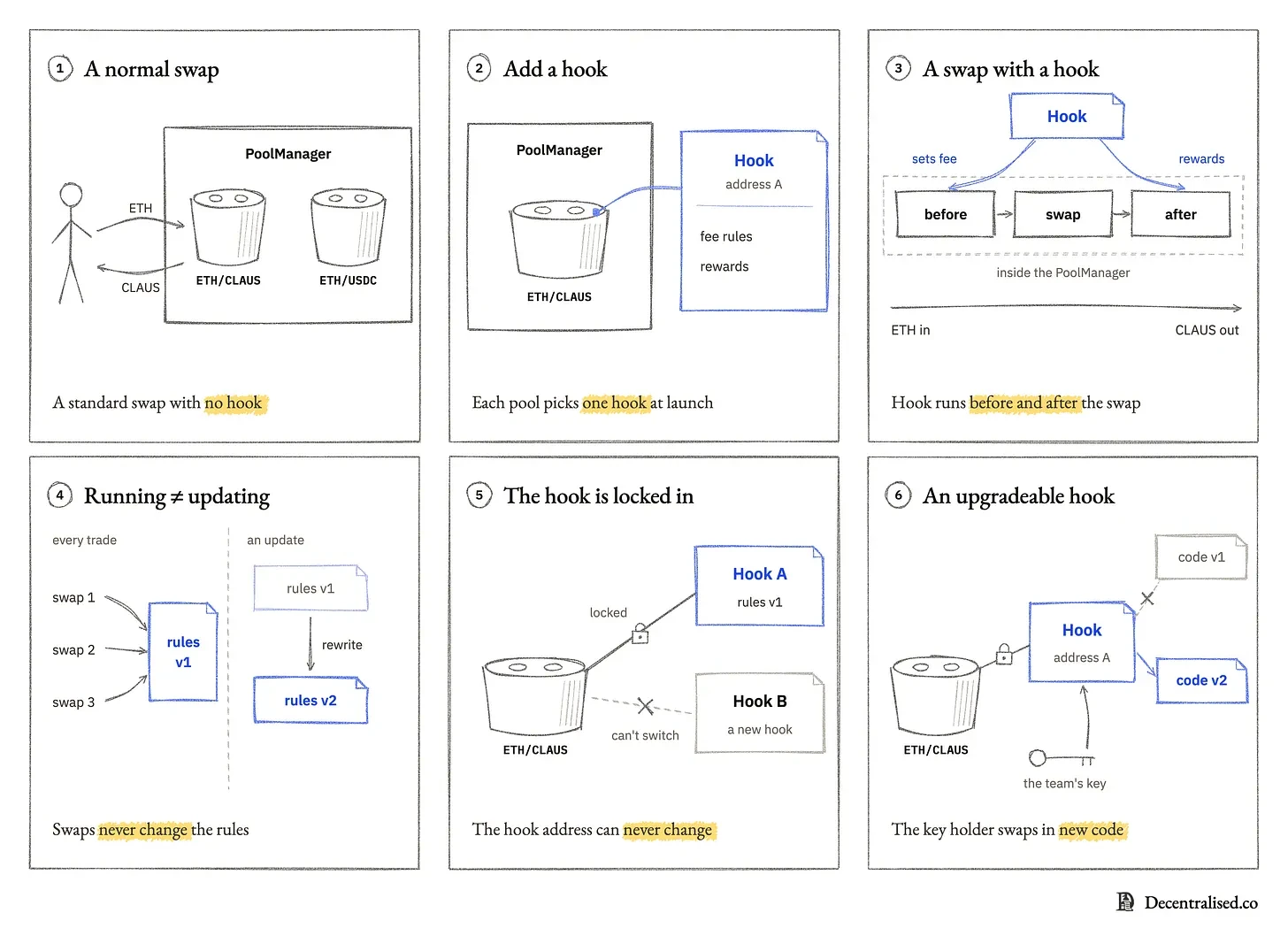
When Claus's authorized administrator wants to change the rules, they only need to deploy new instruction code and notify the proxy contract to switch to the new version. The trading pool still calls the same Hook address, but the code logic executed by the Hook has already been updated.
This is the principle by which existing trading pools can gain entirely new features without requiring users to migrate tokens. The party holding upgrade permission has the power to control the pool's behavior, and this is where users need to assess trust risk.
Features That Were Once Difficult to Achieve
Before Hooks existed, developers could already give tokens special logic, but it was very difficult to stay compatible with the DeFi ecosystem.
The first approach was to write the rules directly into the token contract. This gave rise on Ethereum to "tax tokens," meaning ERC-20 tokens that automatically deduct a fee when transferred. If you send out 100 tokens for a swap, the token contract deducts 2, and only 98 actually enter the trading pool. But the exchange contract expects to receive the full 100, so the transaction fails.
Uniswap v3 documentation notes that such tokens are incompatible with standard routing contracts. Developers can only use workarounds such as wrapper contracts or custom routers. Although a tax mechanism can raise reward funds, it makes trading the token more difficult, and many exchanges cannot handle such automatic fee deductions.
Developers could also build separate contracts around the pool, or modify exchange code to deploy an independent version of a DEX. But building a whole set of infrastructure is far more work than the feature itself.
Hooks provide developers with a dedicated vehicle for carrying trading rules. They enable these capabilities:
- Extract funds only during trades for buybacks or reward distribution, without taxing ordinary wallet transfers;
- Automatically adjust trading fees, for example when market volatility rises;
- Distribute captured arbitrage profits to traders and liquidity providers;
- Restrict trading permissions so the pool only allows whitelisted wallets to trade;
- Connect liquidity to lending protocols so idle liquidity earns interest when not being used for swaps;
- Build the above features inside an existing exchange without separately deploying and maintaining an independent DEX.
Hooks have also spawned a type of business model: products whose core is customized pool trading logic.
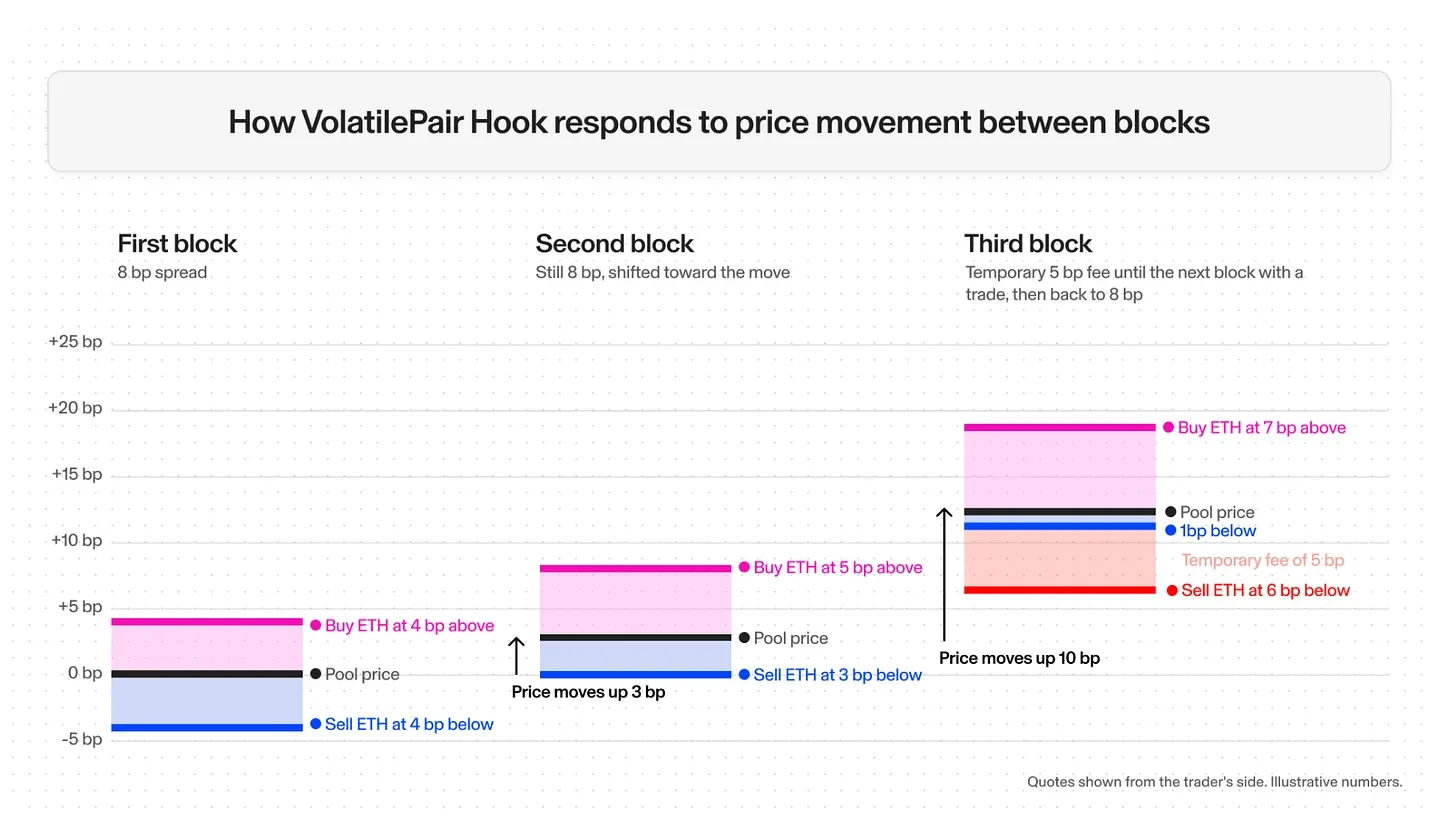
On October 14, Uniswap deployed VolatilePair, a Hook that differentiates buy-side and sell-side fees, first launched on the Ethereum ETH/USDC trading pool. This Hook charges different fees to buyers and sellers based on recent price volatility. According to the official announcement, its previously launched stablecoin pair Hook StablePair reached $3.1 billion in trading volume within four weeks of launch.
Other teams are also dynamically adjusting fees based on the type of asset being traded.
Fables, a DEX project on Robinhood Chain, adopted this approach, supporting the trading of assets such as tokenized stocks. It relies on Hooks to adjust fees based on signals such as time and volatility. When the underlying securities market is closed, stock tokens can still be traded, but at such times reliable price data sources and hedging opportunities are fewer.
The logic behind supporting dynamic fees is that providing liquidity during such periods and providing liquidity during active trading periods involve completely different risks.
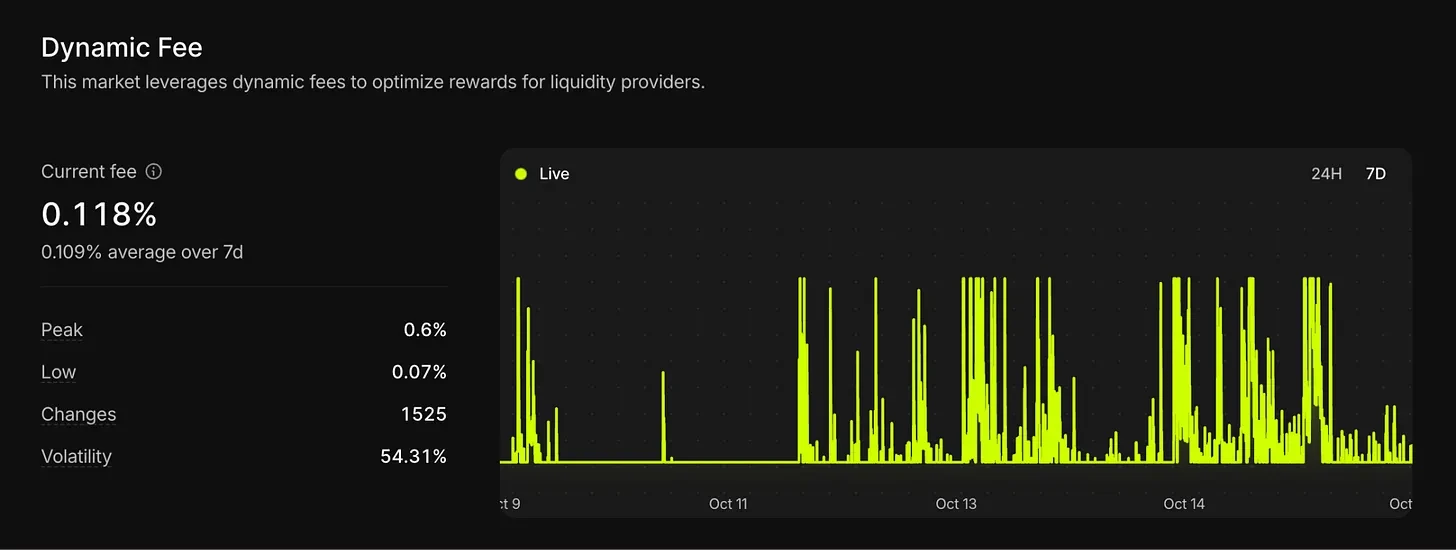
Fables adjusts fees based on US stock market opening and closing times. Some tokenized funds only allow qualified investors to hold them.
Uniswap Labs launched permissioned Uniswap v4 trading pools in July, with Superstate, Securitize, and Dowgo as the first partners. This solution relies on Hooks to verify whether a wallet is eligible to trade and provide liquidity.
Its DualPool Hook lends out market makers' idle tokens and recalls them when they are needed for swaps. Spark has already migrated $150 million in liquidity to v4 and plans to integrate this Hook. An auction Hook can gradually sell new tokens over a period of time and ultimately generate a trading pool based on the buyers' settlement prices. Aztec used this Hook to raise approximately $59 million from more than 17,000 bidders.
On the data side, v4's trading volume over the past 30 days reached $39.7 billion, accounting for about half of Uniswap's total trading volume and contributing 64% of Uniswap's fees. A large portion of that volume came from Robinhood Chain. When Bitquery surveyed the chain's pools in early September, only about one-third of v4 pools had Hooks attached, but those pools contributed 74.5% of trades.
The Ethereum Ecosystem
If Hooks become the new vehicle for storing token trading rules, then the business opportunity lies in selling out-of-the-box rule toolkits. programmable.market is a representative example. It describes itself as open launch infrastructure for Uniswap v4—in simple terms, a toolkit that lets you deploy tokens with preset trading rules on Ethereum and Robinhood Chain with one click. Choosing the Classic version allows you to deploy a token with custom buy and sell fees, paired with a permanently locked ETH trading pool.
In my view, this is essentially a tax token, except the fee logic now sits inside the trading pool and routing contracts can recognize it in advance. The Custom version deployed via API is aimed at project teams that want customized Hook solutions. In programmable's default settings for new custom projects on Robinhood Chain, 0.2% of fees are diverted to a designated address. The documentation also candidly states that the contracts have not yet undergone external audits or public security contests.

Claus launched through programmable.market. Buybacks, NFT rewards, and weather-driven fund allocation can all be integrated as part of the token's trading body. Claus can change the purpose of trading fees without issuing a new token. But holders need to keep paying attention to changes—the rules they accepted when they bought the token may later be modified.
There is a similar tool platform on Robinhood Chain called Hookrfun, which offers 22 "Hook components" for creators to select, including sniper protection and automatic burning. One of them, the What The Hook component, can capture price gaps between pools ahead of arbitrage bots and distribute profits to traders and liquidity providers. Hookr's token launch toolkit has this service built in.
Third-party pools directly connect to What The Hook's default profit distribution rules: 45% goes to liquidity providers, 5% to traders, 40% to the treasury, and 10% to referrers—these are the allocation ratios for captured arbitrage profits. What The Hook is the only tool that publicly discloses relevant data, and most of the arbitrage funds it has distributed cumulatively have remained in its own treasury.
The Solana Ecosystem
The Uniswap protocol is not deployed on Solana, and Solana's trading is spread across multiple DEXs such as Raydium, Orca, and Meteora. There is no unified PoolManager to attach Hooks to, so Solana builds Hooks into the token itself.
Solana's new token standard, Token-2022, supports transfer Hooks attached by creators. Every time a token is transferred, this program runs, covering buy and sell trades as well as ordinary wallet transfers. It can verify rules, such as checking whether the receiving address is eligible to hold the token and blocking the transfer if conditions are not met.
Hooked is a token launch platform on Solana, and every token issued through the platform comes with a built-in transfer Hook. Creators can choose from 39 ready-made rules, such as a "hot potato" mechanism, or requiring buyers to wait 15 minutes after buying before they can sell; they can also have AI generate custom rules. Each rule comes with a plain-language description, and some tokens support the project team or holders voting to rewrite rules later. Each transaction charges a 1% fee, most of which is used to buy back and burn Hooked's native platform token.
But there are limitations here: unless an administrator approves, Raydium will not create a trading pool for tokens with transfer Hooks. Meteora can support such tokens on a value curve; but once a token upgrades into the main trading pool, the transfer Hook logic is removed. Hooked's workaround is to keep tokens permanently on the curve so the rules remain in effect.
In Uniswap v4, attached rules belong to the trading pool. The same token can be traded in a pool with a Hook attached or in a pool without a Hook. Users can choose the trading pool themselves, or routing can select automatically.
Solana's transfer Hook logic is different: rules are bound to the token itself, and any transfer of the token triggers the rules, including transfers between wallets. Both approaches have supporting upstream and downstream ecosystems: routing determines which pool trades flow to, and exchanges determine which token features are supported.
Developers have more market design tools, but the choices they make will determine whether a project can attract users and liquidity.
What Changes Will Upgradeable Rules Bring?
In my view, the upgradeable feature is more important than Hooks themselves. A fixed Hook is merely an improved tax token. It makes the trading market corresponding to a token feel like an app that can receive version updates.
Before this, changing token logic required token migration. The project deploys a new contract, asks all holders to swap their tokens, requests exchanges to relist, and liquidity is split between the old and new versions. In September 2024, Polygon swapped MATIC for POL, requiring all holders to exchange at 1:1, and exchanges also had to assist users with the switch.
Such migrations always leave some holders behind. Upgradeable Hooks allow projects to modify a token's trading behavior without large-scale user migration. This greatly reduces the cost of experimentation for projects.
The most valuable use case for Hooks may not be Memecoins. I think of tokenized securities—the trading rules for real-world assets themselves change continuously. A fund may add an open quota for investors from other countries, requiring an update to investor eligibility checks. Upgradeable Hooks can make this adjustment while retaining the existing trading pool. They will not rewrite investors' legal rights, nor delete restrictions in the token contract, but they can keep the trading venue in step with changing rules. For markets that need to operate over the long term, this capability is far more practical than locking all rules in place at launch.
A fund may need to update trading rules, while a Memecoin community may want rules that are never subject to project team intervention. Both demands are reasonable. When facing upgradeable Hooks, I would focus on verifying what the controller can modify. Updating trading eligibility is one thing; being able to modify fees and redirect reward funds gives much stronger control over pool users.
I want time to review before updates affect my funds, and if I disagree, I want a chance to withdraw. Projects can build in a notice waiting period within the contract and limit the scope of what developers can modify. Completely renouncing upgrade permission eliminates future changes, but also loses the ability to fix vulnerabilities later. Before depositing funds, I would carefully review these terms, while also checking fees and expected returns.
Claus calls the Hook the token's brain. In the future, project teams could let AI agents automatically update Hooks in response to market conditions. For example, AI could adjust fees within a range set by the team and explain the reasoning behind each change. This kind of automated adjustment is appealing, but I would confirm: who sets the boundaries for this AI, and who has shutdown authority when the AI makes a wrong decision.
Money has always had a mind of its own. During the Great Depression in 1932, the Austrian town of Wörgl issued a local currency. To keep the paper notes valid, holders had to buy a stamp worth 1% of the face value at the end of each month. Who would want to hold a currency that keeps shrinking? This design incentivized people to spend rather than hoard.
The local government used this mechanism to fund public works and allowed residents to pay taxes with the currency, including back taxes. In 1933, Austria's central bank intervened and the experiment came to an end.
In that era, currency rules were set by governments. Governments still set rules today, shaping the way people use money. But crypto technology lets developers set such





