






From US Stocks to Hong Kong Stocks: BIT's Brokerage Path Extends to Global Assets


- Core Viewpoint: BIT launched Hong Kong stock trading under the name "BIT Securities" on October 12, adhering to a compliant path of partnering with licensed brokerages and employing a "slowest in the short term, fastest in the long term" strategy to connect traditional finance with digital assets, providing users with real stock trading services.
- Key Elements:
- BIT Securities has repeatedly led similar platforms: in February, it became the first to launch direct stablecoin investment in US stocks, 118 days ahead of the earliest comparable platform; in July, it launched US stock options, making it one of the first platforms to do so.
- The Hong Kong stock product follows the same compliant path as US stocks, with services provided by licensed institution Atomic Vaults Asia (Hong Kong SFC Type 1 license), covering the full range of underlying assets and supporting IPO subscriptions, margin financing, and position transfers without high handling fees.
- BIT's monthly trading volume exceeds $7 billion, with custody and asset management scale surpassing $6 billion and cumulative interest payments exceeding $2 billion; it currently supports cryptocurrency, US stocks (including options), and Hong Kong stock trading.
- Users can deposit and trade multi-market assets directly with USDT/USDC, without the need to convert to fiat currency or open separate accounts; Hong Kong and US stock trading hours are staggered, totaling approximately 12 hours combined, with cryptocurrency covering the remaining hours.
- Options are a key indicator for testing the brokerage path: listed options require OPRA market data, OCC clearing guarantees, and broker suitability reviews, and cannot be synthesized solely through internal platform bookkeeping.
- The Hong Kong IPO market continues to heat up, with Deloitte projecting approximately HK$387.9 billion in fundraising for the first three quarters of 2026, a year-on-year increase of 112%, and an estimated at least HK$480 billion for the full year.
On October 12, BIT officially launched Hong Kong stock trading under the name "BIT Securities," supporting Main Board and GEM trading, IPO subscriptions, margin financing, and stock transfers, with stablecoin deposits accepted. This launch not only completes the product suite but also highlights BIT's differentiated positioning as a brokerage-focused platform: connecting traditional finance and digital assets through rigorous governance, advanced technology, and a compliant framework.
1. From U.S. Stocks to Hong Kong Stocks, BIT Securities Consistently Leads the Market
In terms of product launch cadence, BIT Securities has repeatedly led comparable platforms. Since the beginning of this year, BIT was the first to launch U.S. stock products directly connected to licensed brokerages and was among the earliest to support full options trading; the launch of Hong Kong stock trading marks the third time BIT has been the first to expand into brokerage-type businesses.
Starting with U.S. stocks. On February 3, BIT (Matrixport) announced the launch of stablecoin-direct U.S. stock investment, adopting a "digital assets + licensed brokerage" model. At the time, comparable platforms still focused primarily on tokenized stocks, with similar products launching between June 1 and August 18; even the earliest of these comparable products came 118 days after BIT.
Next, margin financing and options. BIT successively launched margin financing public beta in June, opened securities lending and short selling in July, and launched U.S. stock options; among comparable platforms, real U.S. stock options launched between July 2 and September 1, with BIT among the earliest to go live.
As for Hong Kong stocks, although some platforms already support "Hong Kong stock trading" and a few have rolled out "Hong Kong IPO subscriptions," the related trading remains primarily tokenized stocks or perpetual contracts, and IPO subscriptions are limited to individual offerings. There are still many limitations in terms of transparency and user rights—for example, users may need to pay service fees of 5% to 15%, and even after being allotted shares, they may be unable to dispose of the shares themselves or convert them into real shares. By contrast, BIT's newly launched Hong Kong stock product follows the same compliant pathway as its U.S. stock offering, covers a relatively complete range of underlying securities, and supports IPO subscriptions, margin financing, and stock transfers, further reducing trading costs and providing real Hong Kong stock trading services.
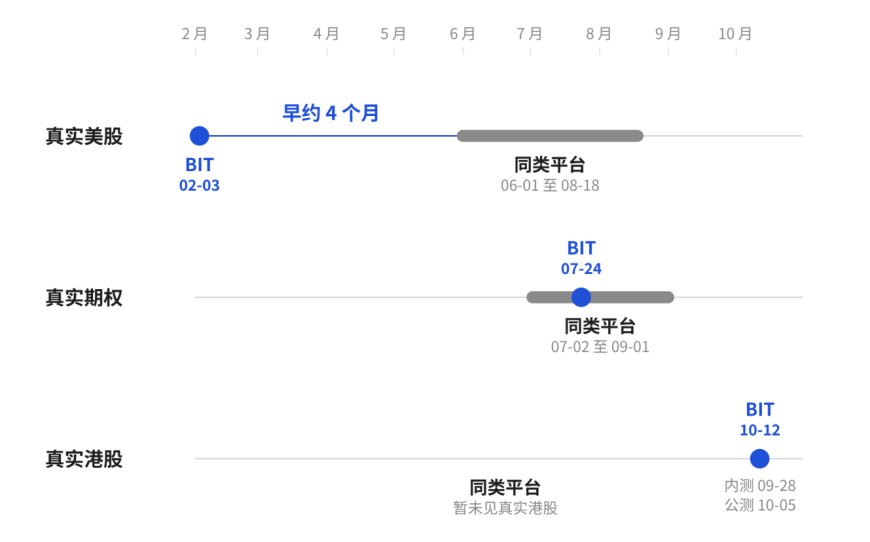
Figure: BIT product launch timeline
2. BIT Securities: One Account Connecting Multiple Markets
With the Hong Kong stock business now live, BIT Securities' business layout has been further refined, with product coverage spanning U.S. stocks (including options), Hong Kong stocks, cryptocurrencies, OTC, wealth management, and asset management. The strategic vision of "one account connecting global markets" is also becoming clearer.
BIT (formerly Matrixport) was founded in 2019 and rebranded as BIT earlier this year. Years of accumulated crypto business experience have laid a solid foundation for BIT. Currently, the platform's monthly trading volume exceeds $7 billion. Custody and asset management scale exceeds $6 billion, with cumulative interest payments exceeding $2 billion. Cryptocurrency spot, OTC, wealth management, and asset management businesses have been developed over a relatively long period, and product differentiation across platforms is relatively limited. Starting from 2026, U.S. stocks (including options) and Hong Kong stocks have become new focal points of competition, and the gap between platforms is gradually widening.
In U.S. stocks, BIT's first-mover advantage and product completeness stand out. On February 3, BIT launched real U.S. stock trading services directly connected to licensed brokerages, nearly 4 months ahead of the earliest comparable platform to launch. Hong Kong stocks also follows the direct licensed brokerage model. Since launching on October 12, users can use stablecoins to trade a broader range of Hong Kong stock underlying securities and utilize margin financing and stock transfer functions.
Options and IPO subscriptions are two business lines that differ significantly from comparable platforms, primarily because both depend on licensed institutions. IPO subscriptions must be processed through licensed institutional accounts, and listed options require clearing guarantees provided by the OCC. U.S. stock business requires broker-dealers, clearing, and custody services, and options also require access to market data systems; Hong Kong stocks require a Type 1 licensed corporation and HKEX settlement systems. Each additional business line raises compliance and risk control requirements, and also raises the barriers to entry for smaller platforms.
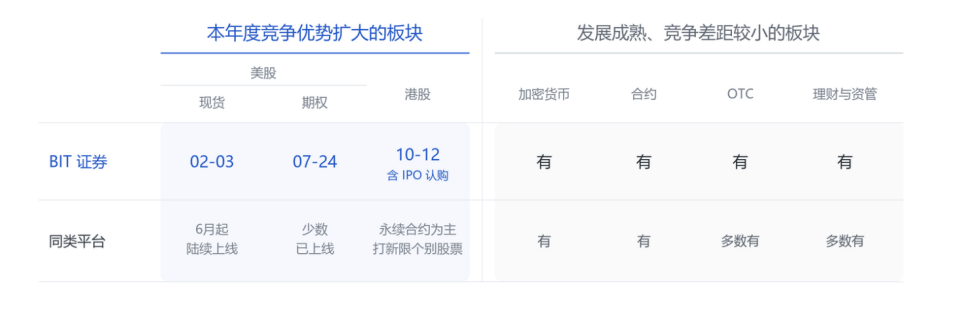
Figure: BIT vs. competitor product comparison
Meanwhile, Hong Kong IPO activity continues to heat up. Data released by Deloitte on September 24 estimates that in the first three quarters of 2026, approximately 116 new stocks will list in Hong Kong (including expected listings), raising approximately HK$387.9 billion, ranking second globally; fundraising increased 112% year-over-year, and the number of new stocks increased 76% year-over-year. Full-year fundraising is expected to reach at least HK$480 billion, with approximately 160 new stocks. After the Hong Kong stock launch, BIT users can directly use stablecoins to subscribe to new shares, with offerings not limited to one or two designated stocks and no need to pay high fees, providing crypto asset users with a channel to participate in Hong Kong stock trading.
In terms of market coverage, BIT currently supports cryptocurrency, U.S. stocks (including options), and Hong Kong stock trading. Users can deposit via USDT or USDC to purchase BTC, Nvidia shares, or subscribe to Hong Kong IPOs without first converting to fiat currency or opening a separate account. Users with existing BIT U.S. stock accounts can directly activate Hong Kong stock trading.
In terms of trading hours, BIT connects the trading sessions of different markets through a single account. Hong Kong stock regular trading hours are 9:30 to 12:00 and 13:00 to 16:00, totaling 5.5 hours; U.S. stock trading lasts approximately 6.5 hours. The two markets' trading sessions are staggered, totaling approximately 12 hours, with cryptocurrency and perpetual contracts covering the remaining time, creating a near-round-the-clock arrangement for related trading within the account; stablecoin deposits and withdrawals also support 7×24 processing with fast settlement.
3. Behind Leading the Market: Solidifying Compliance Infrastructure
BIT Securities' ability to stay ahead is thanks to its early establishment of a complete compliance pathway. This is the most time-consuming but critically important foundational element of the securities business.
When U.S. stock-related products first emerged, the industry's development paths already began to diverge. One path is for platforms to design products themselves, such as perpetual contracts and tokenized stocks. These products do not rely on external institutions, launch quickly, can trade around the clock, and can offer leverage. A report published by CoinGecko on July 8 shows that from early 2025 to May of this year, crypto exchanges listed 358 real-world asset spot and perpetual products. In May alone, related perpetual product trading volume was approximately $347.17 billion, involving stocks and commodities. This model is simpler to launch and faster, but because it compromises on asset completeness and compliance, long-term development may be limited. The other path is to connect with licensed brokerages, allowing users to buy real stocks; every trade must go through brokerage execution, clearing, and custody, so launches are slower. BIT Securities chose this path and summarizes it as "slowest in the short term, fastest in the long term."
More specifically:
The U.S. securities trading system has relatively clear divisions of labor: broker-dealers handle order taking and execution, while clearing and custody are handled separately by licensed institutions. BIT's U.S. stock business partners with three U.S.-based licensed clearing institutions, including Clear Street, RQD Clearing, and Atomic Vaults Securities (AVS), to provide users with clearing and asset custody. Their registration status and business scope can be verified on FINRA BrokerCheck. Notably, BIT released its "Trust White Paper" V2.0 in September 2026, systematically outlining its systems and practices in compliance governance, risk management, security safeguards, and transparency building around three pillars: compliance and regulatory foundation, independent audit and attestation, and technical and operational transparency.
For Hong Kong stocks, service institutions must hold a Type 1 license from the Hong Kong Securities and Futures Commission (SFC), with hard requirements on capital and client money. BIT's Hong Kong stock services are provided by Atomic Vaults Asia; official information shows that this institution holds a Type 1 license (securities dealing) from the Hong Kong SFC. A Type 1 licensed corporation must have paid-up share capital of no less than HK$5 million and liquid capital of no less than HK$3 million. If providing securities margin financing, paid-up share capital must reach HK$10 million. Client money must be deposited into segregated accounts, and license status can be verified on the SFC's public register. These requirements increase operational costs and also constitute barriers to entry.
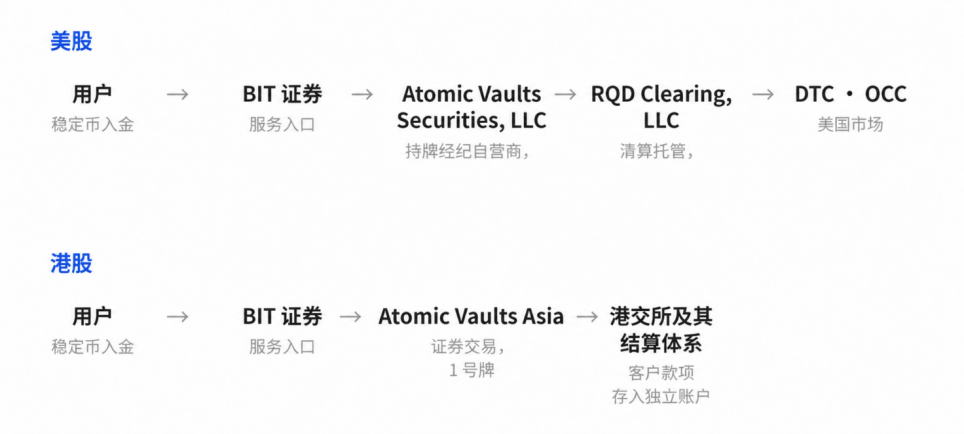
Figure: Comparison of licensed pathways for U.S. and Hong Kong stocks
For users, what they "actually buy" under the two development paths is different. "Buying" Hong Kong stocks on a perpetual contract platform does not add corresponding shares to the account; users hold contracts that track stock prices, must pay funding rates, and may be forcibly liquidated if losses reach a certain level. Tokenized stocks are closer to real stocks but typically only represent economic rights, mostly without voting rights, and redemption is subject to the underlying market's trading hours. Purchasing through a licensed brokerage allows users to hold real stocks and enjoy dividends and voting rights based on shareholding, and also supports stock transfers and new share subscriptions.
Options are the litmus test for whether these two paths are complete. If a platform only provides stock exposure through tokenized stocks or perpetual contracts, accessing listed options would be extremely difficult. U.S. stock options are based on real stocks and traded in securities accounts; their market data comes from OPRA (the Options Price Reporting Authority), and clearing guarantees are provided by the Options Clearing Corporation (OCC). Ordinary market makers or financial institutions typically cannot independently complete these steps. Before opening options, brokerages must also conduct suitability reviews; users can only trade after completing risk disclosure and obtaining written approval. These steps cannot be synthesized through internal bookkeeping alone; without direct brokerage connections, clearing, and custody, it is difficult to provide listed options. Therefore, options are an important indicator of whether a crypto platform has truly adopted the brokerage pathway, and the prerequisite for offering listed options is a real connection to U.S. stocks.
The options market also continues to expand. U.S. listed options cleared by the OCC totaled approximately 15.21 billion contracts in full-year 2025, up 24.4% year-over-year. From January to August 2026, average daily volume was approximately 70.5 million contracts, up 22.7% year-over-year.
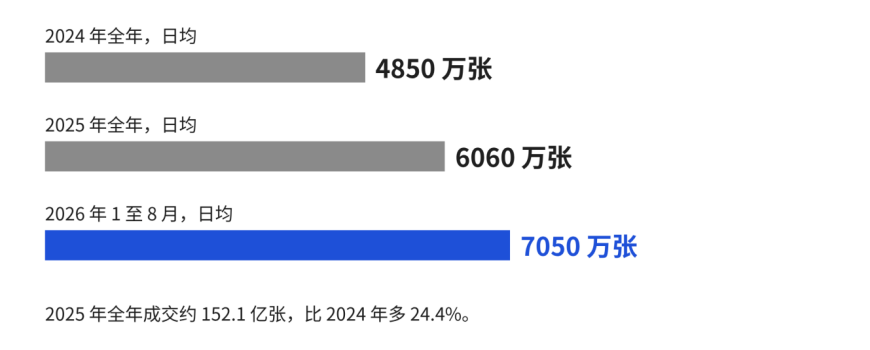
Figure: Average daily volume of U.S. listed options
The differences between the two development paths have already become apparent. Platforms that design products themselves can launch faster, but users cannot buy real stocks, and businesses like options are difficult to access. Connecting with licensed brokerages requires building out brokerage, clearing, and custody links, making initial launches slower, but only this path can access businesses that depend on licensed institutions, such as options and IPO subscriptions. BIT Securities built this critical compliance foundation from the start, choosing the "slowest in the short term, fastest in the long term" development path.
4. From Product to Business: Milestones on the Brokerage Path
From U.S. stocks to Hong Kong stocks, BIT's brokerage path continues to extend. The official launch of the "BIT Securities" brand marks this path entering a new stage; previously launched products are also brought under a unified brand.
When U.S. stocks launched in February, BIT introduced a stablecoin-direct U.S. stock investment service. When Hong Kong stocks launched on October 12, BIT integrated U.S. stocks (including options), Hong Kong stocks, and its existing crypto business under the "BIT Securities" name, bringing them into a unified brand and account system. The difference between BIT Securities and exchange businesses is reflected in security architecture and operating philosophy. Perpetual contracts and tokenized stocks offered by exchanges are mostly designed by the platforms themselves. In BIT Securities, users buy real stocks, with assets held by licensed clearing and custody institutions. In terms of operating philosophy, BIT emphasizes building governance and compliance systems first.
Once the compliance pathways were established, BIT's roadmap progressively came to fruition. BIT launched U.S. stocks on February 3 and opened margin financing public beta on June 26. The pace then further accelerated: securities lending opened 17 days later, and options launched 11 days after that. Margin financing, securities lending, and options share the same brokerage, clearing, and custody infrastructure, with no need to separately connect clearing services or rebuild user deposit processes.
80 days later, BIT launched Hong Kong stock trading on October 12, expanding to a new market for the first time. Hong Kong stocks and U.S. stocks share the same infrastructure, with users still using the same account and stablecoin entry point, while the back end adds a Hong Kong stock licensed entity and clearing pathway. This model can also be replicated in other markets. This development direction also aligns with regulatory and traditional financial institution policy trends. On September 17, the SEC introduced an innovation exemption for on-chain tokenized U.S. stock trading platforms, one condition being that tokens must carry real shareholder rights; synthetic tokens are not within the scope of the exemption.
From U.S. stocks and options to Hong Kong stocks, BIT Securities is extending BIT's accumulated expertise in digital assets into real securities services, connecting different markets through a unified account and stablecoin entry point. Compared to simply adding trading varieties, the brokerage path places greater demands on foundational capabilities such as licensed operations, clearing and custody, and risk management—this is the core of what distinguishes BIT Securities from most crypto platforms. The Hong Kong stock launch is an important milestone in the extension of BIT's brokerage path and further clarifies the "one account connecting global assets" layout. "Real U.S. stocks, real options, real Hong Kong stocks" are gradually being made available to eligible users worldwide.
Risk Disclosure: Investment involves risk. Crypto assets, securities, options, and margin trading are subject to significant price volatility, and you may lose your entire principal; options and leveraged trading carry higher risk, and stablecoins carry de-pegging risk; past performance is not indicative of future results. Hong Kong stock services are not provided to Hong Kong residents or persons located in Hong Kong. This article does not constitute investment advice or an offer or solicitation. Services are only provided to eligible users in jurisdictions where permitted, and are not available to persons in restricted jurisdictions. Specific terms are subject to the terms of each licensed entity.





