






GLM-5.3 Lands on Amazon, Zhipu Surges 14% in Two Days


- Core View: Zhipu's GLM-5.3 consecutively landed on AWS Bedrock, Cursor, and third-party evaluation certifications within a week, compounded by an international investment bank upgrading its rating to "Buy," marking a shift in its business model from "selling models" to a cloud platform revenue-sharing "rent collection" model based on API calls.
- Key Elements:
- AWS Bedrock integrated GLM-5.3 with revenue sharing based on call volume; Cursor launched the model and it achieved the highest score of 42.6% among open-weight models on CursorBench 4.0.
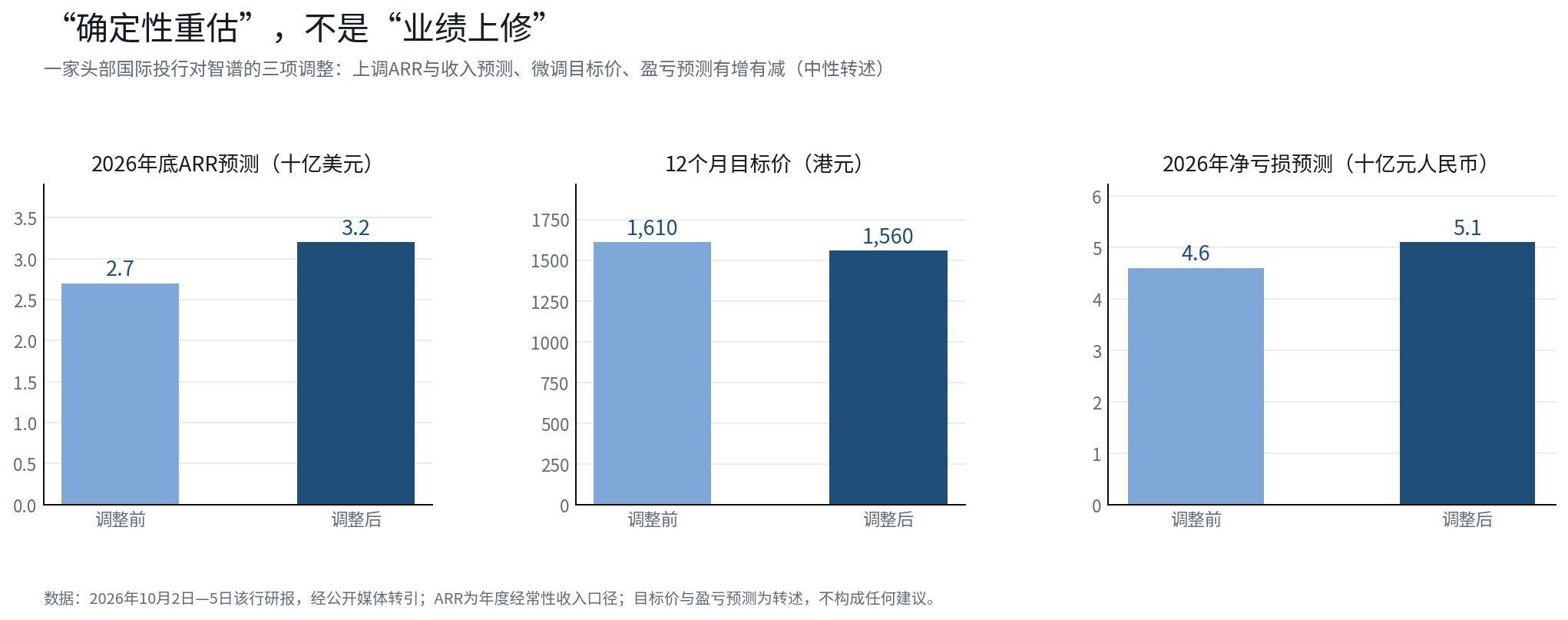
- An international investment bank upgraded its rating from "Neutral" to "Buy" with a target price of HK$1,560, raising its end-2026 ARR forecast from $2.7 billion to $3.2 billion.
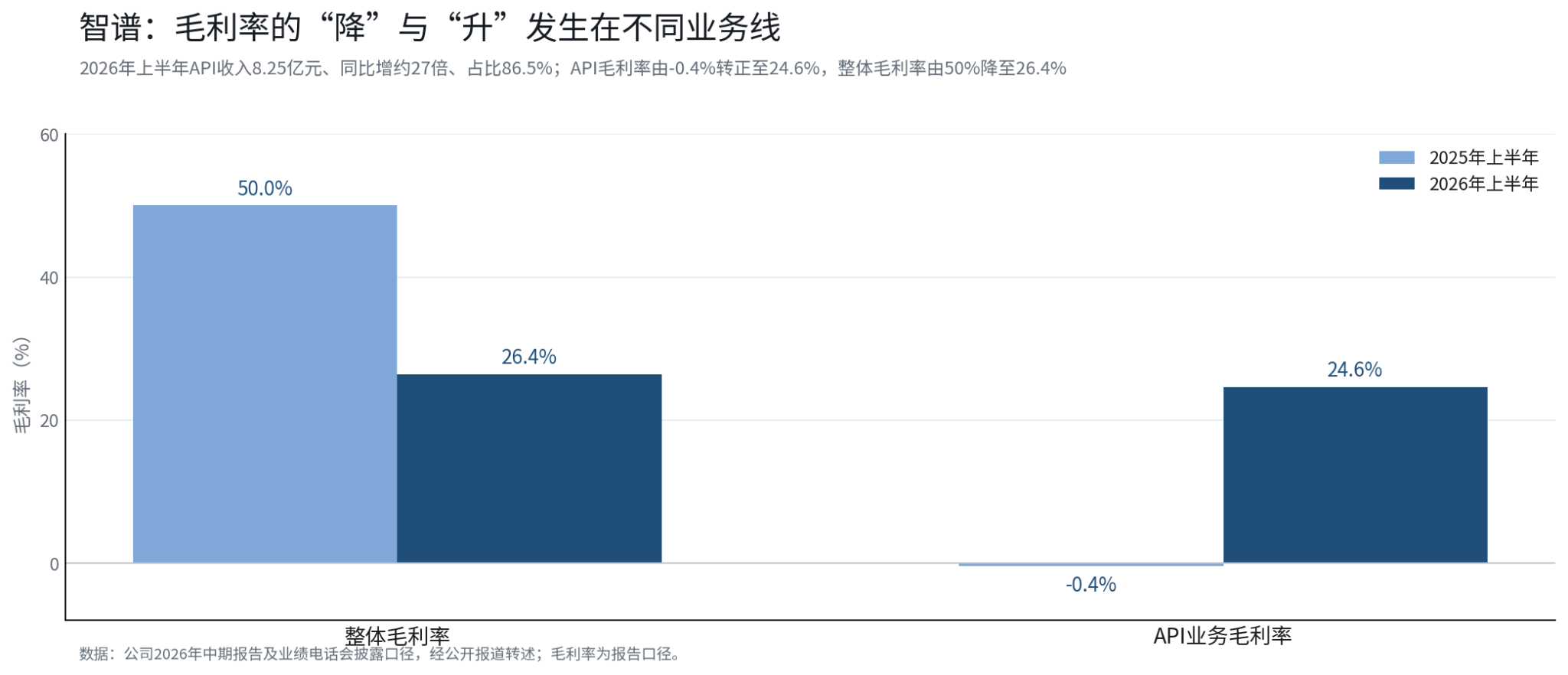
- Zhipu's H1 2026 API revenue reached RMB 825 million, a year-over-year increase of approximately 27x, accounting for 86.5% of total revenue; API gross margin turned positive from -0.4% to 24.6%.
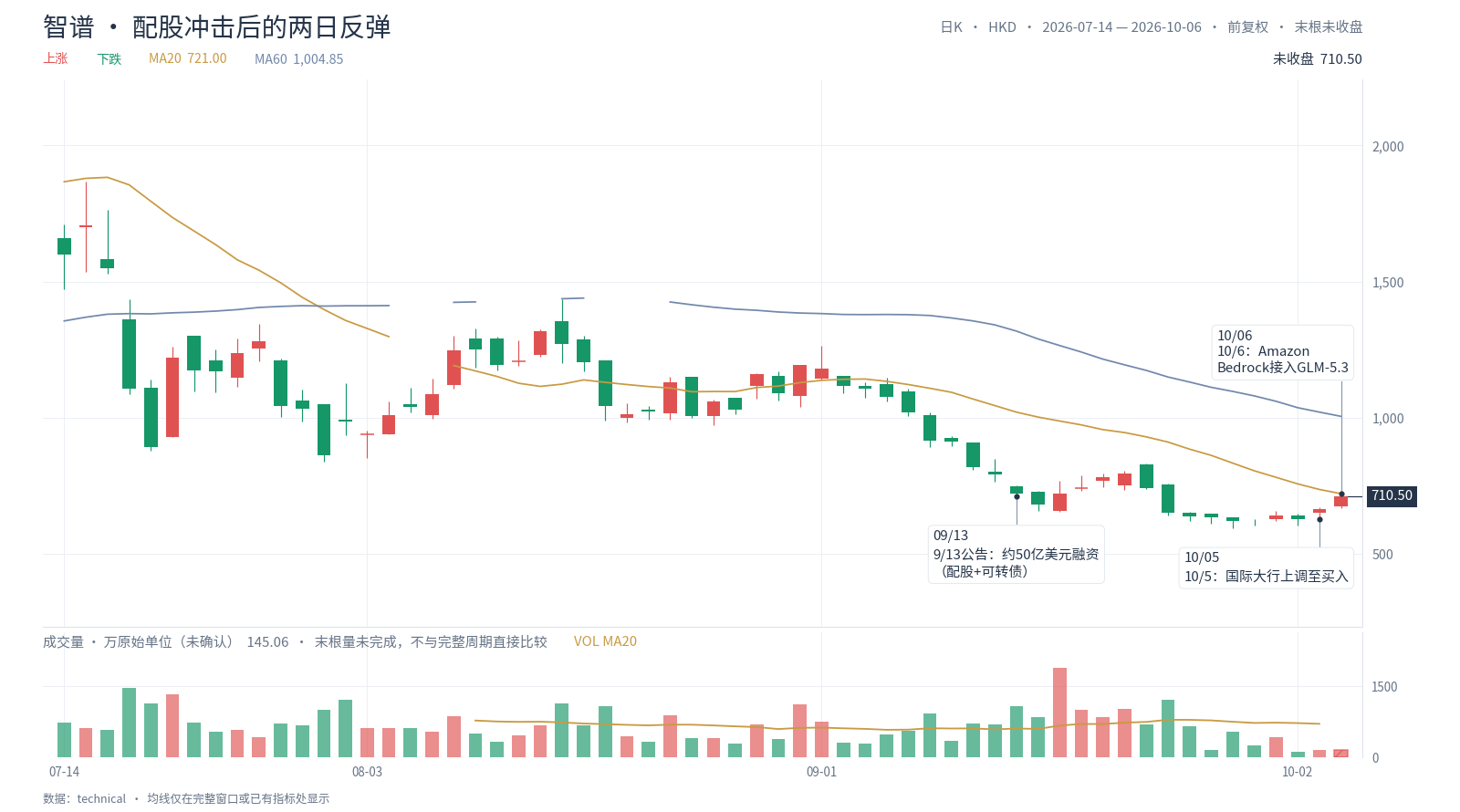
- In September, it received HK$7.884 billion in net southbound capital inflows, with holdings increasing over 460% compared to early July; however, in the same month, due to approximately $5 billion in share placement and convertible bond dilution, the stock fell 46.36%.
- The cloud provider revenue-sharing model transforms open-source models from a cost item to a revenue item, allowing the company to leverage partners' computing power and channels to reduce capital expenditure pressure.
- Key signals to watch going forward: the pace of revenue-sharing recognition starting in October, the progress of digesting placement dilution, and actual overseas developer call volume for GLM-5.3.
A week ago, Zhipu was still mired in the selling pressure of share dilution, falling more than 46% in the single month of September; a week later, its models appeared simultaneously on Amazon's cloud shelves, in the default lists of overseas coding tools, and on an international investment bank's "buy" list. The quality of this rebound and how far it can go depend on three things that are currently unfolding.
1. What Happened: GLM-5.3's Overseas "Triple Strike"
On October 6, Amazon Bedrock, the model service platform under Amazon Web Services (AWS), officially announced the integration of Zhipu's GLM-5.3, with AWS sharing revenue with Zhipu based on model usage volume. According to public reports, in addition to AWS, Zhipu has recently established similar revenue-sharing arrangements with several other overseas cloud providers.
This is not Zhipu's first overseas deployment, but the third stop in the past week alone:
- AI coding tool Cursor has launched GLM-5.3 and GLM-5.3-Flash, and disclosed that GLM-5.3 achieved the highest score among open-weight models (42.6%) on its proprietary coding benchmark CursorBench 4.0 — the benchmark tasks are drawn from real Cursor usage scenarios, covering multi-file processing, code editing, refactoring, and issue investigation;
- When German sovereign AI company Aleph Alpha released its new model Kolibri, its technical report showed that GLM-5.2 and GLM-5.3 were used for supervised fine-tuning data production;
- Cybersecurity certification: An evaluation by CAISI under the U.S. National Institute of Standards and Technology (NIST) was cited in an overseas AI safety research report published on September 29, listing GLM-5.3 as the open-weight model with the strongest cybersecurity capabilities as of the evaluation date.
From being used to being evaluated and certified by third parties, GLM-5.3 is transforming from a "Chinese open-source model" into one of the more widely used options in the global developer toolchain.
2. Why International Banks Are Upgrading Ratings Now
Around October 5, a leading international investment bank upgraded Zhipu's rating from "Neutral" to "Buy," with a 12-month DCF-based target price of HK$1,560 (neutral paraphrase). The bank's three reasons are worth examining separately:
- Commercialization path further clarified. The bank raised its ARR forecast for Zhipu by end-2026 from $2.7 billion to $3.2 billion, based on growing token demand and the company's execution of new commercial cooperation terms with major Chinese and global cloud providers starting in October; it also raised revenue forecasts for 2026 to 2028 by 3% to 12%.
- Compute expansion and balance sheet improvement. Zhipu completed approximately $4 billion and $5 billion in refinancing in July and September respectively, and compute supply may no longer be the primary constraint on revenue growth in the short term.
- Cost efficiency improvement. Management disclosed during a September earnings call that, thanks to GLM-5.3's inference cost-performance, theoretical inference gross margin could reach as high as 80%.
One detail is worth noting: the rating was upgraded, yet the target price was slightly adjusted from HK$1,610 to HK$1,560, and net loss forecasts were revised both up and down (2026 to 2028 adjusted to RMB 5.1 billion, RMB 5.0 billion, and RMB 500 million). This is more a reassessment of the clarity of the commercialization path rather than a simple "earnings upgrade" — what the bank favors is the clarity of the commercialization path, not an overall raising of profit expectations.
3. Cloud Provider Revenue Sharing: Open-Source Models Shift from Cost Item to Revenue Item for the First Time
Amazon Bedrock's integration of GLM-5.3, viewed within Zhipu's commercialization path, may be far more significant than a single news item.
The mainstream concern about Zhipu previously was: open source equals free, and no matter how strong the model capabilities, monetization remains questionable. The cloud provider revenue-sharing model may change this equation — GLM series open-source models are no longer just ecosystem investment but commodities on cloud platform shelves; third-party cloud platforms transform from potential substitutes into distribution channels. Domestically, Zhipu has signed similar revenue-sharing agreements with leading cloud providers including Alibaba Cloud's Bailian platform, and Huawei Cloud has listed GLM-5.3 and reached intent for similar cooperation.
Some market views use the path of leading overseas AI companies as a reference: the combination of models and cloud platforms has validated large-scale distribution capabilities, and related companies' usage-based revenue has grown significantly over more than a year. Zhipu management stated during the earnings call that after entering revenue-sharing arrangements with cloud service providers, the company can reduce compute pressure on certain businesses and accelerate global business expansion — with partners providing inference infrastructure and sales channels, the company receives usage-based revenue sharing, and related revenue growth is partially decoupled from its own compute capital expenditure. Whether this path can be replicated, and to what extent, remains uncertain.
4. A Set of Numbers That Need to Be Viewed Together: Southbound Accumulation, Stock Price Plunge
Zhipu received HK$7.884 billion in net southbound buying in September, ranking among the top net buys of active Stock Connect stocks; total Stock Connect trading volume in September reached HK$93.376 billion, the highest among all Stock Connect targets; the latest shareholding stood at 37.2901 million shares, up more than 460% from early July.
But in the same month, Zhipu's stock price fell 46.36% cumulatively.
Southbound capital continued to accumulate while the stock price fell — one important backdrop for this divergence is the approximately $5 billion financing announced on September 13: including $2 billion in share placement and $3 billion in zero-coupon convertible bonds, with a placement price of HK$714 representing a discount of approximately 9.96% to the previous closing price, and the convertible bonds, if fully converted, would add approximately 5.3% to share capital. The market widely regards placement dilution as one of the important factors behind the September decline, while southbound capital chose to keep buying during the decline, possibly reflecting that some mainland capital's pricing anchor is not short-term stock price but the pace of commercialization path realization — this interpretation remains uncertain. Whether the September decline has partially priced in the dilution impact of the placement remains to be seen; the overseas deployment of GLM-5.3 in October and the opening of cloud provider revenue-sharing channels provide new observation anchors.
5. From "Selling Models" to "Collecting Rent"
Some market views summarize the core logic of Zhipu's current rally in one sentence: the business model is shifting from "selling models" to "collecting rent."
"Selling models" means project-based, private deployment, one-time revenue, with high gross margins but an obvious scale ceiling; "collecting rent" means cloud platform usage-based revenue sharing, continuous token billing revenue, with relatively lower gross margins but a much higher scale ceiling. According to the company's interim report, Zhipu's open platform and API revenue in H1 2026 was RMB 825 million, a year-on-year increase of approximately 27x, rising to 86.5% of total revenue; API business gross margin turned positive from -0.4% to 24.6%. Overall gross margin fell from 50% to 26.4%, which may not necessarily indicate deterioration but more likely reflects structural changes during the migration of revenue mix from high-margin private deployment to large-scale API — however, the trajectory of profit quality still requires continuous tracking. If the revenue-sharing model proves viable on overseas cloud platforms, the slope of this revenue curve could be significantly steeper, though this remains to be validated by data.
 The bank ranked Zhipu's ARR run rate first among Chinese peers in its research report (neutral paraphrase) — by this judgment, Zhipu may be one of the Chinese large model companies leading in combining "open-source ecosystem" with "commercial monetization," though the competitive landscape continues to evolve.
6. Watch Three Signals
- The actual recognition pace of cloud provider revenue-sharing income. Management stated that revenue sharing with cloud service providers will be recognized starting in October. If October and November revenue data can validate the scale potential of the revenue-sharing model, it may be an important observation point for the market to reprice its valuation logic.
- The digestion progress of placement dilution. Whether the approximately 46% decline in September has sufficiently priced in the dilution impact of the placement and convertible bonds depends on subsequent southbound capital inflow pace and institutional holding changes. The combination of southbound accumulation and low stock prices has appeared historically in similar situations, but historical performance does not represent future results, and this combination itself does not constitute a reliable pattern.
- GLM-5.3's actual usage volume in overseas developer communities. Cursor and Amazon Bedrock integrations are "listings" — the real test is "usage volume after listing." If GLM-5.3 forms stable usage habits in overseas coding scenarios, the ramp-up pace of overseas revenue-sharing curves could be faster than domestic ones.
Data notes:
- Market data: Closed at HK$665 on October 5 (+6.15%); intraday high of HK$720 on October 6 (+8.3%), at HK$703 as of 10:08 (+5.7%), total market cap approximately HK$313.4 billion; MINIMAX-WP, Alibaba-W, Baidu Group-SW gains are intraday data around 10:08. Public market data.
- Rating: A leading international investment bank upgraded the rating from "Neutral" to "Buy," target price HK$1,560 (adjusted from HK$1,610), ARR forecast $2.7B → $3.2B, 2026–28 revenue forecast +3% to 12%. October 2–5, 2026, media citing research reports.
- Overseas deployment: Cursor launches GLM-5.3 (CursorBench 4.0 score 42.6%); Amazon Bedrock integration with usage-based revenue sharing; Aleph Alpha Kolibri technical report; overseas AI safety research report citing NIST/CAISI evaluation. September–October 2026, company announcements and public reports.
- Financials: H1 2026 revenue RMB 954 million (+399.7%), API revenue RMB 825 million (86.5% share), adjusted net loss RMB 1.964 billion; ARR approximately $1.8 billion, year-end guidance $3 billion. August–September 2026, company interim report and earnings call.
- Southbound capital: September net buying HK$7.884 billion, Stock Connect total trading volume HK$93.376 billion ranking first, shareholding up more than 460% from early July. October 2026, public data (Wind methodology).
- Financing: Approximately $5 billion ($2 billion placement + $3 billion zero-coupon convertible bonds), placement price HK$714, discount approximately 9.96%. September 13, 2026, company announcement.
Disclaimer:
This content is for general informational and market commentary purposes only, based on public information available as of the time stated herein, and relevant market data, expectations, and probabilities may change with market conditions. The views and investment strategies of third-party institutions, analysts, or other persons cited herein represent only the views of the relevant third parties at specific times and do not represent the views or recommendations of BIT. This article does not constitute investment advice, investment research, an offer, solicitation, or recommendation for any securities, investment products, or trading strategies, and should not be relied upon as the basis for any investment decision. Financial markets involve risks, securities prices and market performance may fluctuate, and historical performance and past market trends do not represent or guarantee future results. Investors should independently assess relevant risks based on their own circumstances and seek professional advice when needed.





