






Nasdaq hits record closing high, Nvidia approaches $6 trillion, but last night's most extreme move was in biotech


- Core View: On October 5, U.S. equities displayed a divergent pattern of "record index highs alongside deteriorating internal breadth": the Nasdaq hit a new high and Nvidia approached $6 trillion, yet 51% of Russell 3000 constituents have entered a bear market, raising market concentration risk.
- Key Elements:
- The 10-year U.S. Treasury yield closed above 5.30% (near its highest since around 2002), yet the Nasdaq still posted a record closing high, with ten of the S&P 500's eleven sectors advancing and one declining.
- Nvidia rose 2.12% to $238.9, with a market cap of roughly $5.79 trillion, just 3.7% away from $6 trillion; on September 28 it announced a record $150 billion buyback authorization, but the Philadelphia Semiconductor Index closed up only 0.27%, with clear divergence within the sector.
- Vaxcyte's 31-valent pneumococcal vaccine VAX-31 met all primary endpoints in Phase 3 trials, surging more than 85% premarket and closing up 30.7%, lifting NVAX about 20% and Moderna nearly 7%.
- SpaceX closed up 7.63%, with its valuation anchor shifting from "launch count" to "compute connectivity capability"; cumulative defense contracts exceed $12.7 billion; Musk's net worth has returned to $1 trillion (approximately $1.03 trillion).
- Market breadth continues to deteriorate: 51% of Russell 3000 constituents are down more than 20% from their June highs, and the median S&P 500 stock is 16% below its 52-week high; 96% of semiconductor sector stocks have pulled back more than 20%, versus only 4% in the banking sector.
- The MOVE index broke above 100 while the VIX remained below 15, diverging bond volatility from the equity fear gauge; institutional scenario analysis suggests the S&P 500 could test 6,800–7,300 over the next month.
- Earnings remain the primary support: FactSet forecasts S&P 500 Q3 earnings growth of nearly 30% year-over-year, but growth is increasingly dependent on a handful of AI-weighted stocks.
U.S. stocks on October 5 presented an intriguing combination: the 10-year Treasury yield closed above 5.30%, yet the Nasdaq set a record closing high; on the same day, a biopharma stock briefly doubled in pre-market trading. The index is hitting new highs while the market internally diverges — this combination is worth unpacking.
1. Last Night's Most Extreme Gain Wasn't in the Index
The day's trading looked lively on the surface: ten of the S&P 500's eleven sectors rose and one fell, with Materials (+1.22%) and Communication Services (+1.14%) leading. But the truly extreme move came from biopharma.
Vaxcyte (PCVX) surged more than 85% in pre-market trading at one point, triggered by its 31-valent pneumococcal conjugate vaccine VAX-31 meeting all prespecified primary endpoints in the pivotal adult Phase 3 trial (OPUS-1). According to company disclosures and public reports: in a head-to-head design across approximately 30 research sites and more than 4,000 subjects, VAX-31 achieved non-inferiority on all 20 serotypes shared with Pfizer's Prevnar 20, met the threshold on 17 of 19 serotypes shared with Merck's Capvaxive, and demonstrated superiority on its own unique serotypes; tolerability was comparable to the comparator vaccines. The closing gain pulled back to 30.7%, at $73.82. Other names lifted in the same sector included Novavax (NVAX), up about 20%, and Moderna, up nearly 7%.
It should be viewed objectively: meeting non-inferiority is a high-standard result under this trial design, but "meeting the bar" does not equal "superior," and according to public reports, the company still needs results from two additional trials before submitting a marketing application. There remains uncertainty over how the clinical trial data will ultimately translate into outcomes.
This was a day worth examining closely. With the 10-year Treasury yield still above 5.3% — reportedly near its highest level since 2002 — the Nasdaq was setting a record high, and a biopharma stock nearly doubled in pre-market trading. What exactly is the market paying for? Let's break it down piece by piece.
2. Nvidia: One Step Away from $6 Trillion
Nvidia rose 2.12% on the day, closing at $238.9, touching an intraday record high of $240.1, with a market cap of approximately $5.79 trillion — about 3.7% away from $6 trillion. On October 2 and 5, its intraday highs set new record levels for two consecutive trading days; from crossing roughly $5 trillion in market cap (late October 2025) to now approaching $6 trillion, only about a year has passed.
Based on options market implied pricing (per public reports), the probability of Nvidia's market cap surpassing $6 trillion this month is about 50%, about 13% this week, and about 67% before December 18.
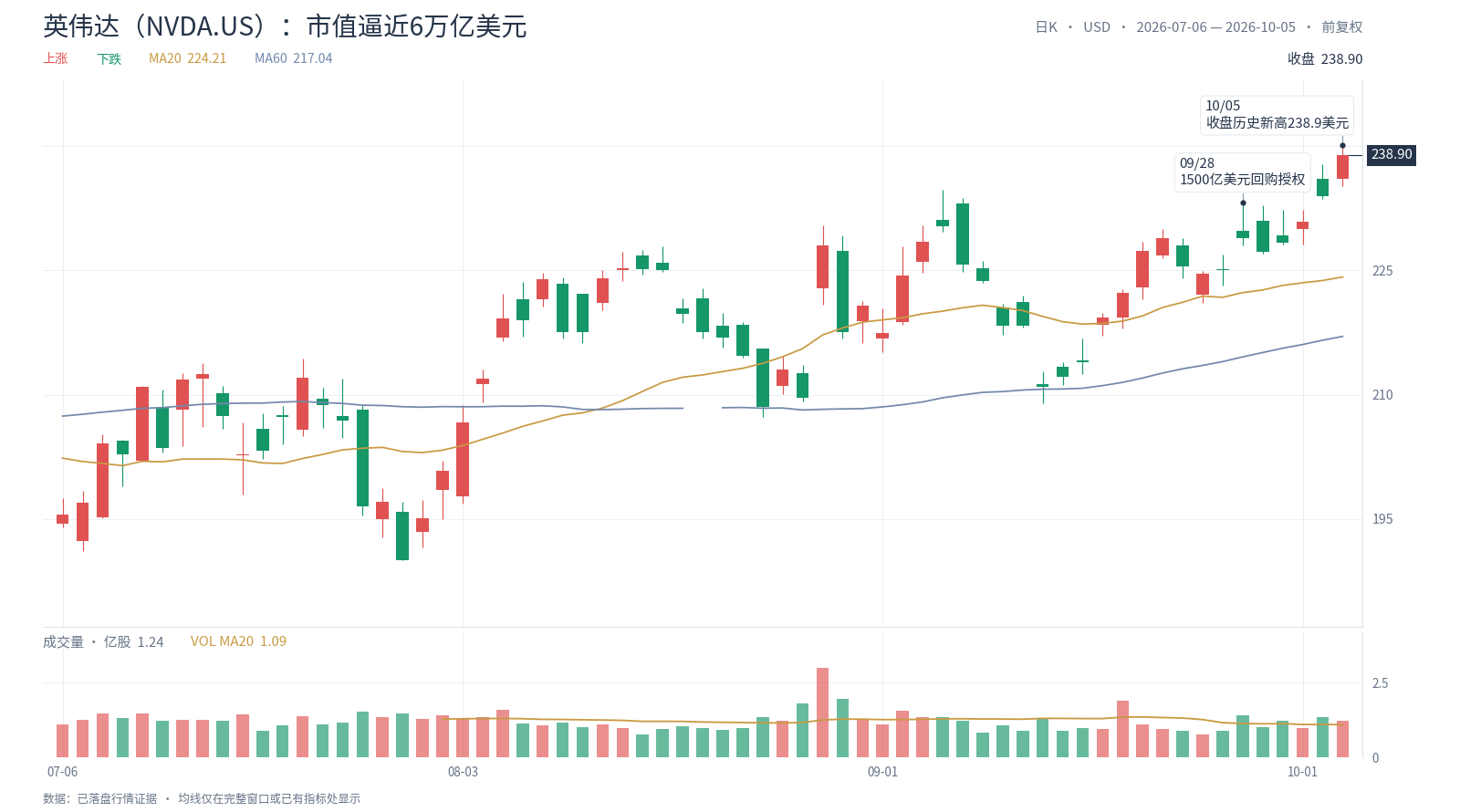 What's driving Nvidia's strength is less about fresh news from the day and more about the $150 billion share buyback authorization announced on September 28 — described in public reports as the largest in history. A rate strategist at an asset management firm commented: "Share buybacks are not just shareholder returns; they are a capital allocation event signaling confidence in long-term AI demand."
But clear divergence emerged within the chip sector. The Philadelphia Semiconductor Index briefly turned negative during the session (roughly -1% per public quotes) and closed up just 0.27%; AMD, Intel, Micron Technology, and ASML weakened, while TSMC and Broadcom rose more than 2%. Capital made more granular selections within the AI chain — core computing power names continued to be bought, while traditional semiconductors and memory came under pressure.
3. SpaceX: Musk Returns to Trillionaire Status
SpaceX (SPCX) closed up 7.63% at $171.09, hitting a new high since mid-June. A major U.S. bank reportedly maintained its "overweight" rating and $300 price target in a weekend report, with the core thesis pointing to the growth potential of Starship test flights and AI operations; the bank flagged the late-October quarterly earnings and the next Starship test flight as two time windows worth watching, and suggested that if SpaceX attempts to recover the Starship upper stage on its next flight, it could become one of the most important catalysts since the company went public.
Musk's net worth subsequently surpassed $1 trillion again: according to the Forbes real-time billionaires list, including his Tesla and SpaceX holdings, it stands at approximately $1.03 trillion. He first became a trillionaire after SpaceX's IPO on June 12, but the stock subsequently pulled back, and he briefly lost the title within just over ten days — at which point he jokingly referred to himself on social media as a "former trillionaire."
More notable is the shift in SpaceX's valuation anchor: from "number of launches" and "Starlink user count" gradually toward "computing connectivity capability." The company acquired Musk's xAI in February this year, recently acquired Cursor, and generates substantial revenue by leasing computing resources to companies including Google and Anthropic; defense contracts have cumulatively exceeded $12.7 billion, and the Pentagon announced last week that Musk and others would co-lead Project Meridian to study the weapons and technologies the U.S. may need for future warfare.
4. Chinese ADRs: Behind the Independent Rally
The Nasdaq Golden Dragon China Index closed up 1.71%. GDS and VNET rose more than 6%, Alibaba gained over 4%, Baidu, Hesai Technology, and Vipshop rose more than 3%, and JD.com and Bilibili gained over 2%.
The rebound in Chinese ADRs has a relatively weak correlation with U.S. Treasury yields. One explanation widely discussed in the market: Chinese ADRs as a whole are less sensitive to U.S. Treasury yields than domestically high-valued U.S. growth stocks — when the 10-year Treasury yield stands above 5.3%, the valuation anchor for U.S. growth stocks comes under pressure, whereas Chinese ADRs had already undergone significant prior correction with valuations at relatively low levels, giving capital incentive to pursue a phase of valuation repair. Beyond this, company earnings, liquidity conditions, and policy expectations are also contributing factors.
5. But the Market Is Cracking Internally
Even as the Nasdaq sets record highs, market "breadth" continues to deteriorate.
A chief equity strategist at a major U.S. bank noted in a recent report: among Russell 3000 constituents, 51% have fallen more than 20% from their June highs, entering what is typically defined as bear market territory; the median S&P 500 stock is 16% below its 52-week high, with market breadth falling to its lowest level since the dot-com bubble burst. The strategist estimates a roughly 12% divergence gap between current U.S. equity market breadth and index prices — a divergence that typically needs to converge in some way: either the index corrects downward to "meet" market breadth, or bond volatility cools and individual stock catch-up drives the market to broaden again.
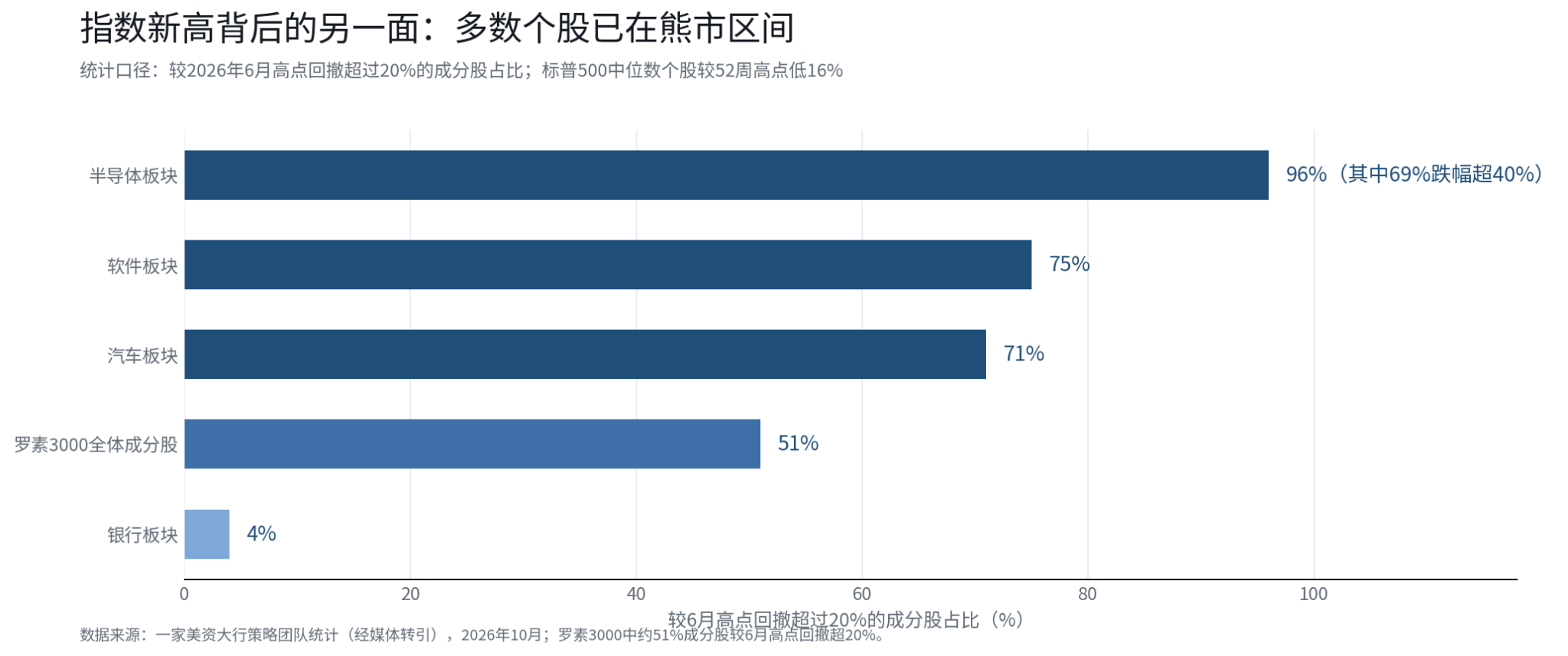 By sector, the damage is extremely unevenly distributed. In semiconductors, 96% of stocks have pulled back more than 20% from June highs (with 69% falling more than 40%); software stands at 75%, and autos at 71%; banking is the sole exception, with only 4% seeing comparable drawdowns.
The timeline is even more worth noting. Throughout the summer, the proportion of S&P 500 constituents above their 200-day moving average rose from 59% at the end of May to about 75% — breadth kept improving even as oil and Treasury yields rose in tandem; but this trend reversed sharply after the Jackson Hole global central bank symposium in late August, and has now fallen to 49%. The strategist attributes the sudden narrowing of breadth not to rising oil prices, but to the market beginning to price in a more hawkish Fed path after Jackson Hole.
Another divergence worth watching: the MOVE index, which measures Treasury volatility, has breached 100, while the VIX fear index remains below 15. The strategist warns that if bond volatility cannot subside, the S&P 500 could potentially test a range of roughly 6,800 to 7,300 points within the next month (a scenario projection by the institution, not a definitive forecast).
6. Earnings Remain One of the Primary Supports
Investors are willing to hold tech stocks in a 5.3% rate environment, with a core basis being earnings growth. According to FactSet data, analysts forecast S&P 500 constituent earnings to grow nearly 30% year-over-year in Q3; if realized, it would mark the third consecutive quarter of growth exceeding 25%.
But that growth is increasingly dependent on a handful of AI-weighted stocks. Nvidia's market cap went from roughly $5 trillion to $5.79 trillion in about a year, while roughly half of Russell 3000 stocks are effectively experiencing their own bear markets — the index hitting new highs and the majority of individual stocks declining are happening simultaneously.
An Asia-based bank-affiliated research institution argues that Nvidia's current P/E combined with an estimated ~70% earnings growth rate next year shows that AI-driven tech stocks remain far from a typical bubble; another major U.S. bank reportedly maintained its "overweight" view on U.S. equities and set a 12-month S&P 500 target of 8,600 points. This view represents only the relevant institutions' judgment. But the strategist's warning is equally worth recording: when half the stocks have already entered a bear market while the index is still setting new highs, this structural concentration could amplify the index's downside risk when the rate environment changes.
Final Thoughts
Last night's combination was: record index highs, elevated rates, deteriorating breadth, and a biopharma surprise. What it signals is not simply "bullish" or "bearish," but structural divergence — earnings delivery by a few weighted stocks running parallel to valuation declines for the majority of individual stocks; rising rates have not yet overwhelmed earnings, but changes in bond volatility may be the next key variable. The Q4 earnings season and the Fed's path are the two verification points worth tracking going forward.
Data Sources
- Quotes: Nasdaq 27,477.31 (+1.05%), S&P 500 7,773.95, Dow 51,267.90; Nvidia, SpaceX, Vaxcyte and other gain/loss figures. October 5 close, public quotes.
- U.S. Treasuries: 10-year closed above 5.30% (approximately 5.303%–5.307%). October 5 close, public quotes.
- Breadth and institutions: 51% of Russell 3000 stocks down more than 20% from June highs, median S&P 500 stock 16% below 52-week high, MOVE>100, VIX<15; institutional views per major U.S. bank report. October, media reports, anonymized.
- Nvidia: market cap approximately $5.79 trillion; $150 billion buyback authorization. October 5/September 28, public quotes/company announcements.
- Vaxcyte: VAX-31 Phase 3 met primary endpoints; pre-market gain over 85%, closing gain 30.7%. October 5, company announcements/public reports.
- Earnings: S&P 500 Q3 earnings growth forecast near 30%. October, FactSet.
Disclaimer:
This content is provided for general informational and market commentary purposes only, based on public materials available as of the time stated herein, and relevant market data, expectations, and probabilities may change as market conditions evolve. The views and investment strategies of third-party institutions, analysts, or other persons cited herein represent only the views of the relevant third parties at specific times and do not represent the views or recommendations of BIT. This content does not constitute investment advice, investment research, an offer, solicitation, or recommendation of any securities, investment products, or trading strategies, nor should it serve as the basis for any investment decision. Financial markets involve risk; securities prices and market performance may fluctuate, and historical performance and past market trends do not represent or guarantee future results. Investors should independently assess relevant risks based on their own circumstances and seek professional advice when needed.





