Kimi's Parent Company Reportedly Prepares for Hong Kong IPO at ~$50B Valuation! Kling AI Also Joins the Fray


- Core Viewpoint: Moonshot AI is sprinting toward a Hong Kong IPO at a valuation of approximately $50 billion, while Kling AI is simultaneously preparing for listing, signaling that AI capitalization in Hong Kong is moving from isolated cases to a wave; the primary market's ~50x P/S ratio far exceeds that of secondary market peers, essentially constituting a bet on ARR growth rates—pricing power during the window period is more valuable than the window itself.
- Key Elements:
- Moonshot AI's valuation rose from approximately $10 billion to about $50 billion in one year, with ARR climbing from about $300 million in June to approximately $1 billion, and the company expects to reach $2 billion by December—a static P/S ratio of about 50x.
- Zhipu's secondary market static P/S ratio is approximately 22x; the valuation gap between primary and secondary markets needs to be bridged either by ARR growing at an accelerated pace or by listing pricing coming down—December ARR is the core validation checkpoint.
- Hong Kong recorded 116 IPOs in the first three quarters, raising over HK$388 billion—a record for the same period; 19 Chapter 18C specialist technology companies listed, with over 600 applications in the queue, meaning scarcity is entering its final countdown.
- Kling AI completed a $2.8 billion funding round in July this year at a pre-money valuation of approximately $15 billion, and plans to raise at least $1 billion; following Sora's shutdown, Chinese video generation companies are vying for the market gap.
- Southbound capital saw net inflows of HK$428.2 billion year-to-date, with Zhipu receiving HK$40 billion in net buying—the highest—and the marginal buyers of AI IPOs will most likely continue to come from this pool of capital.
- Kuaishou's stock price has fallen over 50% year-to-date; a weak parent company could weigh on Kling's valuation, but the spin-off also gives the AI video business its first opportunity for independent pricing.
Many people use Kimi to write reports and follow long-form articles, but few know that its parent company has yet to go public. On October 6, Bloomberg brought this matter to the fore: Moonshot AI is reported to have completed its final round of private financing at a valuation of approximately $50 billion—roughly a fivefold increase from about $10 billion within a year; on the same day, Kuaishou pushed its most valuable AI asset, Kling AI, onto the IPO track as well. These are not two isolated new-stock stories, but a signal that Hong Kong's AI capitalization is moving from individual cases to a batch phenomenon: the window is real, and so is the competition within it.
1. What Happened: Two News Items, One Signal
According to Bloomberg, Moonshot AI has completed its final round of pre-IPO private financing at a valuation of approximately $50 billion. The company has begun preparing for investor intention communications, with preliminary meetings potentially starting as early as this month. Previously, it was reported that the company had confidentially filed a listing application with the Hong Kong Stock Exchange, with Bank of America serving as overall coordinator and CICC, Deutsche Bank, and Goldman Sachs serving as sponsor banks. The report noted that discussions are still ongoing and the IPO timeline may change; Moonshot AI did not respond to requests for comment.
On the same day, according to Bloomberg, Kling AI is working with CICC, Goldman Sachs, and UBS to prepare for a Hong Kong IPO, targeting a listing as early as next year and aiming to raise at least $1 billion; details may still be adjusted, and Goldman Sachs and UBS declined to comment. Separately, The Information previously reported that regulators have launched data security investigations into DeepSeek and Moonshot AI—whether this affects valuation or timelines currently has no public conclusion.
With both news items landing on the same day, we tend to believe this is not a coincidence: the current absorption capacity of Hong Kong's new-stock market, the Chapter 18C channel, and southbound capital preferences together constitute a window that may not exist for long. For companies preparing for listing, filing early secures not time, but pricing power.
2. Valuation: A 50x P/S Ratio Is Not a Valuation, It's a Bet
First, look at this curve: based on public reports, three consecutive financing rounds from January to February pushed the valuation from $10 billion to $18 billion; after the Series D in May, it reached approximately $20 billion; a summer round brought it to approximately $31.5 billion (another report cites a subsequent round at approximately $35 billion, indicating discrepancies in reporting); the latest round is approximately $50 billion. Roughly fivefold in one year.
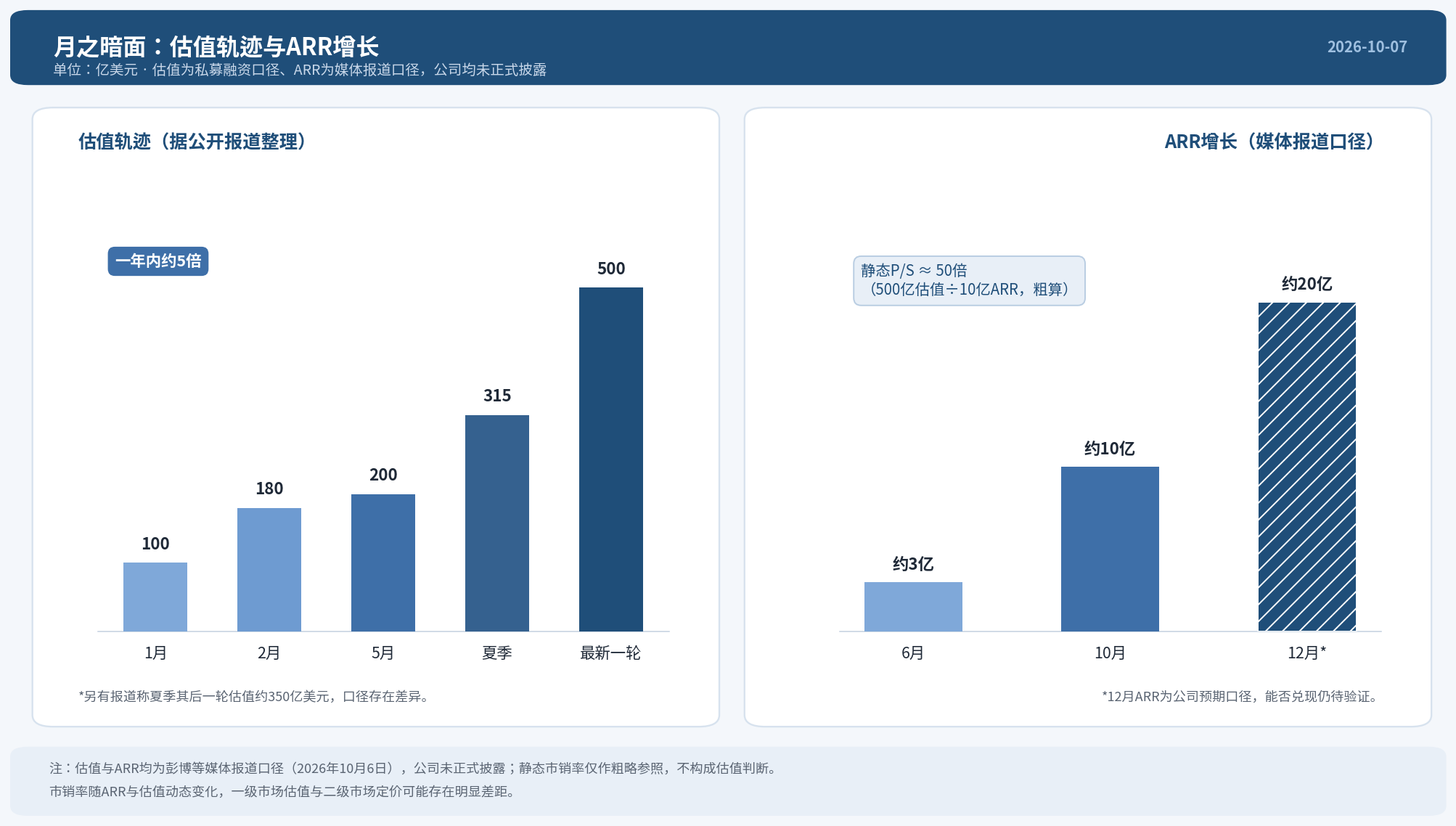
The supporting story is revenue growth rate, not revenue scale. According to Bloomberg, ARR rose from approximately $300 million in June to approximately $1 billion currently, and the company expects it could reach $2 billion by December—note that this is the company's own forecast. In terms of business model, the consumer side consists of Kimi's tiered subscriptions, while the enterprise side exports underlying technological capabilities to businesses. In June, it launched the agent product Kimi Work, and the open-source model Kimi K3 released in July is reported to be comparable to leading models from OpenAI and Anthropic on certain evaluation metrics.
Our view is: at approximately 50x static P/S ratio, what's being bought is not Moonshot AI as it is today, but a bet on the speed at which ARR will materialize. Let's do two rough calculations: $50 billion against $1 billion ARR gives a static multiple of approximately 50x; even if ARR doubles as expected to $2 billion, the forward P/S ratio would still be 25x. The reference point is the secondary market: Zhipu, based on a market cap of approximately HK$313.4 billion at intraday trading on October 6 and interim report ARR of approximately $1.8 billion, gives a rough static multiple of approximately 22x. The multiple the primary market is giving Moonshot AI is roughly more than double what the secondary market is giving its already-listed peer—the gap in between can only be filled by two things: either ARR continues to scale at a pace exceeding the current rate, or the IPO pricing falls back toward the secondary market anchor. The essence of IPO pricing discussions is precisely this negotiation; and if the December ARR materializes at approximately $2 billion, that will be the first validation checkpoint for this bet.
3. Hong Kong's IPO Market: The Window Is Real, But It's Being Used Up
KPMG's Q3 review released on October 6 shows (as cited by media): in the first three quarters, there were 116 new listings raising a total of over HK$388 billion, more than double the same period last year and a record high for the period; active listing applications exceeded 600, significantly above the norm in previous years; full-year fundraising could reach HK$500 billion, which if realized would break the 2010 annual record of HK$427 billion.
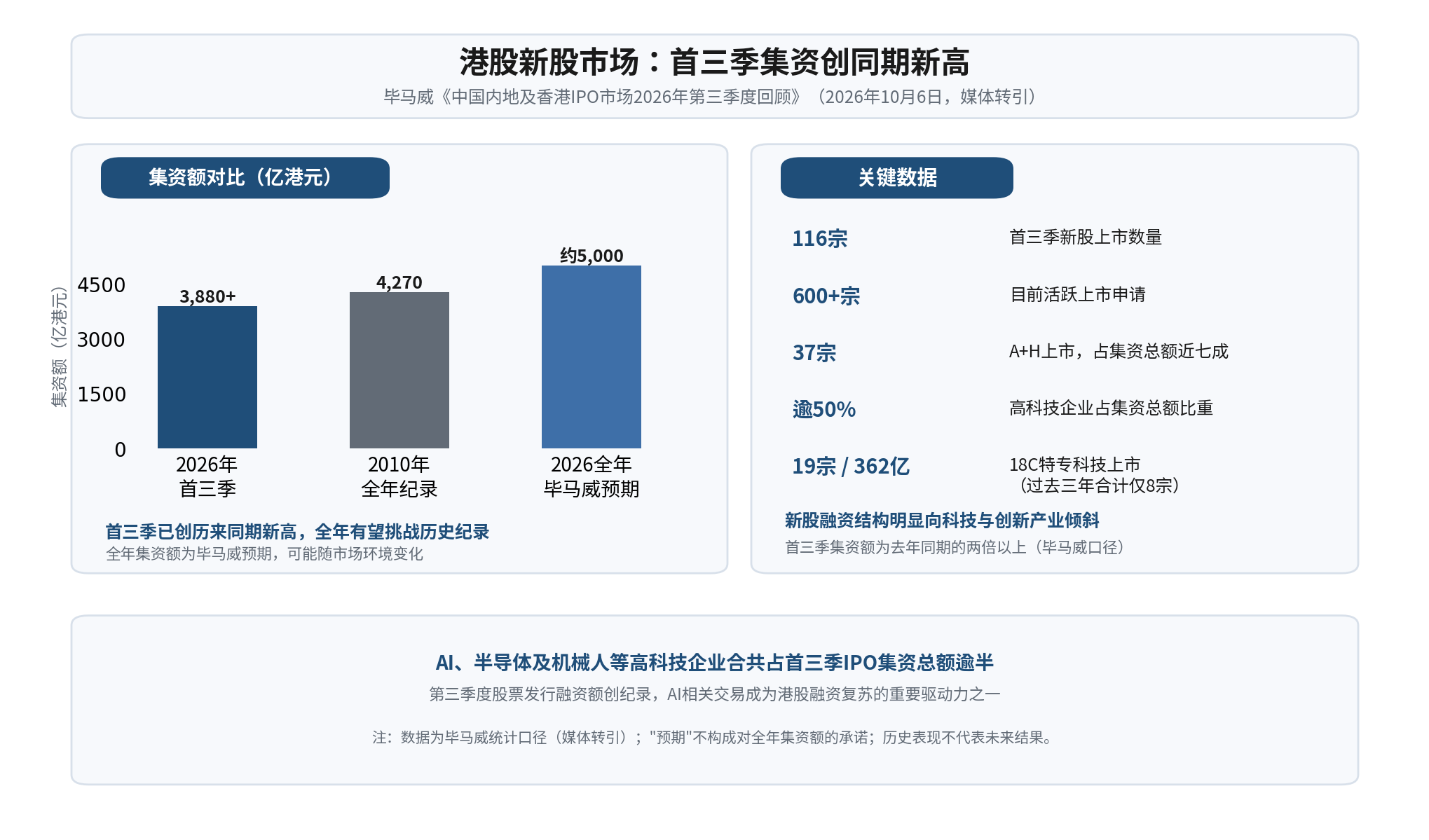 Structurally, two threads are worth watching: high-tech companies (AI, semiconductors, robotics) accounted for more than half of total fundraising, with Q3 equity issuance reaching a record; 19 Chapter 18C specialist technology companies listed during the period, raising HK$36.2 billion, compared to only 8 deals in the past three years combined. Our judgment on the 18C channel is: it has already transformed from a backup door to the main door, and once the main door opens, the countdown on scarcity begins. Chapter 18C's listing eligibility requirements mainly include market capitalization and R&D investment-related conditions, and do not require profitability as a prerequisite, thus providing a listing path for specialist technology companies still in their investment phase. However, the greater the channel's throughput, the thinner the scarcity premium any single target can enjoy—companies filing this year enjoy the window, while companies filing next year may face an already-saturated allocation pool.
4. Kling AI: Ammunition for the Arms Race, Not a Simple Exit
Kling AI was launched in 2024, focusing on generative AI video. According to Bloomberg, after OpenAI shut down Sora, Chinese service providers like Kling are vying to capture the market space it left behind; in July this year, it completed a $2.8 billion financing round at a pre-money valuation of approximately $15 billion, with investors including Alibaba, Tencent, and Baidu. At the end of August, according to Kuaishou announcements and reports, another round of capital increase was completed, and the independent financing quota launched this year has been fully used up.
Placing Kling's IPO within the competitive landscape, our interpretation is: this is an act of restocking ammunition for an arms race, rather than a simple shareholder exit. ByteDance's Seedance, Shengshu Technology (also reportedly planning a Hong Kong listing per Bloomberg), and PixVerse (Aishi Technology, same source) are all betting on the same track; video generation's computing power and data costs are extremely high, and the decisive factor on this track is likely not model leaderboards, but cash flow endurance—whoever runs out of capital ammunition first falls behind first. How much of the void left by Sora's exit can be captured and for how long remain unanswered; but the length of the competitor list itself is a hint: on this track, money is currently burning faster than it is being earned.
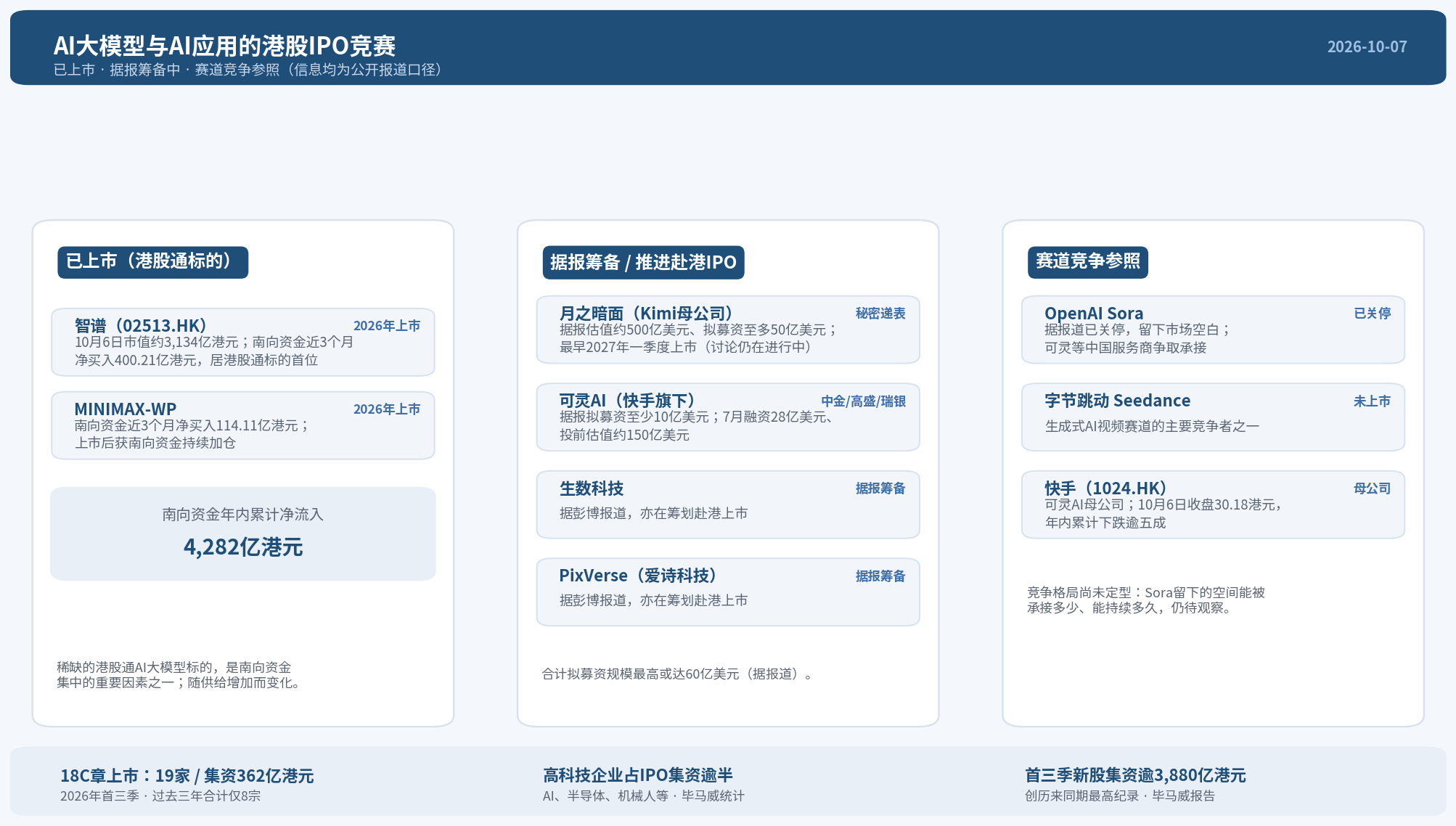 The parent company's stock price is another variable worth pondering. According to Bloomberg and confirmed by market data, Kuaishou has fallen more than 50% year-to-date (closing at HK$66.25 on the first trading day of 2026, and at HK$30.18 on October 6). This double-edged sword cuts both ways: a weak parent company could suppress Kling's valuation expectations; but conversely, spinning off the AI asset from Kuaishou's "content platform valuation" for separate pricing is precisely the market's first opportunity to price the AI video business independently—whether the spin-off yields a premium or a discount, the issuance pricing will give the first answer. We tend to believe the latter may also be one of the factors Kuaishou is considering in pushing for the spin-off.
5. Why Hong Kong, Why Now
Southbound capital is the key variable for absorption. Under Wind's methodology, southbound capital has accumulated net inflows of HK$428.203 billion year-to-date (as of September 28), with holdings valued at approximately HK$6.02 trillion (as of September 29); the top net buyers over the past 3 months are all AI-related targets—Zhipu leading at HK$40.021 billion, and MINIMAX-W at HK$11.411 billion. Extrapolating from this structure, if new stocks like Moonshot AI and Kling AI list and are included in Stock Connect, the marginal buyers will most likely still come from this pool of capital; their post-listing performance will in turn determine southbound capital's overall attitude toward the large model asset class—the performance of the first batch of targets is the pricing environment for those that follow.
Scarcity premium has a shelf life, and this is precisely the answer to "why now." After Zhipu and MINIMAX-W listed, they received continued southbound accumulation, with the important backdrop being that large model targets in Stock Connect are simply too few; by KPMG's count, in the first three quarters alone, 19 Chapter 18C companies listed and over 600 applications are queued. When "scarce" becomes "batch," early listers enjoy pricing power while later listers pick up the tail end of allocation pools. For companies preparing for IPO, pricing power during the window is more valuable than the window itself—this is our core understanding of this wave of密集 filings. [Note: The original text contains a Chinese word "密集" here that should be translated — "dense/clustered"]
6. What to Watch Next
- Filing and hearing progress: the official application versions on HKEXnews, particularly disclosure standards for ARR composition and the breakdown of subscription versus B2B revenue;
- Feedback from initial investor meetings: the intention communications potentially starting this month are the first-hand window into how secondary buyers view the 50x static P/S ratio;
- Whether December ARR can meet the approximately $2 billion expectation: this is the core data point for whether the valuation story holds together;
- Kuaishou's stock price and market environment: the parent company's performance, interest rate environment, and overall new-stock sentiment will all feed into issuance pricing.
Final Thoughts
Three sentences to sum up our judgment. First, Moonshot AI's approximately 50x static P/S ratio versus Zhipu's approximately 22x leaves a chasm of growth expectations between the primary and secondary markets—the December ARR data will be one of the important observation points: if realized, it would provide some support for the current valuation logic; if not realized, it could increase the likelihood of the market reassessing its valuation. Second, the 18C channel shifting from a backup door to the main door means scarcity is on a countdown, and the essence of this wave of dense filings is grabbing pricing power, not joining the crowd. Third, Kling AI's IPO is a move to restock ammunition for the AI video arms race, with the decisive factor being cash flow endurance rather than leaderboard ranking; Kuaishou's weak stock price could both suppress the valuation and may be precisely the motivation for the spin-off. These judgments are based on currently available public information and conclusions will change as conditions change.
Data Sources
Bloomberg (2026/10/6), KPMG 2026 Q3 Review, Wind, exchange market data, and public reports.
- Moonshot AI: valuation approximately $50 billion, targeting 2027Q1 listing and raising up to $5 billion; ARR 3→10→20 hundred million USD; valuation 100→180→200→315 hundred million (another figure of 350 hundred million). Company has not formally disclosed.
- Moonshot AI sponsors/filing: BofA, CICC, Deutsche Bank, Goldman Sachs; confidential filing.
- Kling AI: underwriters CICC, Goldman Sachs, UBS; targeting at least $1 billion raise; July financing of $2.8 billion at pre-money valuation of approximately $15 billion. Kuaishou announcement cites a difference of approximately RMB 3 billion in financing quota.
- Hong Kong IPO: 116 deals, over HK$388 billion, 600+ applications; 18C 19 deals/HK$36.2 billion; high-tech accounted for over half; 2010 record HK$427 billion.
- Southbound capital: cumulative net inflow HK$428.203 billion, holdings approximately HK$6.02 trillion; Zhipu HK$40.021 billion, MINIMAX-W HK$11.411 billion. As of 9/28–29.
- Kuaishou: closed at HK$66.25 on the first trading day of 2026, closed at HK$30.18 on 10/6 (approximately -54%).
- P/S ratio: Moonshot AI approximately 50x static; Zhipu approximately 22x (based on intraday market cap of approximately HK$313.4 billion on 10/6 and interim report ARR of approximately $1.8 billion). These are rough calculations by this column, with an exchange rate of approximately 7.78 HKD/USD, for reference only and not constituting a valuation judgment.
Note: Information related to Moonshot AI and Kling AI has not been formally disclosed by the companies and is based on media reports; Kling AI has discrepancies with Kuaishou's announcement figures, which have been noted in the text.
Disclaimer:
This content is intended for general informational and market commentary purposes only, based on public information available as of the time described in the text. Relevant market data, expectations, and probabilities may change with market conditions. The views and investment strategies of third-party institutions, analysts, or other persons cited in the text represent only the views of the relevant third parties at a specific time and do not represent the views or recommendations of BIT. This article does not constitute investment advice, investment research, an offer, solicitation, or recommendation of any securities, investment products, or trading strategies, and should not be relied upon as the basis for any investment decision. Financial markets involve risk, securities prices and market performance may fluctuate, and historical performance and past market trends do not represent or guarantee future results. Investors should independently assess relevant risks based on their own circumstances and seek professional advice when necessary.