Micron Earnings Preview: As FY2026 Q4 Approaches, Can HBM, SCA, and Buyback Plans Propel Micron into a New Era of "De-Cyclicalization"?


- Key Takeaways: Micron's FY26Q4 earnings will likely set another record, but market focus has shifted from the results themselves to three "de-cyclicalization" signals: whether SCA long-term agreements can continue to expand contracted revenue, whether HBM's high premium can be sustained through 2027, and whether buybacks can materialize after CHIPS Act restrictions are lifted.
- Key Elements:
- Last quarter's revenue beat expectations by approximately 15%, with marginal gross margin reaching 98%. Sixteen SCA agreements locked in roughly $100 billion in guaranteed revenue and $22 billion in prepayments, driving the stock up about 16% in a single day.
- Sell-side expectations this quarter already exceed the midpoint of guidance and continue to be revised upward, with the beat margin narrowing to 2%–4%. The stock is up approximately 277% year-to-date with a market cap surpassing $1 trillion, suggesting the bullish case may already be fully priced in.
- Goldman Sachs assigned a $1,100 price target (normalized EPS of approximately $62 × 18x), while UBS set $1,625 (anchored to 2029 EPS of approximately $219 × 8x). The core disagreement lies in whether Micron should be viewed as a cyclical stock.
- HBM's premium continues to expand on the back of technological barriers. UBS projects FY27 blended HBM average selling prices to rise approximately 76% year-over-year. Micron holds roughly 20% of the global HBM market, with profit elasticity driven primarily by pricing rather than shipment volume.
- HBM consumes 3–4x the wafer capacity of standard DRAM. TrendForce estimates HBM's share of DRAM wafer input will rise from 18% in 2025 to 30% by the end of 2027, supporting a tight supply-demand balance for standard DRAM.
- CHIPS Act buyback restrictions will be lifted on December 9, 2026. Micron's FY26Q3 free cash flow reached $18.3 billion with approximately $25 billion in net cash. UBS expects buybacks of approximately $20 billion per quarter to commence in FY27Q2.
After the U.S. market close on Wednesday, September 30 (Eastern Time), Micron Technology is set to release its fiscal year 2026 fourth quarter (June–August 2026) earnings report. Judging from the密集 upward revisions in sell-side expectations, the company is highly likely to deliver another record-breaking quarter. However, with a trillion-dollar market cap and heavily crowded profit-taking positions at elevated levels, the marginal significance of the quarterly financial data itself has become relatively limited. The question the market cares about more is whether Micron can truly shed its identity as a "deeply cyclical stock" and transform into a growth company with more resilient and predictable earnings.
Top investment banks such as Goldman Sachs and UBS have locked their sights on three core signals management is about to deliver — can SCA strategic agreements continue to break through the growth ceiling of contracted revenue? Can HBM's hefty premium hold firm beyond 2027? And after the CHIPS Act restrictions are lifted on December 9, can the share buyback program deliver real, tangible numbers? On the eve of the fourth-quarter earnings release, how should we assess these three key variables reshaping the storage industry landscape?
1. Recap: Why Did Last Quarter's Earnings Drive a ~16% Single-Day Stock Gain?
Looking back at June 24, when Micron released its FY26Q3 (March–May 2026) earnings, the stock rose about 16% after hours and closed up 15.7% the next day. The fundamental driver was the substantial magnitude of the earnings beat:
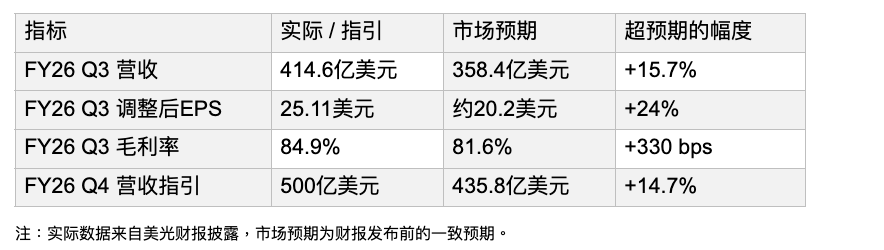
The significantly better-than-expected financial performance was one of the key factors driving the stock higher: Micron's third-quarter revenue and next-quarter guidance both exceeded market expectations by about 15%; more critically, the marginal gross margin corresponding to its third-quarter incremental revenue reached as high as 98%, meaning most of the incremental revenue converted into profit, reflecting Micron's strong pricing power and cost pass-through capability during an industry upcycle.
The commercial rollout of SCA long-term agreements changed the market's perception of the company's business model: the signing of 16 Strategic Customer Agreements (SCAs) not only locked in approximately $100 billion in guaranteed contracted revenue under 14 of those agreements, but also brought in $22 billion in prepayments and deposits, of which $18 billion was cash. This marked Micron's "de-cyclicalization" attempt as no longer a concept, but a transformation into enforceable, highly certain cash assets on the balance sheet.
Management's optimistic outlook on the medium-term supply-demand landscape extended the market's expectations for this upcycle: Micron sharply raised its server shipment growth forecast from about 10% to nearly 20%, and explicitly stated that the tight supply-demand dynamic would persist beyond 2027. The triple combination of an earnings beat, long-term agreement execution, and cycle extension collectively supported the 16% single-day gain following the third-quarter earnings release.
2. Micron's Q4 Earnings Expectations Have Become Consensus: Market Pricing Ahead — Can Perfect Expectations Be Revised Higher?
Sell-side institutions' forecasts for Micron's FY26 Q4 are now broadly above the midpoint of company guidance, and they were still being revised upward before the earnings release. "Beating guidance" itself can hardly constitute a significant stock catalyst.
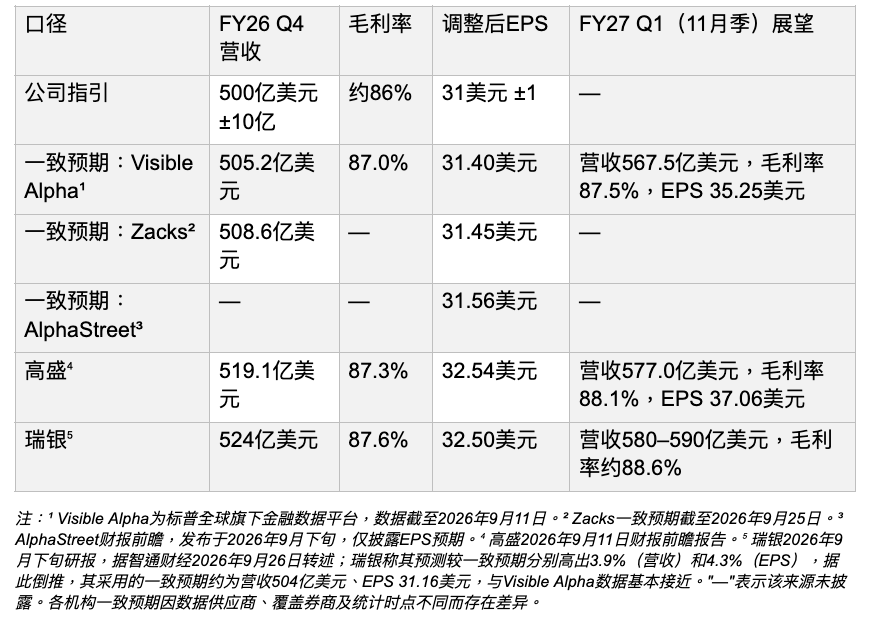
Multiple indicators show that the market has formed a high degree of consensus that this quarter will beat expectations. The market consensus is not only above the midpoint of company guidance but was continuously revised upward before the earnings release: Visible Alpha's revenue estimate was $50.52 billion (as of September 11), and by September 25, the Zacks estimate had risen to $50.86 billion, with EPS expectations raised by $0.06 that week. Second, forecasts from major brokerages are generally 2%–4% above consensus, and Citi has also publicly stated it expects Micron to exceed guidance, citing sharp DRAM and NAND price increases during the quarter. The majority of analysts covering Micron have issued bullish ratings.
The notable narrowing of the beat margin means the likelihood of replicating last quarter's big rally this quarter has decreased. When last quarter's earnings were released, Micron's revenue came in nearly 16% above market expectations; this quarter, the beat margin from major institutions has narrowed to 2%–4%, and revenue landing in the $51 billion to $52.5 billion range would be entirely within market expectations. More concerning is the aftermath of last quarter: after the big rally, the stock gave back about 20% within a week, with a maximum drawdown of about 32% within 30 days. Even with a significant earnings beat, profit-taking after the good news is realized could still weigh on short-term price action.
At elevated valuations, the stock is more sensitive to any signal of marginal slowdown. Micron's stock has risen about 277% year-to-date, closing near $1,080 on September 24, with a market cap surpassing $1 trillion; Goldman Sachs' $1,100 price target is now nearly indistinguishable from the current price. This means the biggest potential risk in this earnings report is not an earnings miss, but that the beat has already been fully priced in, leaving no room for further upward revisions after the good news is realized.
3. Valuation Divergence: Goldman Sachs at $1,100 vs. UBS at $1,625 — Where's the Disagreement?
Goldman Sachs and UBS have a 48% divergence in their Micron price targets: although both institutions predict Micron will beat market expectations this quarter and neither directly uses this cycle's earnings peak for valuation, Goldman Sachs gives only a "Neutral" rating and a $1,100 price target, while UBS maintains a "Buy" rating and a $1,625 price target.
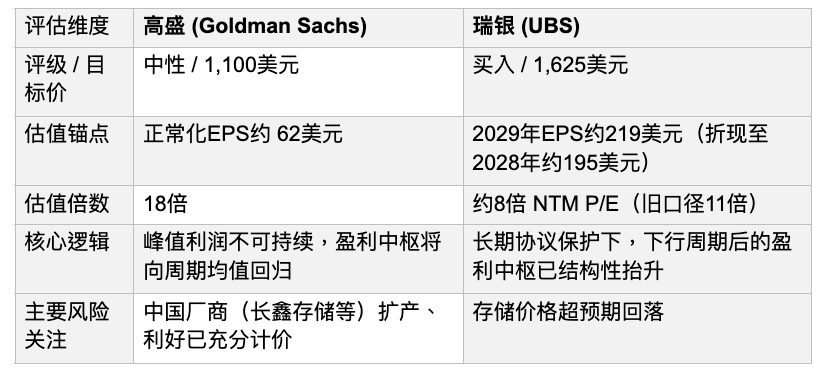
Goldman Sachs' valuation framework is built on a reasonable multiple of "normalized earnings," essentially still viewing Micron as a cyclical stock: Goldman Sachs multiplies a normalized EPS of about $62 by an 18x P/E to arrive at a $1,100 price target. This EPS base is only a little over 30% of its 2027 EPS forecast of $170.70, implying the judgment that current profits are at a cyclical high and should not be considered a sustainable long-term level. Therefore, Micron's low P/E calculated on peak earnings is not an undervaluation signal, but a typical characteristic of a cyclical stock at the top of the cycle. Under this framework, Goldman Sachs believes the good news has been fully priced in: investor positioning is "leaning optimistic," and pre-earnings market expectations are "still elevated." Additionally, Goldman Sachs lists ChangXin Memory Technologies' continued DRAM share gains and price suppression as a major downside risk, arguing that long-term capacity expansion by Chinese manufacturers remains a key variable weighing on industry valuations, and that as long as this uncertainty persists, the market will struggle to give Micron's peak earnings higher valuation recognition.
UBS's assessment logic, by contrast, looks past the cycle peak and directly anchors to the earnings base after the downcycle ends: according to UBS's valuation model disclosed in public markets, UBS forecasts Micron's 2029 non-GAAP EPS at approximately $219, discounted back one year to 2028 using a 12.2% cost of equity to arrive at about $195, then applies a forward P/E (NTM P/E) of about 8x to derive a $1,625 price target. UBS chose 2029 as the valuation base because by then the industry is expected to have completed a full mild downcycle, and that year's earnings level can more objectively reflect Micron's cross-cycle profitability supported by SCA long-term agreements — consistent with its industry judgment that "storage prices will begin to decline in the second half of 2028."
Micron's recent stock rebound may have been driven by factors such as capital sentiment and catalyst expectations: after last quarter's earnings release, Micron's stock continuously pulled back from its 52-week high of $1,254.81, dipping to around $900 in early September; it has since recovered to around $1,080 over the past two weeks, during which market attention to pre-earnings positioning increased. On the one hand, sell-side institutions like UBS have loudly reiterated their bullish stance; on the other hand, SK Hynix and Samsung have successively rolled out large shareholder return programs, prompting the market to bet that Micron will follow suit with buybacks after restrictions are lifted.
4. Storage Market Divergence: DRAM's Slow Climb vs. HBM Premium — Where Does Profit Elasticity Come From?
The positioning of DRAM and HBM is fundamental to understanding the current supply-demand divergence in the storage industry and Micron's revenue structure. DRAM, or Dynamic Random Access Memory, handles temporary data storage during computing operations and is widely used in servers, smartphones, PCs, and other end devices. HBM, or High Bandwidth Memory, is also essentially based on DRAM architecture, but vertically stacks multiple layers of DRAM chips through TSV (Through-Silicon Via) technology and tightly packages them with GPUs on the same substrate. Its data throughput far exceeds traditional memory, making it an irreplaceable core component of AI accelerators. In terms of revenue structure, DRAM is Micron's primary revenue source: according to Goldman Sachs forecasts, about 75% of Micron's fiscal 2026 fourth-quarter revenue will come from DRAM (including HBM), with the remaining ~25% from NAND flash.
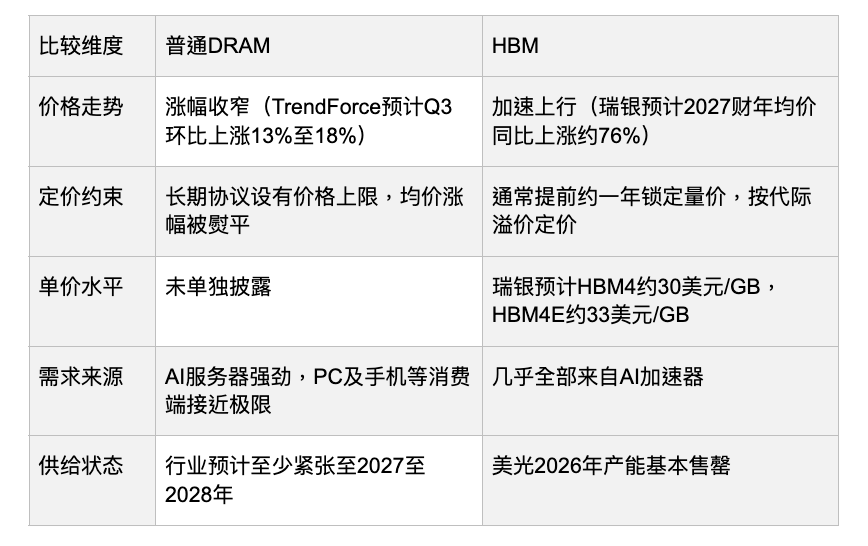
The core characteristic of this storage cycle is the high degree of divergence in price structure, with the HBM premium replacing broad-based traditional DRAM price increases as the primary source of profit elasticity. Traditional DRAM and NAND prices, constrained by long-term agreement ceilings and weak consumer demand, have shifted from explosive gains to a slow-climb trajectory; HBM, by contrast, continues to see its premium expand thanks to extremely high technical barriers and a highly concentrated capacity landscape. This divergence means Micron's profit driver in this cycle is shifting from industry-wide broad-based DRAM price increases to the high marginal premium brought by HBM.
Quantitative comparisons further highlight HBM's pricing power, and its profit elasticity mainly comes from price rather than shipment volume. Entering the third quarter of 2026, TrendForce expects standard DRAM contract price increases to narrow to 13%–18% quarter-over-quarter. In contrast, UBS expects Micron's blended HBM average price to rise about 76% year-over-year in fiscal 2027, with HBM4 at about $30/GB and HBM4E at about $33/GB — pricing power far exceeding ordinary storage products. Micron currently holds about 20% of the global HBM market, and cumulative HBM4 revenue has surpassed $1 billion; however, with capacity essentially sold out, its bit shipments are constrained by actual capacity ceilings and cannot be significantly ramped. Although the market has concerns about NVIDIA reducing the per-GPU HBM configuration for its next-generation GPUs, since the current bottleneck is on the supply side rather than the demand side, a lower per-GPU configuration could actually allow limited HBM supply to match more GPU shipments, alleviating system delivery pressure. Therefore, under the constraint of limited shipment growth, the ~76% average price increase and its corresponding high marginal gross margin could constitute an important source of growth elasticity for Micron's future revenue and profit.
On the supply side, HBM's crowding out of wafer capacity is the key mechanism sustaining ordinary DRAM's "slow but steady" price climb, while Chinese manufacturers' capacity expansion pace is the biggest uncertainty. Producing the same bit volume of HBM requires about 3 to 4 times the wafer capacity of ordinary DRAM. The three major manufacturers — SK Hynix, Samsung, and Micron — all prioritize allocating new wafer capacity to HBM, significantly compressing effective supply of ordinary DRAM. TrendForce expects HBM's share of global DRAM wafer input to rise from 18% in 2025 to 30% by the end of 2027, while its bit output share rises only from 8% to 13% — the enormous gap between capacity consumption and bit output is clearly visible. Since new wafer fabs typically take more than two years from groundbreaking to mass production, this crowding-out effect will keep ordinary DRAM supply-demand relatively tight for an extended period. Micron management judges that supply-demand tightness will persist beyond calendar year 2027, and UBS also believes industry DRAM will remain in shortage until the second quarter of 2028. The divergence centers on ChangXin Memory Technologies (CXMT): Goldman Sachs lists its share expansion as a major downside risk, while UBS believes its expansion is constrained by access to advanced equipment and process yields, and that market concerns about its price impact are somewhat overblown.
Structural imbalance on the demand side is intensifying: AI-related demand continues to concentrate toward HBM and server memory, while consumer electronics are approaching price tolerance limits. According to TrendForce estimates, AI applications will consume about 20% of global DRAM wafer capacity in 2026, while global DRAM capacity grows only about 10%–15% annually — AI demand is expanding notably faster than supply. AI training and inference servers impose extremely high requirements on memory capacity and bandwidth, and the surge in inference demand has also driven shipments of high-capacity enterprise SSDs; cloud service providers are signing multi-year long-term agreements to lock in capacity. In stark contrast, consumer end devices such as PCs and smartphones are approaching their tolerance limits in the face of record contract prices, with signs of weakening demand becoming increasingly evident. From a supply-demand balance perspective, the possibility of near-term easing is limited: most new capacity is prioritized for HBM, and ordinary DRAM expansion is relatively restrained. Notably, TrendForce points out that in early 2026, HBM's revenue per wafer was once lower than that of DDR5 64GB server memory modules, meaning HBM's relative profitability was once inferior to ordinary DRAM. This also explains why manufacturers sharply raised HBM quotes in 2027: only by maintaining a sufficiently high premium will manufacturers have the incentive to continue tilting capacity toward HBM.
The core differences between the two product categories are as follows:
5. What Do Micron's SCA Long-Term Agreements Lock In? Can They Help Micron Shed the "Cyclical" Label?
Memory chips are a classic deeply cyclical industry, and this cyclicality is precisely the root of Micron's long-standing valuation discount: memory chips are highly commoditized standard products whose prices are almost entirely determined by supply and demand: when supply falls short of demand, prices surge and manufacturers race to expand capacity; one to two years later, new capacity is released en masse, the market turns to oversupply, prices plummet, and manufacturers fall into losses and are forced to cut production. This "boom—expansion—glut—shakeout" cycle is identical to cyclical industries like steel, shipping, and LCD panels. The cost is volatile earnings and a lack of operational predictability — Micron fell into significant losses in fiscal 2023. Precisely because of this, capital markets exhibit a counterintuitive pricing pattern for cyclical stocks: "the higher the profit, the lower the P/E." Micron's 2027 forecast P/E is only about 6x, SK Hynix about 4x, while the weighted average for comparable semiconductor companies is about 16x.
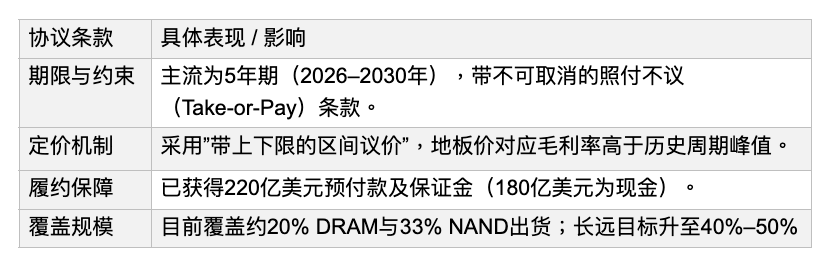
The essence of SCA strategic customer agreements is trading some upward price elasticity for long-term volume and price certainty: these agreements primarily target large cloud service providers. According to data disclosed by Micron last quarter, the company has signed 16 SCAs, of which 14 correspond to minimum contracted revenue of approximately $100 billion, and it has collected about $22 billion in prepayments and performance deposits, of which about $18 billion is cash.
The first batch of SCAs officially entered the execution phase in 2026, but at this stage the proportion of actual shipments covered by contracts remains relatively limited: according to publicly available market information, signed agreements currently cover about 20% of Micron's DRAM shipments and one-third of NAND shipments. Management expects that after all planned agreements are signed and implemented, fixed-price or price-capped revenue will account for about 40% of total revenue, with the final coverage ratio potentially reaching more than half. This means that at the current stage, about 80% of Micron's DRAM shipments are still primarily sold at market prices, allowing it to fully benefit from price increases during an industry upcycle.
Micron has not disclosed specific agreement price ranges, but its floor price mechanism demonstrates strong resilience against cyclical downturns: Micron stated that the gross margin corresponding to agreement floor prices is "far above the peak quarterly gross margin of any previous cycle"; for reference, Micron's peak gross margin in the last cycle was about 62%. On the ceiling price side, based on publicly available industry information, the price caps for the first batch of agreements roughly reference market prices in the second quarter of 2026. Since then, market prices have continued to rise, and SCA customers have effectively received a certain discount.
The gradual implementation of long-term agreements has flattened Micron's blended average selling price (ASP) increases, which is the structural reason for its quarter-over-quarter revenue growth deceleration: Micron's last quarter (FY26 Q3) revenue grew 74% quarter-over-quarter; according to Goldman Sachs forecasts, FY26 Q4 quarter-over-quarter growth will slow to about 25%, and further to about 11% in the November quarter. This growth deceleration is not a sign of weakening fundamentals or industry downturn, but a natural result of the rising share of SCA revenue during a price upcycle. Conversely, once the industry enters a downcycle, the floor prices and "take-or-pay" guaranteed purchase volumes in the agreements will provide a cushion — this is precisely the core basis for why the market is willing to pay a valuation premium for Micron's "de-cyclicalization" thesis.
SCA Core Terms Design Framework